



Most barbershop scheduling runs on gut instinct and whatever worked last month. That's fine until you realize you're turning away $800 in walk-ins on Saturday while Tuesday afternoon sits completely empty, or your top barber's chair generates $420 daily while the station next to him barely clears $180.
The scheduling math that actually matters isn't complicated. A four-chair shop booking at 70% capacity generates more profit than one running at 85% with constant overbooking chaos. The difference comes down to understanding chair-level economics and building schedules that match real client flow patterns, not theoretical maximums.
Most shops track total appointments and maybe revenue per day. Profitable scheduling requires breaking down each chair's actual capacity, factoring in service mix, barber speed variations, and the buffer time that prevents your Saturday from collapsing into a three-hour wait by noon.
Why standard appointment blocks fail in barbershops
Traditional 30-minute blocks work great if every haircut takes exactly 30 minutes. In reality, your senior barber knocks out a fade in 22 minutes while the newer guy needs 35. Kids cuts run 15-20 minutes. That executive who wants the works blocks 50 minutes. Beard trims squeeze into 10-minute gaps.
The mismatch compounds throughout the day. By 2pm you're running 25 minutes behind, texting apologies to waiting clients while walk-ins pile up at the door. The schedule that looked perfect at 9am has turned into a stress test for everyone involved.
Service variation isn't the only problem. Client behavior creates its own chaos. The guy who books a 5pm Friday fade shows up at 5:15. Your 10am Saturday regular brings his kid unexpectedly. The walk-in who "just needs a quick cleanup" actually wants a full redesign.
Then there's barber availability. Tony works Tuesday through Saturday but takes a long lunch on Thursdays. Marcus handles walk-ins but only books appointments after 2pm. Your apprentice can take men's cuts but needs supervision for fades. Building a schedule that accounts for all of this while staying profitable requires more than blocking out time slots.
Breaking down chair capacity by the numbers
A single chair's theoretical maximum varies wildly based on service mix and operating hours. Here's the actual math for different shop configurations.
Never miss a booking amidst the hustle.
Trimzly helps you schedule, confirm, and manage every client visit seamlessly.
- Unified appointment management
- Automated client reminders
- Optimized staff scheduling
No credit card required
Single-chair owner-operator setup:
-
Operating hours
9am-6pm (9 hours)
-
Average service time
35 minutes
-
Buffer between appointments
5 minutes
-
Lunch break
30 minutes
-
Realistic booking target
75% capacity
That gives you 510 total minutes, minus lunch leaves 480. At 40 minutes per slot (service plus buffer), you get 12 theoretical appointments. At 75% capacity, you're targeting 9 appointments daily. If your average ticket runs $35, that chair generates $315 daily or roughly $6,930 monthly across 22 working days.
Three-chair neighborhood shop:
-
Chair 1 (senior barber)
11 appointments at $40 average
-
Chair 2 (mid-level)
9 appointments at $32 average
-
Chair 3 (junior/walk-ins)
7 appointments at $28 average
Daily revenue potential: $924 Monthly potential (22 days): $20,328
Most calculations break down here because they assume perfect efficiency, zero no-shows, and consistent demand across the week. Real operations need deeper planning than that.
Sample daily schedules by shop size
Two-chair shop (owner + one employee)
Tuesday (slow day):
-
Chair 1
4 pre-booked appointments, 3 walk-in slots
-
Chair 2
3 appointments, closes at 3pm
-
Total capacity
10 cuts
-
Buffer rule
45-minute blocks to allow flexibility
Friday (peak):
-
Chair 1
10 appointments, no walk-ins after 2pm
-
Chair 2
9 appointments, 2 express slots
-
Total capacity
21 cuts
-
Buffer rule
30-minute blocks, 10-minute float time built in
Saturday (maximum demand):
-
Both chairs
appointment-only until noon
-
12pm-3pm
mixed booking/walk-in
-
3pm-close
walk-ins only
-
Total capacity
28-32 cuts
-
Buffer rule
Stack similar services, group kids cuts early
Four-chair established shop
Scheduling complexity multiplies with more chairs. Here's a Thursday framework:
-
Chairs 1-2
Full appointment books, 85% pre-booked
-
Chair 3
Hybrid model, 50% appointments, 50% walk-in
-
Chair 4
Dedicated walk-in, rotates barbers every 3 hours
This configuration handles 38-42 cuts on a typical Thursday while maintaining service quality. The key is matching chair allocation to actual demand patterns rather than spreading everything evenly.
Buffer rules that prevent scheduling collapse
Buffer time isn't wasted space—it's operational insurance. Without it, one late client creates a cascade that wrecks your entire afternoon. The right buffer depends on a few factors.
For appointment-heavy schedules, build 5-minute buffers after every third appointment. This creates natural catch-up points without sacrificing too much capacity. Running 10 appointments? That's 15 minutes of buffer distributed throughout the day.
Walk-in heavy schedules need a different approach. Instead of fixed gaps, use flexible slots. Mark certain periods as "walk-in preferred" but allow appointments if needed. A 2pm-4pm walk-in window might take 3 appointments if it's slow or handle 6 quick cuts if it gets busy.
Peak times require strategic buffering. Never book your fastest barber at 100% on Saturday morning. Keep roughly 20% capacity open for the inevitable "squeeze me in" from regulars. That flexibility is worth more than the guaranteed booking—both in revenue and client relationships.
Service-based buffers work better than purely time-based ones. After a complex design cut, add 10 minutes. After three quick fades, add 5. After any kid's cut, add 5 minutes just for cleanup. This matches buffer to actual need rather than applying the same gap regardless of what just happened.
After a complex design cut, add 10 minutes.
This matches buffer to actual need rather than applying the same gap regardless of what just happened.
Walk-in slot allocation strategies
The walk-in versus appointment balance shapes both revenue and shop atmosphere. Too many appointments creates a sterile, rush-through environment. Too many walk-ins leads to unpredictable waits and frustrated clients who eventually stop coming.
For shops under three chairs, dedicate specific hours to walk-ins rather than specific chairs. Tuesday 2pm-5pm might be walk-in hours across all chairs. This concentrates walk-in traffic into predictable windows while protecting appointment availability during peak booking times.
Larger shops can dedicate chairs, but rotation matters. The same barber handling walk-ins all day burns out. Rotate every three hours, or alternate days. Some shops assign walk-ins based on seniority—newer barbers build their clientele through walk-in exposure.
Dynamic walk-in rules adapt to real-time conditions. When the appointment book is light, open more walk-in slots. When you're slammed, restrict walk-ins to quick services only. The decision framework looks something like this:
| Current wait time | Walk-in acceptance |
|---|---|
| Under 20 minutes | All services |
| 20-40 minutes | Cuts only, no designs |
| 40-60 minutes | Simple cuts only |
| Over 60 minutes | Close walk-in list |
AI-powered scheduling platforms can monitor real-time capacity and automatically adjust walk-in availability based on rules you set. When integrated with your booking system, they can send accurate wait times to walk-ins without anyone picking up a phone.
Same-day booking decision tables
Opening same-day slots seems like free money until you're double-booked because someone grabbed a slot while you were mid-cut. You need clear rules about when slots open, who can book them, and how they're priced.
When to open same-day slots:
| Scenario | Open slots? | Conditions |
|---|---|---|
| Cancellation before 10am | Yes | Full price, any service |
| Cancellation 10am-2pm | Yes | Quick services only |
| Cancellation after 2pm | Maybe | Regular clients only |
| No-show | No | Keep as buffer time |
| Barber calls out | No | Redistribute existing appointments |
Pricing same-day appointments:
Some shops charge premiums for same-day booking. Others discount to fill chairs. The right approach depends on your market and demand patterns.
If you're consistently busy, charging 15-20% more for same-day slots filters for serious bookings while boosting revenue. If you're struggling with empty chairs, a 10% discount for same-day bookings made before noon can help move the needle.
The sweet spot often involves tiered pricing: regular price for bookings made before 11am, 10% premium for afternoon same-day requests, and 20% premium for walk-up requests during peak hours.
Building schedule templates that actually work
Generic templates fail because every shop has unique patterns. Your Saturday might peak at 10am while the shop two blocks over gets slammed at 2pm. Build templates from your actual data, not industry averages.
Start by tracking hourly appointment counts for four weeks. You want to capture appointments booked versus completed, walk-in counts by hour, wait times, no-show patterns, and how service types distribute across the day. That last one matters more than people realize—a Thursday stacked with fades runs completely differently than one full of beard work and shape-ups.
This data shows your actual capacity needs. Maybe Wednesdays need more walk-in slots than you thought. Maybe that dead zone every Thursday around 3pm is better used for maintenance than keeping chairs open waiting for clients who aren't coming.
Sample Wednesday template for a 3-chair shop:
-
9am-12pm
-
- Chair 1
4 appointments pre-booked
-
- Chair 2
3 appointments, 1 buffer slot
-
- Chair 3
2 appointments, rest walk-ins
-
12pm-3pm
-
- Chair 1
Lunch, then 2 appointments
-
- Chair 2
Working lunch, walk-ins only
-
- Chair 3
3 appointments
-
3pm-7pm
-
- All chairs
Mixed model
-
- Target
60% appointments, 40% walk-in
-
- Float barbers between stations
This template adapts to Wednesday's typical flow—moderate morning demand, a slower afternoon, busy early evening. The flexibility in the afternoon prevents overstaffing while keeping availability open for unexpected rushes.
Here’s a visual of the template-building workflow.
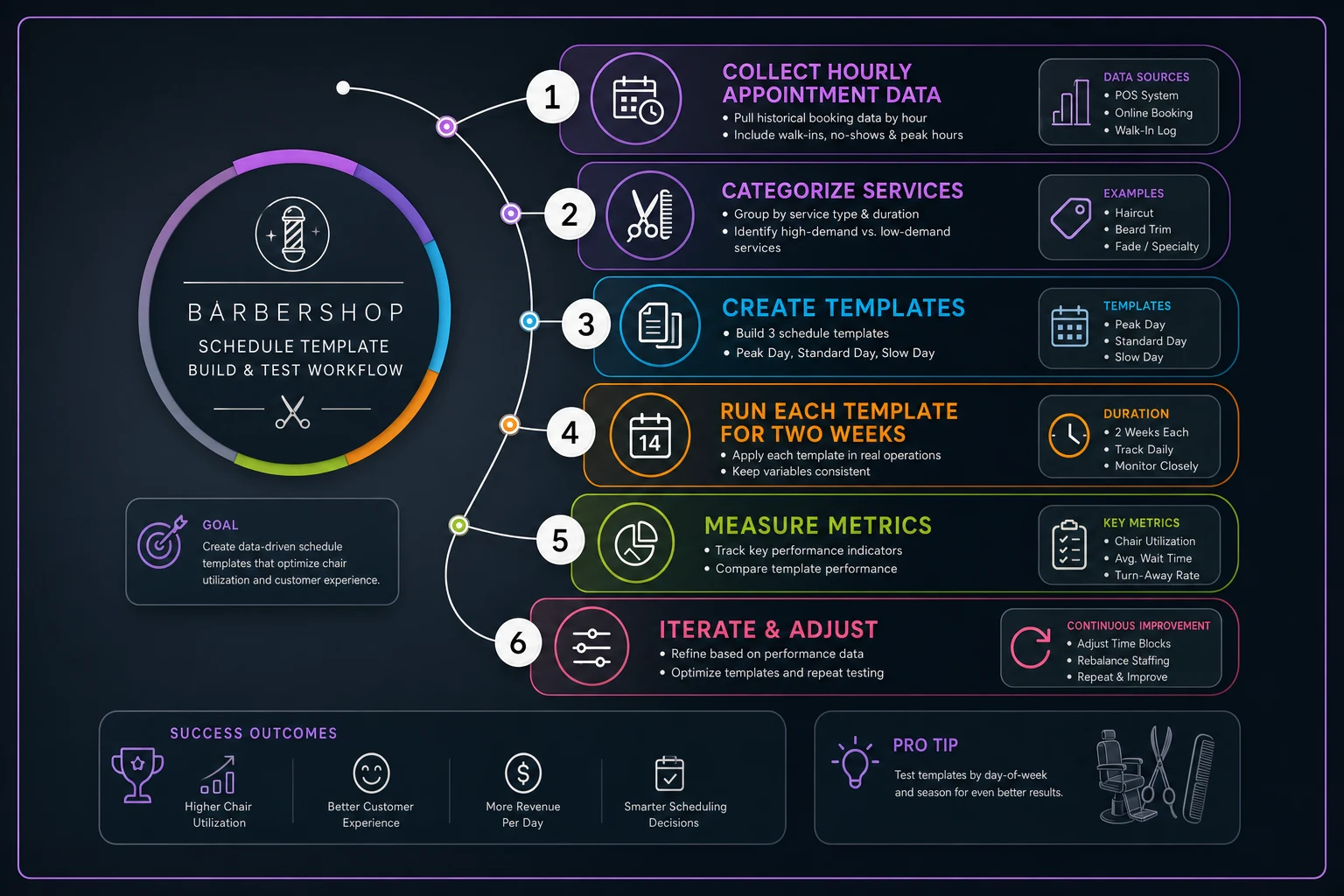
This data shows your actual capacity needs and helps you iterate templates based on measured results.
Seasonal adjustments and capacity flexing
December Saturdays need different math than August Tuesdays. Your scheduling framework has to flex with seasonal patterns, local events, and even weather.
Summer often means longer hours but more no-shows. Adding around 10% overbooking to Saturday mornings in July makes sense. Drop that to 5% in January when people actually show up. Back-to-school season might mean doubling kids' cut slots while pulling back time for complex styles.
Local patterns matter more than national trends. A shop near a college campus empties during spring break. A shop in a business district goes quiet during holiday weeks. It's worth building out multiple schedule templates:
-
Standard week
-
Holiday week
-
Summer schedule
-
Event weekend (sports, festivals)
-
Bad weather contingency
Each template carries different capacity targets, buffer rules, and walk-in allocations. Switching between them becomes routine rather than scrambling to adjust every time conditions change.
Measuring schedule effectiveness
Most shops measure success by whether they survived Saturday. Better metrics reveal actual performance.
Chair utilization rate: Actual cuts divided by scheduled capacity. Target 75-80% for appointment-heavy models, 65-70% for walk-in focused shops.
Revenue per available hour: Total daily revenue divided by total hours all chairs were available. This accounts for barbers working different schedules.
Wait time accuracy: Compare estimated to actual wait times for walk-ins. If you're consistently off by 20+ minutes, your capacity math needs adjustment.
Turn-away rate: Track how many walk-ins you turn away during peak times. More than 3-4 per day suggests you need capacity expansion or better distribution.
Schedule stability score: How many appointments get moved or rescheduled? High movement usually points to poor initial scheduling.
Modern operational software tracks these metrics automatically and surfaces dashboards showing real-time performance against your targets. You can catch problems before they compound—like Thursday's schedule consistently running behind after 2pm, which might mean you need more buffer time or fewer afternoon bookings stacked together.
Technology and automation in schedule management
Manual schedule management works until it doesn't. An owner-operator juggling cuts while answering phones and updating the book loses close to 90 minutes daily on scheduling tasks alone. That's 6-7 additional cuts per week, or somewhere around $8,000-$9,000 in annual revenue walking out the door.
AI-powered scheduling platforms handle the complex decisions automatically. They learn your patterns, adjust for seasonal shifts, and optimize chair allocation in real time. When integrated with your POS and client management systems, the whole operation starts to run as a coordinated flow rather than a series of manual handoffs.
The automation handles routine decisions: when to open same-day slots, how to redistribute appointments after a sick call, which walk-ins to accept based on current capacity. Your team focuses on cutting hair instead of playing schedule Tetris.
Smart waitlist management fills last-minute gaps without anyone having to think about it. When someone cancels, the system texts waitlisted clients immediately. By the time you notice the cancellation, it's often already filled. This kind of automation typically recovers a meaningful chunk of lost appointment revenue over the course of a month.
These platforms can also handle client communications around scheduling—responding to booking requests, suggesting optimal times based on service type and barber availability, managing rescheduling requests. It eliminates the back-and-forth that either eats up a receptionist's time or pulls barbers away from their chairs mid-day.
Common scheduling mistakes that kill profitability
The biggest mistake is optimizing for maximum bookings instead of sustainable operations. A fully booked Saturday that runs two hours behind generates less profit than an 80% booked day that runs smoothly. Stressed barbers make mistakes. Frustrated clients don't return. Your reviews take a hit.
Ignoring barber preferences creates hidden costs. Forcing your best barber into split shifts or cramming appointments during their natural slow periods chips away at quality and increases turnover. Losing one senior barber costs more than a year's worth of scheduling improvements can recover.
A lot of shops also fail to account for non-cutting time. Every appointment needs cleanup, payment processing, and transition time. Scheduling 12 cuts back-to-back across 12 slots assumes zero friction—that falls apart by appointment three.
The "every slot must be filled" mentality is another one. Buffer slots aren't wasted capacity. They're opportunities for walk-ins, catch-up time, or handling last-minute requests from regulars. A 90% full schedule with built-in flexibility outperforms a 100% full schedule in practice, consistently.
And over-relying on one scheduling method limits growth. Pure appointment shops miss walk-in revenue. Pure walk-in shops can't build predictable income. The hybrid model requires more complex management but delivers better results across the board.
Adapting the framework as you scale
A framework that works for two chairs breaks at four. The one that handles four chairs falls apart at eight. Your scheduling system has to evolve with the business.
At 2-3 chairs, focus on basic capacity management and consistent service. Simple rules work here: appointments in the morning, walk-ins in the afternoon, buffers every third slot.
At 4-5 chairs, you need role specialization. Designate appointment chairs versus walk-in chairs. Create senior/junior pairings. Build service-specific schedules—one chair dedicated to kids on Saturday mornings, for example.
At 6+ chairs, systematic automation becomes necessary. Manual scheduling can't handle the variables. You need AI-powered systems that balance barber skills, client preferences, service requirements, and real-time demand simultaneously.
The framework scales through modular additions rather than complete overhauls. Start with basic capacity math. Add buffer rules. Layer in walk-in strategies. Integrate automation tools. Each layer builds on the previous one, creating a system that handles growth without constant crisis management.
Building your shop's custom scheduling framework
Stop copying other shops' schedules. Your client base, team composition, and local market create patterns that generic frameworks miss entirely.
Start with a two-week scheduling audit. Track everything: appointment times, actual service duration, wait times, walk-in patterns, no-shows, revenue per hour. This baseline reveals what's actually happening versus what you think is happening.
Build three initial templates: peak day (usually Saturday), standard day (Tuesday through Thursday), and slow day (usually Monday or Wednesday). Each template should specify the hours per chair, appointment versus walk-in allocation, buffer placement, same-day rules, and any service restrictions by time period.
Test each template for two weeks and measure what actually matters to your shop. Maybe that's chair utilization. Maybe it's client wait time. Maybe it's barber satisfaction. Adjust based on results, not feelings.
Document decision rules for common scenarios. When someone calls in sick, who covers which appointments? When walk-ins surge, who handles overflow? When appointments run behind, how do you communicate and recover? Clear rules prevent panic decisions that make a bad situation worse.
The framework succeeds when it becomes invisible. Your team should be able to run smooth days without constant manual intervention. Clients should experience consistent service regardless of how busy you are. Revenue should become predictable within about a 10% range week to week.
Operational software codifies these rules into automated workflows. Instead of manually checking and adjusting throughout the day, the system handles it based on your framework—freeing you to focus on service quality and growth rather than schedule management.
Moving from reactive to strategic scheduling
Most barbershops schedule reactively—filling spots as requests come in, scrambling when things go wrong, hoping Saturday doesn't implode. A proper framework flips that.
You know Tuesday afternoons drag, so you schedule training or maintenance. You know Saturday 10am-1pm peaks hard, so you staff accordingly and pre-block buffer time. You know your junior barber needs 40 minutes for fades, so you book him differently than your guy who cranks them out in 25.
This shift from reactive to strategic typically improves revenue by 15-25% without adding chairs or extending hours. Not through some scheduling magic trick—just by aligning every operational decision with how your shop actually runs.
Your scheduling framework becomes a competitive advantage over time. While other shops stress through Saturdays and dead Tuesdays, you're running predictably profitable operations. Clients notice the consistency. Barbers appreciate the organization. The business builds momentum instead of lurching between crisis and calm.
The math isn't complicated. The templates aren't revolutionary. But applying them consistently, measuring results, and adjusting based on data rather than gut instinct—that's what separates profitable shops from those barely scraping by.
Start with one week. Track your actual capacity. Build one template. Test it. Adjust. Build another. Within 60 days, you'll have a framework that turns scheduling from daily chaos into something that actually runs itself.
Start with one week. Track your actual capacity. Build one template. Test it. Adjust. Build another. Within 60 days, you'll have a framework that turns scheduling from daily chaos into something that actually runs itself.
Ready to elevate your barbershop operations?
Join 500+ barbershops using Trimzly to save time, reduce scheduling conflicts, and enhance client satisfaction.