

Running a barbershop is basically controlled chaos. Between walk-ins, appointments, inventory, no-shows, and keeping the whole place from falling apart — most owners end up buried in the day-to-day instead of ever stepping back to work on the business itself.
The difference between shops stuck at 4-6 chairs and ones that grow to multiple locations usually isn't talent or even location. It's whether they've built an actual operating system — something that makes the work repeatable and predictable regardless of who's on the floor.
Why Most Barbershops Hit a Wall at 6-8 Chairs
Once you pass roughly 6 chairs, informal management stops working. The owner can't personally oversee everything anymore. Quality starts varying between barbers. Good barbers leave for shops that feel less disorganized. Revenue plateaus while stress compounds.
This happens because most shops grow by adding chairs, not by building systems. More chairs without proper roles, processes, and accountability just means more chaos at a larger scale.
The shops that successfully push past this point share something specific: they've built an operating system. Not just booking software or a point-of-sale terminal, but an actual framework for how work gets done, how decisions get made, and how standards stay consistent across chairs and shifts.
Core Roles That Actually Matter (Not Job Titles)
Traditional barbershops typically have two roles: owner and barber. Maybe a receptionist if they're doing well. That works fine until around $30k in monthly revenue. Past that point, undefined responsibilities create constant friction — and the owner ends up as the default solution to every problem.
Never miss a booking amidst the hustle.
Trimzly helps you schedule, confirm, and manage every client visit seamlessly.
- Unified appointment management
- Automated client reminders
- Optimized staff scheduling
No credit card required
Here's the role structure that actually enables scaling:
Operations Lead (often the owner initially)
-
Manages scheduling conflicts and coverage gaps
-
Handles inventory ordering and vendor relationships
-
Oversees maintenance and equipment issues
-
Reviews weekly numbers and adjusts pricing/promotions
-
Makes hiring and firing decisions
Floor Manager (can be a senior barber)
-
Handles day-to-day customer issues
-
Ensures service standards during each shift
-
Manages walk-in flow and wait times
-
Coordinates between barbers during busy periods
-
Closes out registers and secures the shop
Lead Barber (your best technical barber)
-
Trains new barbers on shop standards
-
Quality checks other barbers' work
-
Handles complex cuts and fixes
-
Sets the technical standard for the team
-
Documents new techniques and trends
Client Experience Owner (might be part-time initially)
-
Manages online reviews and responses
-
Handles appointment confirmations and reminders
-
Coordinates special events and promotions
-
Maintains client database and preferences
-
Oversees loyalty program if you have one
| Role | Key Responsibilities |
|---|---|
| Operations Lead | Manages scheduling conflicts and coverage gaps; Handles inventory ordering and vendor relationships; Oversees maintenance and equipment issues; Reviews weekly numbers and adjusts pricing/promotions; Makes hiring and firing decisions |
| Floor Manager | Handles day-to-day customer issues; Ensures service standards during each shift; Manages walk-in flow and wait times; Coordinates between barbers during busy periods; Closes out registers and secures the shop |
| Lead Barber | Trains new barbers on shop standards; Quality checks other barbers' work; Handles complex cuts and fixes; Sets the technical standard for the team; Documents new techniques and trends |
| Client Experience Owner | Manages online reviews and responses; Handles appointment confirmations and reminders; Coordinates special events and promotions; Maintains client database and preferences; Oversees loyalty program if you have one |
In a 6-chair shop, one person might cover 2-3 of these roles. That's fine. What matters is that someone explicitly owns each area, understands what success looks like in that role, and has documented processes to follow.
Building SOPs That Barbers Will Actually Follow
Standard Operating Procedures sound corporate. Most barbershop owners resist them because they feel unnecessary — until they're wondering why every new hire takes months to figure out "how things work here," or why two chairs in the same shop are producing wildly different client experiences.
The SOPs that matter most:
Opening Procedure Checklist
Not "unlock the door and turn on lights" but the actual sequence — checking overnight messages, reviewing the day's appointments, confirming product levels at each station, testing equipment, setting music volume, adjusting temperature. One shop cut their opening time from 35 minutes to under 20 just by putting this in writing and following it consistently.
New Client Intake Process
This covers everything from the greeting through the consultation to follow-up. Specific questions to ask, how to document preferences, what products to recommend based on hair type, and how to book the next appointment before they walk out. When every barber runs the same intake, new clients convert to regulars at noticeably higher rates.
Service Standards by Cut Type
Define what's actually included in each service level. What steps are in a "standard cut"? How long should it take? What's the quality check? This prevents the "my last barber did it differently" complaints and keeps pricing consistent.
Inventory Management Cycle
When to check levels, how to record usage, when to reorder, where to store backstock, how to rotate product. Most shops lose somewhere in the $400-600 range monthly just from poor inventory control. A simple weekly check process cuts that significantly.
Closing and Cash-Out Procedure
Reconciling the register, securing cash, cleaning stations, checking equipment, setting alarms, prepping for tomorrow. Who counts what, where money goes, how discrepancies get reported.
The trick to SOPs people actually follow: write them with your team, not for them. Have your best barber document their own client intake process. Let your most organized person build the inventory system. People follow processes they helped create.
Decision Frameworks for Common Situations
Beyond basic processes, you need clear decision rules for recurring situations. Otherwise every issue becomes an owner problem.
Pricing Decisions
-
When utilization drops below 65% for two weeks
Run a specific promotion from the approved list
-
When a specific barber books solid for 10+ days
Raise their prices by $5
-
When product costs increase over 15%
Adjust service prices using a set formula
-
When a competitor raises prices
Review, but don't auto-match
Scheduling Conflicts
-
Appointments always trump walk-ins
-
Regulars get priority for prime slots
-
New barbers can't book Saturdays until 60 days in
-
Double-booking only allowed if a backup barber is available
-
Late arrivals past 10 minutes become walk-ins
Staff Issues
-
First tardiness
Verbal note
-
Second tardiness same month
Written warning
-
Third tardiness
Reduction in prime scheduling slots
-
Customer complaint
Document, review with barber within 24 hours
-
Technical issue
Lead Barber reviews and provides coaching
Equipment and Maintenance
-
Any barber
Up to $25 for immediate supplies
-
Floor Manager
Up to $200 for urgent repairs
-
Operations Lead
Up to $1,000 for equipment
-
Owner approval
Required for anything above $1,000
These frameworks cut out most of the "what should I do?" texts to the owner. When situations have clear decision paths, the shop can handle itself.
The 90-Day Implementation Roadmap
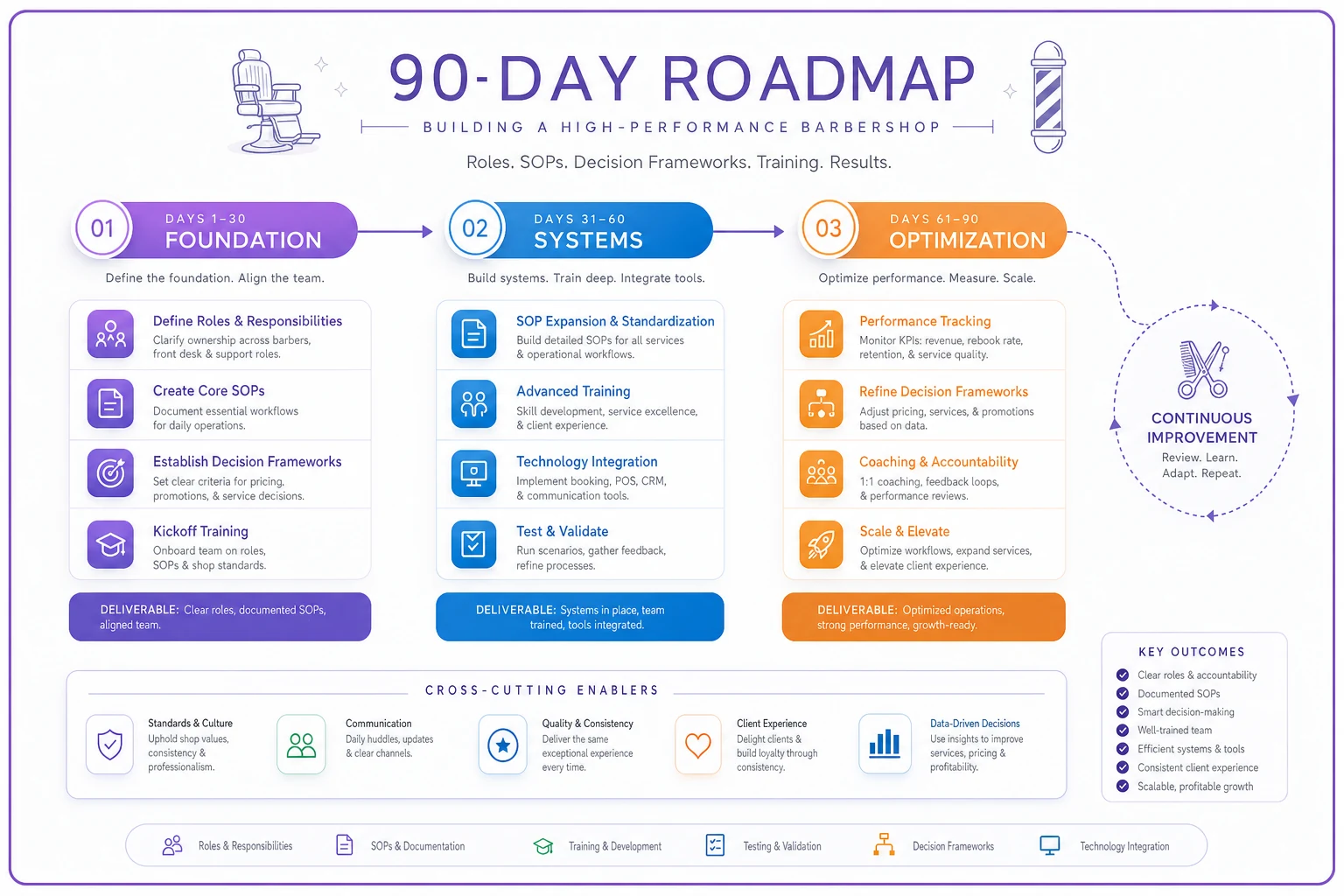
Most owners try implementing everything at once, burn out after two weeks, and revert to chaos. Here's the sequence that actually sticks:
Days 1-30: Foundation Phase
Week 1: Document current reality
-
Track every issue that requires owner intervention
-
Note which problems repeat daily or weekly
-
Identify your biggest time drains
-
Map current informal processes
Week 2: Define core roles
-
Assign the four key roles to current team members
-
Write one-page descriptions for each
-
Set a weekly check-in schedule
-
Create a simple accountability tracker
Week 3: Build first three SOPs
-
Start with the opening procedure
-
Then the closing procedure
-
Then the new client intake
-
Keep them to one page each
Week 4: Test and adjust
-
Run the SOPs for a week
-
Gather feedback from the team
-
Make adjustments based on actual use
-
Acknowledge what's working
Days 31-60: Systems Phase
Week 5-6: Expand SOPs
-
Add service standards documentation
-
Create the inventory management process
-
Build appointment booking rules
-
Document cash handling procedures
Week 7-8: Implement decision frameworks
-
Roll out the pricing decision matrix
-
Set scheduling conflict rules
-
Define staff issue escalation
-
Create spending authority limits
Days 61-90: Optimization Phase
Week 9-10: Technology integration
-
Audit current software tools
-
Identify manual processes worth automating
-
Implement measurement dashboards
-
Set up automated reporting
Week 11-12: Training and delegation
-
Cross-train team on all SOPs
-
Delegate specific processes to role owners
-
Create backup plans for key roles
-
Run "owner out" test days
Week 13: Full system review
-
Measure results against your baseline
-
Identify remaining bottlenecks
-
Plan next quarter improvements
-
Document lessons learned
Visual roadmap of the 90-day implementation.
Most owners try implementing everything at once, burn out after two weeks, and revert to chaos. Here's the sequence that actually sticks:
Weekly Management Cadence That Prevents Drift
Systems without regular review always fail eventually. The shops that scale successfully run the same three meetings every week, consistently:
Monday Morning Huddle (15 minutes) Review last week's numbers, this week's goals, any schedule changes, and one key focus area. Keep it tight. Run it even if only two people show up.
Wednesday Check-in (10 minutes) Quick pulse on the week. Any issues surfacing? Supplies running low? Customer complaints to address? This catches problems before Friday.
Friday Wrap-up (20 minutes) Review performance, acknowledge wins, identify what didn't work, prep for next week. Include cash reconciliation and inventory check.
These aren't complaint sessions or open forums. They follow specific agendas, have defined outcomes, and rotate who runs them. That rotation matters — it creates distributed leadership instead of owner dependency.
Change Control: How to Adjust Without Chaos
Once your system is running, people will constantly want to tweak things. A barber wants to change the consultation flow. Someone suggests new hours. A customer requests a service you don't offer. Without any change control, a working system degrades back into chaos within a few months.
Minor adjustments (under $100 impact or affecting one role):
-
Role owner can test for one week
-
Must document what changed and why
-
Report results at Friday meeting
-
Team votes to keep or revert
Moderate changes (affecting multiple roles or $100-500 impact):
-
Propose at Monday meeting
-
Test for two weeks with measurement
-
Requires majority team agreement
-
Must update SOPs if keeping
Major changes (affecting the whole shop or over $500 impact):
-
Requires a written proposal with actual numbers
-
Two-week discussion period
-
Test for 30 days with clear metrics
-
Owner has final veto
This keeps your system flexible enough to improve but stable enough to actually rely on. Changes happen deliberately, not randomly.
Making Technology Work With Your System
Most shops are running 4-5 different tools that don't connect — booking software, point of sale, inventory tracker, team messaging, customer records. The constant switching and manual data entry waste hours every week.
Modern operational platforms with AI automation can consolidate these functions while adapting to your specific processes. Rather than forcing your team to work around rigid software, better platforms fit how your shop actually runs — handling appointment confirmations, inventory alerts, staff scheduling, and performance tracking based on your documented SOPs.
When a client books online, an AI-assisted system can pull their history, route them to their preferred barber, send reminders calibrated to their no-show history, and flag add-on services they've purchased before — without anyone manually managing each step.
The important thing is choosing platforms that support your operating system rather than replacing it. Your SOPs and decision frameworks stay the foundation. Technology just executes them automatically instead of manually.
Measuring What Actually Matters
Most barbershops track revenue. Maybe chair rental if they're on that model. But revenue is a lagging indicator — by the time it drops, the problems have usually been building for weeks.
-
Utilization rate per chair (target 70-85%)
-
Average ticket per service (watch for slow declines)
-
Rebook rate before leaving (target 60%+)
-
No-show rate by day (reveals pattern problems)
-
Product sales per service (shows upsell effectiveness)
-
New client return rate (critical for real growth)
These numbers show you what's actually happening. When utilization drops, you adjust marketing or scheduling. When average tickets decline, you check service standards. When no-shows spike on certain days, you adjust your confirmation process.
Shops that scale successfully can usually predict their revenue 30 days out based on these indicators. They catch problems early and adjust before it shows up in the bottom line.
From Chaos to Predictable Growth
The barbershops that push past the 6-8 chair ceiling share a few things. They've moved from personality-driven operations to system-driven ones. They've defined clear roles instead of hoping people figure it out. They've documented their processes instead of relying on institutional memory that walks out the door when a barber leaves.
Building an operating system isn't about turning your shop into a corporate franchise. It's about creating enough structure that you can focus on growth instead of daily fires. When routine decisions handle themselves and standard processes run consistently, you can spend time on things that actually move the business forward.
Start with documenting what you already do. Define who owns what. Create simple processes for repeated tasks. Build decision rules for common situations. Review and adjust weekly.
Most importantly — build the system with your team. They know where the real friction points are. They see what wastes time. They understand what clients actually respond to. A system built with your team becomes their system, not something imposed on them from above.
Three months from now, you could still be personally handling every scheduling conflict, inventory order, and customer complaint. Or you could have a system that handles most of those automatically, frees up a meaningful chunk of your week, and gives you a real foundation for growth.
The question is whether you want to run a bigger barbershop or build a barbering business. One requires more of your time as it grows. The other requires less. The difference is having an actual operating system — not just good intentions and a packed schedule.
Three months from now, you could still be personally handling every scheduling conflict, inventory order, and customer complaint. Or you could have a system that handles most of those automatically, frees up a meaningful chunk of your week, and gives you a real foundation for growth.
The question is whether you want to run a bigger barbershop or build a barbering business. One requires more of your time as it grows. The other requires less. The difference is having an actual operating system — not just good intentions and a packed schedule.
Ready to elevate your barbershop operations?
Join 500+ barbershops using Trimzly to save time, reduce scheduling conflicts, and enhance client satisfaction.