



Most barbershop owners learn payroll math the hard way. You bring in a talented barber at 60% commission thinking you've made a competitive offer. Six months later, they're gone—either opening their own shop down the street or jumping to a competitor who offered 65%. Meanwhile, you're stuck figuring out whether that chair even broke even after factoring in product costs, utilities, and the three weeks of training you put in. The real problem isn't just losing talent. It's that most shops operate without any real barber hiring and compensation framework. You negotiate different deals with different barbers, track performance inconsistently, and wonder why some chairs generate $8,000 a month while others barely hit $4,000.
Why traditional barbershop hiring creates expensive turnover cycles
Walk into any barbershop struggling with retention and you'll spot the same pattern. The owner interviews by gut feel, offers whatever commission rate sounds right, then hopes the new barber sticks around. No structured process. No clear performance expectations. No documented pay progression.
That worked fine when a shop had three chairs and the owner cut hair full-time. Past five chairs, informal hiring becomes a profit leak. You end up with mismatched skill levels, wildly different productivity rates, and barbers who view your shop as a temporary stepping stone.
The math gets ugly fast. Say you have eight chairs. Four barbers are crushing it—averaging 35 cuts weekly at $45 each. Two are middling performers hitting maybe 20 cuts. The last two chairs? One's been empty two months, the other has a new barber still building clientele. Your monthly revenue swings $12,000–15,000 depending on who shows up, and you're constantly recruiting because someone's always leaving.
Three compensation models (and which one actually builds loyalty)
Pure Commission (50-70%)
Never miss a booking amidst the hustle.
Trimzly helps you schedule, confirm, and manage every client visit seamlessly.
- Unified appointment management
- Automated client reminders
- Optimized staff scheduling
No credit card required
The default model most shops use. Simple to calculate, zero risk on slow periods. But your best barbers quickly realize they're essentially renting a chair with extra steps. Once they build enough clientele, they either demand higher splits or leave to booth rent elsewhere. You become a training ground, not a destination.
Hourly Plus Commission (Base $15-20 + 15-25% commission)
This hybrid attracts newer barbers who want income stability. The base covers slow periods, commission rewards productivity. Problem is it creates a weird dynamic—some barbers coast on hourly wages during quiet times instead of hustling for walk-ins. Payroll complexity also doubles since you're tracking hours AND services.
Tiered Commission with Bonuses
Start barbers at 45% commission. Hit 100 cuts monthly, bump to 50%. Reach 150, jump to 55%. Add quarterly bonuses for client retention, retail sales, or positive reviews. Suddenly barbers have clear growth targets within your shop instead of planning their exit.
One shop in Phoenix implemented this and watched average barber tenure jump from 8 months to 22 months. The key was making the top tier—60% plus bonuses—achievable but genuinely requiring both volume AND quality metrics like rebook rates.
Building a hiring funnel that filters for operators, not just skilled cutters
Technical skills matter, but they're maybe 40% of what makes a profitable barber. The rest is work ethic, client interaction, upselling, and reliability. Most shops test only for cutting ability then act surprised when their technically excellent barber can't build a book or shows up late constantly.
A more complete evaluation framework:
Initial Screen (Phone/Text)
-
Response time to initial outreach
-
Communication clarity
-
Basic availability alignment
-
Salary expectations
Skills Assessment (In-Person)
-
One basic men's cut (30 minutes)
-
One fade or specialty cut (45 minutes)
-
Tool cleanliness and organization
-
Speed versus quality balance
Behavioral Interview
-
"Walk me through your busiest day at your last shop"
-
"How do you handle a client who's unhappy but you followed their instructions?"
-
"What's your strategy for filling slow periods?"
-
"Describe your ideal shop environment"
Shadow Shift
-
How they interact with walk-ins
-
Booking system adoption
-
Cleaning between clients
-
Retail product knowledge
Score each element 1-5. Anyone averaging below 3.5 won't magically improve after hiring. More time upfront, but it prevents the expensive mistake of hiring someone who can cut hair but can't run a profitable chair.
Revenue-per-chair metrics that actually predict retention
Most shops track total revenue and call it a day. Revenue-per-chair tells the real story about whether your compensation model works. A profitable chair typically generates $6,000–10,000 monthly depending on market and service mix. But raw revenue misses context.
Week-over-week booking consistency
If someone's weekly bookings swing wildly—32 cuts one week, 11 the next—they're either unreliable or unhappy. Stable barbers show predictable patterns, usually varying less than 20% week to week.
Service mix evolution
New barbers typically start with basic cuts. By month three they should be adding specialty services. By month six, selling add-ons like beard trims or hot towel shaves. Barbers who never expand their menu usually leave within a year—they're not invested in growing inside your system.
Client retention rate
Track how many clients return within 6 weeks. Strong barbers hit 65-75%. Below 50%? Either skills need work or they're already mentally checked out. This metric tends to predict turnover 2-3 months before it actually happens.
Retail attachment rate
Barbers who recommend and sell products show buy-in to your shop's success. Those who never mention products view themselves as independent contractors. Aim for 20-30% of clients purchasing something beyond the service.
Why traditional contracts fail (and what actually protects your investment)
Standard barbershop contracts focus on the wrong things. Non-competes courts won't enforce. Vague performance standards. Commission calculations complicated enough to create disputes. Meanwhile they miss the operational elements that actually matter.
Effective contracts should specify:
Training repayment terms
"Barber agrees to repay training costs ($X) if departing within 6 months of hire date, prorated monthly thereafter through month 12."
Client ownership clarity
"Clients serviced at [Shop Name] remain shop clients. Contact information obtained through shop operations cannot be used for external solicitation."
Booking system requirements
"All appointments must be scheduled through shop booking system. Private bookings or cash-only services outside system constitute grounds for termination."
Performance minimums after ramp period
"Following 90-day ramp period, barber must maintain minimum 80 services monthly or position converts to as-needed scheduling."
Supply and product responsibilities
"Shop provides: clippers, station setup, back-bar products. Barber provides: shears, personal tools, capes. Retail products sold at shop-set prices with X% commission to barber."
Don't rely solely on legal enforcement. The real protection comes from creating an environment where leaving doesn't make financial sense.
The 6-month retention roadmap most shops miss
Retention isn't about convincing someone to stay at month 11. It's deliberate touchpoints from day one that build real connection to your shop. Most owners have one or two conversations with new hires and then wonder why they're gone by summer.
Month 1: Foundation
-
Week 1
Daily check-ins on system adoption
-
Week 2-3
Identify their strongest services, promote accordingly
-
Week 4
Formal review covering bookings, quality, and shop integration
Month 2-3: Momentum Building
-
Highlight wins publicly (shop group chat, social media features)
-
Introduce them to the shop's best clients
-
Start tracking their specific metrics, share progress
Month 4-5: Growth Conversation
-
Review performance against initial expectations
-
Discuss commission tier progression
-
Identify additional training or certification opportunities
-
Address any brewing frustrations before they fester
Month 6: Commitment Point
-
Formal performance review with documented metrics
-
Commission adjustment if warranted
-
Future planning discussion
where do they see themselves in a year?
-
Introduce advanced opportunities like mentoring newer barbers or managing social media
This isn't micromanagement. It's showing you're invested in their success inside your shop, not just their daily production numbers.
Payroll math that determines profitability thresholds
Real payroll scenarios, because most owners don't fully understand their per-chair economics until it's too late.
| Model | Barber Revenue | Barber Pay | Shop Keeps | Fixed Costs | Net Per Chair |
|---|---|---|---|---|---|
| 60% Commission | $7,000 | $4,200 | $2,800 | $800 | $2,000 |
| $18/hr + 20% Commission | $7,000 | $4,280 | $2,720 | $800 | $1,920 |
| Tiered (50% tier + bonus) | $7,000 | $3,900 | $3,100 | $800 | $2,300 |
The tiered system leaves more margin while motivating performance. But the real difference shows up in retention. The flat commission and hourly hybrid models typically see 40-50% annual turnover. Tiered structures often hold 75-80% retention because barbers see a path forward—not just a static split they'll eventually outgrow.
Interview scorecards that eliminate gut-feel hiring mistakes
Stop hiring based on personality and hoping skills follow. Use a scorecard that weights competencies appropriately.
| Category | Weight | Components |
|---|---|---|
| Technical Skills | 35% | Fade execution, beard shaping, speed/quality balance, tool handling |
| Client Interaction | 25% | Consultation quality, conversation flow, upselling comfort, problem resolution |
| Operational Fit | 25% | System adoption, team collaboration, punctuality/organization, growth mindset |
| Business Acumen | 15% | Retail understanding, booking optimization, social media awareness, prior shop performance |
Each component scored out of 5. Multiply scores by weights to get a final number. Anyone under 3.8 total won't thrive. 4.2+ suggests a potential standout. Between 3.8-4.2 means specific development is needed but there's potential worth investing in.
Creating compensation transparency without triggering jealousy
One awkward part of tiered compensation is managing the dynamics when barbers earn differently. Some shops try keeping pay secret, but that breeds resentment and rumors. Full transparency has its own problems.
The middle path works better. Publish the tier structure so everyone knows what's possible, but keep individual earnings private. Post monthly leaderboards showing cuts, retail sales, and rebook rates—let barbers draw their own conclusions about who's in which tier.
When someone advances, make it a moment. "Congrats to Mike for hitting Tier 2 this month." Creates positive peer pressure and proves the system actually rewards performance instead of just being something written on a poster.
Also set clear expectations around discussing compensation. Not a ban—that's likely illegal—but guidelines about professional conduct. Drama about pay differences gets addressed with management, not debated on the shop floor.
The operational load of complex compensation structures
Nobody really talks about this enough: sophisticated pay models create administrative burden that overwhelms shops without proper systems. Tracking individual metrics, calculating tiered commissions, managing bonuses—it adds up fast.
Manual tracking starts breaking down around four or five barbers. You'll spend hours weekly calculating payroll, probably make errors, and almost certainly end up with payment disputes. This is where AI-powered operational software becomes genuinely useful for scaling compensation models that actually retain talent.
Automate tier tracking before you hit five barbers to avoid weekly payroll headaches.
Modern platforms can automatically track services per barber, calculate commission tiers, flag when someone's approaching a new level, and generate payroll reports in minutes. They also create transparency—barbers can check their real-time earnings, which cuts down on "surprise" paycheck disputes considerably. The same systems help manage hiring pipelines: track candidates through each interview stage, store scorecard ratings, maintain waiting lists. When a chair opens up, you're choosing from pre-vetted candidates instead of scrambling to fill the seat.
Retention economics most owners never calculate
Turnover costs money, but few owners actually run the number. What does losing a productive barber really cost?
-
Empty chair revenue loss
$6,000-8,000 monthly until filled
-
Recruiting costs
$500-1,500 (ads, time, interviews)
-
Training investment
40-60 hours of reduced productivity
-
Client defection
roughly 30-40% of their regulars leave
-
Team morale impact
other barbers absorb overflow, friction increases
-
Administrative time
15-20 hours for a full hiring cycle
Total damage lands somewhere in the $12,000-18,000 range per departed barber. More if they take clients to a competitor.
Compare that to what retention actually costs:
-
Quarterly bonuses
$1,200-2,000 annually
-
Professional development
$500-1,000 annually
-
Better commission tiers
$3,000-5,000 annually
You could increase a good barber's compensation by $6,000 a year and still come out ahead versus replacing them. Most shops squeeze commissions to save 5% while bleeding money on turnover.
Building your complete hiring and compensation framework
Here's a simple phased workflow visualization.
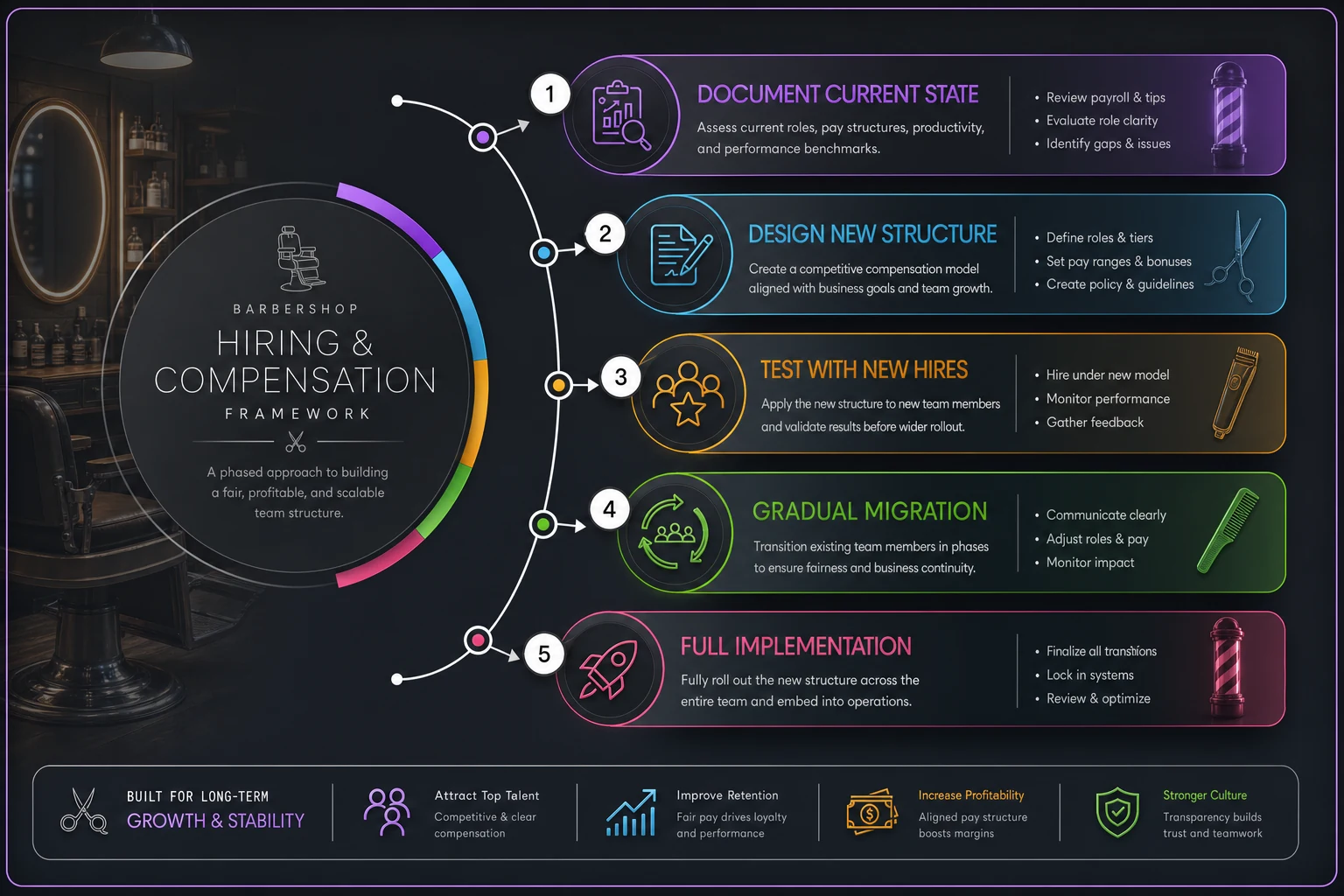
-
Document Current State (Immediately) — Map existing compensation deals. Calculate true revenue per chair. Identify turnover patterns. This baseline tells you what's actually broken versus what just feels broken.
-
Design New Structure (Month 1) — Choose a compensation model based on your market and goals. Create tier requirements. Draft updated contracts. Build interview scorecards. Don't implement yet—just design.
-
Test With New Hires (Month 2) — Use the new framework for your next two or three hires. Don't change existing deals yet. Gather feedback, adjust scorecards, refine tier thresholds.
-
Gradual Migration (Month 3-4) — Offer existing barbers the option to switch to the new model. Some will, some won't. Let results do the convincing.
-
Full Implementation (Month 6) — All new hires on the new model. Existing barbers see the benefits and gradually come over. Track metrics obsessively. Adjust quarterly based on actual data.
Working through these phases takes time, but it's a lot more manageable than trying to overhaul everything at once while also running a shop.
The difference between profitable shops and struggling ones isn't location or raw talent—it's systems. Specifically, having a barber hiring and compensation framework that attracts the right people, motivates performance, and creates genuine career paths.
Most owners avoid building these frameworks because they seem complex. But the complexity upfront is a lot cheaper than the ongoing chaos of constant turnover, inconsistent service, and unpredictable revenue. Pick a random Tuesday and map out your true per-chair economics. Calculate what turnover actually costs. Then decide whether investing in proper hiring and compensation systems makes sense.
The shops that thrive over the next decade won't necessarily have the best barbers. They'll have systems that consistently develop good barbers into great ones while keeping them engaged and earning within their ecosystem—and that starts with admitting the current approach probably isn't working.
Ready to elevate your barbershop operations?
Join 500+ barbershops using Trimzly to save time, reduce scheduling conflicts, and enhance client satisfaction.