



Picture this: your new barber just butchered three fades in a row. The second-chair guy keeps double-booking himself because nobody actually walked him through how the booking system works. And that talented recruit you pulled from across town? He's grabbing walk-ins off the floor while your regulars sit stewing for 45 minutes.
This is what happens when shops wing it. No handoff rules. No real checkpoints. Just throw them a chair and hope they figure it out.
Most shops lose somewhere between $8,000 and $12,000 in the first 90 days — botched cuts, angry regulars, barbers who bounce because they never felt settled. That's before you factor in the reputation damage when your new guy gives the mayor's kid a crooked lineup.
The revenue ramp nobody actually maps out
Every barbershop owner knows the hiring math. You need someone producing $3,500+ weekly to cover their chair, supplies, and overhead. But the actual ramp timeline that gets them there? Most owners just kind of eyeball it.
A barber who gets properly onboarded follows a pretty predictable curve:
-
Days 1–30
$800–1,200 weekly (supervised cuts, lower-stakes clients)
-
Days 31–60
$1,800–2,400 weekly (semi-independent, starting to build regulars)
-
Days 61–90
$2,800–3,500 weekly (fully operational, own book)
Without any structure, that same barber might hover around $1,500 weekly for six months while frustrated clients quietly find somewhere else to go.
The difference comes down to real handoff rules, booking privileges that expand with demonstrated skill, and mentorship that goes beyond "watch me cut for a week."
The first month: foundation before freedom
The first month determines whether this barber becomes an asset or a recurring problem. Skip the checkpoints and you spend the next several months correcting habits that never should have formed.
Never miss a booking amidst the hustle.
Trimzly helps you schedule, confirm, and manage every client visit seamlessly.
- Unified appointment management
- Automated client reminders
- Optimized staff scheduling
No credit card required
Week 1: Systems before scissors
Don't let them touch hair yet. They shadow your top barber and learn:
-
How your booking system actually works — not just clicking buttons, but the etiquette behind it
-
Client consultation standards specific to your shop
-
Product placement and upsell opportunities
-
Cash handling and tip distribution
Most shops hand over clippers on day two. That's how you end up with barbers who can cut fine but can't function inside your operation.
Weeks 2–3: Supervised cuts only
Start with three categories of clients:
-
Staff and family (low stakes, honest feedback)
-
Basic cuts under $25 (minimal risk)
-
Walk-in repair jobs (already compromised situations)
Every cut gets checked by a senior barber before the client leaves the chair. Yes, it slows things down. Catching mistakes before they hit the parking lot saves your Yelp reviews.
Track these metrics:
-
Cut accuracy (checked by senior barber)
-
Time per service
-
Client interaction quality
-
Product knowledge demonstration
Week 4: First real gate
| Skill Area | Required Proficiency | Assessment Method |
|---|---|---|
| Basic fade | 8/10 cuts pass inspection | Senior barber review |
| Consultation | Asks 5 key questions consistently | Manager observation |
| Booking system | Zero double-books for 7 days | System reports |
| Sanitation | Perfect score on surprise check | Random inspection |
| Time management | Within 15% of standard times | Tracked averages |
Fail any category? Stay in week four until they pass. Pushing someone forward who can't nail a basic fade creates problems all the way down the chain.
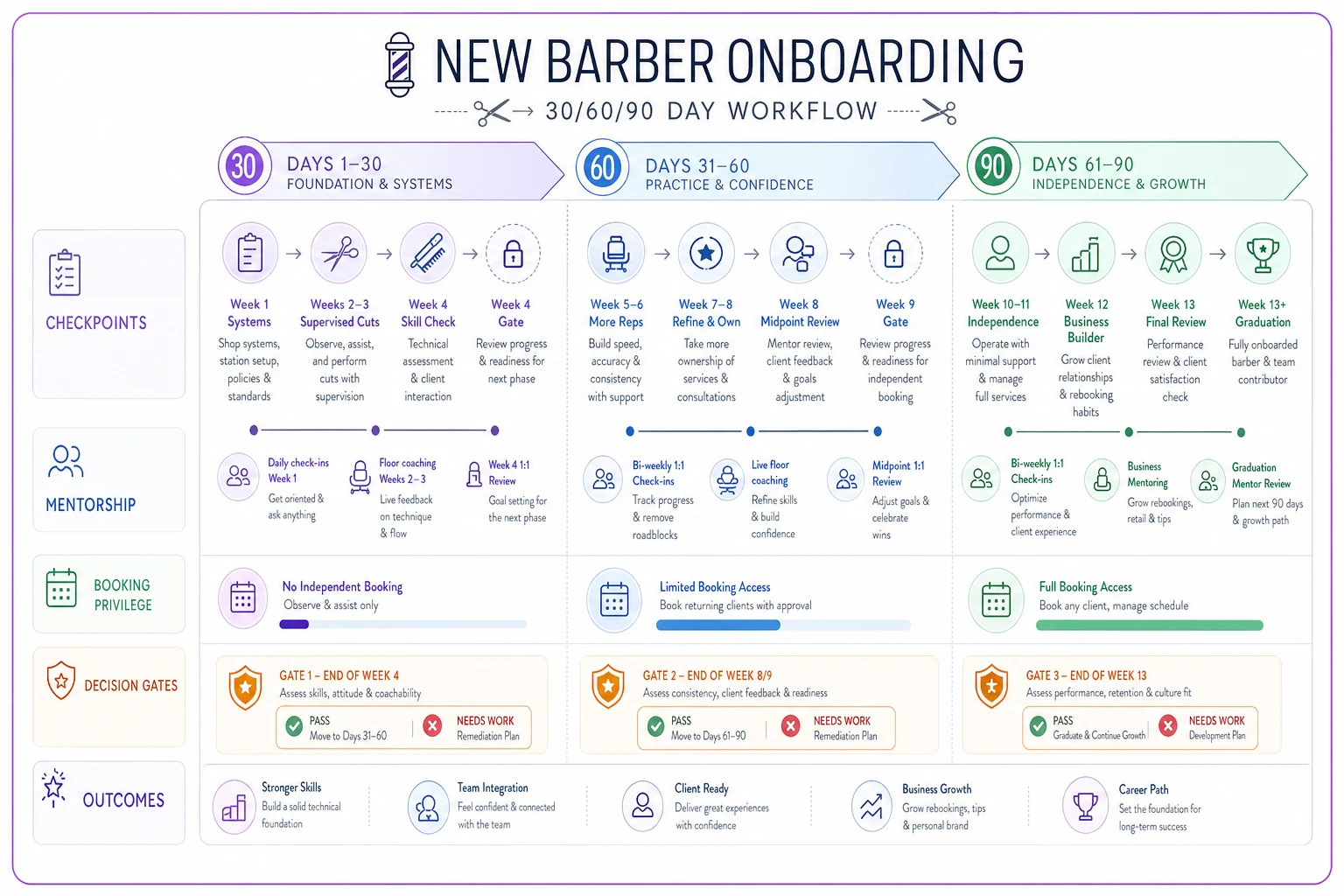
A simple visual of this workflow helps staff see the checkpoints at a glance.
Month two: testing judgment, not just skill
This is where you find out if you have a future producer or a permanent apprentice. Technical skill was month one. Month two is about whether they can operate independently without someone hovering over them.
I've watched owners skip this phase entirely because the barber seemed "good enough" — and almost every time, it ended badly. Not catastrophically, just slowly. Clients started coming in less. The barber started getting frustrated. By month four, everyone was miserable and nobody could point to exactly why.
Booking privilege progression
Days 31–40:
-
Can book regular cuts up to $35
-
No color services
-
No VIP clients
-
Maximum 4 appointments daily
Days 41–50:
-
Add beard work and hot towel services
-
Increase to 6 appointments daily
-
Can accept new walk-ins during slow periods
Days 51–60:
-
Full service menu except chemical treatments
-
8 appointments daily
-
Can book one week ahead instead of same-day only
This graduated approach prevents the classic Saturday disaster where a new barber books himself solid with complex services he can't handle yet and creates a backup that ruins everyone's afternoon.
Mentorship that actually has structure
Assign one specific mentor — not "whoever's around." That mentor gets 10% of the new barber's revenue during month two as compensation for:
Document it. All of it.
Daily observations:
-
Technical issues noticed
-
Client interaction wins and misses
-
Time management problems
-
Upsell opportunities taken or missed
Weekly assessments:
-
Revenue generated vs. target
-
Rebooking rate
-
Service time averages
-
Customer feedback scores
Without documentation, you're guessing whether someone's ready for month three. With it, you have actual data — their $1,850 weekly average needs to reach $2,400 before they get full autonomy. That's not a judgment call anymore, it's just a number.
Month three: accountability with a real book
Month three tells you whether you built a producer or a chair-warmer. Full privileges come with full expectations.
By day 61, your barber should have:
-
Their own column in the booking system
-
Authority to book two weeks ahead
-
Access to all services except chemical straightening
-
Direct relationships with somewhere around 15–20 regular clients
But most shops miss the reverse handoff rules entirely. What happens when things go sideways?
If weekly revenue drops below $2,000 for two consecutive weeks:
-
Review their book with management
-
Identify where they're losing money
-
Temporarily reduce booking privileges if needed
This isn't about punishing anyone. It's pattern recognition. Maybe they're spending 90 minutes on $40 cuts. Maybe they're not rebooking anyone. Whatever the issue, you want to catch it at $2,000 — not when they're down to $800 and quietly shopping their resume around.
Revenue targets tied to reality
| Week | Revenue Target | Key Metrics | Warning Signs |
|---|---|---|---|
| Week 9–10 | $2,400–2,600 | 35 cuts, $70 average ticket | Under 30 cuts, long service times |
| Week 11–12 | $2,800–3,000 | 40 cuts, $72 average | Low rebooking rate, client complaints |
| Week 13 | $3,200+ | 45 cuts, $75 average | Plateauing at lower numbers |
These aren't arbitrary. At $3,200 weekly, after a 60/40 split and chair fees, your shop nets roughly $580 per barber. Below that, you're subsidizing their learning curve indefinitely.
The mentorship checklist that actually scales
"Shadow Steve for a month" isn't mentorship — it's hoping Steve knows how to teach and has time to do it.
Build an actual checklist:
Week 1–2 Mentorship Focus:
-
[ ] Demonstrate consultation process 5 times
-
[ ] Explain pricing psychology for upsells
-
[ ] Show rebooking conversation techniques
-
[ ] Review sanitation shortcuts that still meet standards
-
[ ] Introduce to 3 VIP clients as "future booking option"
Week 3–4 Mentorship Focus:
-
[ ] Co-cut 3 difficult fades
-
[ ] Practice complaint handling scenarios
-
[ ] Review time-saving techniques
-
[ ] Demonstrate product sales approach
-
[ ] Begin handoff of 5 basic regulars
Month 2 Mentorship Focus:
-
[ ] Weekly technique improvement session
-
[ ] Review their consultation recordings
-
[ ] Analyze their rebooking rate together
-
[ ] Identify service bottlenecks
-
[ ] Plan their regular client acquisition strategy
Month 3 Mentorship Transition:
-
[ ] Move from daily to weekly check-ins
-
[ ] Shift from oversight to optimization
-
[ ] Focus on advanced techniques
-
[ ] Develop their signature services
-
[ ] Plan their marketing approach
With this in place, every mentor delivers consistent training instead of whatever they happen to remember to share that day. New barbers know what they're learning and when. And you can actually tell if mentorship is happening — or if everyone's just hoping things click.
When to extend and when to cut ties
Not every barber hits these targets on schedule. Some need 120 days. Some won't make it regardless of how much time you give them. Having clear criteria for both situations makes these calls objective instead of awkward.
Extend the ramp period when:
-
Technical skills are solid but speed is still slow
-
Revenue is trending upward but behind schedule
-
Client feedback is positive despite lower numbers
-
They're actively working on the specific weaknesses you've flagged
End the relationship when:
-
Same mistakes keep showing up after repeated coaching
-
Consistent client complaints about attitude
-
Revenue flat or declining after 60 days
-
Consistent pushback on feedback and systems
The money you lose keeping an underperformer is nothing compared to the clients you lose while they keep delivering bad experiences. A structured 90-day program turns these decisions data-driven instead of personal.
Where operational software actually helps
Managing this level of detail across multiple barbers gets messy fast without the right systems in place. Some shops are now using AI-powered operational software that tracks these metrics automatically, sends milestone reminders, and keeps mentorship documentation organized without requiring a paper trail you have to manually maintain.
The better platforms tie your booking system directly into performance tracking — automatically calculating weekly revenues, service times, and rebooking rates. Instead of manually checking whether someone's ready for expanded booking privileges, the system flags it when they've hit the criteria.
This matters most when you're scaling. At three chairs, you can keep it all in your head. At eight chairs with regular turnover, you need systems that don't depend on your constant attention. Some platforms can also surface early warning patterns in performance data before the numbers get bad enough to notice on your own.
Making the math work
A real 30/60/90 plan changes your hiring economics. Instead of hoping new barbers eventually figure it out, you're engineering their trajectory from day one.
The investment:
-
Around 40 hours of mentor time over 90 days
-
Temporary revenue reduction from supervised cuts
-
Administrative time for tracking and documentation
-
Roughly $3,000–4,000 in total opportunity cost
The return:
-
Barber producing $3,200+ weekly by day 90
-
Significantly fewer client complaints during the ramp period
-
Much better 90-day retention
-
Consistent service quality that protects your shop's reputation
There's another angle worth mentioning — shops with real programs attract better talent. Experienced barbers want structure, not chaos. When word gets around that you actually develop people instead of just filling chairs, recruiting gets easier on its own.
The shops doing well right now aren't necessarily the ones with the most talented barbers. They're the ones with systems that make barbers better faster. A documented, milestone-driven onboarding program turns hiring from a gamble into something repeatable.
Your next hire doesn't need to be perfect on day one. They need a path that makes them profitable by day 90.
Ready to elevate your barbershop operations?
Join 500+ barbershops using Trimzly to save time, reduce scheduling conflicts, and enhance client satisfaction.