
Your service menu might be quietly killing your revenue.
Walk into most barbershops and you'll find menu boards loaded with 20-plus services, weird package names like "The Executive" or "The Classic," and pricing that makes no sense to anyone standing there reading it. Clients stare at it for ten seconds, panic, and default to whatever seems cheapest because they can't figure out what they actually need.
After restructuring menus for dozens of shops, the pattern is always the same—owners add services over time without thinking about how clients actually make decisions. You end up with this Frankenstein menu that actively works against your business.
The worst part? Your barbers hate it too. They spend half their consultation time explaining what each service includes, then still end up doing add-ons that weren't properly charged because the client "didn't know" a beard trim wasn't included in their haircut.
Why Traditional Barbershop Menus Fail
Most shops organize their menus based on what makes sense to barbers, not what makes sense to clients. You've got standalone cuts, standalone beard services, random add-ons, and maybe some packages thrown in—but no clear logic connecting them.
Clients don't think in services. They think in outcomes. A guy doesn't walk in thinking "I need a fade plus beard trim plus line-up." He thinks "I want to look sharp for this wedding" or "I need my regular cleanup."
When your menu forces clients to piece together services like they're building a sandwich at Subway, two things happen. First, they get overwhelmed and pick the simplest option. Second, they miss services they actually want because they didn't realize they needed to ask for them separately.
The naming makes it worse. Every shop has their own creative names that mean nothing to a first-time client. What's the difference between "The Gentleman" and "The Professional"? Is "The Works" everything or just most things? These names force your front desk to explain the same stuff over and over, every single day.
Then there's the pricing structure. Most shops price services individually, which seems logical until you watch clients do mental math trying to figure out if the package saves them money. That confusion leads to one outcome—they pick the cheapest option and move on.
The Hidden Cost of Menu Confusion
Take a shop doing around 340 cuts monthly at an average ticket of $35. Pretty standard for a 4-chair shop. Now watch what happens when clients can't figure out your menu.
Never miss a booking amidst the hustle.
Trimzly helps you schedule, confirm, and manage every client visit seamlessly.
- Unified appointment management
- Automated client reminders
- Optimized staff scheduling
No credit card required
Roughly 40% of those clients probably wanted a beard service but didn't book it because your menu made it confusing. That's around 136 missed beard trims monthly. At $20 each, you're leaving close to $2,700 on the table every month—just from beard services.
Add in the clients who would've gotten a hot towel shave, hair treatment, or another add-on if they actually understood what was available, and you're easily missing another $1,500 monthly in services clients wanted but didn't know how to ask for.
The real time drain, though, is consultations. When every appointment starts with a 3-minute menu explanation, you're burning roughly 17 hours monthly just clarifying services. That's time barbers could spend cutting hair.
Your front desk takes the worst of it. Same questions on repeat: "What comes with this?" "Can I add that?" "What's the difference between these two?" Every confused client is another few minutes gone.
From there it compounds. Barbers end up doing services that weren't booked because clients assumed they were included. Appointments run long. Scheduling gets thrown off. And training new staff takes forever because they need weeks just to memorize your menu logic.
Menu Structure That Actually Converts
Tiered bundles with clear progression. That's what works.
Tier 1: Essential ($35)
-
Haircut
-
Basic cleanup
-
Standard finish
Tier 2: Premium ($55)
-
Everything in Essential
-
Beard trim & shape
-
Hot towel service
-
Premium products
Tier 3: Executive ($75)
-
Everything in Premium
-
Detailed beard work
-
Scalp treatment
-
Extended hot towel service
-
Complimentary beverage
Each tier builds on the last. No confusion. No mental math. Just pick your level.
Then add 2-3 standalone add-ons for things that don't fit the tiers—keep these minimal:
-
Kids cut ($20)
-
Buzz cut ($20)
-
Extra hot towel service ($10)
That's your entire menu. Someone can read it in under ten seconds.
The naming matters too. Descriptive beats creative every time. "Premium Cut & Beard" tells clients exactly what they're getting. "The Manhattan" tells them nothing. Save the creativity for your shop atmosphere.
Use straightforward names like 'Premium Cut & Beard' to reduce front desk explanations and speed up bookings.
Visualize this simple implementation flow:
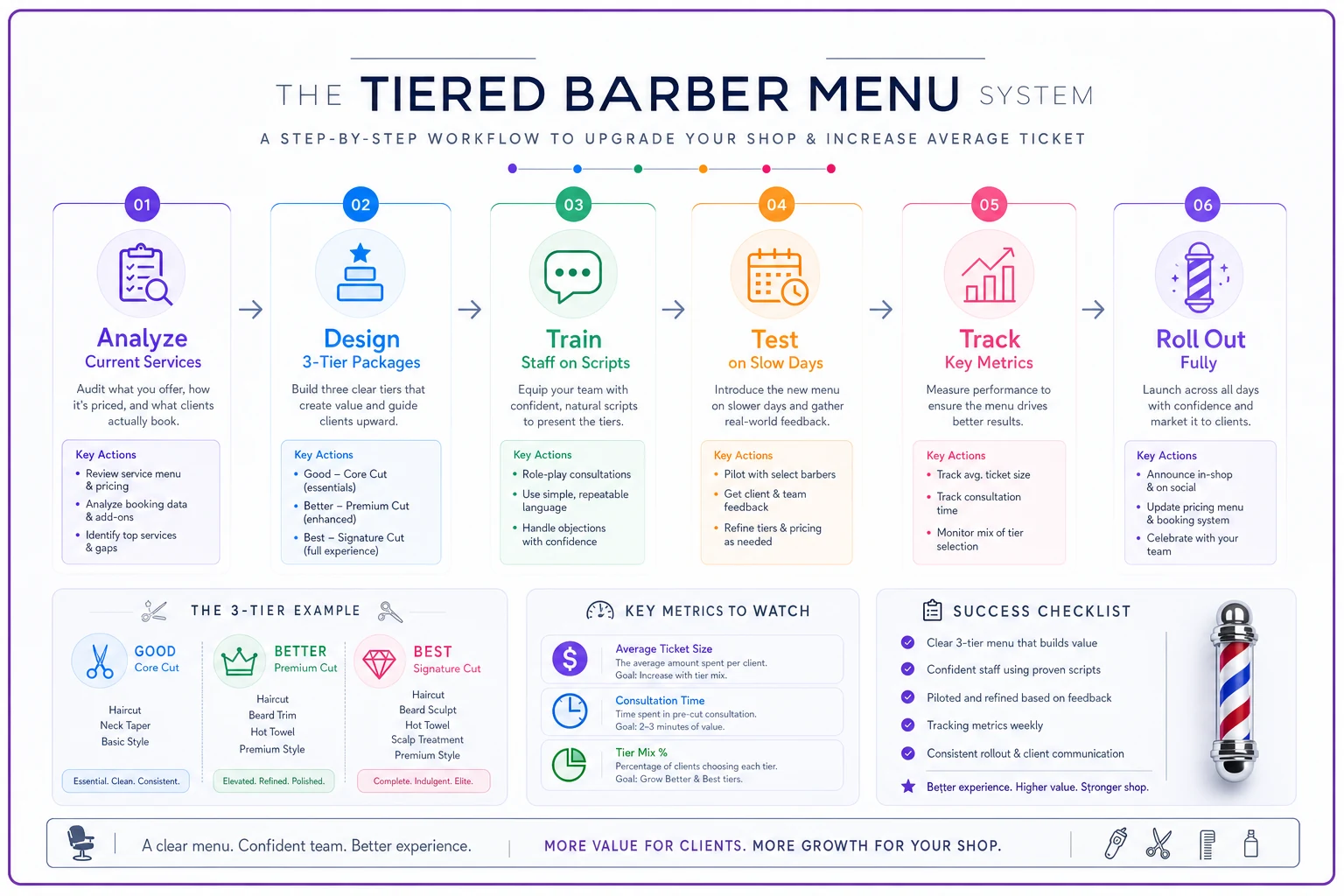
Follow these steps to implement the tiers without confusing clients.
Testing Menu Changes Without Chaos
Don't flip your entire menu overnight. Test it first.
Start with slow days—Tuesday and Wednesday afternoons for the first two weeks. Train your team to offer the new structure to walk-ins and new clients only. Keep existing clients on the old menu for now. You get real data without disrupting your whole operation.
Track three things during the test:
-
Average ticket value per new client
-
Service selection distribution (what percentage picks each tier)
-
Consultation time per appointment
After two weeks, look for patterns. If average tickets are up and consultation time is down, expand the test to all walk-ins and new bookings. Keep regulars on the old system a bit longer.
Train your barbers on a simple transition script—one sentence is enough: "We've simplified our menu into packages that include everything most guys want—which level matches what you're looking for today?"
Most clients adapt quickly when the new structure actually makes sense. The ones who complain were probably difficult to begin with.
Here's a sample conversion tracking table for your test period:
| Week | Old Menu Avg | New Menu Avg | Difference | Sample Size |
|---|---|---|---|---|
| 1 | $35 | $48 | +$13 | 28 clients |
| 2 | $35 | $51 | +$16 | 34 clients |
| 3 | $35 | $49 | +$14 | 41 clients |
| 4 | $35 | $52 | +$17 | 45 clients |
Once you've got consistent improvement across 100-plus services, you're ready for full rollout.
Front Desk Scripts That Drive Higher Tickets
Most shops train their front desk to take orders. That's it. Which is leaving real money behind.
The opening question sets the whole tone. Instead of "What service would you like?" try "Are you looking for just a quick cleanup or the full treatment today?" You're framing the decision as basic versus complete—not cheap versus expensive.
When someone books the basic tier, the follow-up matters: "The Premium includes beard work and hot towel for just $20 more—worth adding since you're already coming in?" Around a third of clients will upgrade on that question alone.
For online bookings, your descriptions do the selling. Don't just list inclusions. Explain who each tier is actually for:
-
Essential
"Perfect for regular maintenance cuts between full services"
-
Premium
"Our most popular choice for guys who want to look sharp"
-
Executive
"When you need to look your absolute best"
Train your team to read the room. Guy mentions a date, job interview, or wedding? That's an Executive moment. Regular monthly client? Premium makes sense. College student watching his budget? Essential is fine, but mention the difference.
Checkout is your last shot at add-on revenue. "We're doing something with our scalp treatment right now—adds about 10 minutes but clients love it. Want to try it for $15?" Specific, low-pressure, timed when they're already committed to spending.
Real Shop Transformation
A 5-chair shop in Austin was stuck around $38 average tickets with a 22-service menu. They had everything from "$25 Clipper Cuts" to "$85 Royal Treatments" with no logic connecting them. Front desk spent half the day explaining services. Barbers constantly dealt with clients who "didn't know" certain things cost extra.
They restructured to three tiers: Foundation ($35), Signature ($55), and Distinguished ($80). Each built clearly on the previous. No clever names. No confusion.
First month after full rollout: average ticket jumped to $54. Not because they raised prices—because clients could finally understand what they were buying. The $55 Signature became the most popular choice almost immediately. Turns out guys will happily pay for a beard trim when it's bundled clearly instead of buried in a list.
Front desk stopped fielding confusion calls. Barbers stopped arguing about what was included. Online bookings went up because clients could figure out what to book without calling first.
Six months later, they're averaging $58 per ticket with the same team, same location, same everything except the menu. That's roughly $7,800 extra monthly just from organizing services in a way that makes sense.
When to Keep Your Current Menu
Not every shop needs an overhaul. If you're running a pure walk-in operation with mostly quick cuts, tiered packages might actually slow you down. If your average ticket is already above $60 and climbing, the menu probably isn't the problem.
Some shops thrive on customization and a more consultative approach. If you're positioning yourself as a high-end, bespoke experience, pre-set packages could actually hurt your brand. Same goes if your market genuinely prefers à la carte pricing—some neighborhoods just work that way.
But for most shops trying to move from $30-40 tickets to $50-60 tickets, menu structure is the easiest win available. You're not asking clients to spend more on the same service. You're making it easier for them to buy what they already wanted.
The Technology Component
Manual menu management becomes a real headache once you start testing and adjusting. You need systems that handle different pricing across booking channels, track which packages actually perform, and update without requiring you to reprint everything.
Operational software makes a big difference here. Instead of managing paper menus, re-training staff on every pricing change, and manually tracking what converts, you centralize everything in one platform. Your online booking shows the right packages. Your POS knows what's included. Changes push everywhere at once.
The better platforms now use AI automation to surface booking patterns and flag menu adjustments worth making—like noticing that Friday Premium clients almost always add scalp treatments, then prompting that upsell at the right moment in the booking flow. That kind of insight is hard to catch manually when you're busy running a shop.
Even without those features, just having your menu properly digitized and consistent across all touchpoints eliminates a lot of the day-to-day confusion. Clients see the same packages online that they see in-store. Your team works from the same structure. Nobody's guessing.
Making the Change Stick
The biggest mistake shops make is treating menu redesign as a one-time project.
Every quarter, pull your service data and look for patterns. Which tier gets chosen most? What add-ons never sell? Are certain barbers consistently pulling higher tickets with the same menu? These patterns tell you what's working and what needs tweaking.
Keep the menu lean. Every time you want to add something new, ask whether it fits your existing tiers or genuinely needs its own listing. Most new services can be positioned as a featured add-on for a month rather than permanently cluttering your menu.
Your menu is essentially a sales tool that works 24/7. When it's confusing or unclear, you're pushing revenue away without realizing it. When it's simple and guides clients toward what they already wanted, your average tickets climb without any pushy tactics required.
The shops doing well right now aren't the ones with the most services or the cleverest names. They're the ones who made it easy for clients to understand and buy what they need. If your menu doesn't sell itself, you're working harder than you should be for less money than you deserve.
Ready to elevate your barbershop operations?
Join 500+ barbershops using Trimzly to save time, reduce scheduling conflicts, and enhance client satisfaction.