

Your Saturday morning is packed. Eight chairs running, walk-ins turned away, and then Marcus texts at 11:47 that he's running late for his noon slot. By the time he shows up at 12:15, you've already lost the walk-in who left after waiting ten minutes, and now your 12:30 is backing up into lunch.
This happens because most shops either blast too many reminders and annoy clients, or send one weak text the night before that does nothing. The sweet spot exists, but getting there means understanding both how clients think and how your operation actually flows.
Why standard reminder systems fail barbershops specifically
Barbershops face messaging challenges that generic appointment software wasn't built for. Your clientele spans multiple generations with completely different communication expectations. The 22-year-old who books through Instagram isn't looking for the same kind of message as the 55-year-old executive who calls in.
And barbershop appointments aren't like medical visits where skipping means waiting weeks. Clients know they can usually walk in somewhere nearby. That lower commitment threshold means your messaging needs more finesse than most software accounts for.
The average barbershop loses somewhere around $2,800 a month from no-shows and late arrivals. That's not just the missed service — it's the walk-ins you turned away during "booked" slots that ended up empty, the overtime when everything stacks up, and the reputation hit when wait times spike without warning.
Most shops try to fix this by adding more reminders. A 48-hour text gets added to the 24-hour email. Then a morning-of call. Pretty soon clients start ignoring everything because the shop cutting their hair has become their most aggressive texter. The pendulum swings too far the other way.
The 3-2-0 cadence framework
After watching a lot of shops test different approaches, the 3-2-0 structure consistently reduces no-shows by 40–65% without pushing complaint rates up.
Never miss a booking amidst the hustle.
Trimzly helps you schedule, confirm, and manage every client visit seamlessly.
- Unified appointment management
- Automated client reminders
- Optimized staff scheduling
No credit card required
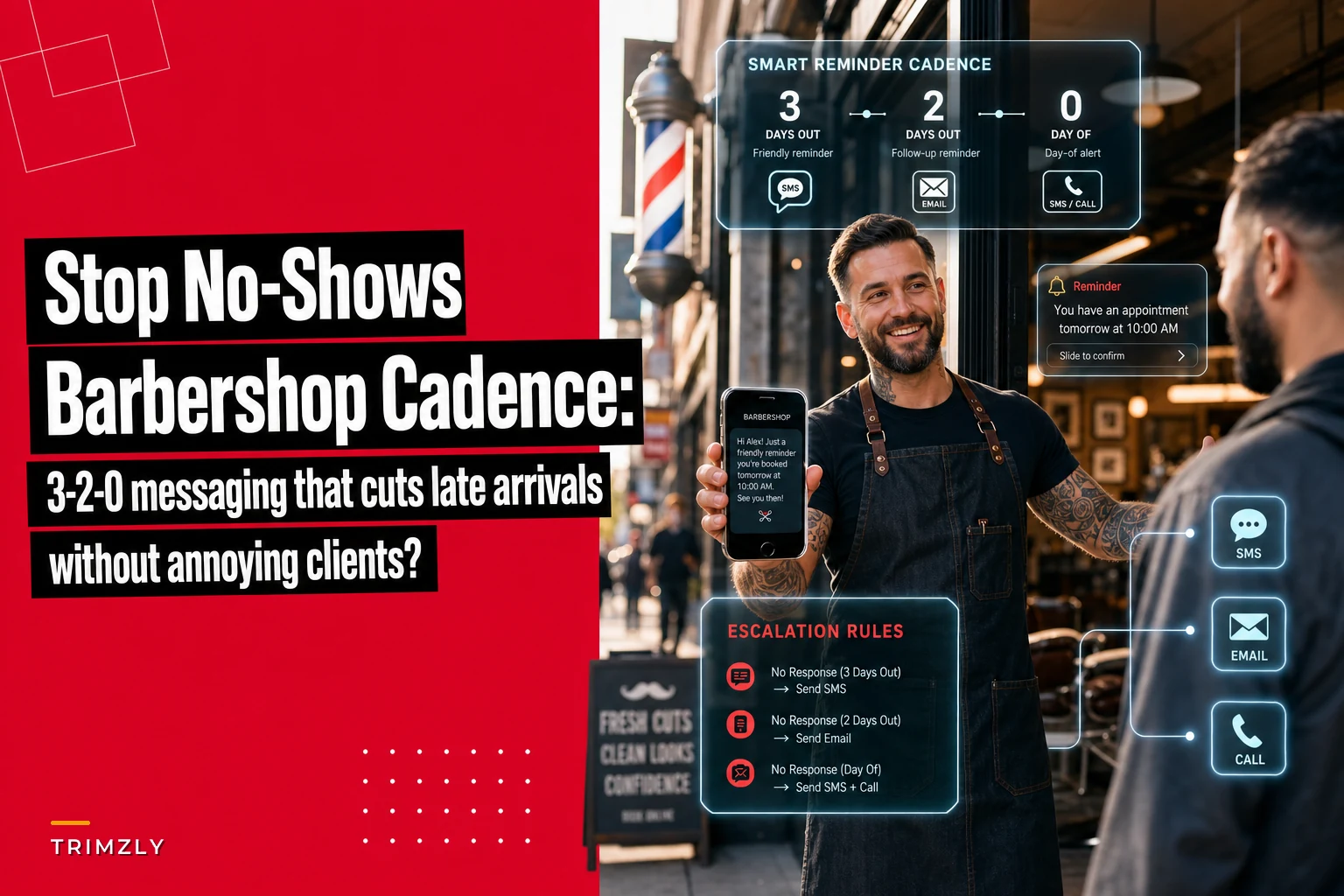
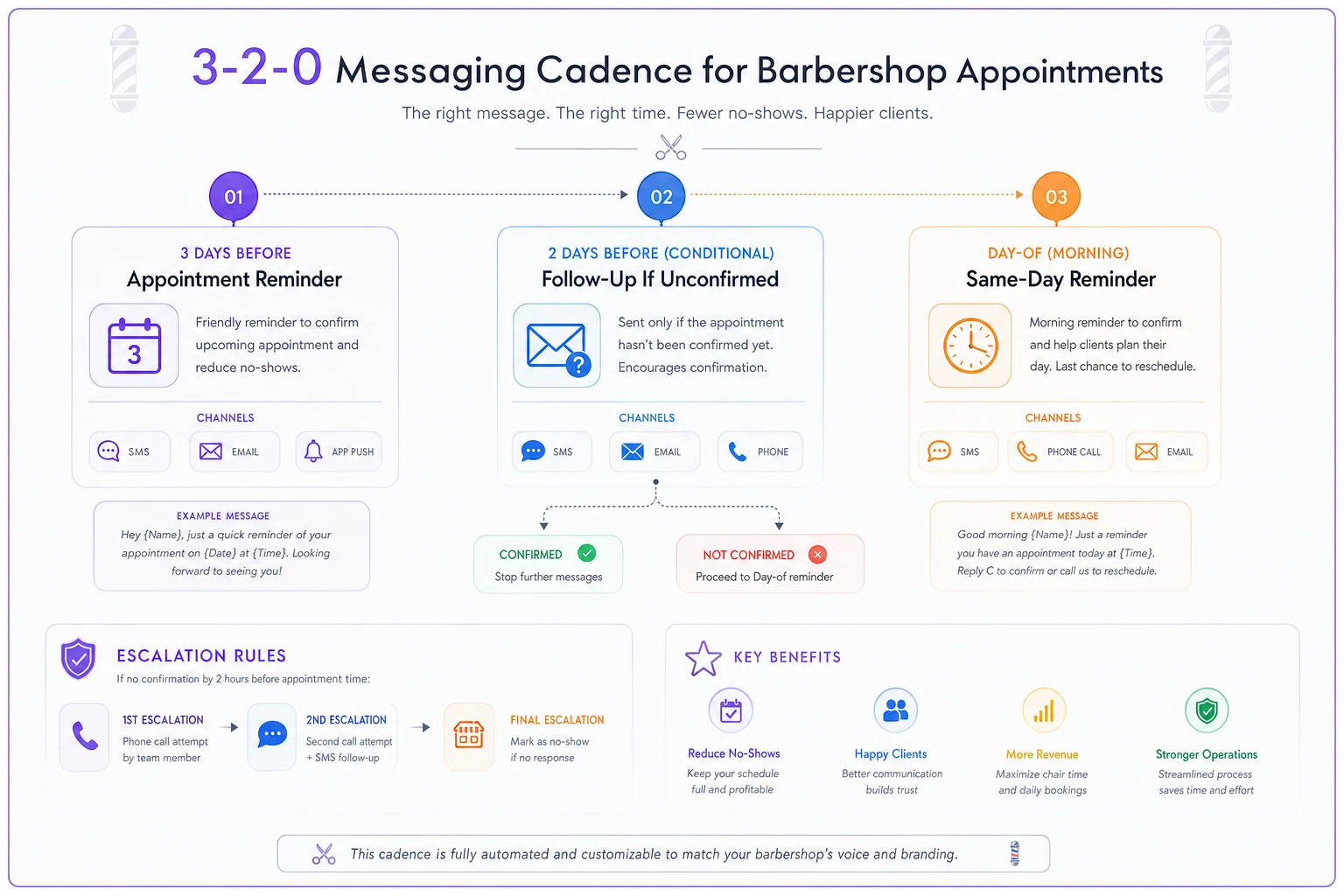
3 days before: Initial confirmation 2 days before: Conditional follow-up (only for specific client types) 0 day of: Morning reminder with specific timing The timing alone isn't what makes it work — it's what you say and how you say it at each stage.
Below is a quick visual of the 3-2-0 cadence workflow.
Day 3: The soft confirmation
Three days out gives clients enough time to actually check their schedule and reschedule if something came up. This message should feel helpful, not like a warning.
SMS Template: "Hey [Name], got you down for [Day] at [Time] with [Barber]. Reply Y to confirm or call us at [Phone] if you need to move it. -[Shop Name]"
Email Template (for clients who prefer email): Subject: Your spot with [Barber] this [Day] [Name], looking forward to seeing you [Day] at [Time]. If something came up, no stress – just hit reply or call [Phone] to reschedule. Otherwise, we'll see you then. [Barber] mentioned he's been working on that fade technique you asked about last time. -[Shop Name] crew
Notice what these don't do: no guilt trips, no warnings about fees, no "IMPORTANT" in all caps. Just clear information with an easy out.
Day 2: The strategic skip
This is where most shops go wrong. They message everyone again at 48 hours, which trains clients to tune it all out. Instead, only trigger day-2 messages in specific situations:
-
New clients (first 3 visits)
-
Clients who've no-showed in the past 90 days
-
High-value services over $75
-
Weekend appointments, which tend to have higher no-show rates
For everyone else? Skip it. They already confirmed or rescheduled at day 3.
Day 2 SMS (when needed): "Quick reminder: You're all set for tomorrow at [Time] with [Barber]. Need to adjust? Text MOVE or call [Phone]. -[Shop]"
Day 0: The morning precision message
Send this 2–3 hours before the appointment, not at 7am for a 3pm cut. Timing matters more than most shops realize.
Morning-of SMS: "See you at [Time] today! [Barber]'s ready for you. Running late? Text us so we can adjust. -[Shop]"
For premium clients or more involved services, add a little personalization: "[Name], see you at [Time] for your cut & beard detail. [Barber] set aside extra time for the design work you wanted. Running behind? Just text us. -[Shop]"
The timing and wording together are what make the 3-2-0 cadence effective.
Escalation rules that prevent awkwardness
After one no-show, the system adjusts slightly. Not as punishment, just as a practical response.
First no-show in 6 months: Add a friendly "confirmation required" to their next booking. "Hey [Name], got you scheduled for [Day] at [Time]. Since we missed you last time, just reply YES to hold your spot. -[Shop]"
Second no-show in 6 months: Require a deposit or same-day booking. One message explains it: "[Name], due to recent missed appointments, we'll need a $20 deposit for advance bookings or you're welcome for same-day spots. Questions? Call [Phone]. -[Shop]"
Third strike: Walk-ins only for 90 days. It protects your schedule while keeping the door open.
The key is enforcing this consistently but communicating it calmly. These aren't punishments — they're how you keep the operation running smoothly.
A/B testing that actually matters
Most shops test the wrong things. They tweak emoji usage while leaving timing and tone untouched. Here's what's actually worth testing:
Test 1: Professional vs. Casual Tone
Version A: "Your appointment with Marcus is confirmed for Tuesday at 2:00 PM. Reply Y to confirm."
Version B: "Yo [Name], locked in with Marcus Tuesday at 2pm. All good? Hit us with a Y."
Track confirmation rates and no-shows over 30 days. Casual tends to win for under-35 clients, professional for over-50 — but it varies by shop.
Test 2: Timing Windows
Version A: 3-day, skip, morning-of Version B: 2-day, skip, morning-of Version C: 3-day, 1-day, skip
Measure no-show rates and complaint rates both. The winner shifts depending on neighborhood and clientele.
Test 3: Channel Preference
Version A: All SMS Version B: Email for booking confirmation, SMS for reminders Version C: Client choice at booking
Some shops find email confirmations actually get more engagement for weekend appointments. Worth checking.
Test 4: Urgency Framing
Version A: "See you tomorrow at [Time]!" Version B: "Your spot's held for tomorrow at [Time]" Version C: "[Barber] has you down for tomorrow at [Time]"
Small wording differences can shift no-show rates by 10–15%. The personalized barber mention in Version C tends to perform best.
Walking the annoyance line
Client tolerance varies more by booking frequency than age:
Weekly regulars: One message max. They don't forget. Bi-weekly clients: Full 3-2-0 for the first month, then pull back to 3-0. Monthly clients: Full cadence every time. Sporadic clients (3+ months between visits): Full cadence, and require confirmation for the booking to hold.
Track unsubscribe rates. If more than 2% opt out monthly, you're overdoing it. If no-shows are above 15%, you're not doing enough.
-
No-show rate
5–8%
-
Late arrivals
Under 10%
-
Unsubscribe rate
Under 1% monthly
-
Complaint rate
Near zero
A well-calibrated system looks something like the metrics above.
Channel strategy based on client type
Different clients respond to different channels, and pushing everyone into SMS-only costs you effectiveness.
| Client Type | Primary Channel | Backup Channel | Notes |
|---|---|---|---|
| Under 25 | Instagram DM | SMS | Many won't answer calls |
| 25-40 | SMS | Most responsive overall | |
| 40-55 | SMS | Phone | Appreciate call option |
| 55+ | Phone | SMS | Many prefer talking |
| Executives | SMS | Check email religiously | |
| Blue collar | SMS | Phone | Simple and direct |
| Students | Instagram/SMS | Varies by school culture |
Don't guess — ask at booking. "Best way to remind you?" takes two seconds and saves the awkwardness of calling someone who never picks up.
When manual becomes impossible
Running this system manually works fine until you're somewhere around 200 appointments a month. Past that, someone's spending a couple hours daily just managing confirmations. That's when barbershop appointment reminder cadence automation stops being optional.
The math is pretty simple: at 300 monthly appointments with a proper 3-2-0 cadence, you're sending 600–750 messages. Add confirmation tracking, no-show follow-ups, and rescheduling coordination — now someone's entire morning is gone.
Good operational software handles the whole flow automatically. It tracks who confirmed, triggers escalation rules, switches channels based on client preferences, and adjusts timing for different segments. But the less obvious benefit is consistency. Manual systems break down when whoever handles reminders is sick, quits, or just gets slammed during a busy Thursday. AI-powered scheduling platforms don't have off days.
Automate confirmation tracking once you exceed about 200 monthly appointments to avoid daily manual overhead.
They also catch patterns a person would miss — like how appointments booked through Instagram have significantly higher no-show rates, or how clients who schedule Sunday services on Friday afternoon tend to run late more often. That kind of insight lets you fine-tune your cadence for specific scenarios instead of running the same message for everyone.
Common mistakes that increase no-shows
Using shame or guilt: "We held your spot and turned others away" might feel justified, but it makes clients less likely to rebook, not more likely to show up next time.
Generic messages from short codes: When texts come from 55847 instead of your shop number, clients treat them as spam.
All-caps urgency: "REMINDER: APPOINTMENT TODAY!!!" reads as desperation, not professionalism.
Inflexible rescheduling: If moving an appointment means calling during business hours, busy clients just no-show instead.
One-size messaging: Sending identical reminders to the college student who books weekly lineups and the lawyer who comes quarterly creates friction for both.
Over-automation: When messages feel completely robotic, clients mentally file them with promotional spam.
The real numbers from implementing this correctly
A typical 8-chair shop doing around 340 appointments monthly tends to see something like this after dialing in their messaging cadence:
Before:
-
No-shows
45–50 monthly (13–15%)
-
Late arrivals
60–65 monthly (18%)
-
Revenue lost
Roughly $3,200
-
Walk-ins turned away during empty slots
20–25
After 60 days:
-
No-shows
20–25 monthly (6–7%)
-
Late arrivals
35–40 monthly (11%)
-
Revenue recovered
$1,800–2,100
-
Walk-ins captured
Additional 12–15
The part shops don't expect? Client satisfaction usually goes up. They appreciate being able to reschedule easily and not getting guilt-tripped when life happens. Shops that nail this see retention improve because the whole operation just runs tighter.
Crafting your shop's specific approach
Start with the base 3-2-0 structure and adjust from there:
High walk-in volume? Shorten the morning-of reminder to an hour before the appointment, giving yourself more time to fill sudden openings.
Older clientele? Add phone call options and consider pushing the initial confirmation out to 4 days.
College town? Instagram DM might be your primary channel with SMS as backup.
Upscale neighborhood? Professional tone, email-heavy, understated reminders.
Mostly established regulars? Reduce frequency for proven clients while keeping the full cadence for newer ones.
Test one variable at a time over two weeks. Track confirmations, no-shows, complaints, and unsubscribes. The winning formula usually becomes clear pretty fast.
Beyond basic reminders
Once your base cadence is running well, you can layer in some additions:
-
Weather triggers
Storm coming? A quick "Roads look rough tomorrow – need to reschedule?" message can prevent both a no-show and a frustrated client.
-
Service prep reminders
For colors or treatments requiring clean hair, add prep instructions to the morning-of message.
-
Loyalty nudges
Every fifth appointment, mention their accumulated rewards or an upcoming milestone.
-
Preference updates
Every few months, ask if their reminder preferences still work for them. Communication habits shift.
-
Waitlist alerts
When someone cancels, immediately text the next two or three waitlist clients who can make that window.
These should enhance what's already working, not patch something that isn't. If the base messages aren't landing, adding complexity won't fix it.
Making this sustainable long-term
The best messaging system is one your team actually maintains. It needs to be part of daily operations, not something someone manages "when they have time."
Assign clear ownership. Whether it's running through software or managed manually, someone needs to own the outcomes — tracking metrics, updating templates, handling escalations, testing improvements.
Review performance monthly. No-show rates creeping back up? Messages getting ignored? Catch drift early before it becomes the new normal.
Keep templates fresh but consistent. Small updates every quarter prevent staleness without losing familiarity. "Spring's here – time for that fresh cut" beats running the same message unchanged for two years.
Most importantly, treat your messaging as core operations, not marketing. This isn't about promotion — it's about running a shop where everyone shows up when they're supposed to, chairs stay full, and barbers aren't sitting around waiting.
The shops that get this right stop treating no-shows as inevitable. They run with the kind of precision that lets them maximize chair time, keep barbers busy, and serve more clients without adding chaos. Fewer empty chairs is the obvious win. But the real one is just a smoother operation overall.
The shops that get this right stop treating no-shows as inevitable. They run with the kind of precision that lets them maximize chair time, keep barbers busy, and serve more clients without adding chaos. Fewer empty chairs is the obvious win. But the real one is just a smoother operation overall.
Ready to elevate your barbershop operations?
Join 500+ barbershops using Trimzly to save time, reduce scheduling conflicts, and enhance client satisfaction.