

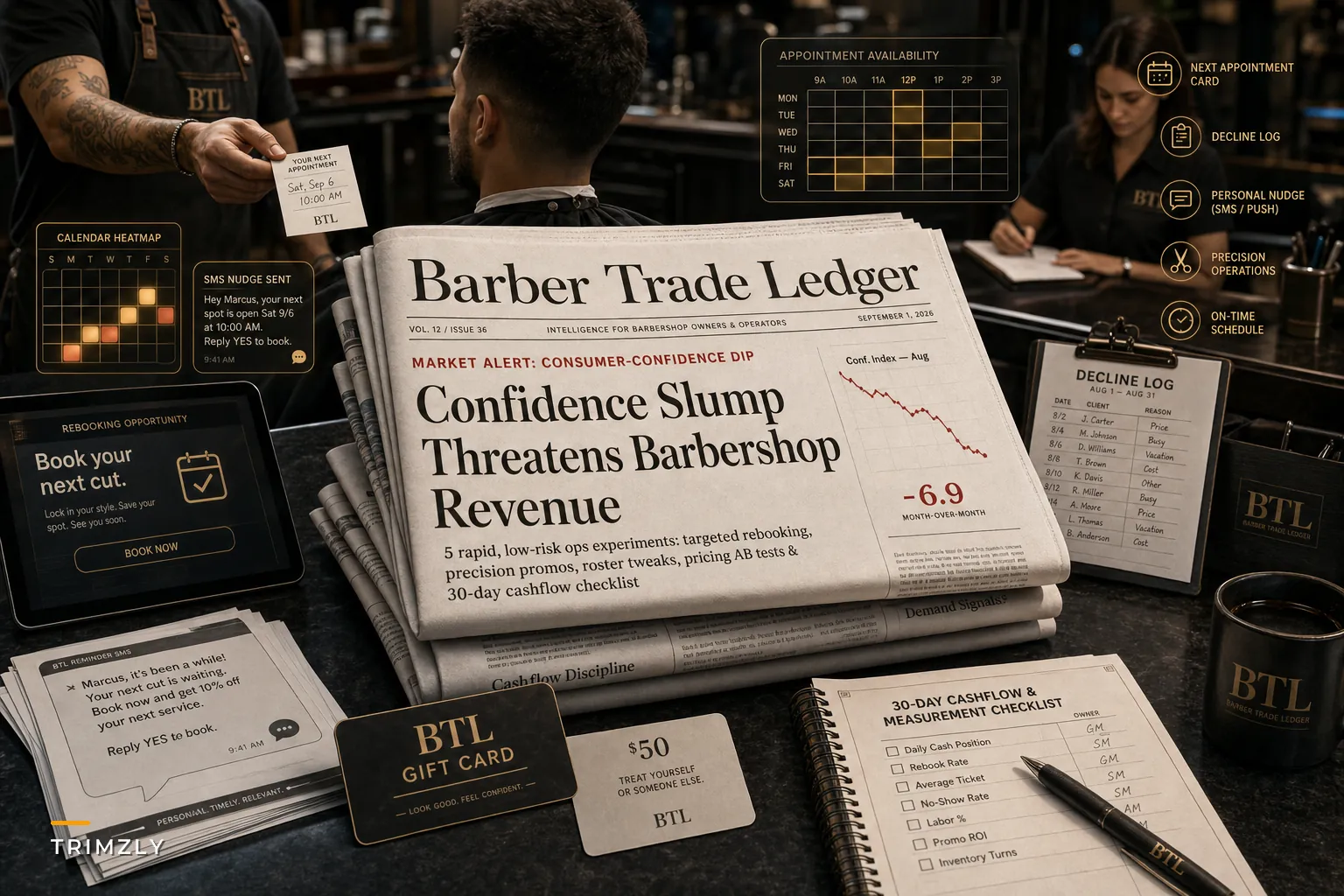

The Conference Board's August reading came in at 89.4, down from 90.2 in July, with most of the pullback driven by the Expectations Index. Buried in the Conference Board's release was a detail that matters more for shops than the headline number: people said they plan to spend less on beauty and personal care over the next six months. Reuters framed it as broadening caution about near-term spending.
For most industries a 0.8-point dip is noise. For a barbershop it's a signal, because the way clients cut back on grooming isn't dramatic. Nobody cancels their haircut forever. They just quietly go from every 3 weeks to every 4. They skip the beard trim. They wave off the product at checkout. Multiplied across a full book, that quiet stretching is where your revenue leaks out — slowly enough that you don't notice until a month feels short and you can't quite explain why.
This post isn't about the economy. It's about the five operational levers you actually control when demand gets softer at the margins.
First, understand *how* softness shows up in a barbershop
Before touching any lever, it helps to know exactly what you're fighting. Softer confidence doesn't hit shops as a wave of cancellations. It shows up as three separate erosions, and they each need a different response.
-
Interval creep. The gap between visits stretches. A client on a 3-week cycle drifts to 4 or 5. Your chair time stays the same, but you're seeing each person 30% less often.
-
Ticket shrinkage. The cut happens, but the add-ons don't. No beard detail, no gray blending, no hot towel, no product on the way out.
-
Trade-down. The client who used to book with your senior barber starts booking with whoever's cheapest or available.
Interval creep is by far the most expensive of the three, and it's the one owners react to slowest. A missed $18 add-on stings once. A regular who now comes 9 times a year instead of 13 costs you four full tickets — quietly, permanently, and without ever showing up as a lost client in your reports. They're still on the books. They're just worth less.
Most shops chase the wrong erosion. They panic and slash prices — attacking trade-down — when the real bleed is interval creep among their best clients.
Move 1: Protect your visit frequency before you touch price
The instinct in a soft month is to discount. Resist it as your first move. Discounting trains your most loyal clients to expect lower prices while doing almost nothing for the person who was going to stretch their interval anyway.
Never miss a booking amidst the hustle.
Trimzly helps you schedule, confirm, and manage every client visit seamlessly.
- Unified appointment management
- Automated client reminders
- Optimized staff scheduling
No credit card required
What actually holds frequency is rebooking at the chair, not marketing after the fact. A client who walks out with their next appointment already set is dramatically less likely to drift. The barber asking "same time in three weeks?" while ringing them up is worth more than any email campaign you'll send afterward.
A simple rule that works:
-
Every completed service ends with a specific rebook offer — a real day and time, not "come back whenever."
-
If they decline, that's fine — but the decline gets noted, so you can track who's drifting.
-
Anyone who used to be a 3-week regular and hasn't booked in 5+ weeks gets a light, personal nudge — not a blast.
The difference between "book soon" and "I've got you penciled for Thursday the 14th at 5:30" is enormous. Specificity converts. Vagueness lets interval creep win.
Have barbers offer one concrete next appointment time during checkout — specificity boosts rebooks.
A simple workflow to follow:
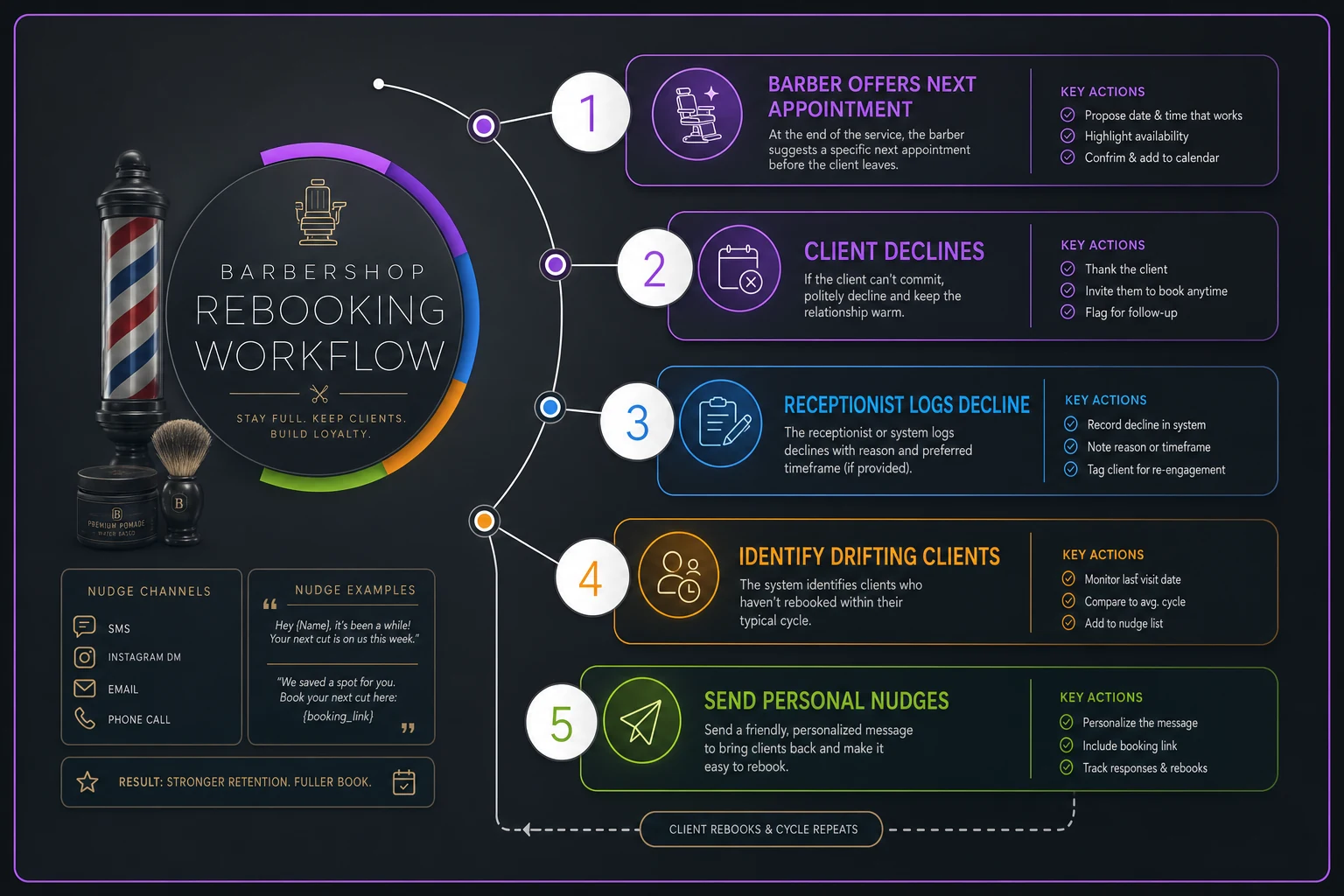
When this makes sense: basically always, but especially now. When it backfires: if barbers push rebooking so hard it starts to feel like a sales pitch. The tone has to stay casual, or regulars feel handled.
Move 2: Defend the average ticket without a single price change
Ticket shrinkage during cautious months is rarely about the money itself. It's about friction and default. When someone's feeling careful, anything that requires a decision at checkout tends to get declined. So you remove the decision.
Two things that actually move the needle:
Bundle the add-on into the service, don't offer it after. A "cut + beard cleanup" as one named service at one price gets chosen far more often than a $32 cut with a beard trim offered at the end for $15 more. Same total. Completely different acceptance rate. The bundle removes the moment where a cautious brain says "nah, not today."
Make retail a takeaway, not a pitch. Product attach rates in soft periods drop because barbers stop mentioning it, sensing the client's mood. Reframe it: the barber names the specific product they just used — "this is the matte paste I put in, lasts you about a month" — as information, not a sale. Attach rates hold far better when product is framed as continuity of the cut rather than an upsell.
This is also where getting your bundle and gift-card mechanics right matters a lot. Done poorly, promotions cannibalize your regular bookings instead of adding revenue. Worth reading through the rules for running promotions and gift cards that add revenue instead of eating it before you launch anything.
Move 3: Roster to the demand you actually have, not the demand you hope for
The mistake that turns a soft month into a bad month: keeping your full-week roster while your midweek slows. Payroll is fixed, revenue is variable, and the gap eats your margin faster than anything on the demand side.
The move isn't to cut people. It's to concentrate coverage where the money is.
| Roster approach | What happens in a soft month | Effect on margin |
|---|---|---|
| Flat staffing all week | Empty chairs Tue–Thu, packed Fri–Sat | Paying for idle chair time |
| Peak-weighted roster | Heavy Thu–Sat, lean Mon–Wed | Labor tracks revenue |
| Cut hours across the board | Understaffed at peak, lost walk-ins | Missing your best hours |
Peak-weighting is almost always the right answer. The dead Tuesday afternoon isn't where you make money in any month — it just becomes intolerable when demand softens. Pull your strongest barbers into the high-traffic windows, run leaner on the slow ones, and protect the hours that actually convert.
Who should not do this: shops with a strong midweek professional clientele — guys getting cuts on their lunch break. Cutting midweek there kills your most reliable segment. Look at your own booking data before touching the roster. The "obvious" slow day isn't always slow for you specifically.
Move 4: Aim your effort at the clients worth keeping
Not every client is equally worth defending, and a soft market is exactly when that distinction matters. Your top 20–25% of clients — the frequent, higher-ticket regulars — generate a disproportionate share of revenue. Losing three of them to interval creep hurts more than losing fifteen occasional walk-ins.
-
High-value regulars showing drift. These get the personal touch — a real message from their barber, not an automated blast. Highest-ROI outreach, full stop.
-
Solid mid-tier clients. Keep them warm with consistency
reliable rebooking, good experience, occasional value reminders.
-
Occasional and walk-in traffic. Don't over-invest. Convert who you can at the chair, but don't burn your best efforts here.
A workflow that works without a big system: pull a list of clients who came four or more times last year but haven't been in for five-plus weeks. That's your drift list. It's usually short — a couple dozen names. A barber personally reaching out to their own drifting regulars converts far better than any shop-wide campaign, because the relationship is already there.
Shops that survive soft periods well aren't the ones with the biggest promotions. They're the ones who know which 40 clients matter most and make sure those people don't quietly disappear.
Move 5: Watch cashflow at the week level, not the month level
Soft demand plus fixed costs is a cashflow problem before it's a profit problem. The shops that get caught out are the ones still reading monthly totals, because by the time a soft month closes, you've already made your staffing and inventory decisions for the next one.
Tighten the loop:
-
Track bookings and average ticket weekly. A dip in either shows up 2–3 weeks before it hits your bank account. That gap is your reaction time.
-
Watch product-on-hand. Cautious months are when overstocked retail turns into dead cash sitting on a shelf. Order tighter, reorder faster.
-
Know your break-even chair count. How many filled chairs per day covers your fixed costs? If you don't know that number off the top of your head, you can't tell a slow-but-fine week from an actual problem.
Owners who stay calm in soft periods are the ones already tracking numbers weekly. They can see two weeks of softening and adjust the roster before it becomes a payroll squeeze. The ones who panic are usually flying on monthly summaries, reacting a full month late.
A real scenario
A two-chair shop in a mid-size suburb noticed August felt off — not empty, just lighter. Bookings were roughly flat, but the average ticket had slid from around $41 to about $35, and a handful of solid regulars hadn't rebooked.
They didn't discount. Over about six weeks they did three things: switched to specific in-chair rebooking with a real date every time, bundled their most common add-on into a single named service, and had each barber personally text their own drifting regulars — around 30 names total.
The rebook rate on completed cuts climbed noticeably, and average ticket recovered to around $39 without touching the price list. Of the 30 drift-list clients, a bit more than half came back within three weeks. No viral promotion, nothing dramatic — just tightening the parts of the operation that quietly leak when people get cautious.
That's the whole point. A soft confidence reading isn't a crisis for a well-run shop. It's a stress test of the operational basics you should be running anyway.
Consumer confidence numbers will bounce around, and chasing each release is a waste of attention. What the August dip actually exposes is which shops have their fundamentals tight and which are running on autopilot.
The shops that get hurt are the ones with only one lever: price. When demand softens, they discount, train their best clients to expect less, and shrink their own margin at the worst possible time. The shops that hold steady have five levers — frequency, ticket, roster, segmentation, and cashflow — and they pull the cheap ones first.
Get those working now, while the reading is only slightly soft. If caution deepens, the shops that already rebook at the chair, know their drift list by name, and roster to real demand won't have to scramble. They'll barely feel it.
Ready to elevate your barbershop operations?
Join 500+ barbershops using Trimzly to save time, reduce scheduling conflicts, and enhance client satisfaction.