

Your Tuesday afternoons are dead. Three barbers sitting around scrolling their phones, empty chairs from 2pm to 5pm. Meanwhile, Saturday mornings are so packed you're turning away walk-ins. The obvious move? Run a Tuesday discount to fill those chairs.
Except that discount ends up costing you more than those empty chairs ever did.
Most barbershops run promotions backwards. They blast out discounts when they panic about slow days, throw gift cards at anyone who asks, and never track whether any of it actually generates new revenue or just shifts existing customers to cheaper slots. The result? Regular Saturday clients start booking discounted Tuesday slots, your average ticket drops, and somehow you're making less money despite more bookings.
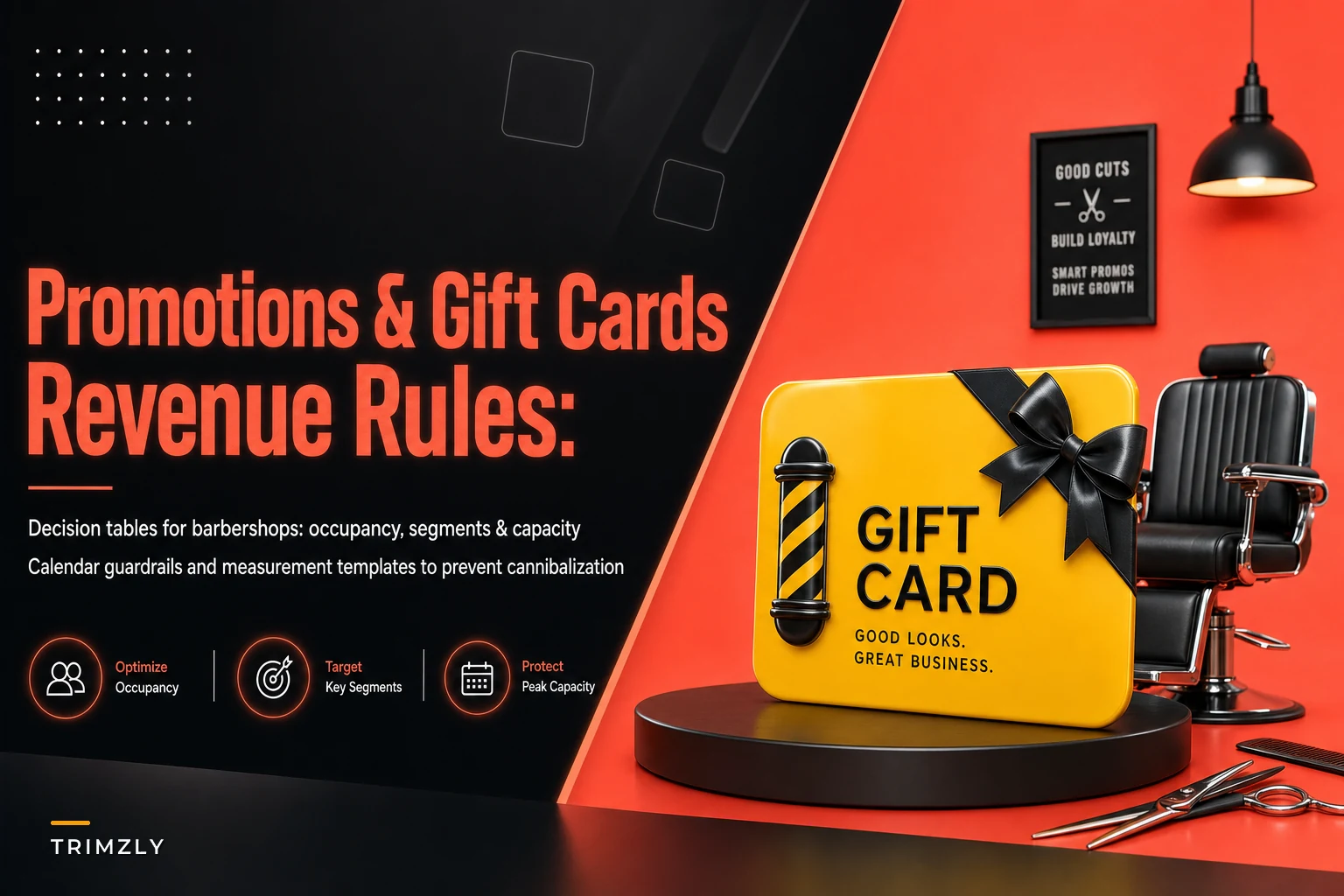
The real problem isn't running promotions – it's running them without guardrails. A solid barbershop gift card and promotions playbook changes everything. Instead of reactive discounting that eats into your bread-and-butter revenue, you build a system that targets the right customers at the right times with the right offers.
The promotion decision table that prevents self-cannibalization
Every promotion decision starts with three factors: current occupancy, available capacity, and customer segment. Get any of these wrong and you're just shuffling revenue around instead of creating it.
Think about occupancy first. If Tuesday afternoons sit at 30% capacity while Saturdays hit 95%, that's not a discount opportunity – that's a value-add opportunity. Discounting Tuesday means your Saturday regulars will just shift their appointments to save money. Instead, you add value to those slower slots. Maybe it's a complimentary beard trim with every cut, priority booking for the next appointment, or honestly even just better music and fresh coffee during those quieter hours.
Here's the decision framework that actually works:
Low occupancy (under 40%):
-
Never discount for existing customers
-
Target only new customers or those inactive 90+ days
-
Add service value instead of cutting price
-
Focus on convenience messaging, not savings
Medium occupancy (40-70%):
-
Light incentives for specific segments only
-
Example
$5 off for customers who haven't booked in 60 days
-
Bundle add-ons at slight discount (cut + beard for $5 less than separate)
-
Test time-limited flash promos (next 48 hours only)
High occupancy (70%+):
-
Zero discounts, period
-
Premium pricing for last-minute bookings
-
Value-adds for pre-booking next appointment
-
Gift card sales at full value only
The customer segment piece matters just as much. New customers get different offers than regulars. Someone who hasn't visited in 90 days gets different messaging than your weekly client. Without this segmentation, you're spraying discounts and hoping something sticks.
Calendar-based guardrails that protect your peak revenue
Your promotion calendar needs hard rules, not suggestions. These guardrails are what prevent the panic discounting that quietly destroys margins.
Never miss a booking amidst the hustle.
Trimzly helps you schedule, confirm, and manage every client visit seamlessly.
- Unified appointment management
- Automated client reminders
- Optimized staff scheduling
No credit card required
January through March tends to be slower across most shops. Hair grows regardless of season, but people stretch appointments after holiday spending. This is value-add territory, not discount territory. Run "New Year, New Look" packages that bundle services at full price. Add complimentary neck shaves to standard cuts. Create loyalty punch cards that reward frequency without touching price.
April through June picks up as people prep for graduations, weddings, and summer events. Now you're protecting revenue, not chasing it. Any promotions during this stretch should target only new customer acquisition or win-back campaigns for clients gone 90+ days. Your regulars pay full price.
July and August vary wildly by location. Business districts empty out for vacations while residential areas might boom with kids getting back-to-school cuts. Track your specific patterns for at least a couple years before making seasonal promotion decisions. Most shops mess this up by following generic retail calendars instead of their actual booking data.
September through December is protection mode. Back-to-school, holidays, end-of-year events drive natural demand. The only promotions worth running are gift card sales and premium service packages at premium prices.
The worst timing mistake? Running deals right before naturally busy periods. A shop I analyzed was running 20% off promotions the week before every major holiday, essentially training customers to hold off until the discount landed. They were paying people to book during times they'd have booked anyway.
Gift card rules that generate new revenue (not just shift existing spend)
Gift cards seem like free money until you realize most get redeemed by existing customers who would've paid full price anyway. Without rules, gift cards quietly become accidental discounts.
First rule: Never discount gift cards more than 10%, and only during specific windows. That "buy $100 get $120" promotion sounds generous until every regular customer stocks up and you've handed away 20% margins for the next several months.
Better approach – tier your gift card bonuses by amount and add restrictions:
-
$50 card = no bonus
-
$100 card = $10 bonus, expires in 60 days
-
$200 card = $25 bonus, expires in 90 days, bonus only valid Monday–Thursday
Second rule: Track gift card redemption by customer type. New customers redeeming gift cards are gold. Existing customers redeeming them might be revenue cannibalization. Your POS should tell you this, but most shops never bother to check.
Pilot digital cards for self-purchase with small bonuses that require immediate booking to separate gift-givers from deal-seekers.
The smartest gift card program I've come across worked like this: physical cards sold at full value, marketed as gifts only. Digital cards for self-purchase included small bonuses but required immediate booking. It separated gift-givers (new revenue) from deal-seekers (shifted revenue). Simple but effective.
Third rule: Gift cards expire. Not the base value – that's likely illegal in your state – but any bonus value absolutely expires. Three months max. This creates urgency and stops customers from sitting on discounted services indefinitely.
Some shops worry about the accounting complexity. Modern operational software handles this automatically – tracking liabilities, redemption rates, breakage, and automating expiration reminders. No more spreadsheet nightmares or surprise liability bombs at year-end.
The post-promotion measurement template most shops skip
Running promotions without measuring actual impact is like cutting hair in the dark. Redemption rates alone tell you almost nothing useful.
Start with baseline metrics for the 90 days before any promotion:
-
Average weekly revenue by day
-
Average ticket by service type
-
Customer visit frequency
-
New vs. returning customer ratio
During the promotion, track:
-
Total redemptions by customer type (new/existing/returning)
-
Services booked with promotion vs. typical service mix
-
Day and time distribution of promotional bookings
-
Full-price bookings during the same period
The critical measurement comes 90 days after the promotion ends. Did those promotional customers come back at full price? Did your regulars' booking patterns shift? Did average ticket recover or stay depressed?
Here's what a proper measurement template looks like:
| Metric | Pre-Promo Baseline | During Promo | 30 Days Post | 90 Days Post |
|---|---|---|---|---|
| Avg Tuesday Revenue | $420 | $580 | $465 | $445 |
| Tuesday Occupancy | 30% | 65% | 38% | 35% |
| Avg Ticket (Tues) | $35 | $28 | $33 | $34 |
| % New Customers | 15% | 40% | 22% | 18% |
| Saturday Revenue | $1,850 | $1,720 | $1,810 | $1,835 |
This shop's Tuesday promotion looked like a win during the campaign – revenue up 38% – but the full picture told a different story. Saturday revenue dropped as regulars shifted to discounted Tuesday slots, and Tuesday only held a 5% occupancy bump after the deal ended. Total weekly revenue actually declined.
The measurement that matters most: customer lifetime value by acquisition source. Customers who first come in through heavy discounts rarely convert to full-price regulars. Track every promotional customer for six months. If they don't book at least three full-price services, that promotion failed regardless of how busy it looked.
Value-add strategies that beat discounts every time
Smart shops stopped competing on price years ago. They compete on value, convenience, and experience. These strategies fill chairs without training customers to wait for the next deal.
The express service menu works well for slow periods. Instead of discounting a full haircut, offer a 15-minute "clean-up" service at a lower price point. This isn't a discount – it's a different service entirely. Customers who need a quick neck trim between full cuts book these slots. You're creating new revenue, not cannibalizing existing cuts.
Your service menu design directly impacts how well promotions land. When services are clearly differentiated, you can promote specific offerings without devaluing everything else.
Another approach worth trying: convenience promotions. "Skip the Wait Wednesday" where booking specific slow slots guarantees zero wait time. Or "Next Appointment Priority" where Tuesday afternoon bookings get first pick of prime Saturday slots for their next cut. You're selling convenience, not discounting the service itself.
Memberships deserve serious consideration if you have consistent regulars. $30–40 monthly for one cut plus perks like priority booking, free beard trims, or product discounts. This locks in revenue, smooths cash flow, and takes the discount conversation off the table entirely. One shop I know switched from random promotions to a membership model and saw revenue climb around 20% without adding a single new customer – just better monetization of the people already coming in.
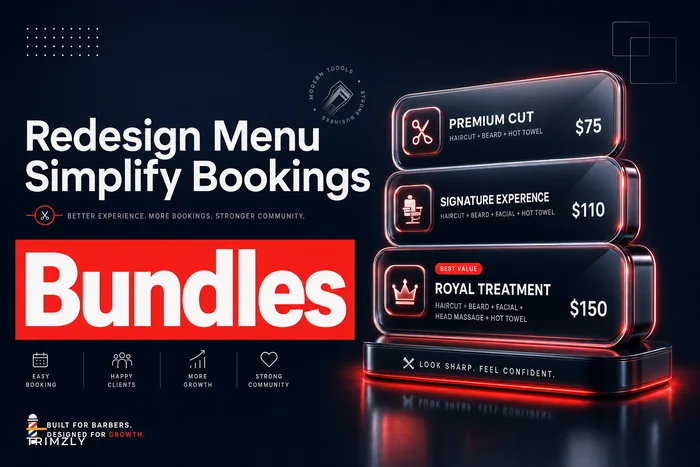
Service bundling works too. Instead of "$5 off any service," build packages that make sense together. "The Executive" combines cut, beard trim, and hot towel for $5 less than booking each separately. Customers feel like they're getting a deal, but you're actually increasing average ticket and improving time efficiency.
Building automation that manages promotions without the chaos
The complexity of running smart promotions overwhelms most shops. Tracking segments, managing calendars, measuring impact – it genuinely is a lot to stay on top of. This is where operational software earns its keep.
Modern platforms can automate the whole promotion workflow. Set your occupancy thresholds, define customer segments, build your calendar guardrails. When Tuesday afternoon occupancy drops below 40%, the system automatically triggers value-add messaging to specific segments. When someone hasn't visited in 90 days, a win-back offer goes out. When gift card bonuses near expiration, customers get a nudge.
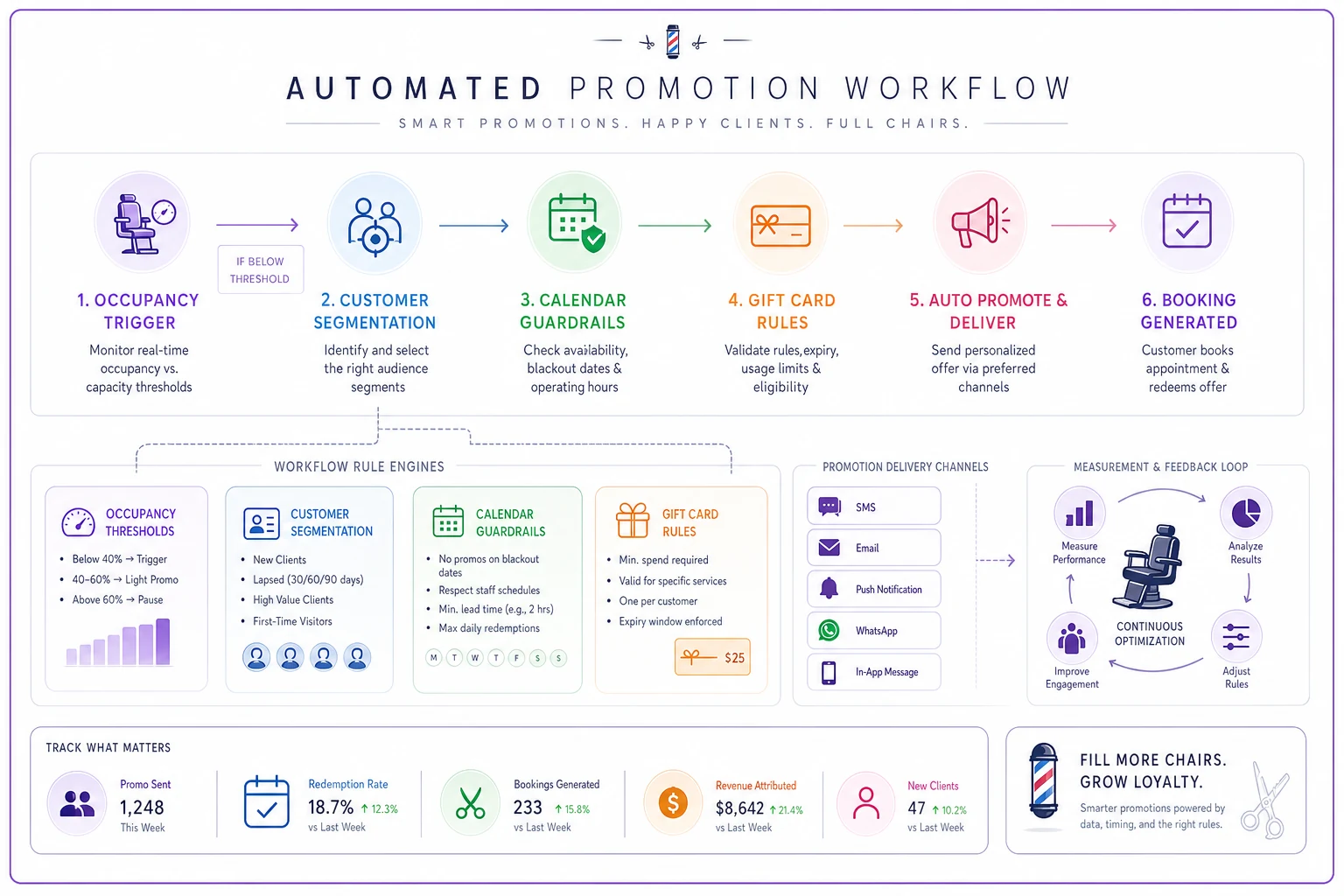
This illustrates the automated workflow from triggers to targeted messaging and measurement.
Your waitlist system can tie into this too. Last-minute cancellations trigger flash promos to waitlisted customers only – filling chairs without broad discounting.
The measurement piece becomes automatic as well. Every promotion gets tracked from launch through 90-day post-analysis. You see exactly which campaigns generated new revenue and which just cannibalized existing bookings. Over time the system builds a clearer picture of what actually works for your shop specifically.
More importantly, automation stops the panic discounting cycle. When you have a system running proven campaigns based on real data, you stop making emotional decisions during a slow week. The Tuesday slump doesn't trigger a desperate Facebook post offering 30% off. It triggers a measured, targeted response that you already know works.
Creating your 90-day promotion transformation plan
Getting from reactive discounting to strategic promotions takes roughly three months if you're focused about it.
Days 1–30: Baseline and setup
-
Pull 6 months of booking data
-
Calculate true occupancy by day and time
-
Identify your customer segments
-
Document current promotion history and results
-
Define your no-discount zones (peak times and seasons)
Days 31–60: Test and refine
-
Run one value-add test for your slowest period
-
Launch one new customer acquisition promo
-
Test gift card rules with a small rollout
-
Track everything manually if you have to
-
Adjust based on weekly results
Days 61–90: Systematize and scale
-
Codify what worked into a playbook
-
Set up automation for proven campaigns
-
Train your team on the new promotion rules
-
Build measurement dashboards
-
Plan next quarter's promotion calendar
Most shops see margin improvement within the first 30 days just from stopping panic discounting. By day 90, you've got a system that drives real growth without sacrificing profitability.
Why most barbershop promotions fail (and yours won't)
The shop down the street will keep posting "20% off Tuesday" on Instagram, wondering why they're busier but somehow not making more money. They'll keep selling discounted gift cards to regulars who stock up and pay less for months. They'll keep running the same tired promotions because that's just what barbershops do.
Your shop runs differently now. Every promotion has a purpose, a target, and a measurement plan. You know when to discount (rarely), when to add value (often), and when to hold the line on pricing (peak times). Your gift cards generate new revenue instead of subsidizing existing customers. Your slower periods fill through strategic campaigns, not desperation.
A proper barbershop gift card and promotions playbook isn't about running more promotions – it's about running fewer, smarter ones. Shops that figure this out stop competing on price and start building something sustainable. They fill chairs without gutting margins. They bring in new customers without training existing ones to hold out for deals.
The shops that don't figure this out stay busy and broke. The ones that do build something that actually compounds over time.
Ready to elevate your barbershop operations?
Join 500+ barbershops using Trimzly to save time, reduce scheduling conflicts, and enhance client satisfaction.