

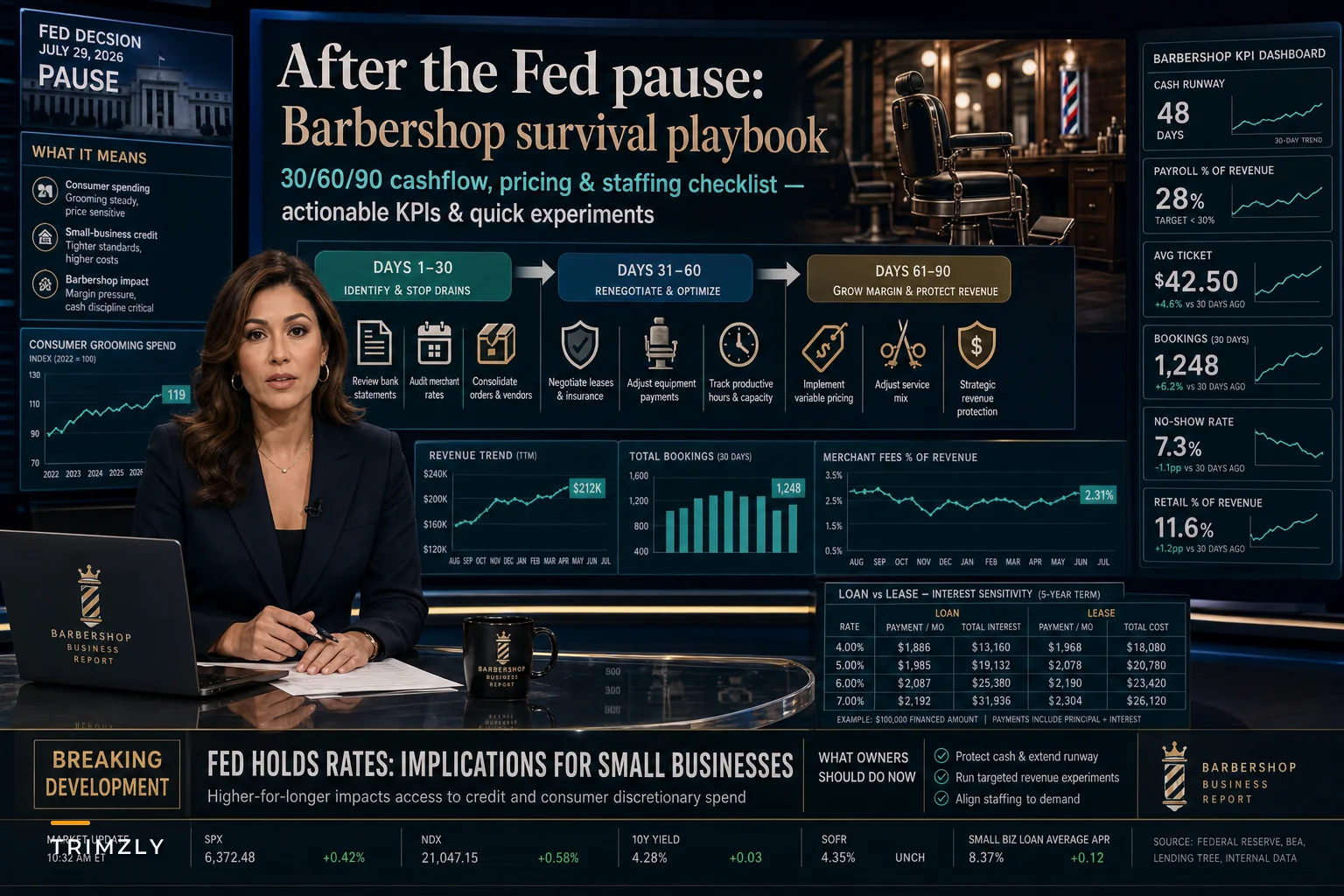
The Fed held rates steady at 3.50%-3.75% yesterday, but three members wanted to hike. That split vote tells you a lot about where the rest of 2026 is headed. Equipment lease costs stay elevated, your clients' wallets stay squeezed, and that expansion you've been planning just got riskier.
I pulled the FOMC statement from July 29 expecting some clarity. Instead, more uncertainty. For barbershops running on 8-12% margins, this halfway position creates a specific problem—you can't make aggressive moves, but standing still means bleeding cashflow slowly.
The real damage happens in the details most shop owners miss. The barbershop cashflow interest rates relationship isn't just about your equipment loan or line of credit. It's about how your average Tuesday looks different when clients stretch their cut cycles from 3 weeks to 4. It's your top barber asking for a raise because their rent went up again. It's whether you can keep that apprentice on when walk-ins drop 15%.
Why barbershops get squeezed differently than other retail
Barbershops face a squeeze most financial advisors don't fully understand. Revenue per square foot runs around $180-240 annually, compared to $300-500 for general retail. But labor costs eat 45-60% of revenue versus 25-35% for retail. Elevated interest rates compress margins from both ends—your operational costs go up and your clients' spending patterns shift simultaneously.
The structural problem goes deeper too. When a clothing store sees demand drop, they reduce inventory orders and cut hours. When your books thin out, you still need walk-in coverage, you still pay chair rental minimums, and cutting your best barber's hours risks losing them to the shop down the street offering guaranteed weekly minimums.
Most shops run cashflow weekly—payroll hits Friday, product orders Monday, rent on the 1st. Rate uncertainty creates rolling pressure points on top of that. Your wholesale supplier tightens terms from net-30 to net-15 because their credit line got more expensive. The POS system you lease bumps your monthly payment by $47 because the lease factor changed. Small hits, but they compound over time.
CNBC's coverage of the Fed decision highlighted how the 9-3 vote split signals potential movement either direction by year-end. For a barbershop, that means defensive positioning now, not reactive scrambling in October.
Build a 30/60/90 day defensive cashflow position
First 30 days: Stop the bleeding The immediate priority is understanding exactly where cash exits your business. Not the obvious stuff like rent and payroll—the hidden drains. Pull your last 90 days of bank statements and credit card statements. Map every recurring charge. You'll almost certainly find $200-400 monthly in forgotten subscriptions, duplicate services, or auto-renewals nobody uses anymore. Check your merchant processing effective rate. Not the teaser rate they quoted you—what you actually pay after all fees. If it's above 2.9% for card-present transactions, you're overpaying. Switching processors feels like a hassle, but saving 0.4% on $28,000 monthly card volume puts roughly $1,300 annually back in your pocket. Review your product ordering patterns too. Most shops order weekly out of habit, paying shipping each time. Consolidating to bi-weekly orders often hits free shipping thresholds and shortens your cash conversion cycle. A shop doing $1,800 monthly in retail sales can improve cashflow timing by 8-10 days just through order consolidation.
Never miss a booking amidst the hustle.
Trimzly helps you schedule, confirm, and manage every client visit seamlessly.
- Unified appointment management
- Automated client reminders
- Optimized staff scheduling
No credit card required
Consolidating to bi-weekly orders often hits free shipping thresholds and shortens your cash conversion cycle.
Days 31-60: Restructure without disruption Now tackle the structural stuff. Your lease, insurance, and equipment payments probably haven't been reviewed since rates were near zero. Call your insurance broker—not to switch, but to adjust coverage levels. Dropping from replacement cost to actual cash value on older equipment, or raising deductibles from $500 to $1,000, typically saves 15-20% on premiums. For equipment leases signed pre-2024, you might be paying 8-11% implicit rates. Current rates make buyout and refinancing less attractive, but negotiating payment deferrals or extensions is worth a conversation. Pushing two payments to the end of a lease term can free up $600-900 in immediate cashflow. Staff scheduling needs surgical precision right now. Instead of cutting hours outright—which triggers turnover—implement "productive hour" tracking. If Tommy averages $67/hour on Tuesdays but $95/hour on Saturdays, you don't cut Tuesday. You find ways to boost Tuesday productivity through targeted marketing or service adjustments.
Here's a quick visual of the 30/60/90 cashflow defense workflow.
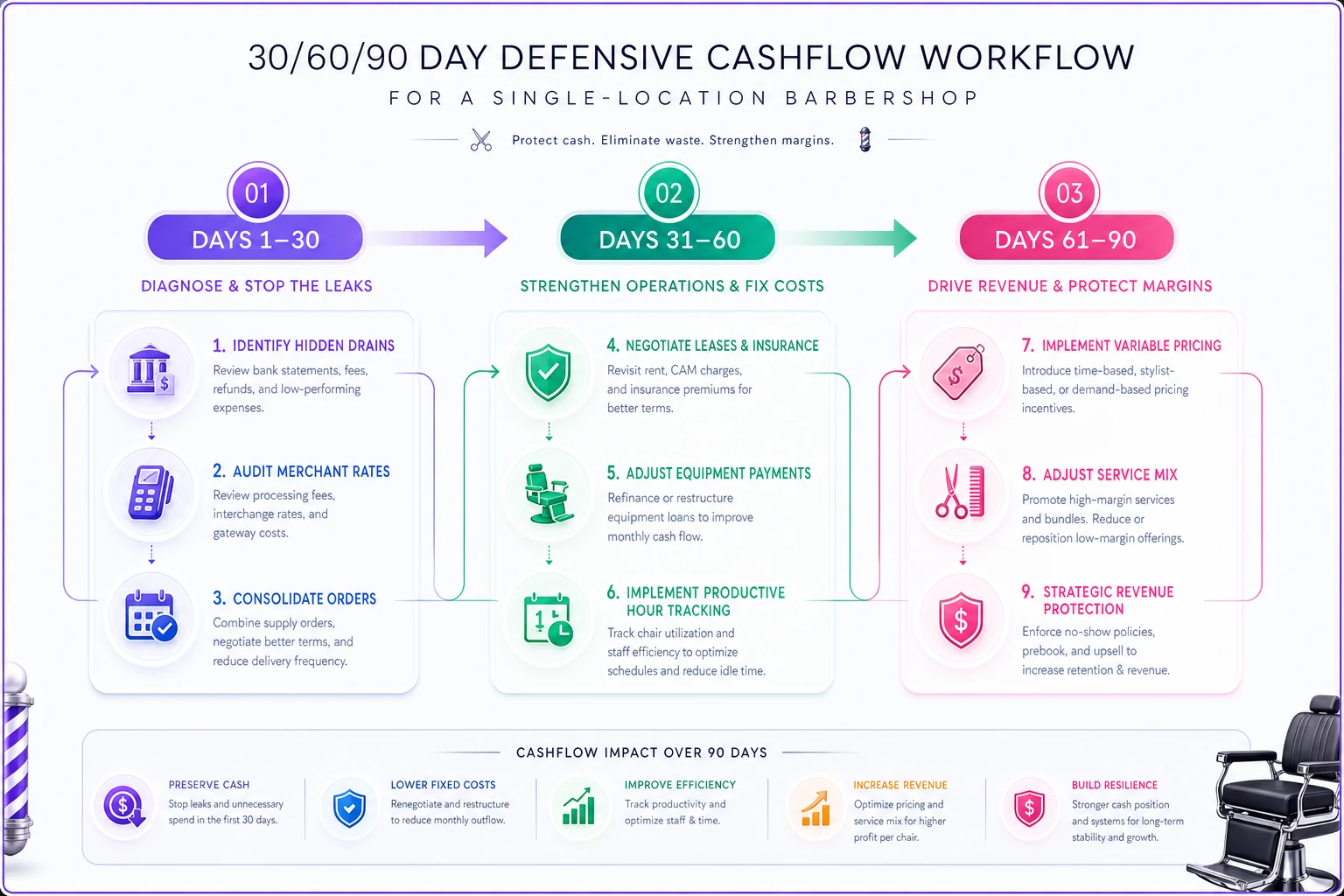
Days 61-90: Strategic revenue protection This phase focuses on revenue optimization without appearing desperate to clients. Implement variable pricing quietly—not surge pricing, but structural incentives. Tuesday-Thursday appointments get a $3 booking discount. Pre-books for next appointment save $2. Cash payments avoid the card processing fee. Small moves that add up to real margin improvement over a quarter. Think carefully about your service mix too. A fade that takes 35 minutes at $35 yields $60/hour. A full cut, beard trim, and hot towel at $65 takes 55 minutes—that's $71/hour. But once you factor in product costs, cleanup time, and tool wear, the simple fade often generates better margins. Adjust booking priorities accordingly.
Staffing adjustments that protect culture
The wrong move here destroys your shop. You can't cut your way to profitability when your entire business depends on skilled professionals who can walk across the street tomorrow.
Use performance-based scheduling instead of blanket changes. Your appointment data tells the real story. Track each barber's metrics: average ticket, rebook rate, product sales per client, no-show percentage. The barber averaging $47 per ticket with 70% rebooking earns premium scheduling. The one at $34 per ticket with 40% rebooking gets opportunity shifts to improve or transition out naturally.
A "swing barber" role is underrated—someone who covers gaps, handles walk-ins, and fills sudden openings. Working 25-30 hours weekly with variable scheduling, it costs less than full coverage but prevents lost revenue from unexpected gaps. Usually works well with a talented apprentice ready for more responsibility or a semi-retired barber wanting flexibility.
Establish minimum productivity standards without framing them that way. If a barber consistently generates less than $300 daily in services, have a development conversation. Sometimes it's scheduling, sometimes service speed, sometimes personality fit. But setting clear performance expectations now prevents painful decisions later.
Pricing adjustments that don't trigger client exodus
Barbershops face a real pricing paradox. Raise prices 10% and lose 15% of clients—net negative. But strategic pricing changes can improve margins without mass departures.
Start with service unbundling. That $45 haircut includes the cut, shampoo, and neck shave. Break it out: haircut $38, shampoo $5, neck shave $4. Most clients still get everything, paying $47 total. Price-sensitive clients skip extras and pay $38 instead of going elsewhere. You retain the client at lower margin versus losing them entirely.
| Service Bundle | Old Price | New Structure | Client Options |
|---|---|---|---|
| Full Service | $45 flat | $38 base + add-ons | $38-47 range |
| Beard & Cut | $65 flat | $38 cut + $22 beard + $5 shampoo | $60-65 range |
| Kids Cut | $25 flat | $22 base + $3 style | $22-25 range |
Convenience fees can work if they make sense to clients. Online booking adds $2. Same-day booking adds $3. Saturday appointments add $2. Pair that with a "member" program that waives all fees for $8 monthly. Most regulars join to avoid the fees, which gives you predictable recurring revenue.
Time-based pricing works if positioned correctly. Instead of "peak pricing," offer "early bird discounts." Same economic effect, different psychological impact. Tuesday 10am-2pm appointments get $5 off. Wednesday seniors get 15% off. Thursday students save $3. You're guiding demand without appearing greedy.
Product sales and retail reality check
Every barbershop consultant pushes retail hard, but the math often doesn't work how they claim. Yes, 40-50% margins look attractive. Factor in inventory carrying costs at current rates, dead stock, and staff time spent selling, and actual returns shrink fast.
The operational reality: successful barbershop retail requires around $3,000 minimum inventory to offer meaningful selection. At current rates, financing that costs roughly $140 annually. Add 10-15% shrinkage from damage, theft, and expiration, and you need $7,500 in annual retail sales just to break even on the investment.
Most single-location shops do better with curated, fast-turning inventory. Five products that move weekly beat fifty products that sit for months. Focus on consumables clients already buy elsewhere: edge control, beard oil, wave cream. Skip the elaborate grooming kits and designer colognes unless you're in a genuinely affluent market.
Barbers won't push products without meaningful incentive. Standard 10% commission barely motivates anyone. Try product bonuses instead—sell $100 in products weekly, earn a $20 bonus. Sell $200, earn $50. The progressive structure creates real earning opportunity without complicated tracking.
One thing that actually works in practice: the "maintenance kit" after specific services. Client gets a fade with line-up? They need edge control and a durag. Fresh beard shape? They need beard oil and a brush. Pre-packaged kits at a slight discount move faster than individual items and reduce decision fatigue at checkout.
Credit and financing decisions
With rates elevated and lending standards tightening, barbershop financing options look different than they did two or three years ago. Equipment leases at 11-14% APR make no sense unless the equipment directly generates proportional revenue increases.
The hidden credit drain is merchant cash advances. Shops struggling with cashflow take these "easy" advances at effective rates of 25-50% annually. You're better off negotiating payment plans with suppliers, even at penalty rates, than touching merchant cash advances in this environment.
If you need credit access, establish it before desperation hits. A $10,000 business line of credit at 9% costs $900 annually if fully utilized. Having it available but unused costs nothing and provides real emergency cushion. The application process takes a few weeks when you're stable—versus getting declined when you're not.
Equipment financing requires new math now. That $4,000 new chair financed at 12% over 36 months runs about $133 monthly. Can you generate $133 in additional monthly margin from that chair? If the answer isn't clearly yes, buy used at $1,500 cash or keep the current chair running another year.
Building operations that self-adjust
The strongest defense against barbershop cashflow interest rates pressure isn't reactive cost-cutting—it's operations that automatically adjust to conditions. Systematic responses instead of panicked decisions.
Create trigger-based protocols. When weekly revenue drops below $6,500 for two consecutive weeks, specific actions kick in automatically: reduce product orders by 20%, shift one barber to on-call status, pause discretionary spending. When revenue exceeds $8,000 for three weeks, reverse those measures. The automatic nature removes emotion and prevents both overreaction and delayed response.
Build buffer zones into your scheduling. Instead of scheduling for exact coverage, maintain roughly 15% excess capacity during peak times. This seems wasteful until you realize it prevents losing walk-ins, reduces wait frustration, and gives flexibility when someone calls out sick. The lost efficiency costs less than the revenue lost from poor client experiences.
Run rolling financial reviews weekly, not monthly. Week 1: labor costs versus revenue. Week 2: product costs and retail performance. Week 3: marketing spend and appointment sources. Week 4: overhead and fixed costs. This rotation keeps you informed without drowning in data every Sunday night. Connecting these operational adjustments to actual data matters a lot here. Modern barbershop management software tracks these metrics automatically and flags variances before they become real problems—reducing the manual monitoring work while improving how quickly you can respond to changing conditions.
Who needs aggressive moves versus wait-and-see
Aggressive action makes sense if:
-
Your cashflow covers less than 45 days of operating expenses. Start with the 30-day bleeding control measures immediately.
-
You're carrying any debt above 15% APR. Every day at these rates destroys margin. Prioritize eliminating this through revenue optimization and cost reduction, even if it means short-term discomfort.
-
Chair utilization runs below 60% during peak hours. Empty chairs on Friday evenings or Saturday mornings signal fundamental demand problems that rate pressure will only amplify.
Wait-and-see works better if: You're maintaining 10%+ margins with steady bookings. Your operation is efficient enough to weather moderate turbulence. Focus on optimization rather than dramatic changes.
Your clients show loyalty through 65%+ rebooking rates. Strong client relationships provide real buffer against economic pressure. Protect those relationships rather than risking them with aggressive changes.
You have 90+ days of operating expenses in reserve. That cushion lets you respond strategically. Use this period to test small adjustments rather than major overhauls.
Make moves now, not in October
The Fed's split decision signals continued uncertainty through year-end. Waiting for clarity means reacting alongside everyone else—when credit tightens further, when nervous clients cut back more, when suppliers demand faster payment.
The barbershop cashflow interest rates squeeze is already underway. Clients stretch appointment intervals. Suppliers tighten terms. Your best barbers get recruited by corporate chains promising stability. These pressures compound whether rates rise, hold, or eventually drop. The shops that come out ahead position themselves now—not through dramatic slash-and-burn tactics, but through systematic improvements that build resilience. That means knowing your true numbers, not the rough math in your head. It means having contingency plans before you need them. It means treating operations as a system that needs constant refinement, not something you set up once and leave alone.
The next 90 days determine whether you're playing defense through all of 2027 or building from a position of strength. Make the moves that fit your specific situation, track results carefully, and adjust based on what actually happens in your shop—not what economists predict might happen in the broader economy.
Ready to elevate your barbershop operations?
Join 500+ barbershops using Trimzly to save time, reduce scheduling conflicts, and enhance client satisfaction.