

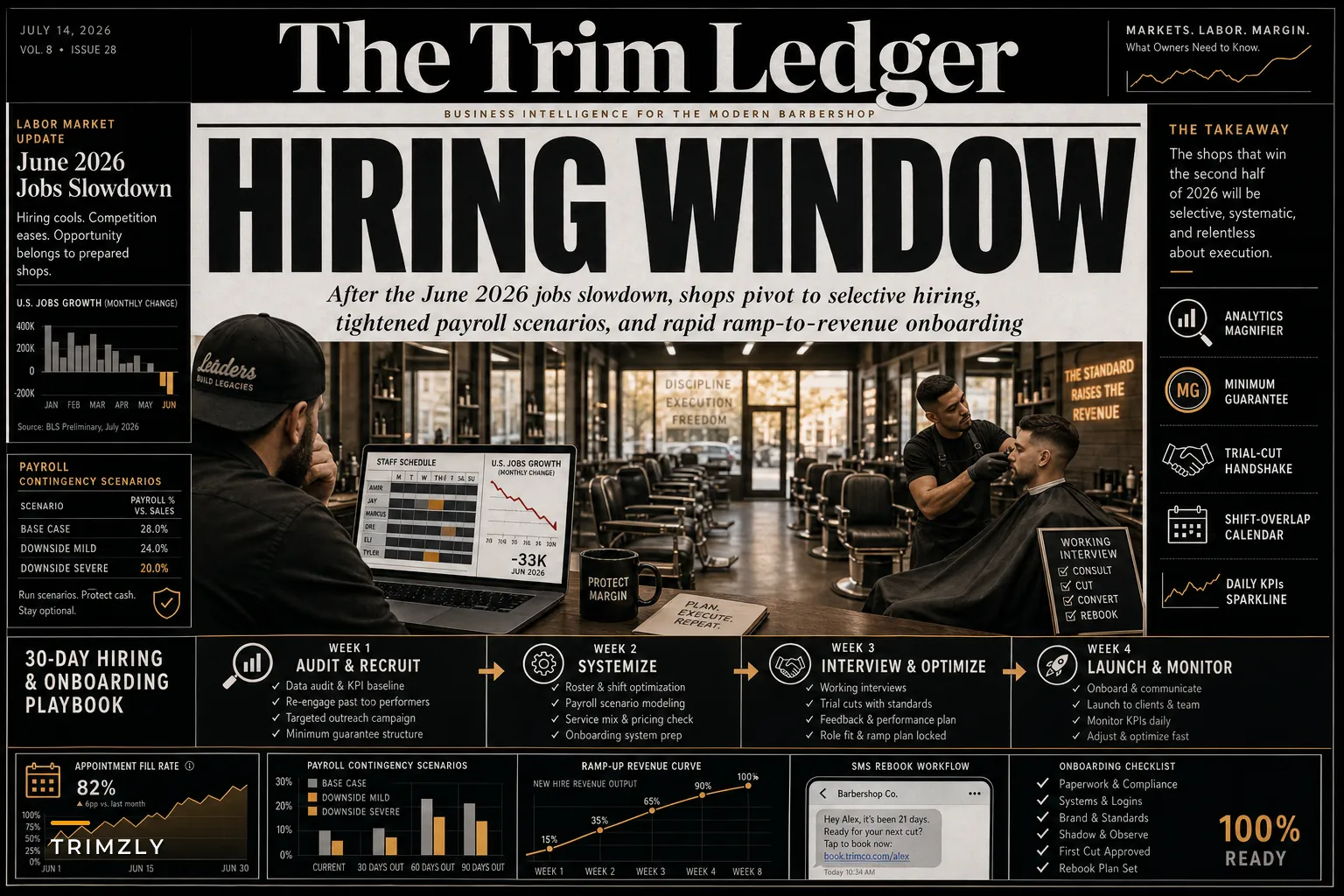

The June jobs report landed like a cold splash of water. According to CNBC, nonfarm payrolls rose by just 57,000—way below expectations—and leisure & hospitality shed 61,000 jobs. For barbershop owners who've been struggling to find decent barbers for the past two years, this creates a narrow window. Most shops won't capitalize on it, though. They'll keep posting the same tired Indeed ads, offering the same commission splits, and wondering why nothing changes. Meanwhile, smarter operators will use this moment to lock in talent, restructure scheduling, and tighten payroll before consumer spending potentially softens.
The hiring window opens (but it's smaller than you think)
When hospitality loses 61,000 jobs in a month, experienced service professionals start looking around. That bartender who's been cutting on the side? Suddenly interested in your chair rental. The cosmetology grad who couldn't find salon work? Reconsidering barbering.
This isn't 2020 desperation. These candidates have options—they're just more open to conversations than they were six months ago. A hiring strategy that worked when everyone was fully employed needs adjusting. You're not competing against their current job anymore; you're competing against other shops who also smell opportunity.
Shops moving in the next 30 days are landing barbers they couldn't touch in March. The ones waiting until August will be fighting over scraps.
The math is simple. If your shop runs six chairs and you've been down one barber since April, that empty chair costs somewhere around $2,800–3,400 monthly in lost revenue. Landing the right person now, even if you pay slightly more upfront through training or guarantee minimums, pays for itself fast.
Rethinking your talent pitch when barbers have choices
The traditional barbershop pitch—"60/40 split, bring your own clippers, see you Monday"—stops working when skilled barbers know the market's shifting. They're evaluating stability, not just percentages.
Never miss a booking amidst the hustle.
Trimzly helps you schedule, confirm, and manage every client visit seamlessly.
- Unified appointment management
- Automated client reminders
- Optimized staff scheduling
No credit card required
A shop owner told me last week he lost two recruiting battles despite offering better splits than his competitors. The winning shops offered guaranteed weekly minimums for the first 60 days and structured onboarding. Barbers are thinking about downside risk differently when Reuters reports labor force participation dropping.
Your recruiting conversation needs to address three concerns they won't say out loud:
Will I actually make money here? Don't just quote splits. Show them real barber earnings from the last quarter. If Carlos made $4,200 in May and Marcus made $3,800, those numbers land differently than "up to $6k possible."
What happens if walk-ins dry up? This is where guaranteed minimums or hybrid arrangements matter. Maybe you guarantee $600 weekly for the first month if they commit to specific shifts. Or salary plus commission after 90 days. The exact structure matters less than showing you've actually thought about their downside.
Can I build a book here? Top barbers care more about client development than chair rental rates. Show them your rebooking rates, your marketing spend, how your online booking works. A shop hitting 70% rebookings beats one offering 5% better splits.
The roster puzzle: optimizing schedules when demand patterns shift
Here's what typically breaks first: you finally land an experienced barber, they start strong, then three weeks later they're sitting empty during your Tuesday 2pm "rush" while Saturday mornings have forty-minute waits. Scheduling mismatch kills their earnings, frustrates clients, and creates tension with the rest of the team.
Most shops run the same schedule they've had for years. When you're bringing in new talent during uncertain economic conditions, rigid scheduling becomes a liability.
Start with demand-based scheduling, not seniority. Pull your actual appointment data from the last 90 days and map out when chairs are full versus empty. Plenty of shops discover their assumed "busy times" are off by a couple hours. That traditional Saturday morning rush might actually be Friday evening now.
Match new hires to actual demand gaps, not theoretical ones. Don't stick a strong barber with all the dead shifts just because they're new. Give them at least two peak periods weekly to build momentum. The faster they build their book, the more likely they stick around.
Consider brief schedule overlaps during transition weeks instead of hard handoffs. The morning barber can introduce regulars to the afternoon person. Small thing, but it reduces client friction when you're restructuring.
Payroll protection without paranoia
The jobs report signals potential softening ahead. You need talent now, but you can't overextend if demand drops in September. This tension paralyzes most owners—they either hire nobody or hire too aggressively.
Build in circuit breakers. Structure new hire agreements with clear performance gates at 30, 60, and 90 days. Not "you're fired" thresholds—adjustment points. Maybe the guaranteed minimum drops after 30 days if they're not hitting 15 cuts weekly. Or commission rates graduate up as they build their book.
Track per-chair revenue weekly, not monthly. If you normally generate $3,200 per chair monthly and a new hire is tracking toward $1,800 after two weeks, you need to know now, not at month-end. Even a basic spreadsheet showing daily cuts, average ticket, and retail sales by chair is enough.
Track per‑chair revenue weekly and set clear short-term gates so small issues are visible early.
Keep your break-even clear. Most shops need roughly $2,400–2,800 per chair monthly to cover base costs. If demand softens and you drop below that for two consecutive weeks, have predetermined responses ready—reduce hours, adjust marketing spend, restructure agreements. Deciding this in advance, when you're calm, beats deciding in panic mode.
The rebooking rate reality check
When economic uncertainty hits, clients stretch appointments. The four-week cut becomes five weeks. The every-other-week fade goes monthly. You can't control macro conditions, but you can control how aggressively you pursue rebookings.
New barbers typically hit 30–40% rebooking rates their first month. That's leaving real money on the table, especially when you need revenue predictability. The fix isn't motivational—it's systematic.
Create a rebooking SOP that new hires follow from day one. Not suggested—required. The barber mentions the next appointment during the cut, not after. They pull up the calendar while the client's still in the chair. They offer two specific times, not "when do you want to come back?"
Post rebooking rates where everyone can see them. Not to shame anyone—to create visibility. When Marcus sees Jennifer hitting 75% while he's at 35%, he asks what she's doing differently. That peer learning beats any formal training.
Incentivize the behavior you need. Add $2 per rebooking, paid weekly. Sounds small, but a barber doing 80 cuts monthly picks up an extra $120 if they hit 75%. During uncertain periods, small nudges toward revenue consistency matter more than they usually do.
Smart automation without losing the personal touch
This is where operational software earns its keep. Not the flashy AI stuff everyone's hyping right now, but straightforward automation that creates consistency when you're juggling new hires and shifting demand patterns.
Your rebooking process? Automate the follow-up if someone doesn't book in-chair. Three days later, text them with specific availability. Seven days, another touch. Two weeks, mention their usual barber has openings. Simple sequences that run without anyone thinking about them.
New hire onboarding? Digital checklists that track completion. When Jennifer starts Tuesday, automated messages cover parking, dress code, where to find supplies. The system tracks what's done and flags gaps. No more "nobody told me about the key code" situations a week in.
Performance tracking? Set up automated daily reports showing cuts per chair, average tickets, and no-show rates. Send them every evening at 7pm. When everyone sees the same numbers, conversations about performance stop being personal.
The data capture that actually matters is client preferences logged consistently. When your new barber can see that Mr. Thompson always wants a 2 on sides, 4 on top, and hates small talk, they deliver better service from visit one. That's how you protect revenue through staff changes—maintain service consistency through better information flow.
Most of this isn't complex to implement. A lot of it can be configured in an afternoon through existing booking software or basic operational platforms. The difference is actually doing it.
The 30-day action checklist
The job market shift creates opportunity, but windows close. Here's the immediate playbook:
Week 1: Audit and recruit
-
Pull your last 90 days of scheduling data
-
Identify actual peak and slow periods
-
Calculate true per-chair revenue needs
-
Post refreshed job ads with stability messaging
-
Reach out directly to five people at competitor shops
Week 2: Structure and systematize
-
Create your 30/60/90-day performance gates
-
Build guaranteed minimum agreements
-
Design demand-based schedule templates
-
Set up rebooking tracking
-
Draft new hire onboarding sequences
Week 3: Interview and optimize
-
Conduct working interviews during peak times
-
Show candidates actual earnings data
-
Test their rebooking approach in conversation
-
Check references specifically on reliability
-
Make offers with clear performance expectations
Week 4: Launch and monitor
-
Start new hires mid-week, not Monday
-
Overlap schedules for introduction periods
-
Track daily performance metrics
-
Run automated confirmation sequences
-
Adjust scheduling based on early data
| Week | Actions |
|---|---|
| Week 1 | Pull your last 90 days of scheduling data; Identify actual peak and slow periods; Calculate true per-chair revenue needs; Post refreshed job ads with stability messaging; Reach out directly to five people at competitor shops |
| Week 2 | Create your 30/60/90-day performance gates; Build guaranteed minimum agreements; Design demand-based schedule templates; Set up rebooking tracking; Draft new hire onboarding sequences |
| Week 3 | Conduct working interviews during peak times; Show candidates actual earnings data; Test their rebooking approach in conversation; Check references specifically on reliability; Make offers with clear performance expectations |
| Week 4 | Start new hires mid-week, not Monday; Overlap schedules for introduction periods; Track daily performance metrics; Run automated confirmation sequences; Adjust scheduling based on early data |
Use this visual as a quick roadmap for the month.
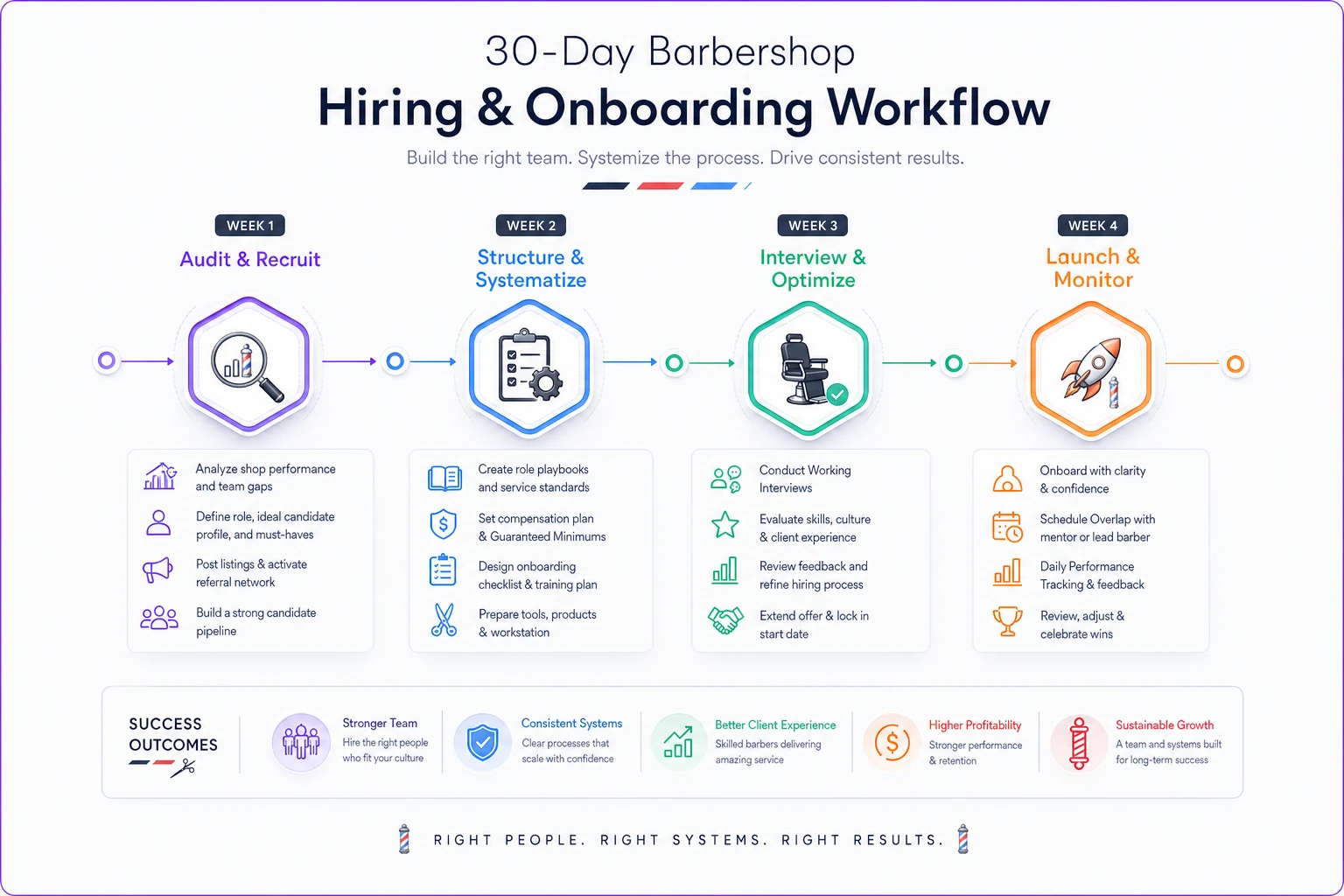
Move fast on these steps in the next 30 days.
Beyond the hire: protecting your shop's economics
Landing talent is step one. Keeping your economics stable while integrating new barbers—that's where shops actually stumble. We've covered common hiring and pay mistakes, but this moment requires extra attention.
Watch product costs. New barbers often use more product while finding their rhythm. A 20% increase across three new hires can eat $400 monthly. Set par levels and track weekly.
Monitor schedule efficiency. Empty chairs during peak times while barbers work slow periods kills profitability fast. Adjust weekly based on actual demand.
Keep marketing spend proportional. Don't slash advertising just because you filled chairs—you need consistent flow to support new hires building their books. But don't overspend chasing growth if consumer demand softens.
The coordination advantage
Shops running tight operations will do fine through this transition. Those winging it will struggle. The gap usually isn't talent or location—it's execution consistency.
Every shop that's come through a shifting market well shares a few traits. They track the right metrics daily, not monthly—per-chair revenue, rebooking rates, and no-show percentages are visible before problems compound. They adjust based on data, not gut feel—when Tuesday afternoons show 40% occupancy two weeks running, they restructure immediately. And they use systems to enforce consistency, whether that's operational software, detailed SOPs, or automated workflows. The system runs regardless of who's working that day.
The June report isn't catastrophic, but it's a signal worth paying attention to. Barbershops that use this moment to strengthen operations—better talent, smarter scheduling, tighter controls—will be in a better position come fall. The ones ignoring it and maintaining status quo might find September harder than expected.
Your empty chair is either an opportunity or a liability right now. The cooling labor market determines which, but only if you move before everyone else figures it out. Recruit aggressively, structure smartly, monitor consistently, and systematize what you can.
The next 30 days matter more than the next quarter. Move accordingly.
The next 30 days matter more than the next quarter. Move accordingly.
Ready to elevate your barbershop operations?
Join 500+ barbershops using Trimzly to save time, reduce scheduling conflicts, and enhance client satisfaction.