

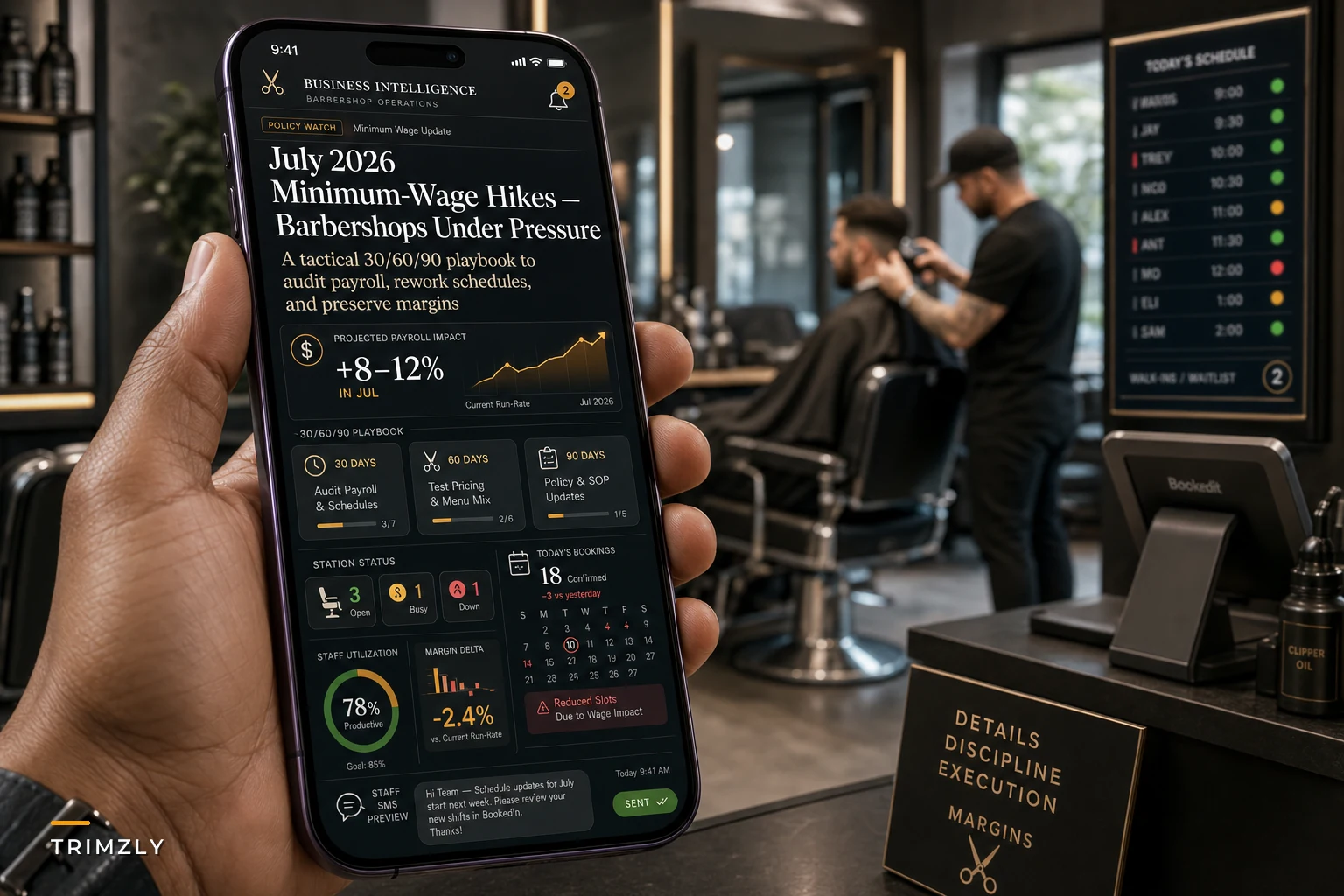

Come July 1st, barbershop owners across more than 20 states and cities are looking at the same problem: higher hourly rates for every assistant, apprentice, and hourly barber on payroll. According to Stateline's recent analysis, jurisdictions from California counties to Illinois cities are pushing wage floors up—some hitting $18 or even $20 per hour.
For a shop running four chairs with two hourly assistants, a bump from $15 to $17 per hour translates to roughly $8,300 more in annual payroll. And that's before the ripple effect—your experienced barbers making $19 will expect $21 to keep the gap meaningful.
The knee-jerk reaction I see too often: shops cut Saturday assistant hours or eliminate the third receptionist shift. Then they wonder why their busiest day turns into chaos, why bookings drop, and why barbers are doing their own cleanup between cuts.
The Real Cost Breakdown Most Shops Miss
When minimum wage July 2026 barbershop increases hit, most owners do quick math on direct labor and stop there. That's the mistake.
Payroll taxes jump proportionally—another 7.65% on top of the wage increase. Workers' comp premiums recalculate off your new payroll total. If any benefits scale with hourly wages, those go up too. That $2 raise actually costs $2.40 or more per hour worked.
Then there's wage compression. Your senior barbers who've been with you three years aren't staying happy when a new hire's base is suddenly $1.50 below theirs. You either bump everyone proportionally—multiplying the cost problem—or you deal with turnover, which costs even more.
The shops that handle these transitions without gutting operations understand one thing clearly: you can't cut your way to the same margin. The math doesn't work when your biggest expense category jumps 10-15%.
Why Traditional Barbershop Economics Break at Higher Wage Floors
Most barbershops run something close to a 60/30/10 split—60% to barber compensation, 30% to overhead, 10% owner profit. When minimum wage pushes support staff costs up, it doesn't just nick that 60%. It squeezes everything.
Never miss a booking amidst the hustle.
Trimzly helps you schedule, confirm, and manage every client visit seamlessly.
- Unified appointment management
- Automated client reminders
- Optimized staff scheduling
No credit card required
Take a four-chair shop grossing $45,000 monthly. Two assistants at $15/hour run about $5,200 monthly including taxes. At $17/hour, that's $5,900. The $700 difference comes straight off the bottom line unless something else adjusts.
Commission barbers are already taking 50-60% of service revenue. You can't cut their percentage without losing them. You can't meaningfully raise prices without pushing out regulars. So most owners try to "optimize" by trimming support staff hours.
Then barbers start handling non-cutting tasks. Average services per day drops from 8 to 6. That's around $120 less revenue per barber per day. Across four chairs, six days a week, that's $11,500 in monthly revenue loss—which far exceeds whatever you saved on labor.
Building Your 30-Day Emergency Response Plan
The shops that handle wage increases well start with triage, not transformation. The first 30 days are about understanding your actual numbers and making adjustments that don't break what's already working.
Document every hour worked by every employee for two full weeks. Not scheduled hours—actual hours. Track what they're doing during those hours. Most shops find 15-20% of time going to tasks that either duplicate effort or could easily be batched.
Document every hour worked by every employee for two full weeks.
A shop in Chicago found their morning assistant spent 45 minutes daily doing individual supply checks for each barber. Shifting to a single weekly audit with daily top-offs saved 3.5 hours per week without any service impact. At $17 per hour, that's about $60 back weekly.
Next, analyze appointment patterns by hour. Most shops have predictable slow stretches—usually 2-4pm on weekdays. Instead of full coverage, create float shifts where one person handles both reception and assistant duties during those windows.
On pricing: skip the across-the-board increase. Find your three highest-margin services and test a $2-3 bump on just those. Fades might stay at $35, but a beard trim add-on goes from $15 to $18. Clients barely notice selective increases on add-ons.
The 60-Day Operational Overhaul
Once the immediate bleeding stops, days 31-60 are about fixing the friction points that waste everyone's time. Not working harder—just eliminating the stuff that shouldn't be happening in the first place.
Track how long each client interaction actually takes, from walk-in to sitting in the chair. A typical shop loses 8-12 minutes per appointment to confusion around services, waiting for cuts to finish, and payment fumbling.
Service bundles simplify decisions. Instead of six different fade variations, try three packages: Classic Cut ($35), Signature Fade ($45), Premium Experience ($65 with hot towel and beard work). Clients decide faster, barbers know what to deliver, and average ticket naturally climbs.
Standardize station setup completely—every drawer, every tool, every product in the same spot across all chairs. When barbers can work any station without thinking about where things are, you kill the "I only work chair 2" bottleneck that wrecks Saturday efficiency.
| Traditional Setup | Standardized System | Time Saved |
|---|---|---|
| Barbers organize own stations | Universal layout across all chairs | 10 min/day per barber |
| Individual product preferences | Core products at every station | 5 min/day finding items |
| Personal tool storage | Shared high-quality tool sets | 15 min/week maintenance |
| Different booking methods per barber | Single system, all chairs | 20 min/day coordination |
The communication flow between chairs and reception also needs rework. Stop the constant back-and-forth about who's next, what they want, whether they're checked in. A simple visual system—green/yellow/red cards at each station for available, 5-minute warning, and cleaning in progress—cuts that noise significantly.
Your 90-Day Profitability Rebuild
Months two and three shift focus from efficiency to revenue growth. The shops that actually thrive after minimum wage July 2026 barbershop increases don't just protect margins—they expand them.
Start with your slowest days and dead hours. Tuesday at 2pm isn't becoming rush hour, but it's perfect for premium services that need more time. A simple "Executive Tuesday" setup—90-minute premium cuts with hot towel, beard sculpting, eyebrow cleanup for $95—only needs three bookings weekly to add over $1,100 in monthly revenue with zero extra staff.
Membership programs matter more at higher wage levels. A $99 monthly structure covering two cuts plus 10% off products creates predictable revenue and locks in visit frequency. Members who prepay show up consistently, which makes scheduling far more manageable.
Retail needs attention too. At current wage levels, every retail transaction should net at least $15 profit to justify the time. Stop stocking fifteen pomades that each sell twice a month. Pick five high-margin products that solve specific problems barbers can identify during cuts.
Cross-training becomes non-negotiable. Every assistant should be able to cover basic reception. Every receptionist should know station prep and inventory. That flexibility lets you run leaner during slow periods without falling apart when it gets busy.
The Coordination Problem That Kills Profitability
What typically derails shops six months after a wage increase isn't payroll—it's information scatter. Scheduling in one system, inventory in another, client preferences in barbers' heads, financials in QuickBooks. Every miscommunication costs money, and at higher wage rates, those small costs add up fast.
Picture a typical Saturday rush. The receptionist doesn't know Client A always gets a skin fade, not a regular fade—five-minute discussion. Barber 2 runs out of their pomade and spends ten minutes tracking down a replacement. The assistant preps the wrong setup for a beard-only appointment. None of these are big deals individually, but they compound into a slow, frustrating day.
Here's a simple workflow to visualize the integrated operational flow.
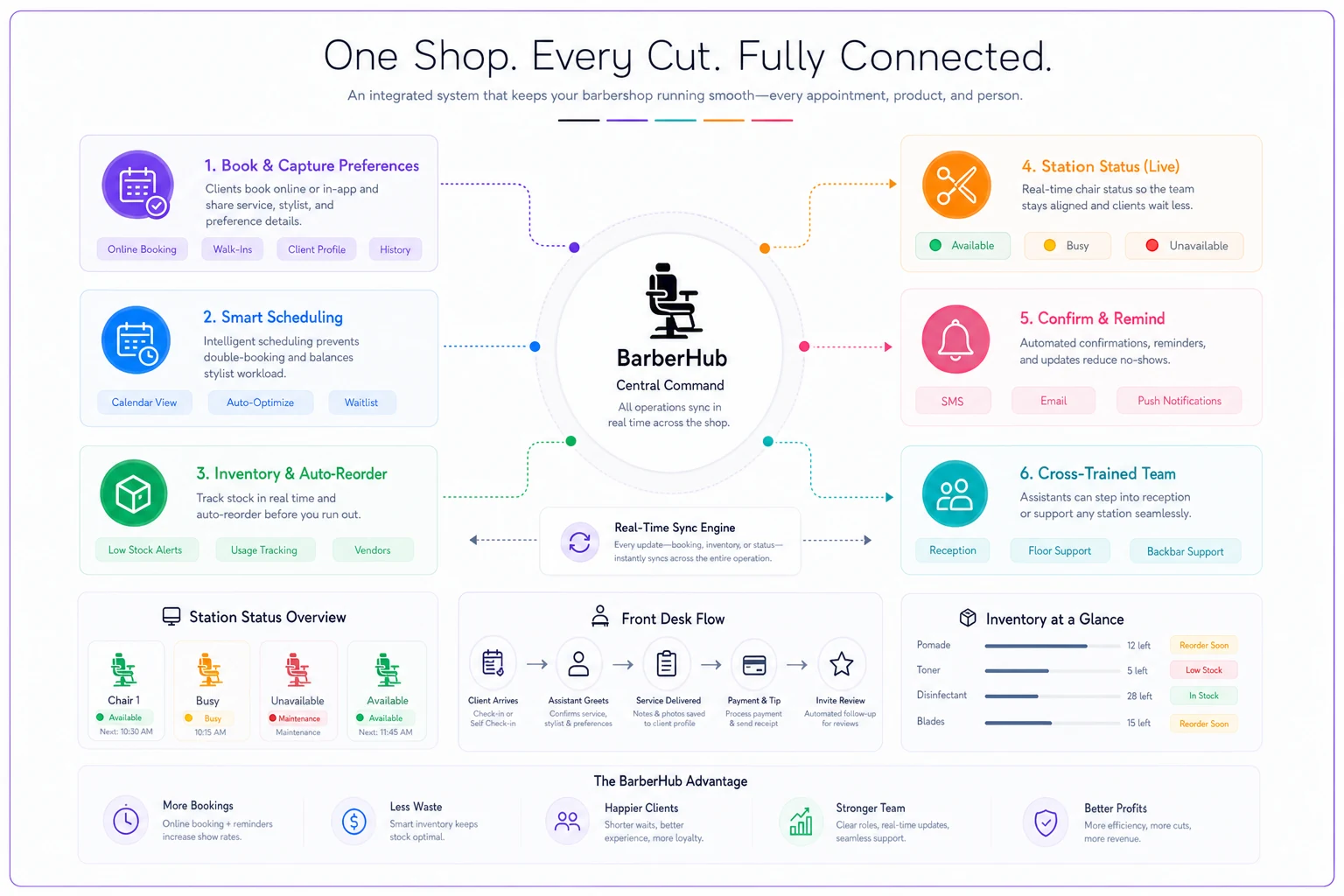
The shops that maintain margins build integrated operational systems where information actually flows. When booking knows client preferences, inventory triggers reorders automatically, and scheduling reflects real service times, you stop losing money to confusion.
This is where AI-powered operational platforms make a tangible difference. Instead of three systems that don't talk to each other, you get unified workflows where client preferences, inventory levels, and scheduling work together. The automation handles repetitive coordination—confirming appointments, tracking supplies, matching clients to available barbers—while your team stays focused on actual barbering.
Service Evolution: What to Add, What to Cut
Not every service makes sense at higher labor costs. That $25 buzz cut taking 20 minutes might have worked at $12/hour support wages. At $17 plus barber commission, you could be losing money after overhead.
Run every service through this lens: revenue per minute versus total cost per minute. Your detailed beard sculpting at $45 for 45 minutes might look profitable until you factor prep time, cleanup, and product. Meanwhile a 15-minute edge-up at $20 could be one of your better margin offers.
Add services that leverage skill over time:
-
Premium beard treatments ($40 for 25 minutes)
-
Gray blending services ($55 for standard cut plus treatment)
-
Steam towel treatments ($15 add-on, 5 extra minutes)
-
Eyebrow and ear waxing ($12 add-on, 3 minutes)
Cut services that burn time without premium pricing:
-
Basic buzz cuts under $30
-
Standalone neck cleanups under $15
-
Any service requiring special setup for under $50
-
"Quick trim" discounts that disrupt normal flow
Clients pay for expertise, not time. A masterful fade in 25 minutes can command $50+. A basic all-over in the same time tops out around $30. Build your menu around services where skill justifies the price.
Real Shop Turnaround: From Panic to Profit
A shop in Portland faced a July jump from $14.75 to $17.50. The owner's first instinct was to cut both part-time assistants and have barbers handle their own cleanup. Within three weeks, his top barber left for a competitor, citing constant flow disruption.
They course-corrected. First 30 days: they mapped every task and found assistants were spending 40% of their time on redundant inventory counts and station resets that could be batched. Restructuring those tasks saved 12 hours weekly without eliminating any positions.
Days 31-60: they cut their menu from twelve options to six packages, added a "Speed Lane" for edge-ups and buzz cuts during lunch hours, and rolled out a color-coded station status system. Average service times dropped four minutes—not through rushing, just better coordination.
By day 90, a membership program was generating $3,200 in predictable monthly revenue, two new high-margin services were on the menu, and the whole support staff was cross-trained. November revenue hit $52,000, up from $47,000 in June, despite higher labor costs across the board.
The difference was treating the wage increase as an operational problem with operational solutions, not a budget crisis requiring cuts.
Conclusion: Your Timeline Starts Now
With minimum wage increases hitting in July across numerous jurisdictions, the window to adjust operations without disrupting service is narrowing. Shops that panic and cut will struggle with turnover and quality. Shops that plan and improve systematically will come out stronger.
Your 30-day focus: stabilize and understand your true costs. Your 60-day focus: eliminate friction and standardize everything. Your 90-day focus: evolve your services and build new revenue streams.
Minimum wage increases tend to expose operational weaknesses that were already there. Shops running tight, efficient operations absorb these costs. Shops running on chaos and hustle don't. If you've been putting off proper workflows, service standardization, or real scheduling systems, this increase is forcing your hand.
The shops that come out ahead don't just survive the wage hike—they use it to fix problems they'd been tolerating for years. When you're forced to examine every labor hour, every menu item, and every step in your workflow, you find opportunities you've been walking past.
The clock is moving toward July. Every week of delay is less time to test changes, train new workflows, and refine your approach before the new rates hit. Start with the basics—track your real numbers, find your friction points, and test small adjustments now. The path from wage-increase panic to operational stability isn't complicated, but it requires starting before late June.
Ready to elevate your barbershop operations?
Join 500+ barbershops using Trimzly to save time, reduce scheduling conflicts, and enhance client satisfaction.