



The Fed is working on a proposal to raise the asset thresholds that trigger enhanced supervision of large banks — pushing some of those cutoffs higher, with the top tier reportedly moving from around $700B toward roughly $960B. Reuters reported the plan on September 25, 2026, and a parallel Bloomberg writeup framed it as a potential shift in how capital and lending strategies get set across the banking sector.
Sounds like something that has nothing to do with cutting hair. It does, though — just indirectly, and that indirect path is exactly why most shop owners miss it until it's already squeezing them.
When the rules around which banks get the heaviest scrutiny change, banks re-price risk, reshuffle their portfolios, and — historically — regional and community bank consolidation picks up. Community banks are where a huge share of small-business lending actually happens. When those banks get acquired, tighten up, or shift their risk appetite, the first loans to get slower, pricier, or quietly declined are the small, unglamorous ones. A $40k equipment loan for a barbershop is about as unglamorous as it gets from a bank's perspective.
This isn't a prediction that your credit line disappears next month. It's a heads-up that the terms, speed, and availability of small-business credit tend to wobble during these regulatory transitions — and the shops that take it seriously come out fine.
The part most owners get wrong about "bank risk"
Most barbershop owners think about financing as a one-time event. You need chairs, you get a loan. You want to open a second spot, you get a line. The relationship with the bank feels like a transaction that ends at signing.
In reality, the bank is quietly re-evaluating you the entire time. Your line of credit has covenants and review dates. Your merchant services pricing gets looked at. Your business checking behavior — how often you overdraft, how lumpy your deposits are, how thin your balance runs at month-end — feeds into how the bank perceives your risk long before you ever ask for more money.
-
A line of credit that used to renew automatically now "needs updated financials"
-
Merchant processing fees that creep up 20–40 basis points at the next statement
-
A loan officer who used to answer in a day now takes a week
-
A request for a personal guarantee or additional collateral on a renewal that didn't need it last year
None of those are dramatic. That's the problem. They're easy to ignore until you're the one who needs a fast approval and suddenly can't get one.
Why barbershops are uniquely exposed here
A barbershop's financials look risky to a bank in ways that have nothing to do with how well-run the shop actually is.
Never miss a booking amidst the hustle.
Trimzly helps you schedule, confirm, and manage every client visit seamlessly.
- Unified appointment management
- Automated client reminders
- Optimized staff scheduling
No credit card required
Revenue is cash-heavy and seasonal. December and the weeks before major holidays spike; late January and February can sag. If your deposits swing from roughly $22k one month to $14k the next, a lender's automated risk model doesn't see "normal seasonality" — it sees volatility. Add in that a lot of the cost base is variable (chair rent splits, commission payouts, product reorders), and your month-to-month cash position can look jumpy even when the business is healthy.
Then there's the documentation gap. Plenty of shops run on a mix of a booking app, a card processor, a spreadsheet, and the owner's memory. When a bank asks for a clean trailing-12-month P&L and you have to reconstruct it from three systems, that delay itself signals risk. In a loose lending environment, the bank waits. In a tight one, they move on.
The uncomfortable truth: in a tightening cycle, the shop that looks organized often gets better terms than the shop that is more profitable but can't prove it quickly.
The underlying problem this exposes
This regulatory shift is really just surfacing a weakness that was always there — most barbershops have almost no financing buffer and almost no visibility into their own numbers between tax seasons.
Think about how the typical single-location shop handles cash. Money comes in, payroll and rent go out, product gets reordered when the shelf looks empty, and whatever's left sits in checking until the owner decides to pay themselves or reinvest. No deliberate reserve, no sense of how many weeks of operating expenses are covered, no early-warning signal when a soft month quietly turns into a soft quarter.
That works fine when credit is cheap and easy, because the line of credit is the buffer. When credit gets harder to reach or more expensive, the shop that was relying on borrowed money to smooth out the lumpy months suddenly has no shock absorber.
That's the real exposure — not the Fed proposal itself, but the habit of using credit as a substitute for actual financial controls.
A financing-stress audit you can run this month
Before worrying about interest rates, figure out how dependent you actually are on bank goodwill. Work through these:
-
How many weeks of total expenses can you cover from cash on hand right now? If the answer is under four, you're financing your stability, not your growth.
-
When does your line of credit renew, and what are the covenants? Pull the actual document. Know your review dates before the bank reminds you.
-
What's your current utilization on that line? A line that's constantly run at 80–90% reads very differently to a lender than one you touch occasionally.
-
How fast can you produce clean financials? If generating a current P&L takes more than an afternoon, fix that before you ever need the loan.
-
Who's your actual relationship at the bank? A name and a direct line beats a general number when approvals slow down.
-
What's your backup lender? If your primary bank changes posture, do you have a second relationship — a CDFI, local credit union, equipment-specific financier — you could actually approach?
Keep a one-page snapshot of your line covenants and utilization so you can produce it quickly at renewal conversations.
Most owners can answer maybe two of these cleanly. The gap between what you know and what the bank will ask for is your real risk.
Decision guide: delay, proceed, or restructure
Say you've got capex on the deck — a new chair setup, a build-out, maybe a lease on a second spot. A shifting lending environment doesn't mean freeze everything. It means decide deliberately.
| Situation | Smart move | Why |
|---|---|---|
| Expansion funded mostly by a new loan, thin cash reserves | Delay or stage it | You'd be taking on debt right as terms get less favorable, with no buffer if a soft month hits |
| Equipment you can partially self-fund, strong cash position | Proceed, but lock terms now | Getting ahead of potential rate/term changes while your financials look strong |
| Existing line coming up for renewal | Renegotiate early, from strength | Easier to extend or improve terms before the bank is under pressure, not after |
| Growth that depends on hiring, not borrowing | Proceed | People investments scale with revenue and don't carry fixed debt service |
| Second location "because the numbers kind of work" | Pause and re-model | Marginal expansions are the first thing a tight market punishes |
When delaying is the wrong call
Delay gets overused out of fear. If you're sitting on healthy reserves and the investment genuinely raises throughput — say a fourth chair in a shop that's turning walk-ins away at peak — waiting a year to "see what rates do" can cost you more in lost revenue than any rate change would. The goal isn't caution for its own sake. It's matching the size of the risk to the size of your buffer.
Indecision has a cost too. That's worth writing down somewhere visible.
A real scenario
A two-chair shop doing roughly $18k–$21k a month wanted to add a third station and a small retail wall, needing about $32k. The owner assumed the line of credit he'd had for years would cover it — he'd never had an issue before.
When he actually pulled the paperwork, two things surfaced. His line was running at around 85% utilization most months because he'd been using it to float payroll during slow stretches. And his renewal date was four months out, with a clause requiring updated financials he hadn't looked at in over a year.
Instead of applying for more, he spent six weeks tightening the basics. He moved to a single system for bookings and payments so his revenue data was clean, built a simple weekly cash snapshot, and deliberately paid the line down to about 40% utilization by trimming over-ordered retail inventory and delaying the retail wall. When he went into the renewal conversation, he walked in with a current P&L and a line that looked disciplined instead of maxed.
The expansion got approved — smaller than planned, phased over two steps — and his effective terms came out better than his existing line because the bank now read him as lower risk. The build-out he thought required perfect timing mostly just required legible numbers.
Building the buffer before you need it
The move here isn't clever financial engineering. It's getting your shop to a point where you're never negotiating from weakness.
-
Get one source of truth for revenue. If bookings, payments, and product sales live in separate places, consolidate them so you can produce a clean picture on demand. This alone changes how fast and how favorably a lender responds.
-
Set a reserve target. Pick a number — eight weeks of operating expenses is a reasonable floor — and treat building toward it as a fixed monthly line item, not an afterthought.
-
Separate the line of credit from day-to-day cashflow. If you're using the line to make payroll in slow months, that's a structural problem to fix, not a feature to rely on.
-
Open a second lending relationship before you need it. A credit union or CDFI you've banked with even a little is far easier to approach than a stranger during a crunch.
-
Run a monthly numbers review. Fifteen minutes looking at deposits, line utilization, and reserve progress catches soft trends while they're still cheap to fix.
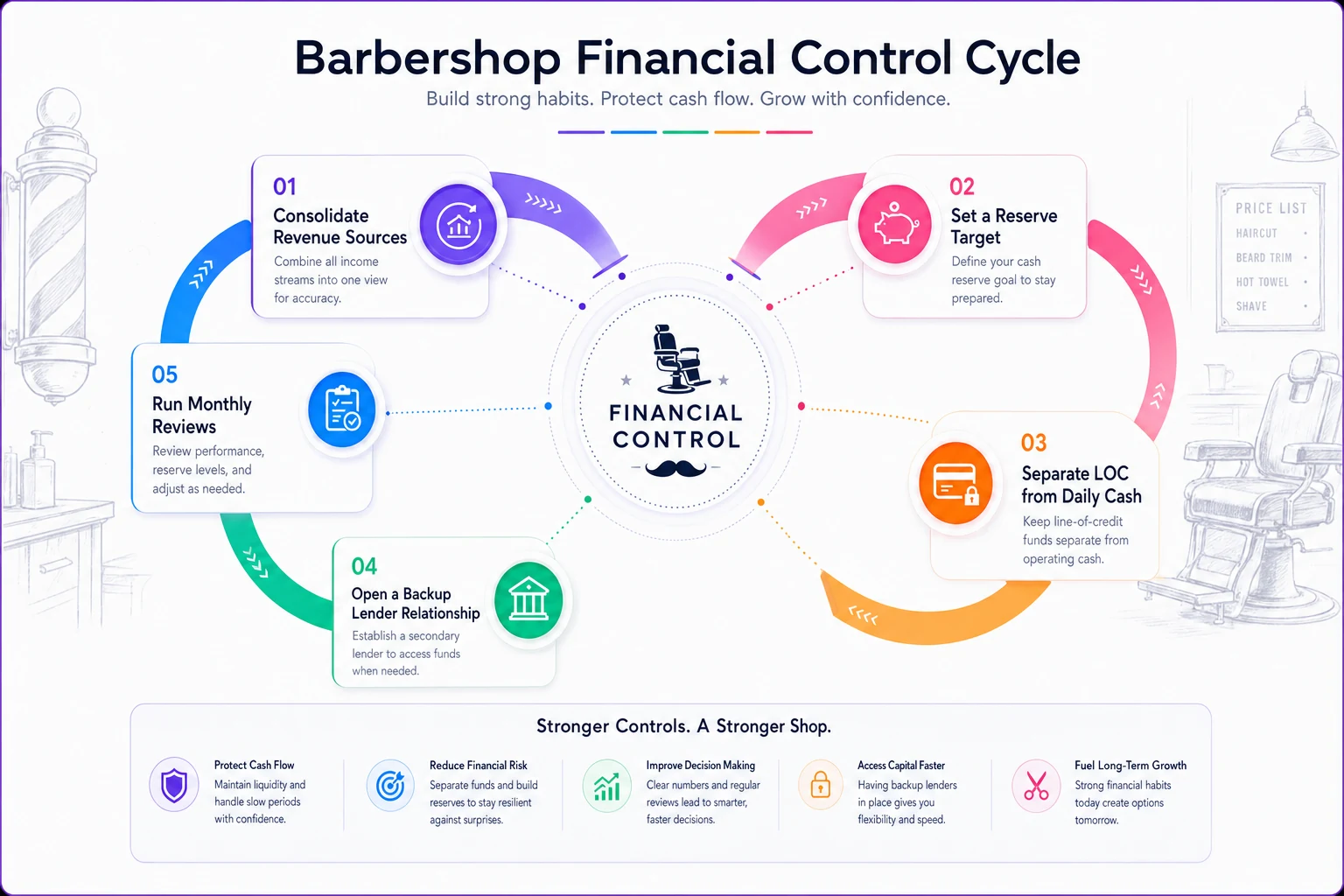
Here's a simple visual of the sequence to follow so you can share it with staff or a lender quickly.
The shops that come through tightening cycles cleanly almost always share one trait: they could see their own numbers clearly and prove them quickly. That's a controls problem, and it's entirely within your reach. Our cashflow and financial-controls checklist for single-location barbershops walks through the specific reserve math, reconciliation habits, and review cadence worth setting up before any of this pressure actually arrives at your door.
The quieter takeaway
Regulatory shifts in banking feel distant because they are. By the time the effects reach a two-chair shop on a side street, they're so diluted they look like random friction — a slower loan officer, a slightly higher processing fee, a renewal that suddenly wants more paperwork.
But that friction is exactly where preparation pays. You can't control what the Fed does with oversight thresholds or how your bank re-prices risk. You can absolutely control whether your financials are clean, your reserve is real, and your dependence on borrowed money is a choice rather than a necessity. Do that, and whatever the lending environment does next, you're negotiating from a position where the bank needs your business more than you need their approval.
But that friction is exactly where preparation pays. You can't control what the Fed does with oversight thresholds or how your bank re-prices risk. You can absolutely control whether your financials are clean, your reserve is real, and your dependence on borrowed money is a choice rather than a necessity. Do that, and whatever the lending environment does next, you're negotiating from a position where the bank needs your business more than you need their approval.
Ready to elevate your barbershop operations?
Join 500+ barbershops using Trimzly to save time, reduce scheduling conflicts, and enhance client satisfaction.