

Most barbershop owners already know they should be collecting more Google reviews. The shops crushing it online have 300+ reviews with a 4.8 average, while yours might be sitting at 60 reviews hovering around 4.2. The math isn't complicated — more five-star reviews means more bookings.
But what actually plays out is this: you tell your barbers to ask happy clients for reviews. They nod, agree it matters, then never actually do it. Maybe they ask once or twice when you're watching, then drop it. Or they ask in this apologetic, uncomfortable way that makes everyone cringe. "Hey, uh, if you get a chance, maybe leave us a review?" The client mumbles something vague and never follows through.
The reviews that do come in naturally tend to skew negative. Angry clients are motivated to write reviews. Satisfied clients just go about their day. So you end up with this lopsided profile where one bad experience from six months ago still sits at the top of your Google listing — scaring off potential clients who don't even know that barber doesn't work there anymore.
The timing breakdown that kills review collection
The core problem with barbershop review automation isn't technology or scripts — it's timing. Most shops either ask too early, before the client has fully settled into how they feel about the cut, or way too late when the good feeling has faded.
Think through the client journey. They book, show up, get their cut, pay, and leave. Three days later they get a generic email that lands in their promotions folder. By then the fresh-cut feeling is gone. They're thinking about work or whatever's happening this weekend, not your shop.
Even when shops try to be more systematic, execution falls apart. One shop I looked at had their receptionist hand out review cards at checkout. Sounds reasonable, except clients are fumbling with their wallet, tipping, maybe wrangling a kid, and definitely not in the headspace for review requests. Those cards ended up in pockets and cup holders, never to be seen again.
The automated review tools most shops default to are even worse. Same templated message blasted to everyone: "Thanks for visiting! Please rate your experience." No personalization, no context, no acknowledgment of who even cut their hair. These convert at maybe 2-3%, and half of those responses are from clients you'd rather not hear from publicly.
And then shops panic-respond to negative reviews with long defensive explanations that make everything worse. Or don't respond at all because the owner doesn't check Google regularly, and by the time they notice, the review has been sitting there for three weeks looking like nobody cares.
Building a review sequence that actually converts
A functional barbershop review automation workflow starts with segmentation. Not every client should get the same request at the same time. Your regular who's been coming every two weeks needs different handling than a first-timer who might never return.
Never miss a booking amidst the hustle.
Trimzly helps you schedule, confirm, and manage every client visit seamlessly.
- Unified appointment management
- Automated client reminders
- Optimized staff scheduling
No credit card required
Start with in-shop identification of genuinely happy clients. Your barbers already know when they've nailed it — the client is checking themselves out in the mirror, talking about an upcoming event, asking about products. These are your review candidates. But instead of making the barber do the awkward ask, build it into your checkout flow.
When a client pays and tips well — anything over 18% is a decent signal — your system should flag them for review outreach. Not immediately. Nobody wants to deal with a review request while they're still walking out the door. But within 90 minutes, while the experience is still fresh.
Flag clients tipping over 18% and schedule a 90-minute thank-you text with an after photo to boost conversion.
The first message shouldn't even mention reviews. Send a simple thank you text: "Marcus, your fresh fade looks great! Thanks for trusting James with your cut today. Here's a photo from your visit." Attach the after photo your barbers should be taking anyway. People love seeing themselves looking good, and they'll often share that photo on Instagram before you even follow up.
About two hours later, after they've had time to get a compliment or two, send the actual ask. Make it specific: "Getting good feedback on the cut? James would really appreciate if you shared that with others looking for a skilled barber." Then a direct link to leave a Google review — not some third-party portal where they have to choose between platforms.
For regulars who've been coming six months or more but haven't reviewed yet, the approach shifts. Don't ask after every visit — that's just annoying. Time it around milestones. After their tenth visit: "Can't believe it's been 10 cuts already! You've been part of the shop for a while now. Would you mind sharing what keeps you coming back?" You're acknowledging the relationship, not just asking for a favor. That distinction matters.
Channel sequencing that respects boundaries
The biggest mistake shops make is hitting clients across every channel at once. They get a text, an email, sometimes even a call, all asking the same thing. This doesn't just fail — it actively annoys people who might have otherwise left a good review.
Your workflow needs clear channel rules. SMS works best for clients under 40 who book online and have opted in. Keep texts short and personal. Email works better for older clients or those who've indicated they prefer it. Never use both channels for the same review request.
Cadence matters too. If someone doesn't respond to your first ask, wait at least 30 days before trying again — and change the angle entirely. Instead of another review request, send a feedback question: "Quick question — what could we do better next time?" Happy clients often reply saying everything was great, and that's your natural opening to suggest they share that as a review.
Don't get clever with incentives either. Offering discounts for reviews violates Google's terms and can get your listing penalized. It also attracts reviewers who care more about saving five dollars than giving honest feedback.
You're better off catching organic advocacy moments. When someone posts their fresh cut on Instagram and tags your shop, that's your window. Reply to their story: "Looking sharp! Mind dropping this same energy in a Google review? Would mean a lot to Carlos." It works because they've already publicly endorsed you. The review is just making it official.
The negative review triage system nobody talks about
The typical owner response to a bad review: see it, get defensive or demoralized, either fire off an emotional reply or ignore it entirely. Meanwhile, potential clients read that review and go somewhere else. It sits there for months, sometimes years.
A working barbershop review automation workflow includes negative review triage, not just positive review generation. You need alerts the moment something below 4 stars posts — not daily summary emails you'll get to "later." Immediate notifications that prompt immediate action.
The response hierarchy should be clear:
-
One-star reviews with specific complaints
owner response within 2 hours
-
Generic complaints ("terrible service")
template response within 24 hours
-
Three-star reviews mentioning specific issues but not angry
personalized response within 48 hours
Response strategy changes based on complaint type. For service complaints about a specific barber, acknowledge and move it offline: "This doesn't sound like the experience we aim for. Please email me directly so we can make this right." Then actually follow up. Around 40% of upset clients will revise or remove their review if you genuinely resolve the issue.
For wait time complaints, skip the excuses. Acknowledge the problem and share what's changing: "You're right that Saturday waits have gotten too long. We've added another barber for peak hours and introduced appointment-only time blocks to better manage flow."
Price complaints are different. Don't defend your rates or explain your overhead costs. Just acknowledge their perspective and redirect: "We understand our prices aren't for everyone. We focus on premium cuts with experienced barbers, but there are good options in the area for different budgets."
Recovery rates and the compound effect
Most shops never track their review recovery rate, so they have no idea how much bad reviews are actually costing them. A single one-star review that sits unaddressed for six months can cost you somewhere in the range of 20-30 potential clients. At an average ticket of $45, that's roughly $900-1,350 in lost revenue from one angry customer.
When you respond quickly and professionally, something shifts. Around a third of negative reviewers will update their review or post a follow-up acknowledging your response. Another 20% or so will remove the review entirely if you actually solve their problem. The rest stay, but the damage is minimized because future readers see you bothered to respond.
The compound effect kicks in when you're steadily generating positive reviews while managing the occasional complaint. If you're adding 8-10 authentic five-star reviews monthly, that 4.2 rating becomes 4.5 within six months. Within a year, you're pushing 4.7.
The ranking improvement is the real payoff. Google heavily weights review recency and response rates in local search. Shops with consistent reviews and active response habits regularly outrank competitors with more total reviews but poor engagement. One shop went from fifth in local search to second simply by tightening up their collection and response process.
Natural scripts that don't sound like scripts
The worst thing you can do is hand your team a word-for-word script. Clients recognize canned language and check out immediately. Train your team on conversation triggers and let them use their own words.
When a client mentions an upcoming event, that's a review opportunity. The barber might say: "Your date's gonna love this look. Hey, if she compliments the cut, mind sharing that feedback online? Helps me out." Natural, conversational, tied to something specific.
For regulars, it gets even more casual: "You've been coming to me for what, eight months now? Never asked before, but would you mind dropping a quick review when you get a chance? No pressure, just helps with the algorithm stuff."
The key is making it about the barber, not the business. Clients feel weird leaving reviews for shops, but they're genuinely happy to help out their specific barber. "Reviews actually help me build my book" lands better than "Please review our barbershop."
Also train your team to recognize negative review situations before they happen. When someone's visibly unhappy with their cut, address it in the chair. Offer to fix it, refund it, or have another barber take a look. "I want to make sure you're completely happy before you leave" prevents most negative reviews. It's way easier to fix it while they're there than to recover from a one-star post later.
Table: Review request timing by client type
Use the table below to guide timing, channel, and follow-up strategy for different client types.
| Client Type | First Request Timing | Channel | Follow-up Strategy | Expected Response Rate |
|---|---|---|---|---|
| First-time happy client | 90 minutes post-visit | SMS | Single ask, no follow-up | 8-12% |
| Regular (6+ visits) | After milestone visit (10th, 20th) | Email or SMS based on preference | Quarterly if no response | 15-20% |
| High-tipper (>20%) | Same day | SMS with photo | One follow-up after 3 days | 22-28% |
| Social media tagger | Within 1 hour of post | Instagram DM | No follow-up needed | 35-40% |
| Referring client | After successful referral visits | Personal email | Thank you focus, soft ask | 25-30% |
| Win-back client | After 2nd return visit | Focus on what brought them back | 10-15% |
Refer to these expected response rates when calculating realistic monthly review growth.
Process: The 48-hour negative review response protocol
A quick visual helps teams follow the steps without delay.
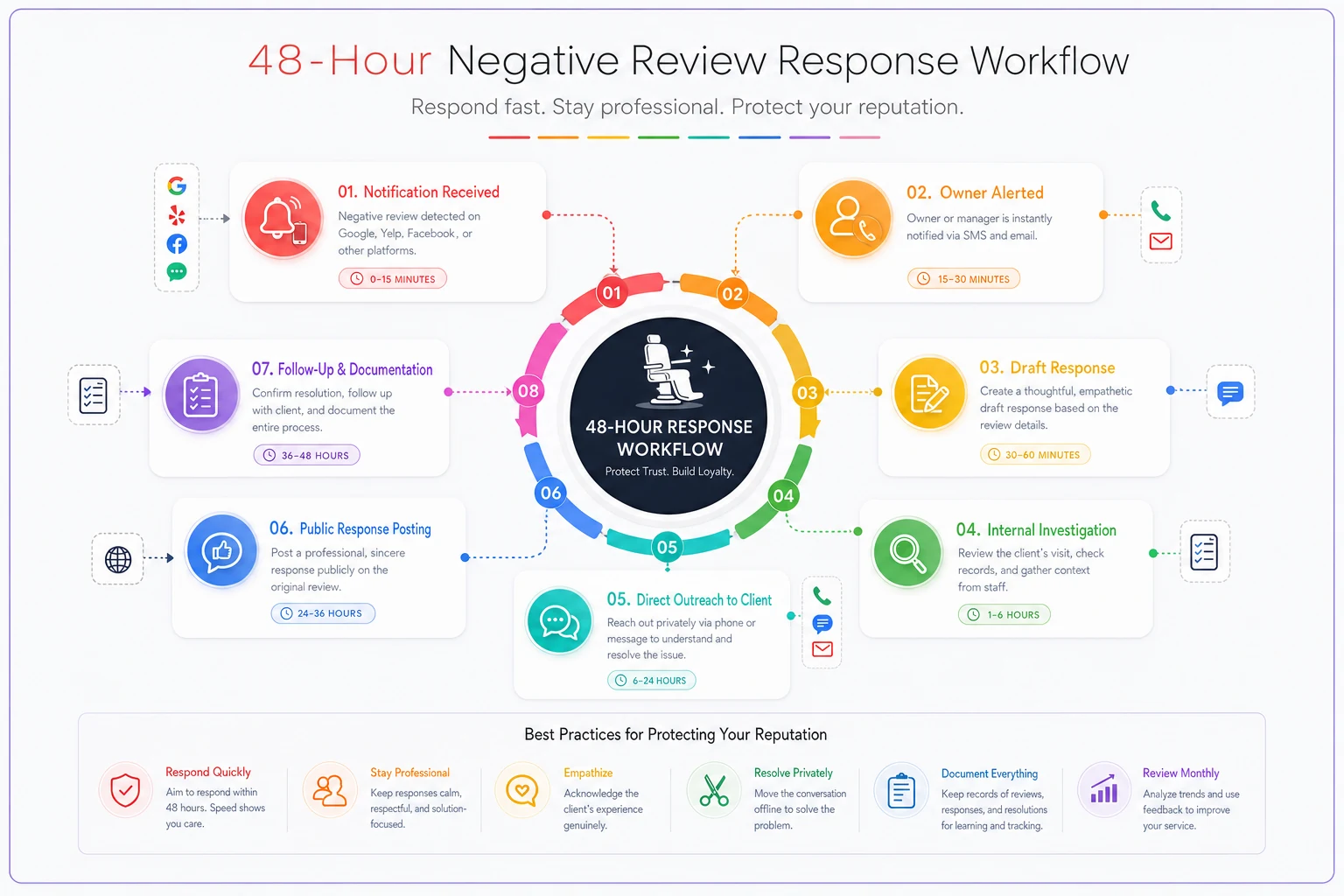
-
Hour 0-2
Notification received, owner alerted, initial assessment of validity
-
Hour 2-6
Draft response (not posted yet), investigate internally if complaint is specific
-
Hour 6-12
If valid complaint, reach out directly to client via phone or email
-
Hour 12-24
Post public response, keep it under 100 words, acknowledge the concern
-
Hour 24-48
Follow up internally with staff mentioned, document resolution attempts
-
Day 3-7
If client responds to outreach, work toward resolution
-
Day 7-14
Check if review was updated or removed, document the outcome
-
Day 30
Add to monthly review analysis, adjust processes if a pattern is emerging
Keep this protocol visible and assign roles so notifications trigger immediate action.
Checklist: Monthly review system audit
Run this audit monthly to ensure your review system is healthy.
-
- [ ] Check total review count vs. last month
-
- [ ] Calculate average rating trend (improving or declining?)
-
- [ ] Review response time for all reviews under 4 stars
-
- [ ] Verify all review request automations are firing correctly
-
- [ ] Spot-check that personalization tokens are working
-
- [ ] Review barber-specific review counts for imbalances
-
- [ ] Update response templates if they're getting stale
-
- [ ] Check for any reviews that mention competitors
-
- [ ] Verify Google Business Profile has current hours and services
-
- [ ] Test review links from different devices
-
- [ ] Compare review velocity to top 3 competitors
Use the checklist items to identify where automation or training needs adjustment.
Real scenario: How one shop went from 3.9 to 4.6 in four months
Downtown Cuts had 47 reviews averaging 3.9 stars, with several nasty one-star reviews sitting at the top of their Google listing. They were losing bookings to a competitor two blocks away with a 4.7 rating. The owner was frustrated but overwhelmed by the idea of managing reviews on top of everything else already on his plate.
They started by responding to every unaddressed review from the past year — even old ones. Not with long explanations, just brief acknowledgments that showed someone was paying attention. Then they implemented a simple system: photograph every finished cut with permission, send a thank you text with the photo 90 minutes post-visit, and follow up with regulars around milestone visits.
The barbers initially pushed back on the photos, saying it would slow them down. But once they saw clients sharing those photos on Instagram and tagging the shop, the resistance faded. The shop started pulling in 12-15 new reviews per month, mostly five-star. More importantly, they caught two potentially negative situations early when clients texted back with concerns, letting them fix things before they turned into public complaints.
Four months later they had 125 total reviews averaging 4.6 stars. Google ranking jumped from fourth to first for "barbershop downtown." New client bookings increased by roughly 30%, and the owner estimated the improved reviews were bringing in an extra $8,000-10,000 monthly in new business.
When this system doesn't work
Some shops shouldn't be running aggressive review collection. If you're genuinely struggling with service quality, fix operations first. Generating reviews when you have systematic problems just amplifies the complaints.
High-end shops charging $75+ per cut need a different approach entirely. Their clientele expects discretion and might find automated review requests off-putting. Better to focus on organic advocacy through exceptional service than push automated messages.
Shops with predominantly older clientele — 55 and up — should lean heavily on in-person assistance rather than automated texts. An iPad at the front desk where someone can help them leave a review right after their cut works better than a text they might not even see.
If your shop has high barber turnover, be careful about tying reviews to specific individuals. You don't want your best-reviewed barber to leave and take their reputation with them. In that case, keep review requests focused on the shop experience overall rather than individual barbers.
The automation sweet spot
A barbershop review automation workflow doesn't mean removing people from the process entirely. The best setups blend automatic triggers with touches that still feel personal. Your booking system identifies candidates based on visit frequency, tipping behavior, and service type — but the actual outreach feels like it's coming from someone at the shop, not a bot.
AI-powered operational platforms help here by tracking response patterns and adjusting timing. If clients tend not to respond to evening messages, the system learns to send requests in the afternoon. If certain message formats get better responses, it adapts. But the core message still reads like it came from a real person.
The triage side especially benefits from this kind of automation. Instead of the owner manually checking Google every day, the system monitors continuously and escalates based on set rules. One-star reviews trigger immediate alerts. Mentions of specific issues get routed to relevant managers. That speed is what turns an angry client into an advocate when you actually address the problem.
Think of it as having a really organized assistant who never forgets to follow up and never misses a negative review. The system handles the logistics. Your team handles the relationships.
Moving forward with sustainable review management
Getting your review average up isn't a three-month project you finish and forget. It's an operational rhythm that becomes part of how the shop runs. The shops holding 4.7+ ratings aren't doing anything magical — they're just consistent about asking the right clients at the right time and catching problems before they go public.
Start small if the full system feels like too much. Pick your happiest regulars and personally text them asking for reviews. Get comfortable with the ask. Then expand to systematic photo collection and thank you messages. Layer in the negative review response protocol once you're seeing steady positive reviews come in.
Each five-star review makes the next booking slightly more likely. Each thoughtful response to a complaint shows potential clients you're paying attention. Over time that compounds into a competitive position that's genuinely hard for other shops to replicate.
Most shops never build a real barbershop review automation workflow because it seems complicated or uncomfortable. The ones that do pull ahead in local search, attract better clients, and can hold premium pricing because their reputation backs it up. The question isn't whether you need better reviews — it's whether you're willing to build the system that generates them on a consistent basis.
Start small, be consistent, and make sure your system flags both advocates and problems so you can amplify the former and resolve the latter.
Ready to elevate your barbershop operations?
Join 500+ barbershops using Trimzly to save time, reduce scheduling conflicts, and enhance client satisfaction.