

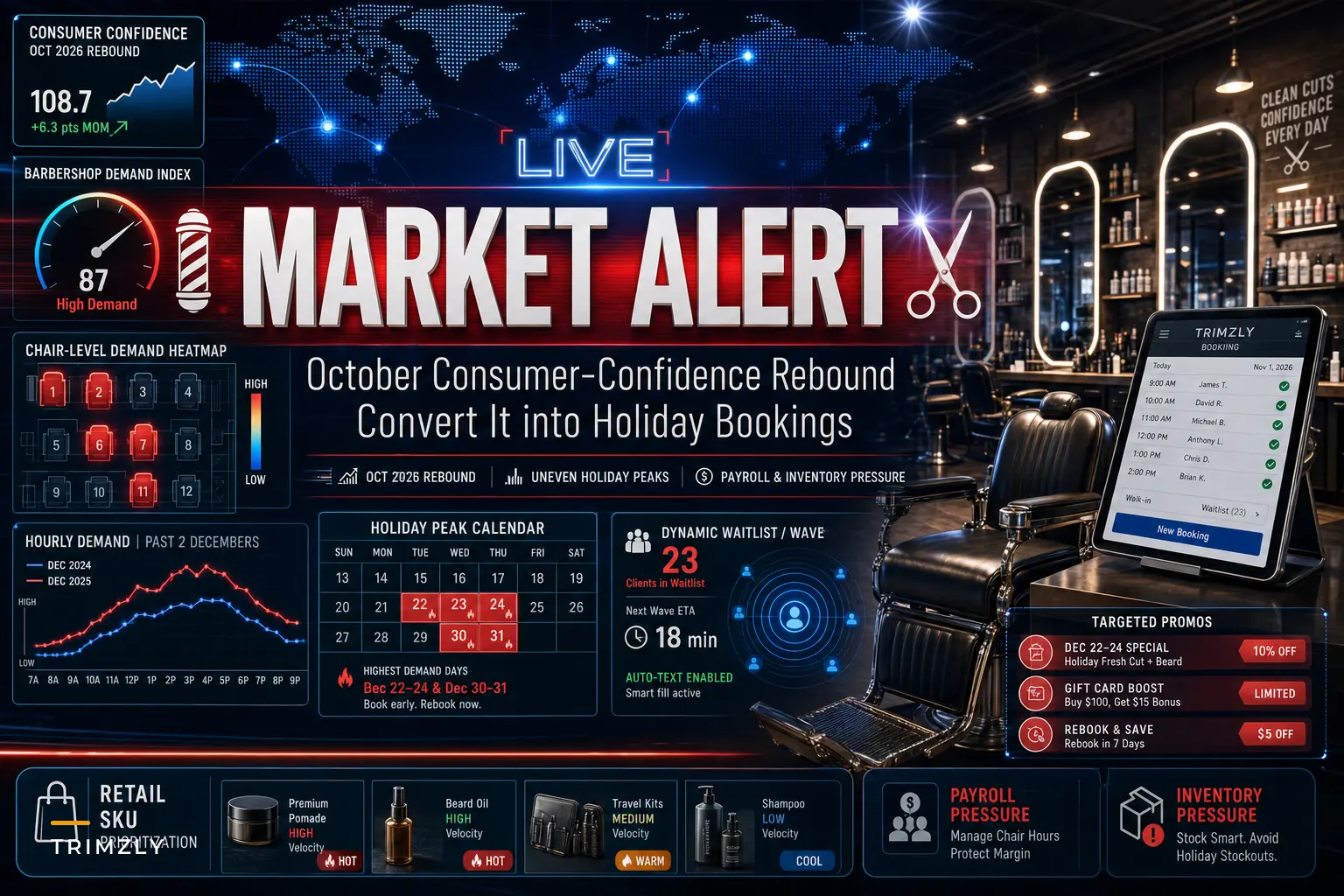

The Conference Board reported that US consumer confidence unexpectedly rose in October 2026, with the index climbing to 91.7 as of October 27. Reuters noted in its coverage that the improvement was broad but uneven — stronger among younger and higher‑income shoppers, softer everywhere else.
For most barbershop owners, a macro number like this means almost nothing on its own. You can't book a chair with an index point. But the timing matters. This uptick lands six to eight weeks before your single densest demand window of the year — that stretch from mid‑December through New Year's where everyone suddenly needs to look sharp for parties, family photos, and whatever else December throws at them.
So the real question isn't "is confidence up?" It's: do you have the staffing, pricing, and shelf stock ready to catch demand that may arrive in bursts instead of a smooth curve? Most shops don't. They react in week two of the rush, when it's already too late to hire, reorder, or reprice without looking desperate.
Here's what this confidence signal actually implies for a barbershop operation, and the specific moves worth making now.
What the "uneven" part of the rebound actually tells you
The headline is "confidence up." The useful part is buried: the rebound skews toward younger and higher‑income cohorts. That detail should shape your decisions, because those two groups behave very differently inside a barbershop.
Younger clients book later, respond to last‑minute availability, and are far more likely to grab an add‑on if it's offered at the chair. Higher‑income clients book earlier, care more about consistency — same barber, same time — and are the ones who buy the $28 pomade without blinking.
A blanket "20% off all cuts" promo is probably the worst thing you could run right now. You'd be discounting the exact clients who were going to pay full price anyway, while doing nothing to pull in the price‑sensitive walk‑in who isn't feeling confident at all. Shops that handle the holiday window well tend to segment their offers instead of flattening them. The confidence bump is a reason to run sharper promotions, not broader ones.
The underlying problem the holiday rush exposes every single year
A confidence uptick quietly makes one thing worse: demand volatility.
Never miss a booking amidst the hustle.
Trimzly helps you schedule, confirm, and manage every client visit seamlessly.
- Unified appointment management
- Automated client reminders
- Optimized staff scheduling
No credit card required
When sentiment is flat, demand is predictable and slow. When sentiment jumps, you don't get evenly distributed extra bookings. You get spikes — a packed Saturday, a dead Tuesday, three no‑shows on a day you turned away walk‑ins, then a Friday where you're drowning.
Most barbershops are built for averages, not spikes. The roster is set to "normal week." The retail shelf is stocked to "normal month." The booking calendar treats every hour as equal when it absolutely is not.
The real failure isn't a lack of demand during the holidays. It's capacity that's shaped wrong for the demand that shows up. Empty chairs at 10am Tuesday and a 40‑minute wait at 2pm Saturday — you lose money on both ends.
This is a scheduling architecture problem more than a marketing problem. If your calendar can't flex to the shape of the rush, more demand just means more chaos and more turned‑away clients. Before you spend a dollar on a holiday promo, your day‑plans need to match where demand actually concentrates — which is exactly the kind of thinking laid out in this chair‑level scheduling framework with sample day plans. Fix the shape first, then pour demand into it.
Staffing: build for the peaks, not the week
The most common mistake is adding hours evenly across the week to "handle the holidays." That just inflates payroll on slow days while the real crunch days stay understaffed.
Map your last two Decembers hour by hour instead. You almost certainly have a demand profile that looks something like this:
| Day block | Typical demand | Common staffing error |
|---|---|---|
| Weekday mornings | Soft, mostly regulars | Overstaffed out of habit |
| Weekday evenings | Rising, after‑work rush | Slightly understaffed |
| Friday afternoon–evening | Heavy | Right‑staffed by luck |
| Saturday all day | Peak, overflow | Chronically understaffed |
| Dec 22–24 and Dec 30–31 | Extreme spikes | Nobody plans for these specifically |
Those last two date ranges are where the money hides. Shops that staff an extra chair specifically for Dec 22–24 routinely capture bookings that competitors physically cannot take.
-
Lock your holiday roster by mid‑November. Barbers make their own December plans fast. Ask late and you're negotiating with someone who already committed elsewhere.
-
Offer peak‑day incentives, not across‑the‑board overtime. A small bump for the Dec 22–24 and Dec 30–31 shifts costs less and targets exactly where capacity is tightest.
-
Pre‑approve extended hours before you need them. Decide now which days you'll open earlier or close later, and tell clients early — not the morning of.
-
Protect your best barbers' calendars for rebooking regulars. Don't let high‑income repeat clients get bumped by walk‑in volume during the one stretch they're most likely to rebook going forward.
Map your last two Decembers hour by hour to spot true peaks before you add any extra hours.
When adding staff actually makes sense — and when it doesn't
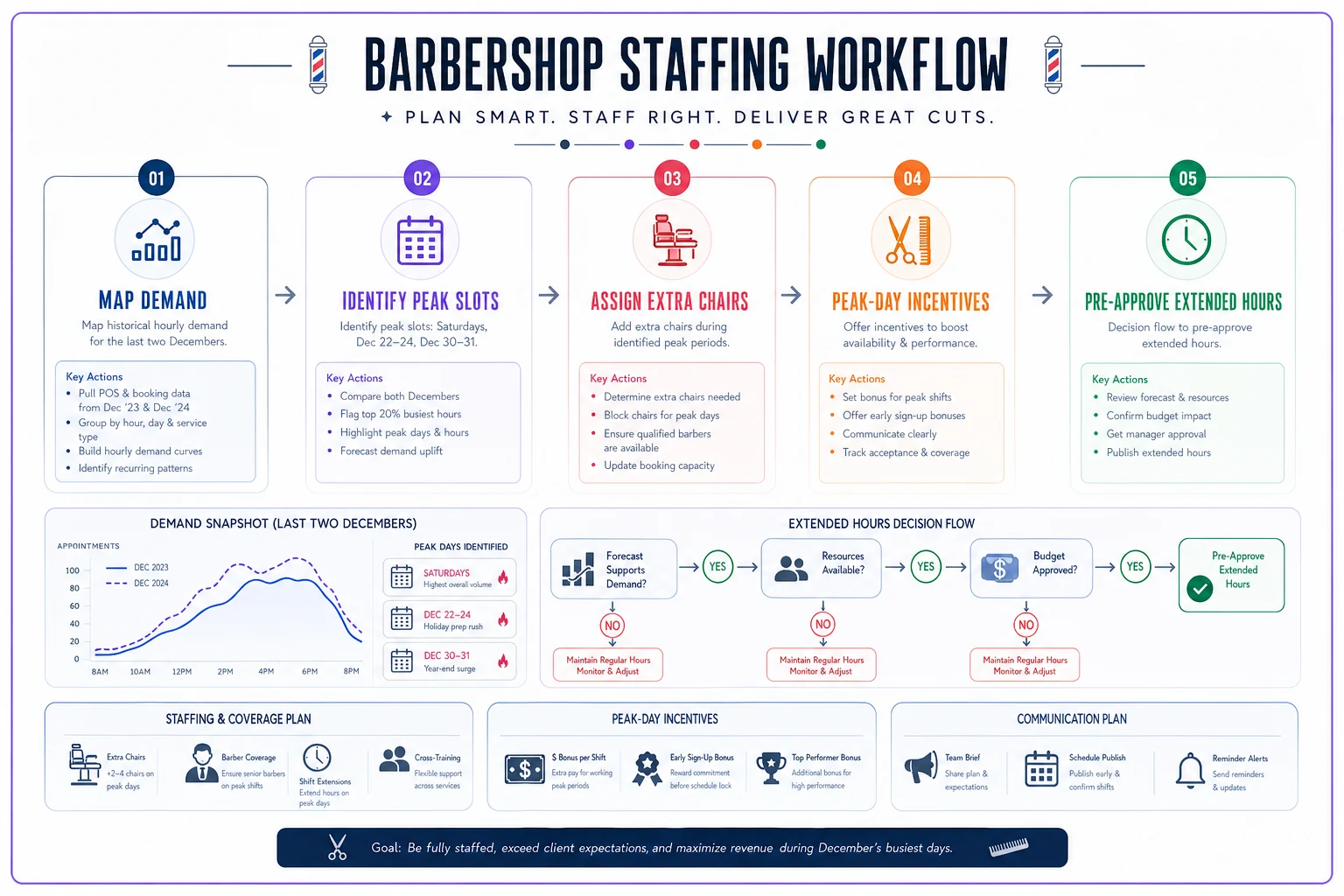
Use this flow to align staffing to observed hourly peaks.
Adding a holiday chair makes sense when your Saturday and late‑December turn‑away rate is real and measurable — you're regularly sending people away or quoting waits over 30 minutes. If that's the case, an incremental barber pays for themselves fast on peak days.
It's a bad move when the "problem" is a slow weekday you're trying to fix with more supply. More barbers don't create demand on a dead Tuesday. That's a marketing and booking‑cadence issue.
Pricing: run targeted tests, not holiday discounts
The confidence rebound is permission to test, not to slash. The cohorts driving the uptick aren't shopping on price — they're shopping on availability and experience.
Three pricing moves that fit this moment:
-
Peak pricing on the obvious crunch slots. Saturday afternoons and the Dec 22–24 window can carry a modest premium. Done quietly and framed as "holiday priority booking," most regulars won't blink — and it naturally pushes flexible clients toward off‑peak slots, which smooths your calendar without any extra effort on your end.
-
Bundle instead of discount. A cut‑plus‑beard‑plus‑hot‑towel holiday bundle at a slight savings raises your average ticket while feeling like a deal. You're trading up, not marking down.
-
Gift‑card push, not price cuts. Gift cards are the single best holiday lever a barbershop has. They pull cash forward, bring in new faces in January, and protect your December margin. Promote them hard from late November onward.
Peak pricing and off‑peak nudges also do your scheduling smoothing for you — when Saturday at 2pm costs a little more and Tuesday at 11am doesn't, price itself redistributes some demand into your empty hours. That's better than manually managing every slot.
Inventory: recheck your retail shelf before the rush, not during it
Retail is where confidence‑driven spending actually shows up in a barbershop, and it's the thing most shops neglect until the shelf is already picked clean.
Younger and higher‑income clients — the cohorts driving this bump — are your most likely retail buyers. If your shelf is bare or stale when they're in a spending mood, you've left easy margin sitting on the counter.
A quick pre‑holiday inventory checklist:
-
Identify your top 5 sellers by units and make sure you have holiday‑window coverage with a buffer. Running out of your best pomade in week two of December is just lost margin.
-
Add 2–3 giftable SKUs — nicely packaged sets, a premium item, something that works as a stocking stuffer. Gift intent spikes in December and most shops have nothing set up to sell into it.
-
Pull slow movers off prime shelf space and replace them with proven sellers and gift sets during the window.
-
Confirm supplier lead times now. December reorders can slip. Know your cutoff dates before you actually need to reorder.
-
Set a simple reorder trigger so a hot seller doesn't quietly vanish mid‑rush without anyone noticing.
The mistake pattern is predictable: stock for a normal month, sell through the best items by the second week, spend the highest‑traffic days with an unimpressive shelf. You want your retail looking its best exactly when foot traffic peaks — not two weeks before it does.
A realistic scenario
Take a three‑chair shop doing roughly 320–350 cuts a month, with retail that's been limping along around $900–$1,100 monthly.
Last December they did what they always do — ran a flat 15% off cuts "for the holidays," kept the normal roster, reordered retail on their usual cadence. Result: busy Saturdays they couldn't fully serve, a handful of turned‑away walk‑ins on Dec 23, and a half‑empty shelf by Christmas week. The discount mostly went to regulars who'd have paid full price anyway.
Same shop, different plan this year. They drop the blanket discount. They add one extra barber specifically for the Dec 22–24 block and the two busiest Saturdays. They introduce a cut‑and‑beard holiday bundle, push gift cards from Black Friday on, and bring in two giftable retail sets.
The outcome isn't a miracle — it's just capturing demand they were already losing. A handful of extra peak‑day cuts they'd normally turn away, a bump in average ticket from bundles, retail closer to $1,600–$1,800 for the month on gift sets and gift cards, and some prepaid gift‑card cash that softens the slow January that always follows. No revenue explosion. Just margin they were previously leaving on the floor.
Who should ignore most of this
If you're a solo barber already booked solid weeks out, you don't need peak pricing games or an extra chair — you need to protect your calendar and probably nudge your prices up permanently. The holiday flex playbook is for shops with capacity to shape.
And if your fundamentals are shaky — inconsistent rebooking, no clean read on your busiest hours, retail you can't track — a confidence bump won't save you. It'll just expose the cracks faster. Get your day‑plans and basic numbers in order before you try to ride a demand wave.
The takeaway
A single confidence reading won't fill your chairs. But it's a reasonable signal that the clients most likely to spend are feeling a little better heading into your biggest window — and that demand is going to arrive unevenly in ways you need to be ready for.
Shops that win December aren't the ones that discount hardest. They're the ones that locked their roster early, priced their peaks deliberately, stocked their shelf for gift intent, and built a calendar that can absorb a spike instead of buckling under it. Do that work in November, and the rush becomes the most profitable stretch of your year instead of the most stressful one.
Ready to elevate your barbershop operations?
Join 500+ barbershops using Trimzly to save time, reduce scheduling conflicts, and enhance client satisfaction.