

You know what's frustrating about barbershop marketing? Owners jump straight to Instagram ads or some referral app when their Google Business Profile is sitting there with outdated hours and three blurry photos from 2019.
Shops burn through $2,000 on Facebook ads while their GBP shows "Temporarily Closed" — for six months. Meanwhile, the shop down the street pulls 15 new clients weekly just by keeping their profile updated and responding to reviews within a day.
The problem isn't that marketing doesn't work for barbershops. It's testing channels in the wrong order, with no clear metrics to know when something's working or when to cut it.
Why barbershops fail at multi-channel marketing
Most barbershop local marketing system attempts fall apart because owners treat every channel like it deserves equal attention. They'll split $500 across five different strategies and give none of them enough runway to show results.
Then there's the timing issue. Launching a referral program when you have 40 regular clients is like trying to start a fire with wet matches. Or pushing hard on social media when your booking system can't handle the incoming inquiries.
The worst part is no clear stop rules. Shops running the same underperforming Instagram campaign for eight months because "it takes time to build momentum" — while bleeding $400 monthly with zero trackable bookings.
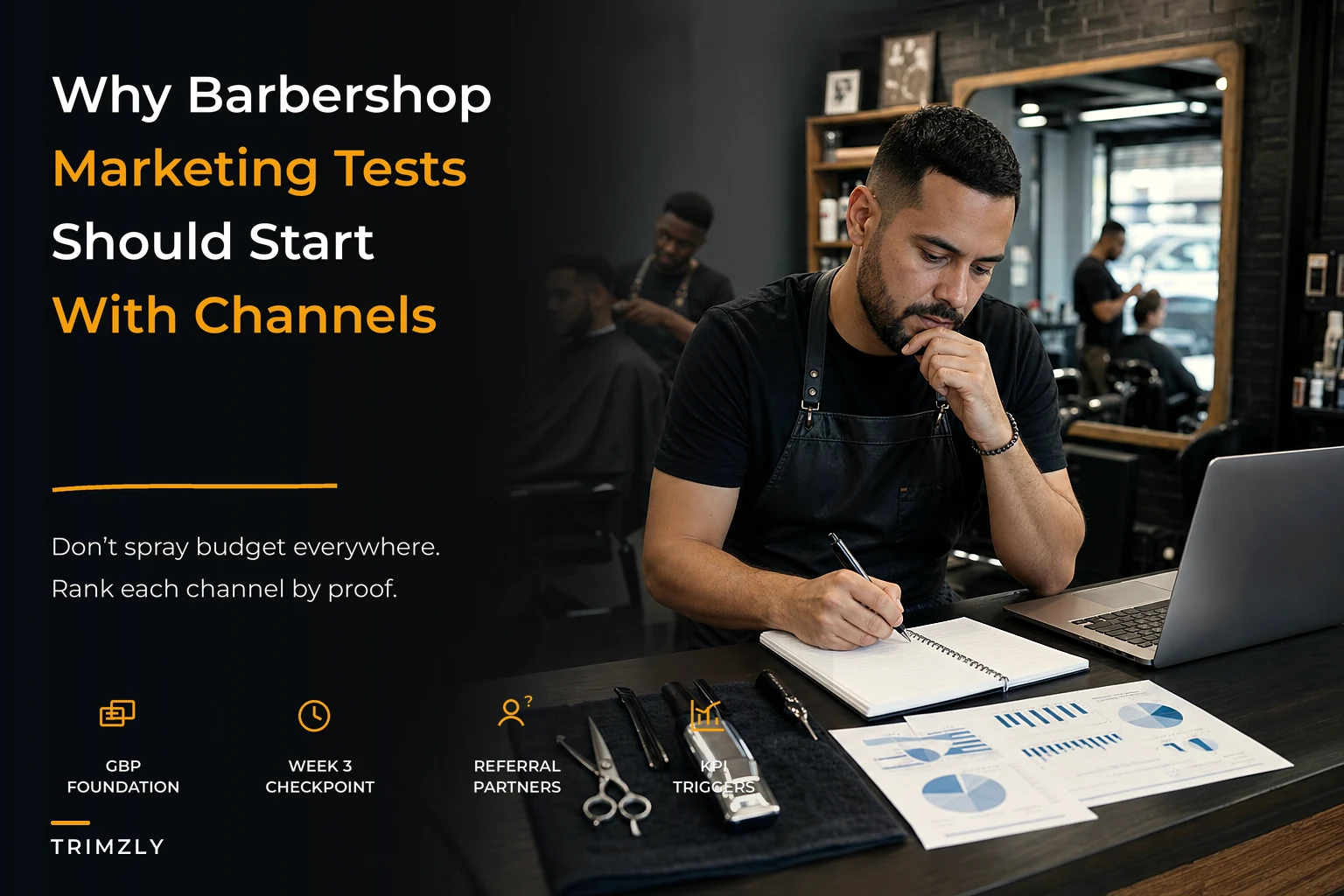
What works is a staged approach where each channel builds on the previous one. Start with what costs almost nothing, then layer in paid channels only after you've proven the basics.
The 12-week channel priority roadmap
``graph
[Week 1-3: GBP Foundation] --> [Week 4-6: Social Proof Builders] --> [Week 7-9: Referral Partner Activation] --> [Week 10-12: Paid Social Testing Sprint]
``
Never miss a booking amidst the hustle.
Trimzly helps you schedule, confirm, and manage every client visit seamlessly.
- Unified appointment management
- Automated client reminders
- Optimized staff scheduling
No credit card required
Weeks 1-3: Google Business Profile foundation
Your GBP is the backbone of any barbershop local marketing system because it captures existing demand. People searching "barber near me" already want a haircut — they're not browsing, they're buying.
Claim and verify your profile. Upload 10-15 real photos — actual cuts, shop interior, your team. Not stock photos. Not that one decent picture from three years ago. Recent content.
Set your hours correctly and update them for holidays. Add your services with clear descriptions and pricing ranges. Enable messaging and respond within an hour during business hours.
Start asking every satisfied client for a review. Not through some automated system yet — just a simple ask at checkout. "If you're happy with the cut, a quick Google review really helps us out." Target 2-3 new reviews per week.
Week 3 checkpoint: At least 6 new reviews, 15+ photos uploaded, and 3-5 profile views daily. If those numbers aren't there, something basic is broken — fix it before moving on.
Weeks 4-6: Low-budget social proof builders
Layer in social proof while your GBP gains traction. This isn't about viral content. It's about giving potential clients multiple touchpoints to validate their decision before booking.
Set up a basic Instagram and Facebook presence if you don't have one. Post three times a week — before/after cuts, shop culture shots, barber spotlights. Nothing fancy, just consistent proof you're active and professional.
Every post should drive back to booking. Not "DM for appointments" — that creates friction. Direct booking links in bio, clear calls to action. Make it easy to go from scroll to scheduled.
Start capturing emails at checkout. "Want to know about last-minute openings and special offers?" Collect them however works — even a Google Sheet is fine right now. You're not sending campaigns yet, just building the list.
Week 6 checkpoint: 100+ Instagram followers, 20+ emails collected, posting 3x per week consistently. If social is taking more than 2 hours weekly, you're overcomplicating it.
Weeks 7-9: Referral partner activation
This is where most shops get the sequence wrong. They try to build referral partnerships before having social proof or a smooth booking process. Partners won't send clients to a shop that looks dormant online.
Find 3-5 local businesses with overlapping clientele and no direct competition. The gym your target clients use. The menswear shop. The coffee spot where professionals start their morning.
Approach them with something specific, not vague "let's partner" talk. "I'll give your members 20% off their first cut, and you get $5 for each one who books." Tangible, trackable, clear.
Set up simple tracking — unique booking codes per partner. "GYM20" or "COFFEE20." Nothing complex. You need to know which partnerships actually drive bookings versus which just sound good.
Week 9 checkpoint: 3 active referral partnerships, each sending at least 2 clients. If a partner sends zero in 3 weeks, replace them. Don't let good-on-paper partnerships drag on.
Weeks 10-12: Paid social testing sprint
Only now do you touch paid advertising. You have reviews, social proof, referral paths working. You know your actual customer acquisition cost from organic efforts, so you can benchmark whether ads make financial sense.
Start with $300-400 monthly on Facebook and Instagram only. One platform, one campaign type, clear tracking. Don't spread across platforms yet.
Run a local awareness campaign targeting men 18-45 within 3 miles of your shop. The creative should be simple — your best before/after transformations, clear pricing, easy booking button. No fancy production.
Track through UTM codes and by asking new clients how they heard about you at intake. You need to know if that $400 brought in 8 bookings or zero. Most shops genuinely have no idea because they never track properly.
Week 12 checkpoint: Paid social should deliver clients at under $25 acquisition cost. If you're paying more than that after the test period, pause and diagnose before spending more.
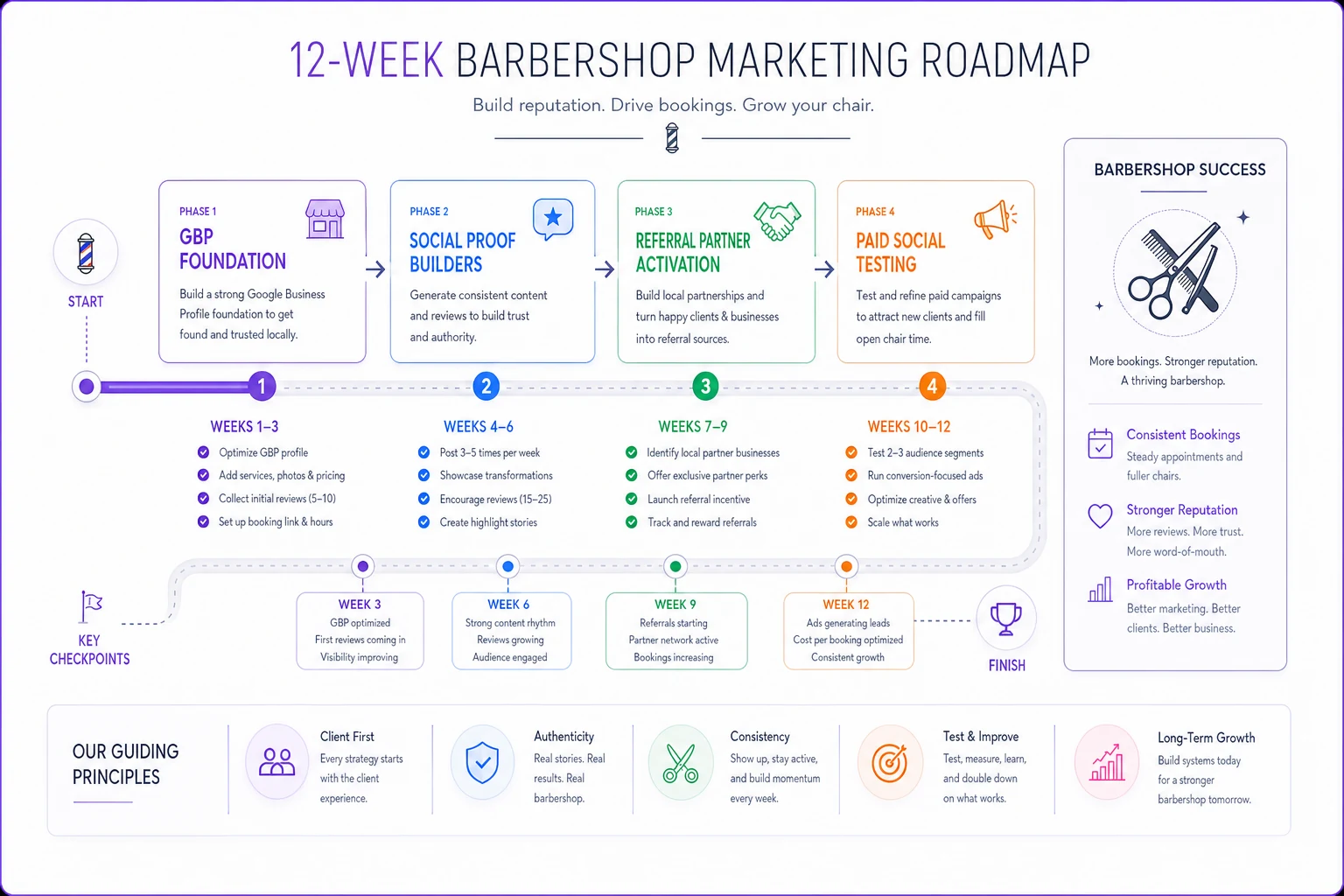
This flow shows the recommended sequence and weekly checkpoints so you can visualize the staged testing approach.
Channel-specific KPIs and stop rules
Every channel needs clear performance triggers — not feelings, not hopes, actual numbers telling you to double down or cut it.
| Channel | Key KPIs | Stop Rule |
|---|---|---|
| Google Business Profile | 5+ daily profile views by week 3, 2+ direction requests weekly, 80%+ message response rate, 4.5+ star average | Not hitting 5+ views daily after full optimization — check location or positioning |
| Social Media | 15+ new followers monthly, 3%+ engagement rate, 2+ trackable bookings weekly, under 3 hrs/week | Fewer than 2 bookings after week 8 or consistently over 3 hrs/week — scale back to maintenance |
| Referral Partnerships | 2+ clients monthly per partner, 50%+ rebook rate, under 1 hr/month to maintain | Any partner sending fewer than 2 clients in month one gets cut |
| Paid Advertising | Under $25 customer acquisition cost, 3X+ ROAS within 60 days, 40%+ second-visit rate | Cost per acquisition over $30 for two consecutive weeks — pause immediately |
Stop rules matter as much as the KPIs themselves. Without them, underperforming channels just keep running on hope.
The compounding effect most shops miss
When you sequence channels correctly, each one amplifies the others.
Better GBP drives organic traffic. Those clients leave reviews, which strengthens the profile further. Social posts featuring real transformations build trust. Referral partners feel confident sending people to a shop with a real online presence. Paid ads convert better when prospects see reviews and active social proof before clicking.
Compare that to running Facebook ads with two Google reviews and a dormant Instagram. Every marketing dollar works harder when the foundation is solid.
The shops winning at local marketing aren't spending the most. They're testing in the right order, measuring what matters, and cutting what doesn't without getting emotionally attached.
Real-world tracking setup
You can't manage what you don't measure, but most shops track nothing beyond total revenue. Here's the minimum setup that actually gets used:
-
New clients by source (GBP, social, referral, paid, walk-in, other)
-
Marketing spend by channel
-
Time invested by channel
-
Client acquisition cost by channel
-
Second visit rate by source
Use a simple template so anyone on staff can update the spreadsheet in under five minutes.
That's it. 15 minutes on Sunday. But after 12 weeks, you'll know exactly which channels drive profitable growth versus which just feel productive.
The data shows things gut instinct misses. Like that networking group sending one client monthly while your GBP quietly delivers 12. Or that Instagram — despite decent engagement — hasn't produced a single trackable booking. You won't see those patterns without writing it down consistently.
When to break the sequence
The 12-week roadmap works for most shops, but three situations justify adjusting the order:
Scenario 1: Brand new location with zero foot traffic. You might need paid ads earlier to build initial awareness while organic channels develop. But still start with GBP — it's free and foundational regardless.
Scenario 2: You have a strong client base (200+ regulars) but they're not referring anyone. Skip toward referral activation while backfilling the digital presence. Your existing clients become your primary marketing channel.
Scenario 3: You're already at capacity with a waitlist. More marketing volume would be pointless. This is when you focus on redesigning your service menu to raise average ticket.
Common objections to the staged approach
"But my competitor is killing it on TikTok!"
They probably also have 50+ Google reviews and respond to every message quickly. You're seeing their highlight reel, not their foundation. Shops rarely succeed on advanced channels without nailing the basics first.
"I don't have time for all these channels."
That's exactly why the sequence matters. You don't manage all channels forever. You test systematically, find the one or two that actually work, then cut everything else. Most shops end up with GBP plus one other channel.
"My clients don't leave reviews or use social media."
Then paid ads matter more earlier in your sequence. But you'd be surprised how many supposedly non-digital clients still check Google before booking somewhere new. Test the assumption before skipping foundational channels.
The automation opportunity
Once you've identified which channels actually drive bookings, that's when operational software starts making sense. Not before. Too many shops buy marketing automation before knowing what they're trying to automate.
AI-powered platforms can handle review requests after appointments — removing the awkward front desk ask entirely. They can track source attribution automatically instead of relying on manual intake questions. They can manage referral partner payouts without the spreadsheet work.
But automation amplifies what's already working. It doesn't fix a broken channel strategy. Get the sequence right first, then systematize what's actually producing results.
The same logic applies to your operations more broadly. Marketing brings clients in, but keeping them requires solid systems behind the scenes. That's when it makes sense to build a barbershop operating system with clear roles and SOPs to handle the increased volume without things breaking.
Stop overthinking, start testing
Most barbershop local marketing system failures come from paralysis, not lack of effort. Owners spend months researching the perfect Instagram strategy while their GBP sits unclaimed. They debate Facebook versus Instagram ads without ever running a single test.
The 12-week roadmap cuts through that. Week 1, you're updating your Google profile. Week 4, you're posting consistently. Week 10, you're running ads. No endless decisions, just execution.
By week 12, you'll have real data on what works for your specific shop, location, and clientele. Not what some marketing course says should work. Not what worked for a shop in Manhattan. What actually drives bookings for you.
The shops growing consistently aren't doing anything revolutionary. They test channels in a logical order, measure results honestly, and double down on what works while cutting what doesn't. Marketing treated like any other operational system — with clear processes, metrics, and decision rules. Your next three months are mapped out.
Ready to elevate your barbershop operations?
Join 500+ barbershops using Trimzly to save time, reduce scheduling conflicts, and enhance client satisfaction.