

Two barbers in the same shop, same price point, same booking software. One has a 68% rebook rate. The other sits around 40% and quietly generates most of your re-dos. Same haircut on the menu, wildly different execution — and the client feels that gap even when they can't name it.
That gap is the thing nobody builds a system around. Owners obsess over ramping new hires and writing SOPs, but once someone is "trained," quality just drifts. Nobody's checking whether Marcus's fade taper still matches what the shop actually promises, or whether Dev's beard lines have gotten sloppier since he got comfortable.
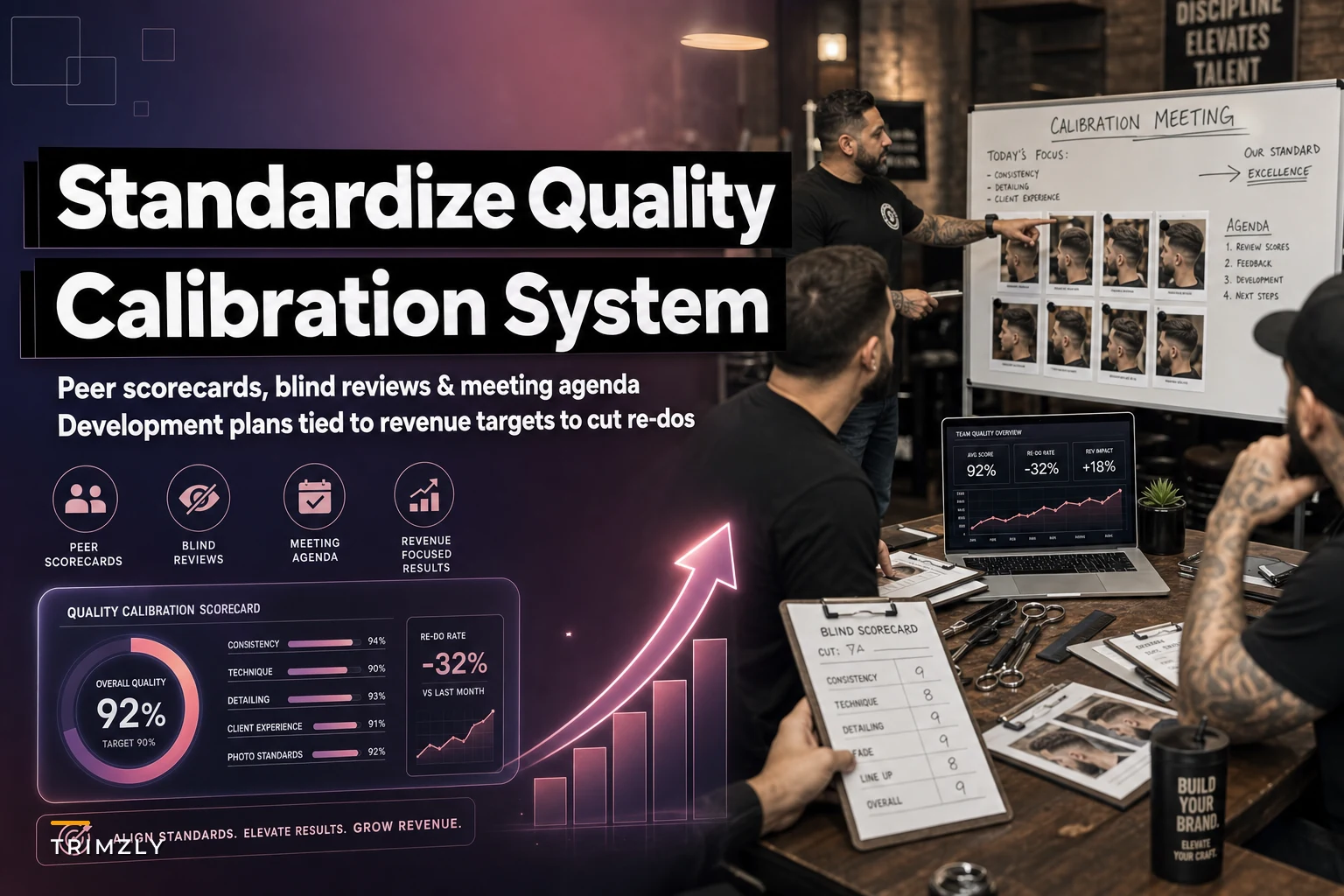
A barber mentoring calibration system closes that drift. It's three pieces working together: a peer scorecard so quality gets evaluated consistently, a monthly calibration meeting so your team actually agrees on what "good" means, and individual development plans tied to real revenue targets so improvement isn't just abstract feedback. Here's how to build each one.
Why quality drifts even in a well-run shop
The pattern is almost always the same. You hire well, onboard people properly, and for the first few months quality is tight because everyone's paying attention. Then the shop gets busy, the owner steps back onto the floor to cut, and nobody's checking work anymore. Standards don't collapse — they erode. A quarter-inch here, a rushed neckline there, a consultation skipped because the barber "already knows what this guy wants."
The insidious part is that each barber recalibrates to their own standard, not the shop's. Six months in, you don't have one shop with one quality bar — you have four barbers running four slightly different shops under one roof. Clients who bounce between chairs feel it immediately, and that's when the "can you just fix this real quick" requests start piling up.
The re-dos are the symptom everyone notices. The actual problem is that no two people in your building agree on what a finished, sellable haircut looks like — and there's no regular moment where they'd ever work that out.
The peer scorecard: making "good" measurable
Most quality evaluation in barbershops is a gut feeling. "That looks clean" or "eh, the blend's a little off." The problem with gut feelings is they don't transfer between people and they don't create accountability.
Never miss a booking amidst the hustle.
Trimzly helps you schedule, confirm, and manage every client visit seamlessly.
- Unified appointment management
- Automated client reminders
- Optimized staff scheduling
No credit card required
A peer scorecard turns that into something repeatable. It's not a performance review — it's a snapshot of a single finished cut, scored by a peer, using the same criteria every time.
Keep it short. If it takes more than three minutes to fill out, nobody will use it consistently. Here's a structure that actually gets used:
| Criteria | What you're checking | Score (1–5) |
|---|---|---|
| Consultation captured | Did they confirm length, guard, and reference before starting | |
| Blend / transition | No visible guard lines, smooth gradient | |
| Outline & neckline | Clean, symmetrical, matches face shape | |
| Detail work | Beard, edges, ear/nose area handled | |
| Finish & styling | Product applied, client shown the back, ready to walk out | |
| Timing vs. booked slot | Finished on time without rushing quality |
The scoring rule that makes this work: a 3 is not acceptable. A 3 means "a paying client would notice something off." Your shop standard is 4s and 5s. If people start treating 3 as "good enough," you've recreated the exact drift you're trying to kill.
Who scores whom matters too. Don't let barbers only score their friends. Rotate it — everyone scores at least two peers' work per week, ideally including someone more senior. This isn't about catching people. It's about building a shared eye across the team so "clean" means the same thing at every chair.
One practical note: score real client cuts on the floor, not staged demos. Staged work is always cleaner and tells you nothing about how someone actually performs at 2pm on a packed Saturday.
The monthly calibration meeting: agreeing on the standard
Scorecards are useless if everyone interprets the criteria differently. One barber's "5" is another's "3." The calibration meeting exists to close that gap — and it's probably the single most skipped and most valuable part of this whole system.
The concept is borrowed from how exam graders calibrate. You take the same piece of work, everyone scores it independently, then you compare notes. The disagreements are the gold. When two barbers score the same fade a 5 and a 2, you've found a place where your shop doesn't actually agree on quality — and that's exactly what you resolve in the meeting.
-
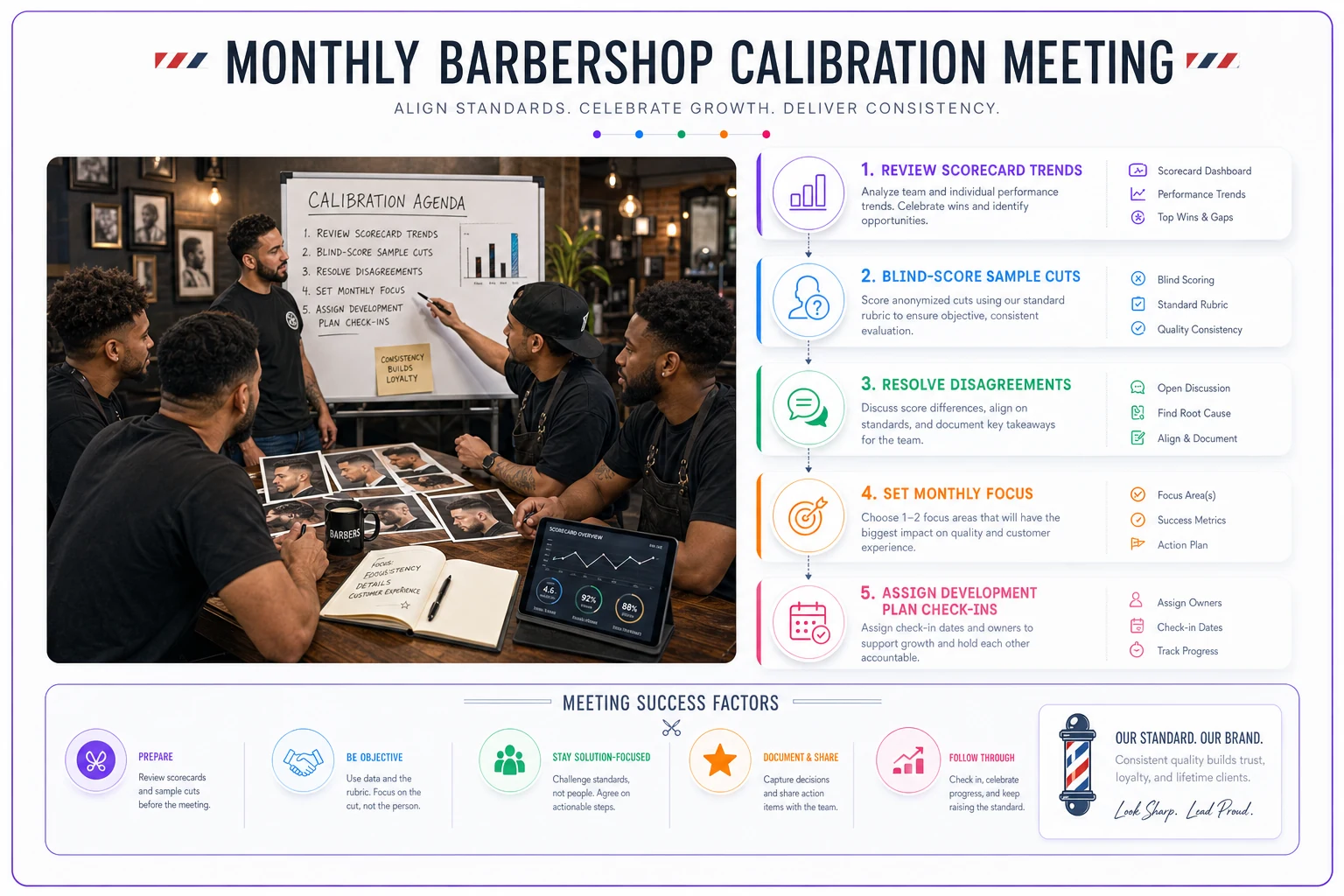
Review last month's scorecard trends (5 min). Where are the low scores clustering? Blends? Necklines? Consultations? Name the pattern, don't name-and-shame individuals.
-
Blind-score two sample cuts together (15 min). Pull 2–3 recent client photos (front, sides, back). Everyone scores independently on paper, then reveal. Discuss the spread.
-
Resolve the disagreements (15 min). This is the core. When scores split, the senior barber or owner explains what the standard actually is, and you write it down. "A visible guard line at the temple is a 2, not a 3" becomes shop law.
-
Set one shared focus for the month (5 min). Pick the single weakest area across the team and make it the calibration theme. Everyone works on blends this month, for example.
-
Assign development plan check-ins (5 min). Quick confirmation of who's meeting with whom on their individual plans.
The meeting only works if the owner resists the urge to just dictate. If you announce the standard and move on, nobody internalizes it. The disagreement discussion is what actually recalibrates everyone's eye. Let people argue a fade for five minutes — that argument is the training.
A workflow for running the monthly calibration meeting:
Consistent before/after photos make this meeting dramatically easier. When every cut is documented the same way, you always have real material to calibrate against instead of relying on someone's memory of what a cut from three weeks ago looked like.
Tying development plans to revenue targets
Most improvement efforts die because they stay abstract. "Work on your blends" isn't a plan. It doesn't have a finish line and it doesn't connect to anything the barber actually cares about — namely, money.
An individual development plan (IDP) takes the scorecard gaps and turns them into specific, dated goals — then ties those goals to a revenue number so the barber sees exactly why the skill matters.
-
Current state Rebook rate 44%, average scorecard 3.4, weakest area = blends and consultation.
-
90-day skill goals Consistent 4+ on blends, consultation captured on every cut, average scorecard to 4.2.
-
Revenue target tied to it Rebook rate from 44% to 55%, which at ~35 clients/week works out to roughly $600–$900 more in monthly repeat revenue.
-
Support Paired with senior barber for two calibration sessions/month, shadowing one blend-heavy cut per week.
-
Check-in cadence Every two weeks, 10 minutes.
The revenue math is approximate and honest. You're not promising an exact number — you're showing the barber that better work directly fills more of their own calendar. That framing shifts the conversation from "the boss thinks my cuts are bad" to "here's how I make more money doing what I already do."
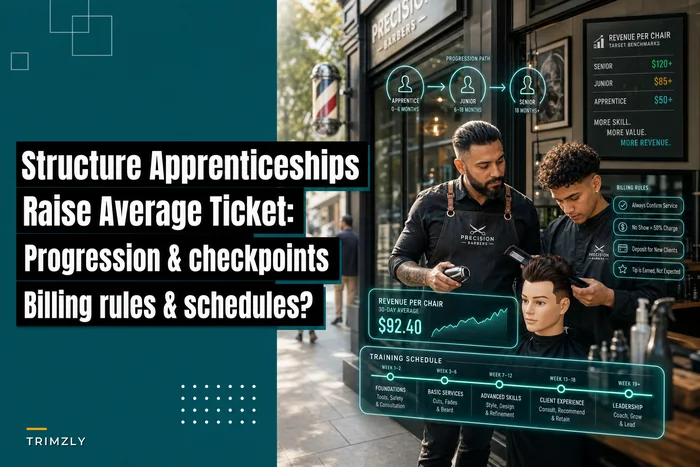
This is also where the mentoring pairing matters most. Mid-level barbers improve fastest when a specific senior person owns their development, not the whole shop vaguely. If you're structuring how junior barbers progress through your ranks, this connects directly to the checkpoint logic in structuring apprenticeships that raise average ticket — the calibration scorecard becomes the objective measure that decides when someone's actually ready to level up.
A real scenario
A three-chair shop in a mid-size suburb had a persistent re-do problem — somewhere around 6–8 free fixes a week across the team, mostly on fades and necklines. The owner assumed it was one weak barber. It wasn't.
When they started scoring cuts with a peer scorecard, the data showed re-dos were spread across everyone, and they clustered in one place: blend transitions. Every barber thought their blends were fine. In the first calibration meeting, the same fade got scored a 5 by one barber and a 3 by two others. That single disagreement told them their standard had never actually been shared.
They ran the system for about a quarter. Monthly meetings, biweekly IDP check-ins, blends as the shared focus for the first two months. Re-dos dropped to around 2–3 a week. Average scorecard across the team moved from the mid-3s to low-4s. Rebook rate crept up a few points, which the owner mostly attributed to clients getting a more consistent result regardless of which chair they landed in.
His own read on it was blunt: the problem was never a bad barber. It was that nobody had ever sat everyone in a room and made them agree on what finished work actually looked like.
When this makes sense — and when it doesn't
This system pays off when you have three or more barbers and quality is visibly inconsistent between them. If clients react differently depending on who cuts them, calibration is exactly the right tool.
It's also worth building if you're about to hand off floor management. You can't delegate quality control to a lead barber if there's no defined standard to enforce. The calibration scorecard gives your lead something objective to manage against — which pairs well with the thinking in tying role handoffs to profit-per-chair.
When it's a bad idea: If you're a solo operator or a two-person shop where you already see every cut, this is overkill. You are the calibration. Skip the formal scorecard and just keep an eye on the work.
Who should not do this: Owners who'll use scorecards as a firing paper trail. The moment your team senses that calibration is really about building a case against someone, honest scoring dies and the whole thing becomes theater. This only works in a culture where a 3 is a coaching opportunity, not a warning.
Keeping it running without it becoming a burden
The reason these systems die is admin friction. Nobody wants to chase paper scorecards, dig through camera rolls for before/after photos, or manually track whose IDP check-in is due. Once it feels like homework, it quietly stops happening within a month or two.
The fix is making data collection nearly invisible. When your booking and client-history platform already captures consultation notes and cut photos as part of the normal appointment flow, you're not creating extra work — the raw material is just there. Scorecards pull from real, documented cuts. Development-plan check-ins get scheduled and reminded automatically instead of living in someone's head. The calibration meeting has photos ready to pull up instead of "does anyone have a pic of that fade from Tuesday?"
That's the practical advantage of running this on top of software you already use daily rather than a separate binder or folder system. The system survives because nobody has to babysit it.
Bringing it together
Standardizing quality across chairs isn't about being stricter or watching people more closely. It's about giving your whole team the same definition of "done" and a repeatable way to move toward it. The peer scorecard makes quality measurable. The monthly calibration meeting makes it shared. The revenue-linked development plans make it worth every barber's time to actually follow through.
Start small. Run one calibration meeting next month with two sample cuts and a basic scorecard. You'll learn more about where your quality actually stands in that first 45-minute disagreement than in a year of assuming everyone's on the same page. Build from there — once the standard is genuinely shared, the re-dos mostly take care of themselves.
Start small. Run one calibration meeting next month with two sample cuts and a basic scorecard. You'll learn more about where your quality actually stands in that first 45-minute disagreement than in a year of assuming everyone's on the same page. Build from there — once the standard is genuinely shared, the re-dos mostly take care of themselves.
Ready to elevate your barbershop operations?
Join 500+ barbershops using Trimzly to save time, reduce scheduling conflicts, and enhance client satisfaction.