


Most barber-owners don't have a delegation problem. They have a decision-rights problem.
You already know you're doing too much. You approve refunds, order product, fix the schedule when someone calls out, close the till, interview, and handle the one angry regular who wants a discount. The advice everyone gives — "delegate more" — is useless because it treats delegation like a switch. Hand off the task, walk away, done.
That's not how it works in a shop. When you hand off ordering without handing off the authority to make the ordering call, you've just added a middleman: yourself. The barber still texts you before placing the order. You've delegated the labor but kept the decision, which means you kept the bottleneck.
This is a playbook for actually letting go — but structured so that every handoff is tied to a number you care about. Specifically profit-per-chair, because that's the metric that tells you whether delegation is working or whether you're just distributing chaos.
Why delegation quietly stalls in most shops
The pattern is almost always the same. An owner gets busy enough to hire help, promotes their most reliable barber to "lead" or "manager," and then nothing structural changes. The lead barber gets a title and maybe a small bump, but the owner keeps making every real decision.
Six months later the owner is still exhausted, the lead is frustrated because they have responsibility without authority, and the shop hasn't gained any capacity to grow.
Here's the mechanism. Delegation fails when three things aren't defined:
-
What decision is being handed off (not the task — the decision)
-
What guardrails the decision lives inside (spend limits, policy boundaries)
-
What the person is accountable for numerically (the outcome you'll measure)
Without those three, you don't have delegation. You have supervision with extra steps.
And the thing that breaks at scale is coordination. One owner running one shop can hold all the decisions in their head. The second you add a second location — or even just a second full shift — the mental model stops fitting. Decisions start getting made inconsistently, or not at all, because everyone's waiting on you. If you're anywhere near thinking about a second location, unresolved delegation is the thing that will quietly sink it.
RACI, but built for a barbershop (not a corporate org chart)
RACI is a boring acronym that solves a real problem: it forces you to separate the person doing the work from the person who owns the outcome from the person who just needs to be told.
Never miss a booking amidst the hustle.
Trimzly helps you schedule, confirm, and manage every client visit seamlessly.
- Unified appointment management
- Automated client reminders
- Optimized staff scheduling
No credit card required
-
- R — Responsible does the actual work
-
- A — Accountable owns the result, has the final call (only ever one person)
-
- C — Consulted gives input before the decision
-
- I — Informed told after the fact
The mistake most owners make is putting themselves as "A" on everything. That's the whole disease. The point of this exercise is to move the A off your name, one row at a time.
Here's a realistic starting RACI for a growing single-location shop with an owner, a lead barber, 3–4 chairs, and a front-desk person:
| Decision area | Owner | Lead barber | Barbers | Front desk |
|---|---|---|---|---|
| Daily schedule adjustments | I | A | C | R |
| Product reordering (under $500) | I | A | C | R |
| Refunds / service redos | C | A | R | I |
| Hiring (screening & trials) | A | R | C | I |
| Final hiring offer | A | C | I | I |
| Pricing changes | A | C | I | I |
| Retail displays & upsell push | I | A | R | C |
| Payroll approval | A | I | I | I |
| Peak-hour chair assignment | I | A | R | I |
| Handling escalated client complaints | C | A | R | I |
Two things worth noticing.
First, the owner is only Accountable for things that genuinely can't be delegated yet — hiring offers, pricing, payroll. Everything operational moves to the lead. That's the shift from operator to owner in one table.
Second, front desk is the most under-leveraged role in the building. They touch scheduling, reordering, and client flow all day, but owners rarely give them real decision rights, so they escalate everything. Give them guardrails and half your interruptions disappear.
Tie every handoff to profit-per-chair
Every delegated decision should connect to a number, and profit-per-chair is the cleanest one for a barbershop because it normalizes across shop size.
Rough math: profit-per-chair = (chair revenue − direct chair costs − allocated overhead) ÷ number of chairs.
Why this metric? Because it exposes whether delegation is helping or just offloading. If you hand off scheduling to your lead and profit-per-chair holds steady while your own hours drop — that's a win, you bought back time at no cost. If you hand off reordering and product cost creeps up 4 points, the delegation is leaking money and you need tighter guardrails, not to take it back.
A typical scenario: a four-chair shop running around $22k–$24k monthly per chair in revenue, profit-per-chair sitting near $6k–$7k. The owner delegates reordering and upsell coaching to the lead over a quarter. Product margin improves slightly because the lead actually watches SKU turns instead of panic-ordering, and average ticket ticks up from a more consistent retail push. Profit-per-chair moves toward $7.5k while the owner's floor hours drop by roughly 12 a week.
That's the whole game. You're not measuring "did they do the task." You're measuring "did handing this off preserve or improve the economics while freeing me."
-
Scheduling & chair assignment → chair utilization → profit-per-chair
-
Reordering → product margin & stockouts → profit-per-chair
-
Upsell / retail → average ticket → profit-per-chair
-
Refunds/redos authority → rework rate → profit-per-chair
-
Hiring & ramp → time-to-productive → profit-per-chair
Each handoff has a metric owner now. Not you.
The 12-week transition roadmap
You can't hand everything off in a weekend. Try, and you'll get one of two outcomes: the lead drowns, or they quietly route everything back to you within a couple weeks. The transition works when it's sequenced from lowest-risk to highest-risk decisions, giving trust and competence time to build together.
-
Weeks 1–2 — Map and baseline. Fill out the RACI honestly — where you actually are, not where you wish you were. Pull baseline numbers: profit-per-chair, chair utilization, average ticket, product cost %. You can't tell if delegation worked without a before.
-
Weeks 3–4 — Hand off scheduling and daily adjustments. Lowest risk, highest daily interruption relief. Give the lead full authority over the day's schedule and callout coverage. Set the guardrail: they can move anything except firing or comping without asking. You get informed, not consulted.
-
Weeks 5–6 — Hand off reordering under a dollar cap. Set a per-order limit ($500 is common for a small shop). The lead owns product margin now. Watch the product cost % weekly. This is where you find out whether your guardrail number is actually calibrated right.
-
Weeks 7–8 — Hand off refunds, redos, and complaint resolution. Give the lead a policy envelope: authority to comp up to one service or offer a redo without owner sign-off. This one scares owners the most and relieves them the most. Track rework rate so you know if standards slip.
-
Weeks 9–10 — Hand off hiring screening and trials. Owner still owns the final offer, but the lead runs the screen and trial shift. This is where a real onboarding structure matters — pair it with a proper 30/60/90 ramp checklist so new hires hit revenue targets predictably instead of dragging profit-per-chair down for months.
-
Weeks 11–12 — Hand off retail/upsell ownership and lock the cadence. Lead owns average ticket and the retail push. By now most of the operational A's have moved off your name. Formalize the meeting rhythm (below) so the handoffs don't quietly reverse.
The reason this sequence works: each stage produces a visible number before the next stage begins. If weeks 5–6 blow up product cost, you fix it before piling refunds authority on top. Delegation that stacks decisions before validating the last one is how shops end up in the "I tried delegating and it was a disaster" trap — and why those owners do everything themselves from then on.
A useful way to visualize this is as a pipeline: baseline and map → hand off low-risk daily decisions → validate numbers → hand off mid-risk operational decisions → validate again → hand off hiring and retail → lock cadence. Each gate only opens if the previous one held.
Here's a simple visual to keep the sequence clear.
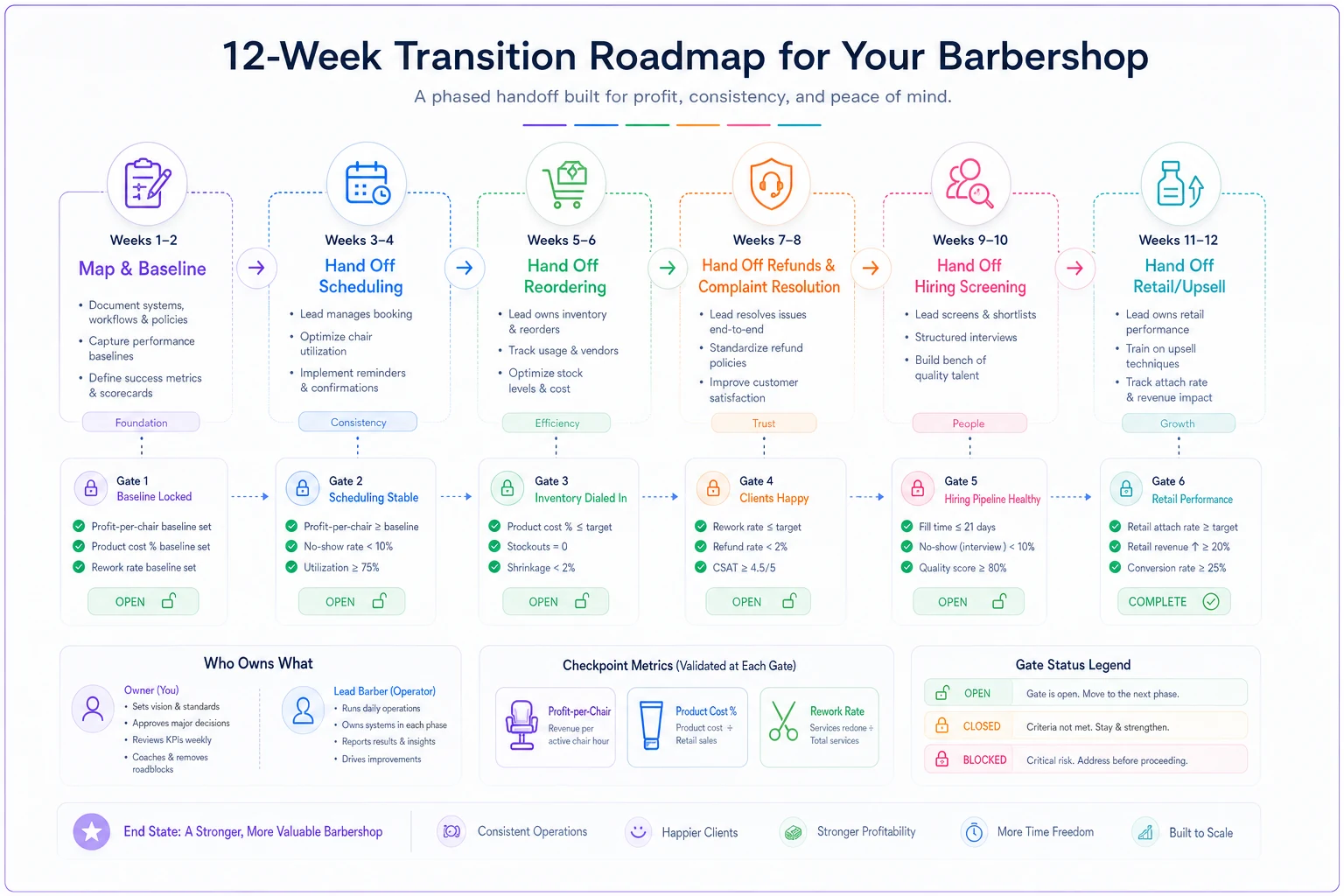
Each gate only opens if the previous one held.
Meeting cadence: the thing that keeps handoffs from reversing
Handoffs decay without a rhythm. What happens is subtle — a barber has a question, you happen to be around, you answer it, and now you've re-inserted yourself into a decision you'd handed off. Do that enough times and the lead stops owning it.
A cadence gives decisions a place to live other than "whenever the owner's around."
-
Daily huddle (5–10 min) front desk + lead. Today's schedule, gaps, any callouts, retail focus for the day. Owner not required.
-
Weekly ops review (30 min) owner + lead. Review profit-per-chair, utilization, product cost %, rework rate, average ticket. This is where the owner stays informed without being involved daily.
-
Monthly business review (60 min) owner + lead. Pricing, hiring pipeline, bigger spend decisions, progress on the transition roadmap.
Keep the weekly ops review focused on metrics and decisions to avoid slipping back into ad-hoc daily interventions.
The weekly ops review is the load-bearing meeting. It's where you resist the urge to grab a decision back. If the lead made a call you'd have made differently but the numbers held, you let it go. That's the discipline that actually completes the transition.
If you already run structured operations, this cadence should slot into your existing operating system of roles and SOPs rather than replace it.
Sample handoff template
Every handoff should be written down. Verbal handoffs are how you end up with two people convinced they had different authority. A one-pager per decision area, roughly like this:
Decision area: Product reordering Now accountable: Lead barber Authority: May place orders up to $500 per order without approval Guardrails: No new suppliers without owner sign-off. Keep product cost under 12% of service revenue. Metric owned: Product cost %, stockout incidents Escalate to owner when: Order exceeds $500, supplier change, product cost trends above 13% for two consecutive weeks Reviewed: Weekly ops review
Boring on purpose. The boring documents are the ones that survive a busy Saturday.
Where the software layer quietly helps
None of this requires software to start. But the friction point that trips up delegation is visibility — the lead can't own product margin if they can't see product margin, and you can't stay informed-not-involved if the only way to check the numbers is to be physically present.
This is where AI-assisted operational platforms actually earn their keep. When your scheduling, till, retail, and inventory data live in one place, the weekly profit-per-chair number generates itself instead of you rebuilding a spreadsheet every Sunday. Automated flags — product cost creeping past a threshold, a chair's utilization dropping, rework rate ticking up — surface exactly what a delegating owner needs to see without hovering over every shift.
The honest role of the tooling is this: it makes "informed" cheap. When staying informed takes five minutes on a dashboard instead of an hour on the floor, you actually stay out of the operational weeds — which is the entire point of the transition.
When this makes sense — and when it doesn't
This works well when: you have at least one person capable of taking on real accountability, your shop is stable enough to survive a few imperfect decisions during handoff, and you can actually articulate what each metric should look like in a good week.
This is a bad idea when: you don't have a reliable second-in-command yet. Delegating decision rights to someone who isn't ready doesn't create an owner — it creates a mess with your name still on the outcome. Fix hiring and ramp first.
Who should not do this yet: owners whose numbers are a mystery to them. If you can't calculate profit-per-chair today, you can't tell whether delegation is helping or hurting. Get the baseline before you hand off a thing.
A real scenario
A two-chair-turned-four-chair shop, owner working roughly 55 hours a week handling basically every decision. Profit-per-chair around $6k, average ticket flat, product ordering done in a panic every couple of weeks whenever something ran low.
Over a 12-week transition, the owner moved scheduling, reordering, refunds, and retail ownership to a lead barber — each with a written guardrail and a metric attached. Nothing exotic, just sequenced handoffs and a weekly review that actually happened.
By the end: floor hours dropped to the low 40s, product cost tightened by 2–3 points because someone was finally watching SKU turns instead of over-ordering, and average ticket edged up from a more consistent retail push. Profit-per-chair landed near $7k. Not a miracle — but the owner got roughly 12–15 hours a week back and the numbers held, which is what expansion-readiness actually looks like.
The real point
Delegation isn't about doing less work. It's about moving decision rights — with guardrails and a number attached — off your name and onto someone accountable, then checking the profit-per-chair math to confirm the handoff didn't quietly cost you.
Do that in sequence over a quarter, protect it with a meeting rhythm, and you stop being the person the shop can't run without. That's not just less exhausting. It's the exact condition you need to be in before a second location is even a reasonable conversation.
Ready to elevate your barbershop operations?
Join 500+ barbershops using Trimzly to save time, reduce scheduling conflicts, and enhance client satisfaction.