

Most barbershop apprenticeship programs fall apart at the same point: they teach technical skills without connecting those skills to revenue. Your apprentice can fade beautifully, but if they're taking 90 minutes per cut and charging half your shop rate, you're running a charity.
The real challenge isn't teaching someone to cut hair. It's structuring their progression so each stage generates enough revenue to justify the training investment while protecting your shop's reputation.
The most successful programs tie skill progression directly to revenue targets. Not vague "when they're ready" checkpoints, but specific performance metrics that prove an apprentice can generate predictable income at each level.
The three-tier progression framework that balances learning with earning
Structuring apprentices through clear tiers creates accountability for both the trainee and the shop. Each tier needs distinct responsibilities, billing rules, and revenue expectations that gradually build toward full barber status.
Apprentice Level (Months 1-6): Foundation and observation
At the apprentice level, trainees primarily assist senior barbers while learning basic techniques. They're not generating direct service revenue yet, but they're creating value through efficiency.
-
Shop maintenance and sanitation
-
Client check-in and preparation
-
Tool sterilization and setup
-
Assisting with shampooing and cleanup
-
Observing consultations and cuts
Revenue contribution at this stage comes from increased throughput. When apprentices handle prep work, senior barbers can fit in 2-3 additional appointments per day. At $35 average per cut, that's roughly $420-630 in weekly value per apprentice.
Compensation typically ranges from minimum wage to $2 above, depending on your market. Some shops offset this by charging apprentices for education hours — usually $50-150 weekly for structured training sessions.
Junior Barber Level (Months 7-18): Supervised service delivery
Junior barbers begin cutting under supervision, starting with simple services and expanding from there. This is where billing structures get critical.
-
Basic buzzcuts and single-guard fades
-
Simple tapers and line-ups
-
Standard fades with basic blending
-
Beard trims and shaping
-
Kids cuts (often their primary focus early on)
Billing during this phase usually follows a split model. Junior barbers charge 60-75% of standard rates, with the discount clearly communicated to clients as "junior barber pricing." For a shop charging $35 standard, juniors might charge $22-26.
The revenue target at this level should be $300-500 daily in service sales. With junior pricing, that translates to roughly 12-20 services. Unrealistic at first, sure — but by month 12-14, consistent juniors get there.
Key checkpoint metrics:
-
Average service time under 45 minutes
-
Rework rate below 10%
-
Client request rate above 20%
-
Weekly revenue minimum of $1,500
Senior Barber Level (Month 18+): Independent operation
Senior progression happens when juniors consistently exceed revenue targets and demonstrate technical proficiency across all services. They charge full rates and manage their own book.
-
Consistent $600+ daily revenue
-
30-minute average service time for standard cuts
-
85%+ rebook rate
-
Less than 5% rework or complaint rate
-
Ability to execute specialty services (designs, razor work)
At this level, barbers typically move to standard commission structures (60-70%) or chair rental arrangements ($200-400 weekly in most markets).
Here's a visual of the progression workflow and how responsibilities, billing rules, and checkpoints connect.
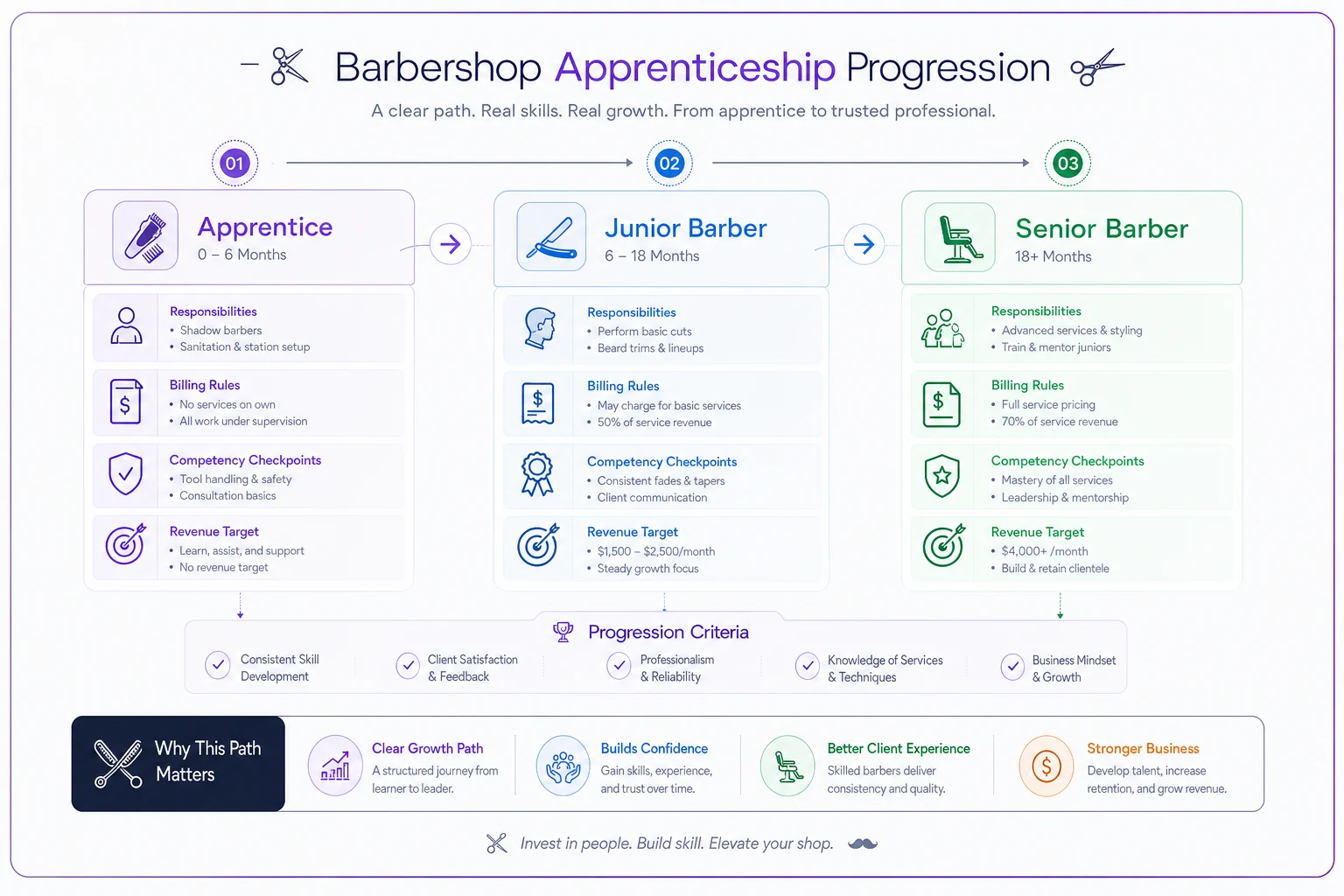
The flow shows how efficiency and revenue expectations increase as technical competency and billing rates change.
Competency checkpoints that prevent premature promotion
The biggest mistake shops make is moving apprentices forward based on time rather than demonstrated ability. Every progression should require passing specific competency checkpoints that prove readiness for the next level.
Never miss a booking amidst the hustle.
Trimzly helps you schedule, confirm, and manage every client visit seamlessly.
- Unified appointment management
- Automated client reminders
- Optimized staff scheduling
No credit card required
Technical skill validation
Create standardized tests for each service type. Not subjective "looks good to me" evaluations — measurable assessments:
Fade Test Requirements:
-
Complete three different fade heights (low, mid, high)
-
Each within 35 minutes
-
Evaluated by two senior barbers
-
Score 4+ on 5-point scale for blend quality
-
Score 4+ for symmetry
-
Score 4+ for guideline consistency
Consultation Test:
-
Role-play five different client scenarios
-
Demonstrate proper questioning technique
-
Suggest appropriate styles based on face shape and hair type
-
Handle a dissatisfied client scenario
-
Upsell additional services appropriately
Speed Test Benchmarks:
-
Buzz cut
15 minutes
-
Standard fade
30 minutes
-
Fade with beard
40 minutes
-
Kids cut
20 minutes
-
Design work
45-60 minutes
Revenue performance gates
Technical skill means nothing without revenue generation. Set clear financial checkpoints:
Apprentice to Junior transition:
-
Shadow 100+ full services
-
Complete 50+ supervised prep services
-
Generate $500+ weekly in efficiency value
-
Pass basic fade and consultation tests
Junior to Senior transition:
-
Maintain $1,500+ weekly revenue for 3 consecutive months
-
Achieve 25+ client requests monthly
-
Hit 85%+ satisfaction scores
-
Complete advanced technique certifications
-
Build a book of 40+ regular clients
These gates protect both your business and the apprentice. Premature promotion leads to frustrated clients, damaged reputation, and barbers who weren't ready for the pressure.
Billing structures that protect margins while building skills
How you price apprentice services directly impacts their development and your bottom line. Price too low and you undervalue the work. Price too high and you're overcharging for inconsistent quality.
The graduated pricing model
Instead of flat junior rates, implement graduated pricing that increases with demonstrated competency:
| Stage | Months | Service | Rate | Barber Take | Shop Take |
|---|---|---|---|---|---|
| Apprentice Observer | 1-3 | None | $0 | Hourly wage | N/A |
| Apprentice Assistant | 4-6 | Prep only | $0 | Hourly wage | N/A |
| Junior I | 7-10 | Basic cuts | 60% of standard | 40% commission | 60% |
| Junior II | 11-14 | Most services | 70% of standard | 50% commission | 50% |
| Junior III | 15-18 | Full menu | 85% of standard | 55% commission | 45% |
| Senior | 18+ | Full menu + specialty | 100% | 60-70% commission | 30-40% |
This structure does a few things well. Clients understand they're paying less for someone still learning. Apprentices see a direct financial reason to improve. And your shop maintains margins while building talent.
Protected service categories
Certain high-margin or high-skill services should stay senior-only until specific certifications are achieved:
Senior-Only Services:
-
Hot towel shaves (liability and skill requirements)
-
Hair designs and artwork (reputation protection)
-
Color services (if offered)
-
Special event styling (weddings, photoshoots)
-
VIP or executive packages
This protects your premium reputation while giving juniors clear goals. One shop posted the daily revenue from senior-only services where apprentices could see it — junior motivation went up noticeably.
Training day billing rules
Formal training days need different billing structures. Most successful programs follow one of these models:
Option 1: Education Fee Model
-
Apprentices pay $75-150 per formal training day
-
Covers instructor time and materials
-
Creates buy-in and commitment
-
Works best in high-demand markets
Option 2: Service Credit Model
-
Apprentices provide free or discounted services to models
-
Shop covers instructor costs
-
Clients get discounted services, apprentices get real practice
Option 3: Hybrid Model
-
Morning education (apprentice pays $50)
-
Afternoon practice on paying clients at reduced rates
-
Revenue splits favor the shop (70-80% take)
-
Balances education cost with revenue generation
This protects your premium reputation while giving juniors clear goals. One shop posted the daily revenue from senior-only services where apprentices could see it — junior motivation went up noticeably.
Sample training schedules that maintain shop operations
The most common apprenticeship failure is disrupting normal operations with poorly planned training. Your education program needs to enhance daily revenue flow, not work against it.
Week 1-4: Pure observation and assistance
Monday/Tuesday (Slower days):
-
9am-10am
Shop setup and prep
-
10am-12pm
Shadow senior barber
-
12pm-1pm
Practice basic techniques on mannequins
-
1pm-5pm
Assist with client prep and cleanup
-
5pm-6pm
Deep clean and close
Wednesday-Friday (Busier days):
-
Full assistance mode
-
No practice time during peak hours
-
Focus on efficiency and flow
-
Document techniques observed
Saturday (Peak day):
-
Pure support role
-
Manage walk-in list
-
Prep stations between clients
-
Handle payment processing
Month 2-6: Structured skill building
Training Schedule Example:
Tuesday (Designated training day):
-
9am-11am
Technique workshop
-
11am-1pm
Practice on volunteers
-
1pm-2pm
Review and feedback
-
2pm-5pm
Assist with paying clients
Other weekdays:
-
80% assistance, 20% supervised practice
-
Practice only during slow periods
-
Focus on one technique per week
Weekends:
-
Maximum efficiency mode
-
No training during Saturday peak
-
Sunday afternoon practice if the shop is open
Month 7-12: Graduated client interaction
This is where you start booking actual appointments for junior barbers. Timing matters a lot here.
Optimal Junior Booking Windows:
-
Tuesday-Thursday, 10am-2pm (slowest periods)
-
Sunday afternoons (if open)
-
Last appointment slots on weekdays
-
Kids cuts on Saturday mornings (parents expect shorter service times)
Start with 2-3 booked appointments daily, increasing gradually as speed improves. By month 12, juniors should be handling 8-12 daily appointments.
One rule worth enforcing hard: don't let juniors take walk-ins during peak hours until they're consistently hitting 30-minute service times. One slow junior can back up your entire Saturday and cost you a significant chunk of revenue.
Building evaluation systems that track real progress
Without consistent evaluation, apprentices plateau. But evaluation systems built on "feels right" assessments create inconsistency and eventually resentment.
The monthly progression scorecard
Track these metrics monthly for each apprentice:
Technical Metrics:
-
Services completed
-
Average service time
-
Rework/fix requests
-
Technical test scores
-
New techniques mastered
Financial Metrics:
-
Total revenue generated
-
Average ticket value
-
Service mix (basic vs. complex)
-
Product sales (if applicable)
-
Tips as percentage of service
Client Metrics:
-
Request rate
-
Rebook rate
-
Satisfaction scores
-
Referrals generated
-
Complaint frequency
Professional Metrics:
-
Punctuality
-
Station maintenance
-
Team collaboration
-
Self-directed learning
-
Client interaction quality
Plot these over time. Clear upward trends signal readiness for progression. Stagnation or decline means intervention before it becomes a pattern.
The 360-degree feedback loop
Monthly scorecards show what's happening, not always why. Do quarterly 360 reviews where apprentices receive feedback from:
-
Lead instructor/mentor
-
Shop owner or manager
-
Peer barbers
-
Regular clients (brief surveys)
-
Self-assessment
This full-picture view surfaces blind spots. Maybe their technical skills are solid but their consultation approach alienates clients. Or their cuts look good but they're taking twice as long as sustainable. Hard to catch that from one angle.
Common apprenticeship pitfalls that kill programs
Even well-designed programs fail when shops ignore a few critical things.
The favoritism problem
Nothing destroys apprenticeship culture faster than perceived favoritism. When one trainee advances without clear performance justification, others mentally check out.
Fix this by making all progression criteria public. Post monthly metrics where everyone can see them. Use blind evaluations for technical tests. Document every advancement decision with specific performance data.
The standards slide
When shops get busy, standards slip. The junior who needs 45 minutes for a fade gets pushed to take walk-ins. The apprentice who hasn't passed their fade test starts cutting unsupervised.
Short-term thinking, long-term damage. Poor service hurts your reputation. Rushed apprentices build bad habits that are genuinely hard to undo.
Create non-negotiable minimum standards. If an apprentice hasn't met the criteria, they don't advance. Better to absorb short-term revenue loss than long-term reputation damage.
The retention crisis
You invest 18 months training someone, they become profitable, then they leave for a competitor offering a couple more dollars an hour. Frustrating, but mostly preventable.
Build retention into the program itself:
-
Graduation bonuses tied to staying 6-12 months post-training
-
Equipment packages for program completion
-
Preferred scheduling for graduates
-
Continuing education opportunities
-
Clear path to shop ownership or management
One approach that works well: "earn your chair" programs where apprentices who complete training and stay two years get a permanently discounted chair rental rate.
When apprenticeship programs actually make financial sense
Not every shop should run an apprenticeship program. The math has to work for your specific situation.
Shops that benefit most
-
High-volume walk-in shops
Apprentices handle overflow and basic services while seniors focus on complex cuts and regulars. The efficiency gain alone often justifies the investment.
-
Expansion-minded operations
If you're planning additional locations, internal talent development is cheaper than recruiting experienced barbers — and those barbers already know your systems.
-
Premium price point shops
When you're charging $50+ per cut, the margin exists to support training costs. Clients at this level expect consistent quality that comes from standardized training.
-
Culture-focused brands
Shops building a specific experience need barbers trained in their approach. External hires rarely match the fit you get through internal development.
When to skip it
-
Single-chair operations
Unless you're expanding immediately, the operational disruption usually isn't worth it. Maximize your own productivity first.
-
Shops with unstable revenue
If you're struggling to keep consistent bookings for existing barbers, adding trainees compounds the problem. Stabilize first.
-
High-turnover locations
Mall shops, travel hubs, college areas — transient populations rarely retain trained talent long enough to recoup the investment.
-
Owner-operators working part-time
Without dedicated training time and attention, apprentices stagnate. Don't start a program you can't properly manage.
Not every shop should run an apprenticeship program. The math has to work for your specific situation.
Technology and systems that streamline apprentice development
Manual tracking of apprentice progress across service counts, evaluation scores, and revenue metrics turns into a mess of spreadsheets nobody updates consistently.
This is where building operational systems becomes essential. Modern barbershop management platforms can automate much of the progression tracking, freeing you to focus on actual training.
AI-powered scheduling can automatically route appropriate appointments to apprentices based on skill level. Instead of manually reviewing every booking, the system assigns basic cuts to juniors and complex services to seniors. As apprentices hit benchmarks, their available service menu expands automatically.
Performance tracking benefits from automation too. Rather than manual counting, your booking system tracks services completed, time per service, and client satisfaction. Weekly reports show exactly where each apprentice stands against progression criteria.
Some shops use video review for skills verification. Apprentices record their cuts, the system flags technique inconsistencies, and mentors only step in to review specific issues. Scales oversight without requiring constant supervision.
On the compensation side, automated systems handle the constant recalculation of junior rates and commission splits. As apprentices move through tiers, pricing and payouts adjust automatically. No manual payment corrections, no confusion about who gets paid what.
Making apprenticeships work with your existing team
Your current barbers make or break an apprenticeship program. Without their buy-in, apprentices become burdens.
Address the obvious issue directly: experienced barbers often see apprentices as future competition for clients and income. Frame the program as expansion, not replacement. Growing talent grows the total pie — it doesn't just split the existing one differently.
Compensation for mentoring matters. Barbers who train apprentices should see direct financial benefit. Some shops pay an hourly training rate. Others share a percentage of junior service revenue with the primary mentor.
The new barber ramp checklist you might already use for experienced hires needs modification for apprentices. The timeline stretches considerably, but the systematic approach still holds. Experienced barbers appreciate when apprentice development follows a predictable structure rather than chaotic trial-and-error.
Set clear boundaries about apprentice assistance too. Senior barbers shouldn't treat apprentices as personal assistants. Define exactly what help apprentices provide and what falls outside their scope. This prevents resentment from building on both sides.
Regular team check-ins about the program keep everyone aligned. Share apprentice progress metrics. Celebrate milestones. Address frustrations before they fester. When the whole team sees apprenticeship as a shop initiative rather than the owner's pet project, the support level shifts noticeably.
The real ROI of structured apprenticeship programs
When run properly, apprenticeship programs generate returns well beyond the individual barbers they produce.
A typical 18-month apprenticeship costs roughly $35,000-45,000 in wages, training time, and reduced productivity. That seems steep until you consider the alternative: recruiting experienced barbers costs $3,000-5,000 per hire in ads, interviews, and onboarding. And external hires have roughly a 40% first-year turnover rate, versus around 15% for internally trained talent.
By month 12, a properly progressing junior generates $1,500-2,000 weekly in service revenue. Even at discounted rates and higher mentor commission splits, the shop typically nets $400-600 weekly. Over the final six months of training, that's $10,000-15,000 in recovered costs.
The real value compounds after graduation. A homegrown senior barber who stays three years generates roughly $150,000-200,000 in annual service revenue. At standard commission splits, that's $45,000-60,000 in annual shop revenue. Compare that to the multiple external hires you'd need to achieve the same stability, accounting for turnover — each costing $3,000-5,000 to recruit.
Beyond direct revenue, shops with formal training programs tend to see:
-
30% reduction in client complaints
-
25% improvement in service consistency
-
20% increase in average ticket (better consultations and upselling)
-
40% improvement in employee retention
-
15% increase in referral rates
One mid-size shop with four chairs tracked their numbers over two years. Before implementing structured apprenticeships, they averaged $380,000 in annual revenue with constant staffing chaos. Two years after launching the program, revenue hit $520,000 with stable, internally-trained staff. The owner spent less time recruiting and more time actually growing the business.
The apprenticeship investment isn't just about creating barbers. It's about building a talent pipeline that reduces recruitment costs, improves service quality, and creates the kind of consistency that keeps clients coming back.
Successful barbershop apprenticeship programs aren't really about teaching people to cut hair. They're about building a systematic progression that turns eager beginners into profitable professionals while maintaining the service quality and culture that define your shop.
The three-tier structure with specific revenue targets and competency checkpoints takes the guesswork out of advancement decisions. Apprentices know exactly what they need to achieve, and you can objectively assess readiness for each level.
Graduated billing — where rates increase alongside demonstrated skill — protects your margins and your reputation. Clients understand they're paying less for junior services. Apprentices have a clear financial incentive to improve their speed and technique.
Most importantly, tying progression to performance rather than time means you're developing genuinely capable barbers, not just moving people through a program. The shops that get this right build talent pipelines that fuel growth for years. The ones that don't end up with expensive training programs that produce mediocre barbers who leave for competitors anyway.
Start with one apprentice and perfect your system before scaling. Document everything. Track metrics consistently. Adjust based on results, not instinct. Build apprenticeship into your operational foundation, not treat it like a side project.
The strongest barbershops a decade from now won't be the ones that recruited the best talent. They'll be the ones that built systems for creating it consistently. Your apprenticeship program is that system — structure it right and you're not just training barbers, you're building the future of your business.
Ready to elevate your barbershop operations?
Join 500+ barbershops using Trimzly to save time, reduce scheduling conflicts, and enhance client satisfaction.