



A single bad haircut doesn't sink a brand. A single bad haircut handled badly, reposted to three review platforms, screenshotted into a local Facebook group, and left to sit for nine days while three managers argue about who's supposed to respond—that's what sinks a brand. And once you're running more than one shop, the gap between those two outcomes is almost entirely about governance, not talent.
Most multi-location owners don't lose their reputation to a dramatic scandal. They lose it slowly, to a hundred small incidents that each got handled inconsistently. One manager comps a full service and throws in free product. Another argues with the client in the comments. A third ignores it entirely. Same company, three completely different brands depending on which door the customer walked through.
This is the part of scaling nobody warns you about. You spent years building a name that means something locally, and the moment you add locations, that name becomes a shared asset that any one of your barbers, managers, or front-desk staff can damage before you even know it happened.
Why reputation risk behaves differently once you have multiple shops
At a single location, reputation management is basically interpersonal. You know your clients. You handle a complaint face to face. If something goes wrong online, you probably see it yourself within a day because you're watching your own profiles.
The second you have two or three shops, three things change at once, and they compound.
First, you lose line of sight. You can't personally monitor every review feed, DM, and tagged post across every location. Incidents happen that you simply never hear about until they've already spread.
Second, responses become inconsistent. Each manager develops their own instinct for how to handle an upset client. Some are generous, some are defensive, some freeze. Without a shared standard, your brand voice fractures by location.
Third—and this is the one that actually does the damage—spillover becomes possible. A client searching for your brand sees reviews across all your shops aggregated on your Google Business Profile. A nasty, unanswered incident at Location C now colors how a prospect judges Location A, which they've never even visited. The reputational blast radius stops being one shop. It's the whole portfolio.
What we've seen across operators who scale fast is that they build systems for scheduling, payroll, and inventory long before they build anything for reputation. Reputation stays "whoever's standing there handles it." Then one incident goes sideways, costs them several thousand dollars in lost bookings and a month of stress, and they finally realize it needed the same structured treatment as everything else.
The spillover scenario that makes this concrete
A three-location shop—roughly 14 chairs total—had a color-correction gone wrong at their newest location. The client posted photos to Google, Yelp, and a 20k-member local group. The manager, nervous and relatively new, left a defensive reply on Google: "our barber followed exactly what was requested." It read as blaming the client.
Never miss a booking amidst the hustle.
Trimzly helps you schedule, confirm, and manage every client visit seamlessly.
- Unified appointment management
- Automated client reminders
- Optimized staff scheduling
No credit card required
What the owner only understood later was the downstream effect. Over the next three weeks, the other two locations—both well-established, both with strong ratings—saw a noticeable dip in new-client bookings. Not because anything went wrong there. Because prospects Googling the brand name hit that thread, read the defensive reply, and quietly chose someone else. The owner estimated the spillover somewhere in the range of $4k–$6k across all three shops, mostly at locations that had done nothing wrong.
The incident itself was recoverable. The handling is what spread. That's the whole argument for governance in one story.
What a brand triage matrix actually is
The fix isn't "respond faster" or "train people to be nicer." Those are outcomes, not systems. The system is a triage matrix: a pre-agreed framework that tells anyone in the company exactly what tier an incident falls into, who owns the response, what they're allowed to offer, and what the public statement should sound like.
Think of it like an ER triage. Nobody improvises whether a situation is critical—they run it through a rubric, and the rubric routes it. Your reputation incidents need the same thing, because the person who first sees the incident is often the least equipped to judge how serious it is.
A workable triage structure usually breaks into four tiers:
| Tier | What it looks like | Who owns it | Target response time | Compensation ceiling |
|---|---|---|---|---|
| T1 – Routine | Normal unhappy review, service wasn't their taste, minor scheduling gripe | Location manager | Within 24 hrs | Re-service or small credit |
| T2 – Service failure | Clear quality miss, re-do needed, client visibly upset | Location manager + regional/area lead notified | Within 12 hrs | Full refund + re-service |
| T3 – Reputational | Public post gaining traction, multiple platforms, emotional language | Area lead owns, owner notified | Within 4–6 hrs | Up to defined cap, owner sign-off above it |
| T4 – Crisis | Safety claim, discrimination allegation, injury, viral spread, media | Owner owns directly | Within 1–2 hrs | Case-by-case, legal looped in |
The point of tiers isn't bureaucracy. It's that the response should match the severity, and the authority to act should scale with it. A new front-desk hire shouldn't be deciding how to answer a discrimination allegation. A manager shouldn't need to call you for permission to re-do a fade. The matrix sorts that out before the incident ever happens.
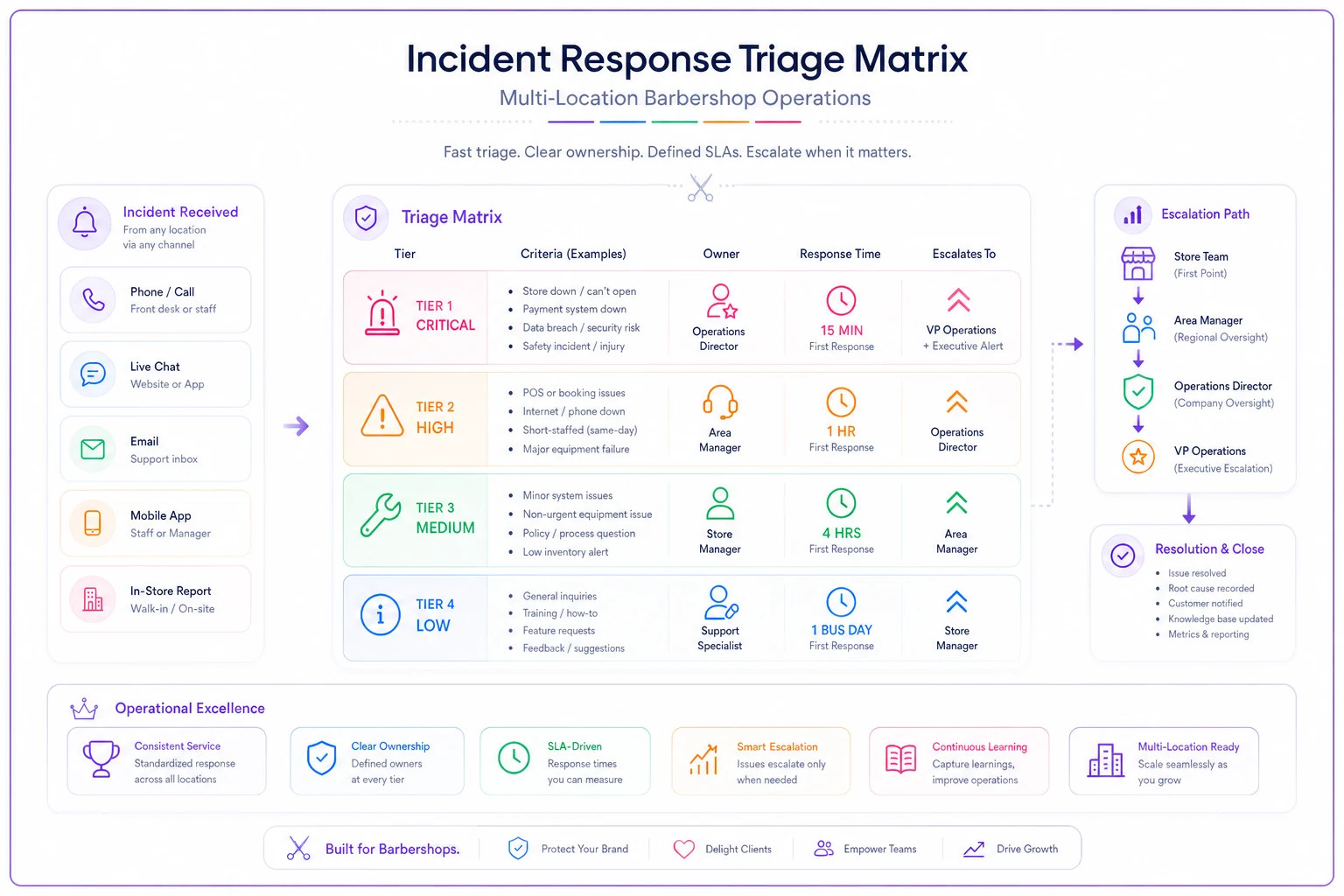
This simple visual shows how an incident is classified, routed, and escalated through owners and time targets.
Templated public responses (and why templates don't make you sound robotic)
Owners resist templates because they assume templated replies sound canned. Built right, the opposite is true. The point of a template isn't to copy-paste a block of text—it's to lock in the structure of a good response so that a stressed manager doesn't skip the parts that matter.
-
Acknowledge without arguing the facts in public.
-
Take it offline with a specific name and direct contact.
-
Signal action, not just apology.
-
Never litigate the details publicly, even when you're right.
The defensive "our barber followed exactly what was requested" reply breaks every one of these. It argues, stays public, and offers no path forward.
> "We're really sorry your color didn't turn out the way you hoped—that's not the experience we want anyone leaving with. I'd like to make this right personally. Please reach me directly at [name/number] and we'll get it sorted this week."
Notice what it doesn't do. It doesn't admit specific fault, doesn't promise anything the company can't deliver, and doesn't try to win the argument in front of an audience. Give your managers a few variations per tier—one for color, one for scheduling, one for staff conduct—and now anyone can produce a brand-consistent response in a couple of minutes instead of freezing or going defensive.
There's also a quieter benefit: templated responses protect you legally. The managers most likely to say something that creates liability are the ones improvising under stress. A structure removes the improvisation.
Compensation rules: the part everyone gets wrong
Comp is where consistency usually collapses. One manager comps everything to make problems disappear. Another refuses to comp anything on principle. Both approaches are expensive—the first bleeds margin, the second bleeds reputation.
You need pre-set compensation authority by tier, with hard ceilings:
-
T1 Manager can offer a re-service or a credit up to a set dollar amount. No approval needed.
-
T2 Full refund plus re-service within a defined cap. Logged, not pre-approved.
-
T3 Up to a higher cap at the area lead's discretion; anything beyond requires owner sign-off.
-
T4 No standing authority—owner and, where relevant, legal decide.
Pro-tip: keep a one-page lookup with each tier's comp ceilings that managers can access from the front-desk tablet.
The rule that saves you money long-term: comp generously at T1 and T2, where the cost is small and the goodwill is real, and tightly control T3 and T4, where emotional situations tempt people to over-promise. Most owners do it backwards—they micromanage the $25 credit and let a panicking manager offer a year of free cuts to make a viral post go away.
Write the ceilings down. Make them boring. A compensation rule that lives in someone's head isn't a rule, it's a mood.
Escalation owners: naming who actually has the ball
Every incident needs one named owner at every tier. Not a department. Not "the team." A person.
The most common failure in multi-location shops isn't that nobody responds—it's that everybody assumes someone else is handling it. The incident sits in a shared inbox or a group chat while three people each think the other two have it covered. By the time anyone realizes, it's been four days and the post has 200 comments.
Your escalation map should answer, for every tier, three questions:
-
Who owns the response? (one name)
-
Who gets notified immediately, even if they don't act? (owners should never learn about a T3 from a customer)
-
What's the backup if the primary owner is unreachable? (vacation, sick day—the chain can't have a single point of failure)
This is where the discipline from a broader QA and audit system carries over directly. If you've already built structured accountability for service quality, as covered in this breakdown of governance for multi-location barbershops, reputation governance plugs into the same ownership logic—just applied to the public-facing side instead of the chair-side.
The monthly reputation dashboard
You can't contain what you can't see. A dashboard is what turns reputation from a reactive scramble into something you actually manage.
Track monthly, per location, at minimum:
-
Volume and rating trend — total reviews, average rating, direction of travel
-
Response rate and response time — what percentage got answered, how fast
-
Incident counts by tier — how many T2s, T3s, T4s this month
-
Resolution time — how long from first flag to closed
-
Compensation spend — total comped, broken out by tier
-
Spillover indicators — new-client booking trend at other locations after any T3/T4 event
That last one is the metric almost nobody watches, and it's the one that actually quantifies brand risk. If a T3 at Location C is followed by a bookings dip at Locations A and B, you now have a number attached to spillover—and spillover is what justifies the entire system to yourself and your managers.
A lot of the raw input for this comes from the review and feedback workflow itself. If you've already got an automated process pulling in and sorting incoming reviews—the kind of setup described in this automated review and triage workflow—feeding that stream into a monthly dashboard is a short step. The point is to have one place where the whole portfolio's reputation health is visible, instead of logging into five profiles and hoping you catch everything.
Bringing it into your QBR
Reputation belongs in your quarterly business review the same way revenue and labor cost do. Once a quarter, you're looking at reputation as a trend, not a series of fires.
-
Average rating trajectory per location across the quarter—flat, rising, or sliding
-
Mean resolution time by tier, quarter over quarter (are you getting faster?)
-
Repeat-incident rate—same barber, same issue, same location recurring signals a training problem, not a reputation problem
-
Comp spend as a % of revenue by location—flags managers who are buying their way out of problems
-
Spillover events—how many T3+ incidents measurably affected other locations' bookings
The pattern worth hunting in the QBR: when one location keeps generating T2 and T3 incidents, the real fix is almost never a better reply template. It's upstream—a barber who needs calibration, a consultation step being skipped, a manager who's over-promising at booking. Reputation metrics are often your earliest warning that something operational is broken, long before it shows up in revenue.
When this level of system makes sense—and when it's overkill
This makes sense when: you're running two or more locations, your brand name is what drives bookings (not just individual barbers' personal followings), and you've already had at least one incident that spread further than you'd like. If a bad month at one shop can measurably hurt the others, you need this.
This is probably overkill when: you're a solo operator or a single shop where you personally see and handle everything. At that stage, a basic review-response habit and solid service recovery is enough. Building a four-tier matrix for one shop is governance theater.
Who should not do this: owners who haven't nailed the basics of service quality yet. Reputation governance manages the fallout from incidents—it doesn't reduce the incidents themselves. If your underlying service is inconsistent, start with calibration and QA first. A great triage system just makes you really efficient at apologizing for the same problem over and over.
The real shift this creates
The goal here isn't to respond to more reviews or sound more polished online. It's to make sure that a bad moment at any one chair stays a bad moment at that chair—contained, handled consistently, closed fast—instead of bleeding into the brand you've built across every location.
The operators who scale cleanly are the ones who stopped treating reputation as something that happens to them and started treating it like inventory or payroll: a system with owners, rules, ceilings, and a dashboard. The incidents still happen. They always will. The difference is that the next one gets caught in hours, routed to the right person, answered in your brand voice, and resolved—before it ever has a chance to become a portfolio problem.
The incidents still happen. They always will. The difference is that the next one gets caught in hours, routed to the right person, answered in your brand voice, and resolved—before it ever has a chance to become a portfolio problem.
Ready to elevate your barbershop operations?
Join 500+ barbershops using Trimzly to save time, reduce scheduling conflicts, and enhance client satisfaction.