


The first shop works because you're in it. You catch the sloppy line-up before the client sees it in the mirror. You notice when the front desk stops offering the beard trim add-on. You feel the room. Quality control at one location is basically just you being present.
Then you open a second shop, maybe a third, and suddenly the thing that made your brand good — that consistency people trusted — starts to drift. Not all at once. It leaks. One shop runs hot on rebooking, another one's Google rating slides from 4.8 to 4.4 over a few months and nobody flags it until a regular mentions it. The gap between your best chair and your worst chair widens, and you can't be in three places at once to close it.
That gap is what a barbershop quality assurance system is actually for. Not paperwork. Not a binder nobody opens. A repeatable way to measure whether every shop delivers the standard you'd deliver yourself, and a feedback loop that corrects it when it slips. This is the piece most owners skip when they expand, and it's the piece that quietly decides whether location three is an asset or a headache.
Below is the whole thing — standards, mystery shops, the QA calendar, corrective-action loops, and a 12-month rollout — built as one connected system.
The real reason quality drifts across locations
It's tempting to blame people. "This barber just doesn't care." Sometimes true. But when you look at what actually happens across multiple shops, quality problems are usually invisibility problems, not attitude problems.
At one location, the owner defines "good" through a thousand small in-person corrections. None of it is written down. So when a manager runs the second shop, they're guessing at your standard. They enforce what they think matters, which is a slightly different bar. Multiply that by three managers and you've got three definitions of "clean fade," three ideas of how the phone should be answered, three tolerance levels for a messy station.
The pattern worth naming: a shop with no written standard doesn't have a low standard — it has an unmeasured one. And unmeasured standards always drift toward whatever's easiest on a busy Saturday.
There's also a communication bottleneck hiding in here. When you had one shop, feedback traveled in seconds — you saw it, you said it, it got fixed. At three shops, feedback has to travel through a system, or it doesn't travel at all. The owner who tries to manage it by dropping in unannounced ends up firefighting the loudest problem at whichever shop they happened to visit, while the quiet erosion continues everywhere else.
If you're actively planning growth, this connects directly to the thresholds covered in opening a profitable second location — because a shop that can't be measured probably shouldn't be duplicated.
Start with the standards library (this is the foundation everything else sits on)
You can't audit against nothing. Before scorecards, before mystery shops, you need a written definition of what "our shop, done right" actually means. Not a novel — a tight, usable reference that a new manager could read and understand your expectations in an afternoon.
Never miss a booking amidst the hustle.
Trimzly helps you schedule, confirm, and manage every client visit seamlessly.
- Unified appointment management
- Automated client reminders
- Optimized staff scheduling
No credit card required
Think of the standards library in four buckets:
-
Service craft standards — what a finished cut/fade/beard should look and feel like, consultation expectations, redo policy, sanitation between clients, timing targets per service.
-
Client experience standards — greeting within X seconds, how the phone is answered, how a wait is communicated, checkout and rebook offer, how complaints get handled on the spot.
-
Environment standards — station cleanliness, floor sweep cadence, restroom checks, retail shelf facing, product stock levels, music/volume, temperature.
-
Operational standards — opening and closing procedures, cash handling, appointment notes and photo capture, no-show logging, waitlist handling.
The mistake most owners make here is writing standards as aspirations ("provide excellent service") instead of observable behaviors ("offer the client a hot towel and confirm the length before the first pass"). If two different people can watch the same interaction and disagree on whether it passed, the standard isn't specific enough yet.
The mistake most owners make here is writing standards as aspirations ("provide excellent service") instead of observable behaviors ("offer the client a hot towel and confirm the length before the first pass").
This library is essentially the quality layer on top of your operating system. If you haven't built the underlying roles and SOPs yet, start there first — the barbershop operating system roadmap covers the SOP structure your standards library will plug into. Standards without SOPs is just a wish list.
The mystery‑shop scorecard: how you actually see what's happening
You will never see your shops the way a client does by walking in as the owner. The room changes the second you're spotted. Mystery shopping — a scored, anonymous visit — is how you get the unfiltered picture.
The scorecard turns your standards library into something measurable. Keep it to one page, weighted toward what matters most to your brand and your revenue. Here's a sample structure:
| Category | What's scored | Weight | Score (1–5) |
|---|---|---|---|
| Greeting & wait handling | Acknowledged within ~10 sec, wait clearly communicated | 15% | |
| Consultation | Barber confirmed style/length, offered relevant add-on | 20% | |
| Cut/service quality | Clean lines, even blend, matches what was agreed | 25% | |
| Cleanliness & station | Station reset, tools sanitized, floor swept | 15% | |
| Checkout & rebook | Rebook offered, retail mentioned when relevant | 15% | |
| Overall feel | Would a first-timer come back? | 10% |
A few things that make mystery shops actually work instead of becoming theater:
-
Use real clients, not just managers. Rotate a small pool of trusted shoppers — a friend of the business, a spouse of a staff member from another shop, someone the local barbers won't recognize. Managers know how they're supposed to score, so they unconsciously grade generous.
-
Score the same categories every time. Consistency across visits is the whole point. A wandering scorecard tells you nothing over time.
-
Photograph the finished cut (with consent framed as normal). A written "fade was uneven" is arguable. A photo isn't.
A realistic cadence: one mystery shop per location per month, plus one surprise peak-Saturday visit per quarter, since Saturdays are where standards break first. Six locations, that's roughly six to eight scored visits a month — very manageable, and it gives you a trend line per shop instead of a gut feeling.
The quarterly QA calendar: rhythm beats intensity
Owners tend to do QA in bursts. Something goes wrong, everyone scrambles, there's a big cleanup, and then it fades until the next fire. That pattern guarantees drift. What actually holds quality steady is a boring, predictable rhythm — the same checks happening on the same schedule whether things feel fine or not.
A workable quarterly QA calendar looks like this:
Month 1 of the quarter
-
Mystery shop each location (week 1–2)
-
Manager self-audit against the standards library (week 3)
-
Scorecard review meeting — managers see their own numbers vs. the group (week 4)
Month 2
-
Mystery shop each location again
-
Deep-dive audit on the shop with the lowest prior-quarter average
-
Retail and rebook spot-check (tie-in with your revenue tracking)
Month 3
-
Final mystery shop of the quarter
-
Full quarterly QA review
trends per location, corrective actions closed vs. open, standards library updates
-
Set focus theme for next quarter (e.g., "consultation quality" or "checkout rebook rate")
The insight most people miss: the review meeting matters more than the audit itself. An audit that produces a number nobody discusses changes nothing. When managers sit in a room and see their shop's greeting score is a 3.2 while another location is at 4.6, the competitive pressure does half your work for you. Numbers create honest conversations that gut feelings never will.
Corrective‑action loops: what happens after you find a problem
This is where almost every QA effort dies. You run the audit, you find the issues, and then… nothing. The report gets emailed, everyone nods, and next month the same thing scores low again.
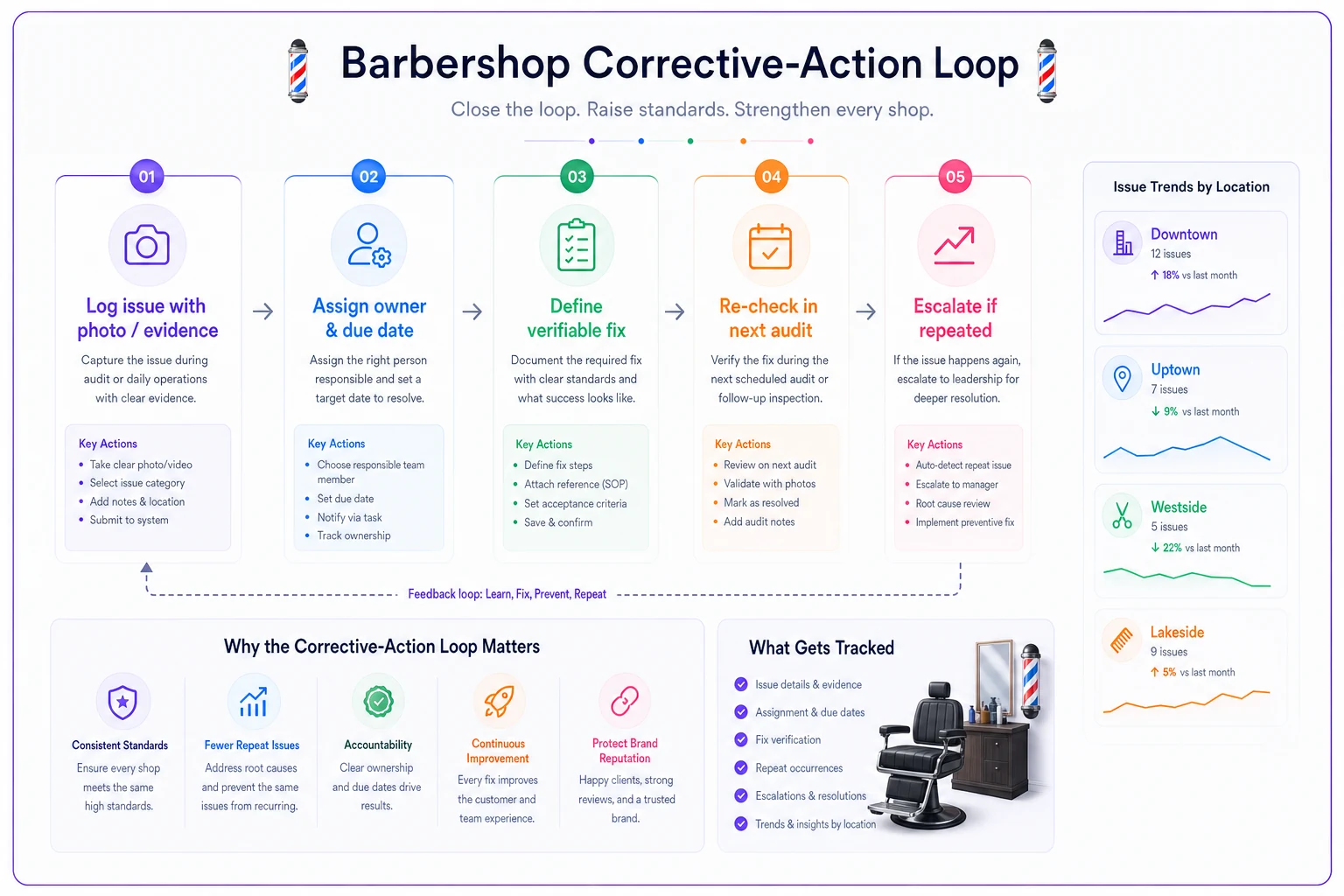
A corrective-action loop closes that gap by making every failed item follow a defined path:
-
Log it. The failed standard, the location, the date, the evidence (photo or written note). No verbal-only issues — if it's not logged, it doesn't exist.
-
Assign an owner and a due date. Not "the shop should fix cleanliness." Specifically: Marcus, station-reset SOP retraining, all staff, by the 20th.
-
Define what "fixed" looks like. The correction has to be verifiable. "Retrained staff" isn't proof. "Next mystery shop cleanliness score ≥ 4" is.
-
Re-check on schedule. The next audit specifically re-tests the failed item. If it passes, close the loop. If it fails again, it escalates.
-
Escalate repeats. An item that fails twice isn't a training issue anymore — it's a management issue at that location, and it should be treated like one.
The pattern worth watching: the same category failing at the same shop three months running is almost never about barber skill. It's usually a broken routine or a manager who isn't reinforcing the standard. Skill problems fix quickly once you point them out. Structural problems repeat, and the loop is what surfaces them.
Here's a simple visual of the corrective-action loop.
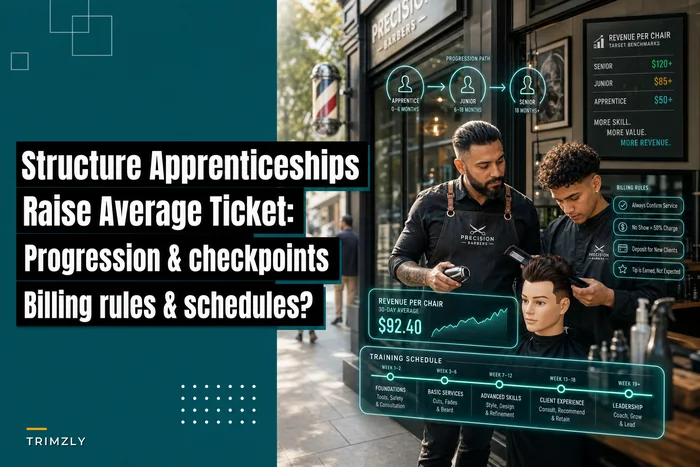
For newer staff, the corrective-action loop should tie back into their development track rather than feel like punishment. If you've structured training with clear progression checkpoints — the way the apprenticeship progression framework lays out — a failed audit item becomes a coaching moment, not a threat.
A real scenario: three shops, one drifting badly
A small group running three shops in the same metro noticed their newest location — open about eight months — was underperforming, but couldn't pin down why. Same services, same pricing, similar foot traffic. Revenue per chair was running maybe 15–20% below the flagship, and the Google rating had slid from a launch-time 4.7 to around 4.3.
They ran their first structured mystery shops across all three. The flagship averaged about 4.5 on the scorecard. The struggling shop came in around 3.4 — and the pattern was specific: consultation and rebook were the weak spots. Barbers were skipping the "confirm the length before the first pass" step, and the front desk almost never offered a rebook at checkout.
Neither of those is a skill problem. Both are routine problems — things that don't happen when nobody's measuring them. They ran corrective-action loops on both: a short consultation SOP retraining, a scripted rebook offer at checkout, and re-checks built into the next two mystery shops.
Over the following quarter the shop's scorecard climbed to roughly 4.2. Rebook rate improved noticeably, which pulled revenue per chair closer to the other two locations, and the Google rating started recovering as fresh 5-star reviews came in from clients who actually got the full experience. Nothing exotic. They just made the invisible visible and then closed the loop.
The 12‑month rollout runbook
Don't try to install all of this at once — you'll overwhelm your managers and it'll collapse. Sequence it.
Months 1–2: Write the standards library. Draft it from how your best shop actually operates. Get your strongest managers to red-line it. Keep it observable and tight.
Months 3–4: Build the audit forms and scorecard. Convert the standards into the one-page scorecard and templated audit forms (opening/closing checklist, station audit, phone audit). Run practice mystery shops so you're calibrating scoring, not yet holding anyone accountable.
Months 5–6: Go live with monthly mystery shops. Start scoring for real. Hold the first review meetings. Expect some resistance — that's normal. Frame it as "we're measuring the shop, not attacking the barber."
Months 7–8: Turn on corrective-action loops. Now that you have baseline scores, start logging failures and assigning fixes with due dates and re-checks. This is where quality actually starts moving.
Months 9–10: Add the quarterly rhythm. Layer in the deep-dive audit on the lowest-scoring shop, the peak-Saturday surprise visit, and the quarterly focus theme.
Months 11–12: Refine and hand off. Review which standards were unclear, tighten the scorecard, and — critically — make QA a manager responsibility, not just an owner one. The system only scales when it runs without you in the room.
By the end of the year you should have a trend line per location, a stack of closed corrective actions, and — this is the real prize — the ability to open a fourth shop knowing exactly what "good" looks like and how you'll verify it.
When this makes sense — and when it doesn't
When it's worth building: the moment you go from one location to two, and definitely before three. If your quality currently depends on you physically being present, you've already outgrown your QA system and just haven't felt the full cost yet.
When it's overkill: a single owner-operated shop where you're behind the chair every day. You are the QA system. Writing a formal audit calendar for yourself is busywork. Focus your energy on the standards library so it exists when you eventually expand — but skip the mystery-shop machinery for now.
Who should not do this: an owner who won't actually run the review meetings or enforce the corrective-action loops. A QA system with no follow-through is worse than none — it teaches your team that audits are theater and that failing scores carry no consequences. If you're not going to close the loops, don't start the audits.
Keeping the paperwork from becoming the problem
The honest risk with any governance system is that it turns into admin overhead — scorecards nobody enters, corrective actions logged across three different spreadsheets, a manager spending Sunday night copying notes instead of actually running their shop. When that happens, the QA system quietly dies and everyone pretends it didn't.
The way through is to keep the record-keeping as light as the standards are strict. Whatever platform you already use to manage appointments, client notes, and history is usually the right home for audit forms and corrective-action tracking too — scores logged where the schedule already lives, re-checks flagged automatically at the next audit date, trends visible per location without anyone building a report by hand. The point isn't the tool. It's that the loop closes without someone having to remember to close it. When follow-up is automatic, the system survives busy seasons. When it depends on human memory across three shops, it usually doesn't.
The takeaway
Scaling a barbershop isn't really about opening more doors — it's about being able to reproduce your standard when you're no longer standing in the room. The shops that grow well aren't the ones with the most talented single barber. They're the ones that made "good" measurable, checked it on a rhythm, and fixed what slipped before clients voted with their feet.
Build the standards library first. Turn it into a scorecard. Run honest mystery shops. Close every corrective-action loop. Do that for twelve months and quality stops being something you hope for and becomes something you can actually prove — location by location, chair by chair.
Build the standards library first. Turn it into a scorecard. Run honest mystery shops. Close every corrective-action loop. Do that for twelve months and quality stops being something you hope for and becomes something you can actually prove — location by location, chair by chair.
Ready to elevate your barbershop operations?
Join 500+ barbershops using Trimzly to save time, reduce scheduling conflicts, and enhance client satisfaction.