

Most barbershop owners who start thinking about franchising are coming from a good place. One location is humming, the chairs stay full, regulars know the staff by name, and someone — a cousin, a loyal client, an ambitious senior barber — floats the idea of opening a second shop under the same brand. That conversation feels exciting. It's also where a lot of people start building on sand.
The problem isn't ambition. It's that a franchise is not a copy of your shop. It's a copy of your system. And a surprising number of shops that look successful from the outside have almost nothing written down. The whole operation lives in the owner's head, in a few trusted barbers' habits, and in a POS that was set up five years ago and never touched again.
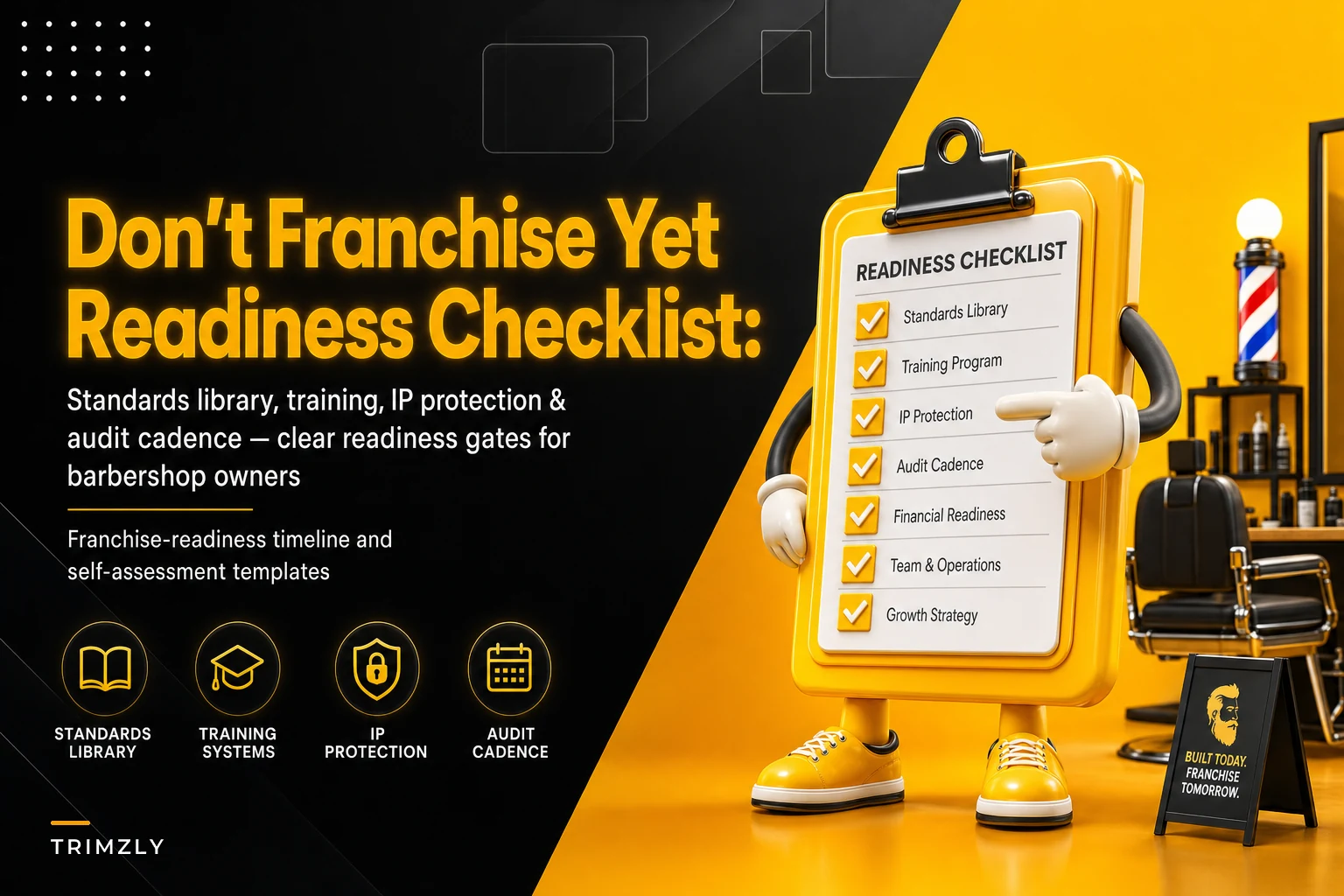
So before you talk to a franchise attorney or start designing a logo for "Location #3," run your shop through some honest readiness gates. This isn't a pep talk. It's a checklist built around the four things that actually break when you try to duplicate a barbershop: your standards library, your training, your intellectual property, and your audit cadence.
Why "we're profitable" is the wrong readiness test
Profit tells you the current shop works. It says nothing about whether the shop works without you.
A shop doing $40k–$55k a month can feel like a machine. But when you look closer, the owner is still the one settling pricing disputes, training new barbers by having them shadow for a couple weeks, approving refunds, ordering product by feel, and knowing which regulars will walk if their favorite barber leaves. None of that is documented. It's muscle memory.
Franchising takes all that muscle memory and asks a stranger — a franchisee you've never worked beside — to reproduce it in a different neighborhood with different staff. If it isn't written down, tested, and teachable, it doesn't transfer. It just degrades. Quietly, one small decision at a time, until the second shop feels like a knockoff of the first.
The real readiness test is this: If you disappeared for 60 days, would a competent new owner be able to run your shop at the same quality using only what you've documented? If the honest answer is no, you're not franchise-ready. You're owner-dependent. Those are very different things.
Readiness Gate 1: The standards library
A standards library is the written version of "how we do things here." Not vibes. Not tribal knowledge. Actual documents someone can read and follow.
Never miss a booking amidst the hustle.
Trimzly helps you schedule, confirm, and manage every client visit seamlessly.
- Unified appointment management
- Automated client reminders
- Optimized staff scheduling
No credit card required
The mistake most owners make is thinking this means a giant binder nobody reads. It doesn't. It means a focused set of documents covering the handful of decisions that happen over and over. If you build it around the places where staff currently ask you questions, you'll cover about 80% of what matters.
At minimum, a franchise-grade standards library includes:
-
Service standards — exact steps for each service, timing expectations, what "done" looks like, and consultation scripts
-
Pricing and discount rules — who can give what discount, when, and the limits. No freelancing at the register.
-
Opening and closing procedures — including cash handling, station setup, and sanitation
-
Client handling rules — late arrivals, no-shows, re-dos, complaints, refunds
-
Product and inventory rules — par levels, reorder triggers, who orders, approved suppliers
-
Hygiene and compliance — sanitation between clients, license posting, local health requirements
-
Brand standards — how the shop looks, sounds, smells, and feels; dress code; music; signage
A good way to pressure-test whether your library is real: hand one document to a barber who didn't write it and ask them to follow it with zero verbal explanation.
A good way to pressure-test whether your library is real: hand one document to a barber who didn't write it and ask them to follow it with zero verbal explanation. If they can, it's a standard. If they come back with three questions, it's a draft.
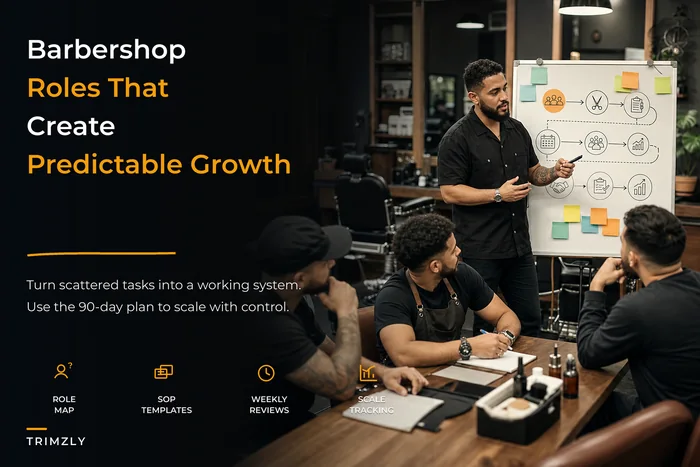
If you've already built out an operating system with roles and SOPs, you're further along than most — this is essentially the formalized, transferable version of that work. If you haven't, the groundwork laid out in building a barbershop operating system with roles, SOPs, and a 90-day roadmap is the prerequisite step before any franchising conversation is realistic. Get that right first, then come back to this checklist.
Readiness Gate 2: Training that works without you in the room
This is the gap that kills franchise quality faster than anything else. Your current training works because you're the trainer. New barbers learn by watching you, absorbing your corrections, picking up the unspoken standards. That's apprenticeship, and it's great for one shop.
It does not scale. A franchisee two cities away cannot absorb your corrections. They get whatever you've managed to package.
The readiness question is: Can a new barber reach your quality bar using your training materials alone, with your help only as backup? For most shops, the honest answer right now is no — because the training isn't materials, it's just the owner being around.
What a transferable training system actually looks like:
-
A defined ramp path — what a new hire learns in week 1, by day 30, by day 90, with checkpoints
-
Skill benchmarks with a pass/fail bar — not "they seem good," but specific calibration points (fade consistency, timing, consultation quality)
-
A calibration method — a way to check that two different barbers in two different shops are actually cutting to the same standard
-
A trainer-the-trainer layer — because at a franchise, you won't be the one training. Someone local will. Can they be taught to train?
That last point is the one people miss. Franchising isn't "can I train a barber." It's "can I train someone to train barbers I'll never meet." That's a harder bar, and it's worth testing at your current shop first — have a senior barber run a new hire's full onboarding while you only observe. If quality holds, the training transfers. If it slips, you've found exactly what's still trapped in your head.
Readiness Gate 3: Your intellectual property (the part owners ignore)
This is the gate barbershop owners skip, and it's the one lawyers care about most. A franchise sells the right to use your brand and system. If you don't actually own clean, defensible IP, you're selling something you can't fully deliver.
Walk through this honestly:
-
Is your business name and logo trademarked? Not "we've used it for years" — actually registered, and cleared against conflicts in the states you'd expand into.
-
Do you own your brand assets outright? The logo a freelancer designed six years ago — do you have the transfer of rights in writing, or does the designer technically still own it?
-
Are your SOPs, training materials, and standards documented as your proprietary system? This is what the franchisee is paying to license. A loose pile of Google Docs with no clear ownership is hard to protect.
-
Do you control your digital presence? Domain, Google Business Profile, social handles, booking URLs — registered to the business, not to a former manager's personal email.
A typical scenario: a shop with a strong local name discovers, when they finally check, that another shop two states over registered a nearly identical name first. Now the expansion map has holes, and the brand they planned to franchise can't legally operate in three of their target markets. That's the kind of problem that's cheap to catch early and brutally expensive to fix later.
You don't need to become an IP attorney. You just need to know your IP is clean before you invest in the franchise structure, not after you've signed your first franchisee.
Readiness Gate 4: Audit cadence
This is what separates a brand from a logo. Standards that nobody checks aren't standards — they're suggestions. The moment you have shops you don't personally walk into every day, you need a rhythm for verifying quality without being physically present.
Audit cadence means a repeatable schedule and method for checking that each location actually runs the standards library. Not a surprise crackdown once a year. A consistent rhythm.
A workable cadence for a small multi-unit or early franchise looks roughly like this:
| Check | Frequency | Who | What it catches |
|---|---|---|---|
| Daily metrics review (bookings, no-shows, average ticket) | Daily | Local manager | Drift in throughput and revenue |
| Quality/cut calibration spot-check | Weekly | Shop lead | Service standards slipping |
| Hygiene & compliance walk | Weekly | Shop lead | Sanitation, license, safety gaps |
| Full standards audit | Monthly | Regional / owner | Systemic deviation from the library |
| Brand & experience review (look, feel, client feedback) | Quarterly | Owner / franchisor | Brand erosion |
The point of a cadence isn't to catch people doing something wrong. It's to make deviation visible early, while it's still a small correction instead of a cultural problem. Shops that only audit when something's already broken are always reacting. Shops with a real cadence catch the drift in week two.
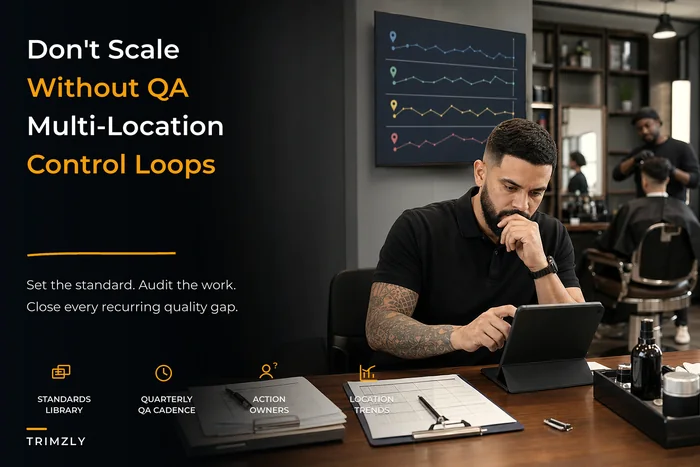
Building this muscle at one shop first is non-negotiable. If you can't maintain an audit rhythm across a single location, you won't maintain it across five you're not standing in. The governance and QA framework in don't scale without QA: a governance and audit system for multi-location barbershops goes deeper on exactly how to structure this layer before you add units.
A realistic timeline to franchise-readiness
Owners wildly underestimate this. Starting from "profitable but undocumented," the honest range is usually 12 to 24 months of real preparation before you're ready to sign a franchisee — and most of that is unglamorous documentation and testing work, not legal paperwork.
A rough phased view:
Months 1–4: Document. Build the standards library. Write what's in your head. Start with the highest-friction decisions first — pricing, re-dos, discounts, onboarding. Expect this to reveal how much was never written down.
Months 4–8: Transfer and test. Convert training into materials. Run the "senior barber onboards a new hire while you watch" experiment. Fix what doesn't transfer. Start the audit cadence at your current shop and actually hold to it.
Months 6–10: Clean up IP. Trademark search and filing, brand asset ownership, digital account control. Start this in parallel — it has lead times you don't control.
Months 10–18: Prove it twice. Ideally, open or operate a second location you own under the full system. This is the real test. If the system holds in a shop you own but don't staff daily, it has a chance of holding in a franchise. If it breaks here, it would have broken worse with a franchisee.
Months 18–24: Formalize. Now the franchise legal structure, disclosure documents, and franchisee recruiting make sense — because you have something proven to sell.
Anyone selling you a faster timeline is usually selling you the legal wrapper without the operational substance underneath.
How the readiness gates connect
It helps to see these gates not as separate boxes but as a sequence — each one depends on the one before it.
Standards Library → Training System → IP Protection → Audit Cadence → Franchise-Ready
Here's a simple workflow showing how the gates connect.
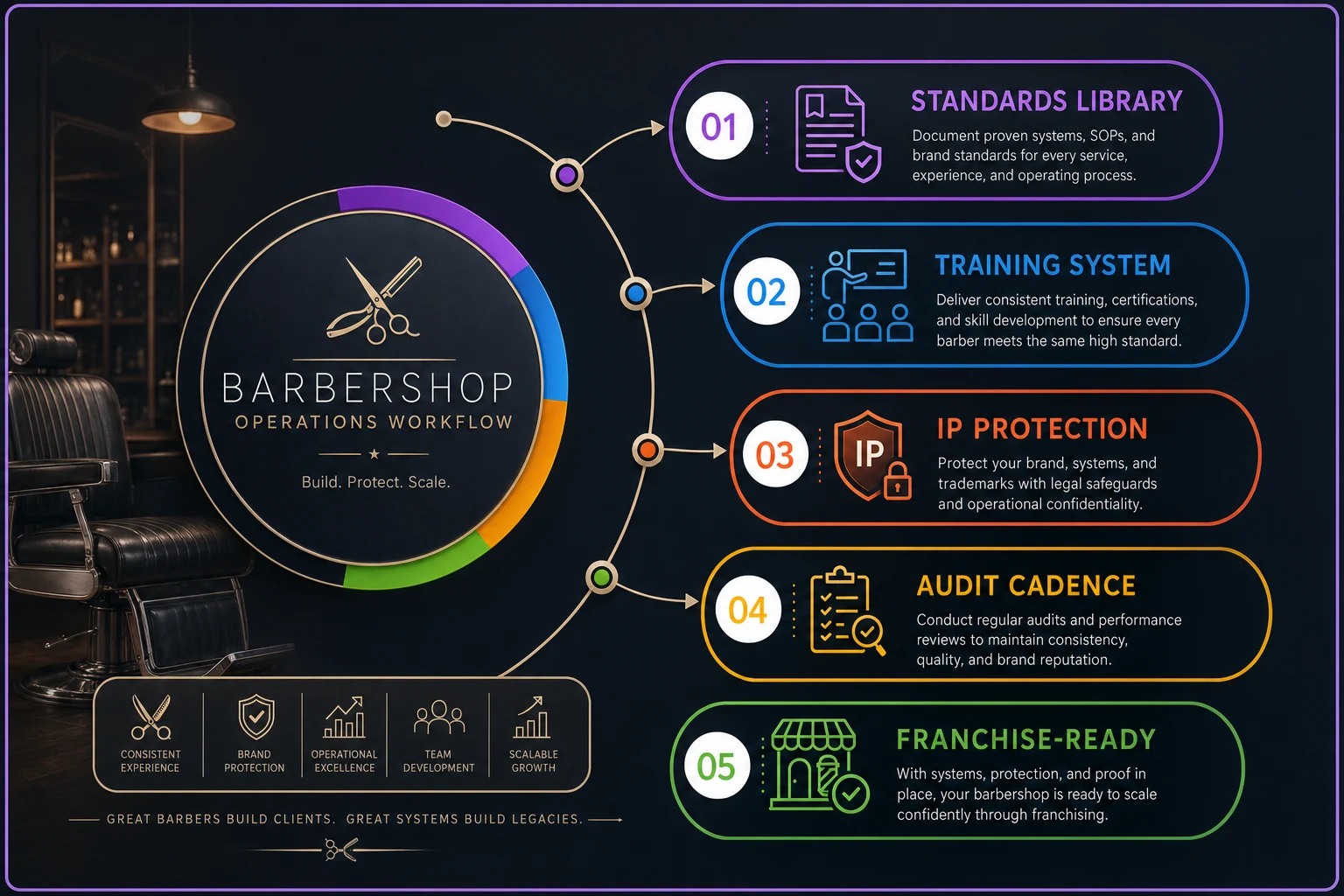
You can't build a real training system before you've documented your standards. You can't protect IP you haven't defined. And audits only mean something if there's an agreed standard to audit against. Skipping ahead creates exactly the kind of patchwork operation that falls apart when a franchisee is running it unsupervised.
When franchising actually makes sense
When franchising actually makes sense
-
Your shop runs well for weeks at a time without your daily involvement
-
Your standards library is written, tested, and followed by people who didn't create it
-
You've successfully trained someone else to train new barbers
-
Your IP is clean and defensible in your target markets
-
You hold an audit cadence consistently, not just when there's a problem
-
You genuinely enjoy building systems and supporting other operators — because that's the actual job
If you're checking most of these boxes, keep going — you're in rare company. If you're checking two or three, that's completely normal, and it's exactly why you shouldn't franchise yet. The readiness gates above aren't obstacles between you and expansion. They're the thing that makes expansion worth doing. Build the system first. The second door can wait until the first shop proves it can run without you.
When it's a bad idea (and who should not do this)
Franchising is the wrong move if the shop only works because you're in it. It's the wrong move if your "system" is three barbers who've been with you forever and would be impossible to replicate anywhere else. And it's the wrong move if you're franchising mainly for a quick capital injection — you'll end up with franchisees running a system you never finished building, and their failures become your brand's reputation.
Honestly, some excellent operators should simply never franchise. If what makes your shop special is you — your eye, your relationships, your taste — that's not a flaw. It's just not franchisable. For a lot of owners, a second or third company-owned location is a far better path than licensing your name to strangers. Owning the units keeps quality in your hands. Franchising hands it to someone whose incentives won't always match yours.
A short real scenario
A single-location shop doing around $50k a month wanted to franchise after an enthusiastic regular offered to open a second location. On paper, ready. In practice, when the owner tried to write the standards library, he realized refund decisions, discount limits, and new-barber onboarding all lived entirely in his head — nothing was documented, and two senior barbers were quietly handling things their own way.
He paused the franchise plan and spent about eight months documenting, then ran the training-transfer test: a senior barber onboarded a new hire using only the written materials. First attempt, quality slipped noticeably — the consultation step got skipped, and re-dos ticked up. That failure was the whole point. He fixed the gaps, ran it again, and the second attempt held. Only then did he start the IP and legal work.
Total delay versus his original plan: roughly a year. But the system he ended up with was real, and the eventual second location actually resembled the first — which is the entire point of a brand.
The self-assessment, in one page
Run your shop through this. Every "no" is a project, not a judgment.
-
[ ] The shop runs at normal quality for 2+ weeks without me physically present
-
[ ] A written standards library exists and covers service, pricing, client handling, inventory, hygiene, and brand
-
[ ] Someone who didn't write a given SOP can follow it with no verbal explanation
-
[ ] Training exists as materials, not just me being around
-
[ ] I've successfully trained someone else to train new barbers
-
[ ] A new hire can reach my quality bar from the materials alone
-
[ ] Business name and logo are trademarked and cleared for target markets
-
[ ] I own all brand assets and digital accounts outright, in writing
-
[ ] An audit cadence runs on schedule — not just during problems
-
[ ] I have proven the system in a second location I own
If you're checking most of these boxes, keep going — you're in rare company. If you're checking two or three, that's completely normal, and it's exactly why you shouldn't franchise yet. The readiness gates above aren't obstacles between you and expansion. They're the thing that makes expansion worth doing. Build the system first. The second door can wait until the first shop proves it can run without you.
If you're checking most of these boxes, keep going — you're in rare company. If you're checking two or three, that's completely normal, and it's exactly why you shouldn't franchise yet. The readiness gates above aren't obstacles between you and expansion. They're the thing that makes expansion worth doing. Build the system first. The second door can wait until the first shop proves it can run without you.
Ready to elevate your barbershop operations?
Join 500+ barbershops using Trimzly to save time, reduce scheduling conflicts, and enhance client satisfaction.