

A membership that lifts visit frequency but quietly eats your margin is worse than having no membership at all. And that's exactly what happens in a lot of shops — the plan sounds great in the owner's head, the first few clients sign up, and six months later nobody's tracking whether the thing is actually profitable or just shuffling revenue around.
The trap is subtle. Memberships feel like they're working because recurring money hits your account every month. Predictable income is comforting. But predictable income at the wrong price point just means you've locked in a loss and put it on autopay.
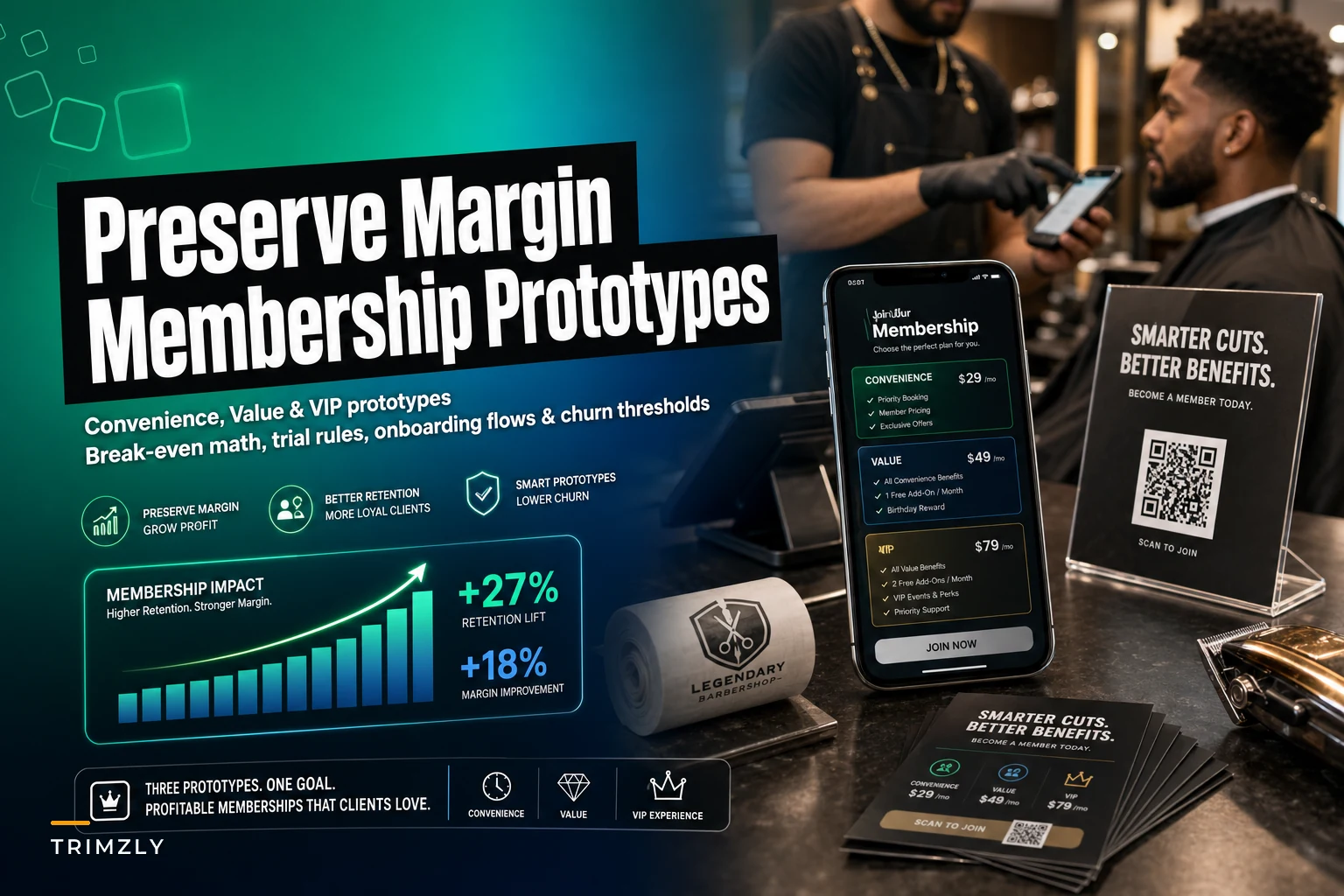
Below are three membership prototypes — Convenience, Value, and VIP — each built around break-even math, trial mechanics, onboarding, and a churn threshold you can actually monitor. The point isn't to pick the fanciest one. It's to pick the one that increases how often people come in without handing away the margin you're trying to protect.
First, the math that kills bad memberships before you launch them
Before designing anything, you need one number: your true variable cost per visit. Not your price. Your cost.
For a standard cut, that's usually the barber's cut of the service (commission or booth rent allocation), consumables, and the slice of overhead that visit consumes in chair time. In most shops, a $35 cut carries somewhere around $18–$24 in real variable cost once you account for the barber's split and the chair time it occupies during a busy block.
The mistake almost everyone makes: they price a membership off the retail price, not the cost. Someone thinks, "My cut is $35, I'll offer two cuts a month for $60 — that's a discount but still $60 coming in." Feels fine. Except if each cut costs you ~$20 in variable cost, two visits cost you ~$40 to deliver, and you've now committed a peak-hour chair slot to a discounted client who might've paid full price anyway.
-
Pulls in visits from people who weren't coming that often (net new frequency)
-
Fills chairs during slow hours you weren't monetizing anyway
-
Locks in a client who would otherwise drift to a competitor
If a membership just gives a discount to your existing weekly regular who was already paying full price, you've handed away margin for nothing. That's the single most common way these programs bleed money.
A quick break-even frame per membership tier:
Monthly price − (expected visits × variable cost per visit) = contribution margin per member
The three prototypes
Each of these is built for a different goal. Read the "when this makes sense" note for each — that's the part most owners skip.
Never miss a booking amidst the hustle.
Trimzly helps you schedule, confirm, and manage every client visit seamlessly.
- Unified appointment management
- Automated client reminders
- Optimized staff scheduling
No credit card required
| Prototype | Monthly price (illustrative) | What's included | Primary goal | Real risk |
|---|---|---|---|---|
| Convenience | ~$55–$65 | 2 cuts/month, priority booking window | Lock in frequency for regulars | Discounting people who'd pay full price |
| Value | ~$40–$50 | 1 cut/month + standing discount on add-ons/retail | Raise average ticket, off-peak fills | Members hoarding value, no frequency lift |
| VIP | ~$120–$150 | 2+ cuts, beard maintenance, product credit, no-wait guarantee | Maximize per-client revenue from top clients | Over-promising on wait times you can't deliver |
Prices here are illustrative — plug in your own cost per visit before you commit to anything.
Convenience membership — for the client who hates booking friction
This is the simplest one and, honestly, the one most shops should start with. The pitch isn't "save money." It's "never think about booking again." Two cuts a month, a priority window where members can grab slots before they open to the public.
The math has to be tight because your best regulars are exactly the people who'll buy this — and those are people already paying you. Margin protection comes from two levers: keep the discount shallow (maybe 10–12% off the price of two cuts, not 30%), and make the priority booking window your real value driver instead of the price.
When this makes sense: You have a loyal base that books every 3–4 weeks and you're worried about a competitor opening nearby. Locking frequency and habit is worth a small margin trade.
When it's a bad idea: Your regulars already rebook reliably and you're not under competitive pressure. You'd just be discounting loyalty you already had for free.
Value membership — for filling the quiet hours and lifting the ticket
The Value tier plays nicely with off-peak scheduling. One included cut a month at a modest price, plus a standing discount on add-ons, beard work, and retail. The included cut is cheap enough to be an easy yes; the money comes from the add-ons and product the discount encourages.
This works best when the included visit is nudged toward slower windows. If your membership terms softly steer members toward Tuesday–Thursday mornings, you're monetizing chairs that were sitting empty. The variable cost of a slow-hour cut is functionally lower because you weren't earning anything in that slot anyway.
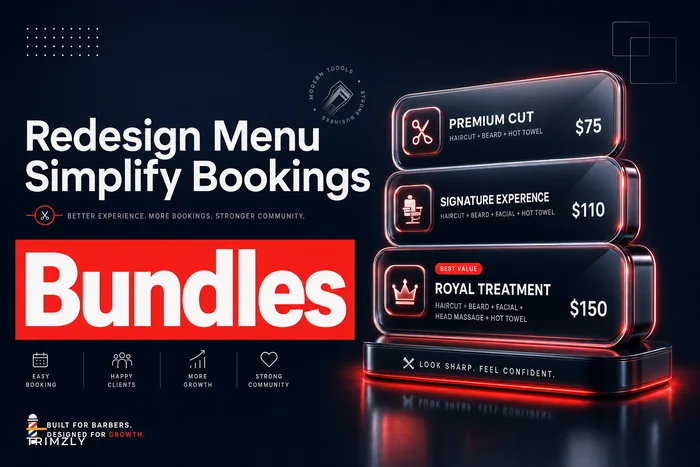
The add-on discount is where this actually pays off, and it ties directly to how you've structured your menu. If you've already done the work of building tiered services and clear add-on paths — the kind of thing covered in redesigning your service menu to raise average ticket — the Value membership becomes a delivery vehicle for that higher ticket. Members feel like they're winning on the discount while your average spend per visit climbs.
When this makes sense: You have real off-peak dead time and a solid add-on or retail menu. This tier turns both into revenue.
When it's a bad idea: Your shop is slammed at every hour. If you have no slow slots, there's nothing to fill.
VIP membership — for your top 10% who'd pay for zero friction
The VIP tier is not for volume. It's for the handful of clients who value their time far more than the money. Two or more cuts, beard maintenance, a monthly product credit, and — the real anchor — a no-wait guarantee.
The margin here is usually healthy because the price is high enough to absorb the perks. The danger isn't the math. It's operational: if you promise "no wait" and can't deliver it, you damage your most valuable client relationships. Only offer the no-wait guarantee if you have the scheduling discipline to actually hold slots. A VIP member who waits 25 minutes after being promised none will churn harder than any discount client.
When this makes sense: You have professionals, executives, or high earners in your base who already tip well and buy product without asking the price.
Who should NOT do this: Any shop that can't reliably control its schedule. Selling a premium promise you break is worse than never selling it.
Trial mechanics that don't give the whole thing away
The trial is where a lot of memberships leak margin before they even start. A "free first month" on a Convenience plan means you just gave away two cuts to someone who might cancel on day 31.
Better trial structures:
-
Discounted first month, not free. Half off the first month filters out the people who were only ever going to grab the freebie and bounce.
-
First-visit-included, not first-month. For VIP especially, include the first premium service at signup, but start the recurring clock immediately.
-
A 30-day satisfaction window instead of a trial. Full price upfront, but "cancel within 30 days for a full refund if it's not for you." Psychologically softer, and far fewer people actually cancel than take a free month.
The pattern across profitable programs: the trial reduces risk for the client without giving away product for free. Those are different things, and confusing them is expensive.
Onboarding — the first 14 days decide whether they stay
Signup is not onboarding. A signed-up member who doesn't book their first membership visit within two weeks is already halfway to churning. The recurring charge hits, they haven't used it, resentment builds, they cancel.
A simple onboarding flow that actually holds members:
-
Day 0 Book their first membership visit at signup. Don't let them leave without a date on the calendar.
-
Day 1–2 A short welcome message explaining exactly what's included and how the priority window or add-on discount works. Confusion is churn.
-
Before visit 1 A reminder that reinforces the perk they signed up for.
-
After visit 1 Book visit 2 before they walk out. Membership stickiness is a function of habit, and habit forms around the second visit, not the first.
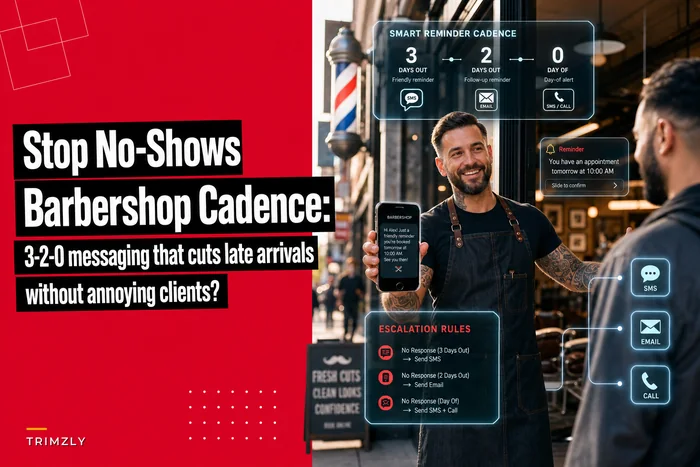
That reminder-and-rebook rhythm matters more than most people expect. The same cadence discipline that keeps regular appointments on track — the kind detailed in a barbershop messaging cadence that cuts late arrivals — applies double to members. A member who no-shows their included visit is a member reconsidering the whole plan.
Here’s a simple visual of that onboarding sequence.
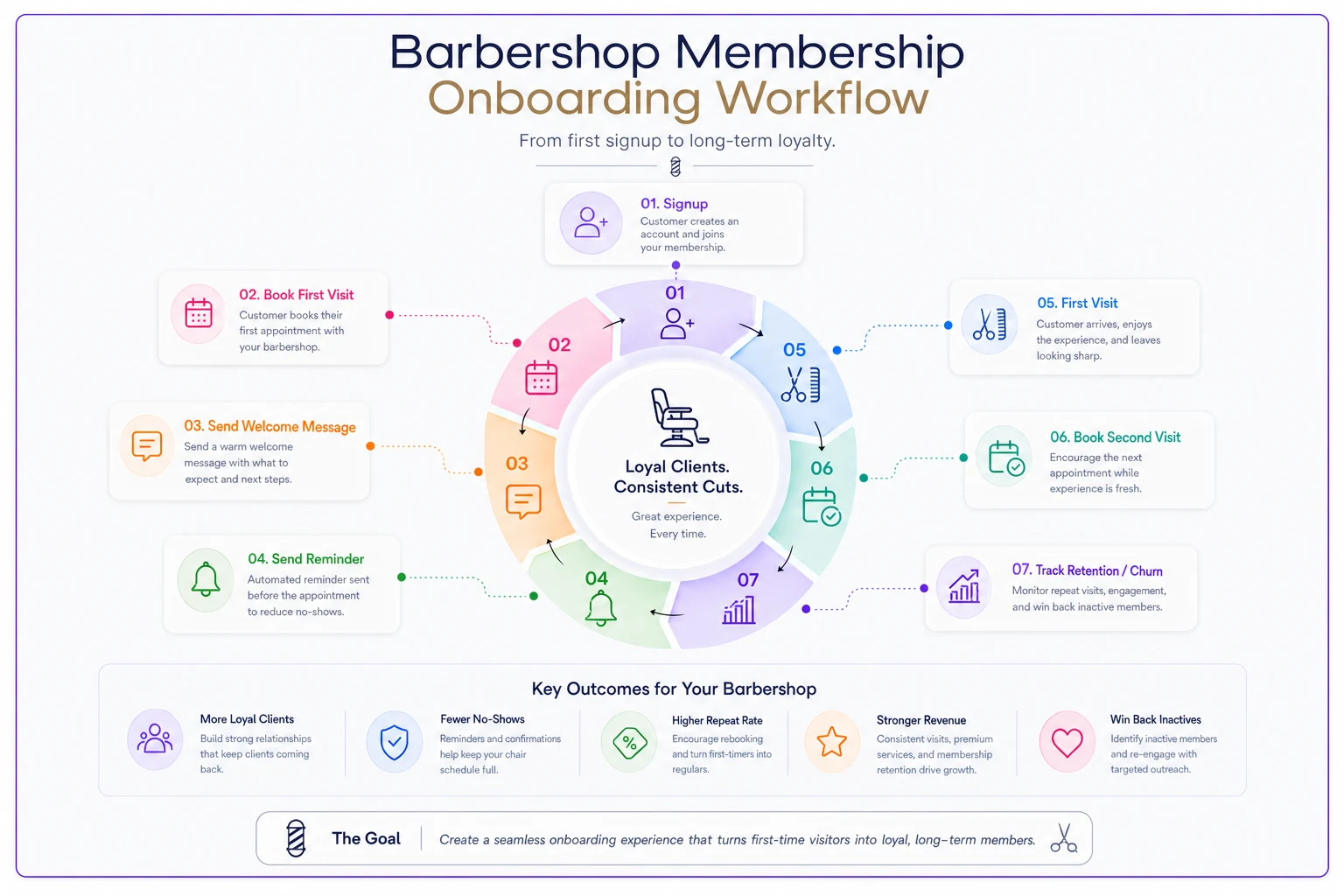
This visual maps the sequence you'd automate in a booking or client-management platform.
Book visit 2 before they leave — the second visit is where membership habit takes hold.
This is also where a decent booking or client-management platform earns its keep: tracking which members have booked their next visit, flagging the ones who've gone quiet, and handling the reminder sequence without you manually chasing thirty people. You don't need anything elaborate — you just need to not lose track of who's drifting.
The churn threshold — the number you check every single month
Almost no shop maintains this discipline: a churn threshold you actually monitor, with a plan for what happens when you cross it.
For most barbershop memberships, monthly churn under roughly 5% is healthy. Between 5–8% is a warning zone. Above 8–10% and something is structurally wrong — usually the value doesn't match the price, or onboarding is failing and people never formed the habit in the first place.
Watch two numbers together:
-
Monthly churn rate (members lost ÷ members at month start)
-
Utilization (are members actually using their included visits?)
The dangerous combination is low utilization + rising churn. That means people are paying, not showing up, feeling vaguely guilty about it, and eventually quitting. The fix is almost never lowering the price — it's fixing onboarding so they use the thing and feel the value.
If utilization is high but churn is still climbing, the plan is priced or structured wrong and you need to revisit the perks.
A real scenario
A two-chair shop was running a "$59 for unlimited cuts" membership. Sounded generous, filled up fast — around 40 members in three months. The owner was thrilled by the recurring revenue right up until he ran the actual numbers.
The heavy users — maybe 8 of the 40 — were coming in every 10 days. At roughly $20 variable cost per visit, those members were costing close to $60 a month to serve on a $59 plan. Break-even at best, and occupying peak chairs that full-price walk-ins would've filled. The lighter users were subsidizing them, but not by enough.
He restructured to a capped Convenience tier: two cuts a month at $62, with a priority booking window as the real hook. About a quarter of the unlimited members grumbled and left — mostly the heavy users who were the unprofitable ones anyway. The remaining base became noticeably more profitable, and the priority window actually added signups from regulars who valued the guaranteed slot. Net result: fewer members, better margin, and visit frequency held roughly steady.
The lesson wasn't "unlimited is bad." It was that he'd never done the per-visit cost math before launching, so he had no way to see he was selling below cost to his most active clients.
Which one should you build first
When in doubt, start with Convenience — priced conservatively, with a shallow discount and a real priority-booking perk. It's the easiest to model, the hardest to lose money on if you keep the discount tight, and it teaches you how your base actually behaves before you commit to anything more complex.
Add a Value tier once you know your off-peak windows and have an add-on menu worth discounting toward. Reserve VIP for when your scheduling is genuinely under control — because breaking a premium promise costs you your best clients.
Whatever you launch, do the per-visit cost math first, price above your delivery cost, and put an actual number on the churn rate that would make you stop and rethink. A membership should tighten the relationship and lift frequency — not quietly convert your best regulars into your least profitable customers.
Ready to elevate your barbershop operations?
Join 500+ barbershops using Trimzly to save time, reduce scheduling conflicts, and enhance client satisfaction.