

Most loyalty programs at barbershops fail for one boring reason: they reward behavior that would have happened anyway. You hand out a "10th cut free" punch card, and six months later your best regulars—the guys who came every three weeks like clockwork—are getting a free cut a couple times a year. You didn't change their behavior. You just gave away margin.
That's the whole problem. A loyalty program only earns its keep if it moves the customers who weren't already loyal. Everyone else is just a discount you're paying on autopilot.
So this post isn't going to pitch you on "why loyalty matters." You already know. What's worth getting into is the three loyalty structures worth piloting in a barbershop, the break-even math behind each, and how to design a proper holdout test so you actually know whether the program did anything before you roll it out shop-wide.
If you're weighing loyalty against a paid membership model, read the three membership prototypes that preserve margin first. Membership sells commitment upfront. Loyalty rewards behavior after the fact. They can coexist, but you shouldn't launch both blind at the same time.
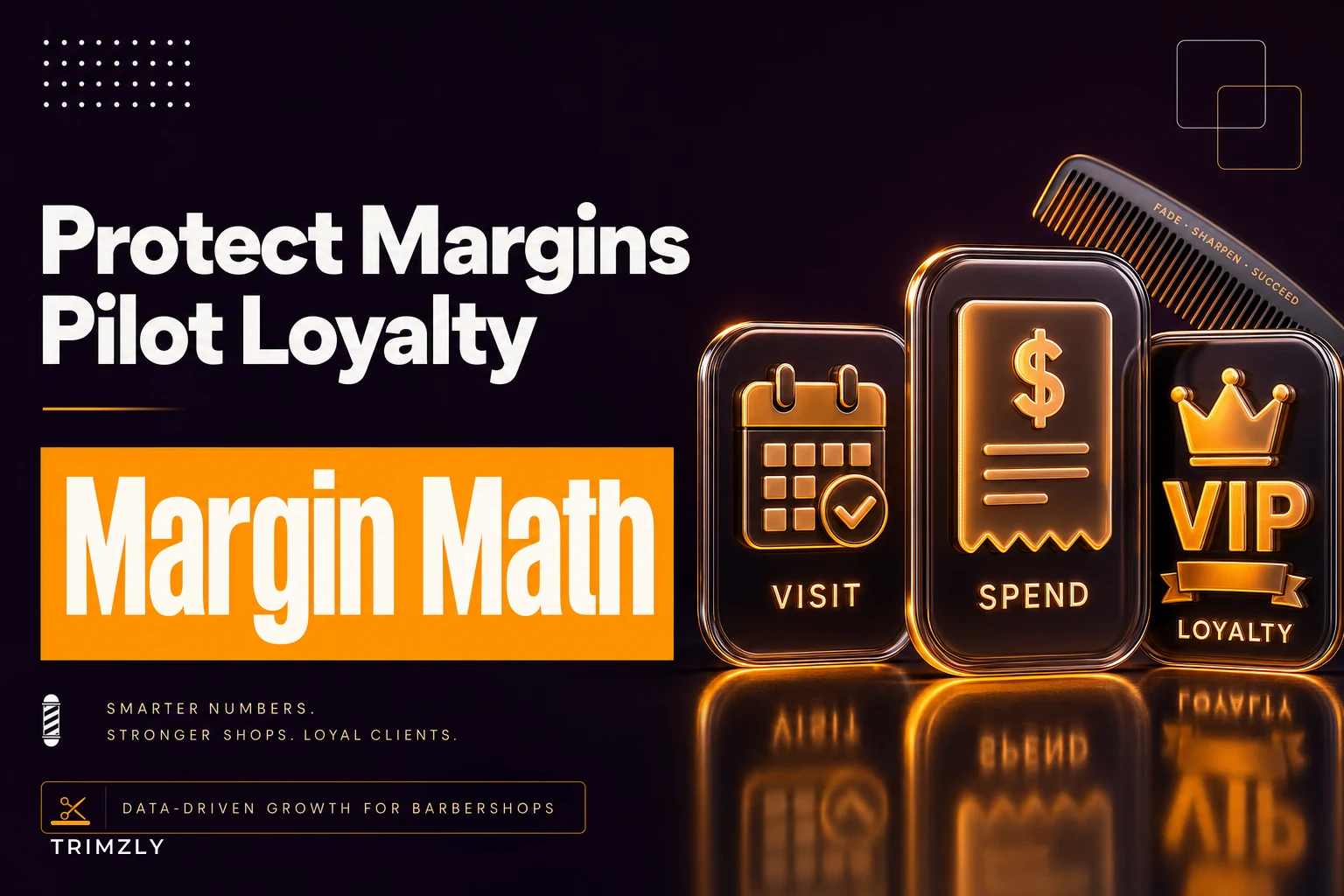
The three prototypes, side by side
Before the math, here's the shape of each one.
These are versions that hold up in an actual chair-based business—not the generic "points for everything" approach that works for coffee chains but falls apart when your average transaction is a $35 fade every three weeks.
| Prototype | How it rewards | Best at moving | Main margin risk |
|---|---|---|---|
| Visit-based | Free/discounted cut after X paid visits | Occasional clients → regulars | Rewarding people who already visit often |
| Spend-based | Points or credit per dollar spent | Add-on and retail attach rate | Bulk discounting on already-high tickets |
| VIP-tier | Perks unlocked at annual spend thresholds | Top 15–20% of clients | Giving perks to people who never leave anyway |
The reason these three are worth piloting—and not referral programs or birthday freebies—is that each one targets a different, measurable behavior: visit frequency, ticket size, or retention of top spenders. If you can't name the specific behavior you're trying to change, you're not designing a loyalty program. You're designing a giveaway.
Prototype 1: Visit-based (the punch card, done right)
The classic "buy 9, get the 10th free" card is where most shops start and where most quietly lose money. The math looks harmless until you actually run it.
Never miss a booking amidst the hustle.
Trimzly helps you schedule, confirm, and manage every client visit seamlessly.
- Unified appointment management
- Automated client reminders
- Optimized staff scheduling
No credit card required
Say your average cut is $32 and your reward is a free 10th cut. That free cut costs you the full $32 in revenue—barber commission still gets paid, product still gets used. So your effective discount is $32 spread across 10 visits, roughly a 10% discount on the whole relationship.
Your regulars who visit every three weeks hit that free cut in about seven months. They were coming anyway. You just cut your margin on your most reliable revenue for zero behavior change.
Where visit-based actually works: when you gate it toward frequency you don't currently have. Instead of "10th cut free," try:
-
Reward triggers only if visits happen within a defined window (e.g., 6 visits in 5 months)
-
Reward is a discounted add-on, not a free full cut—protects more margin
-
Only clients below a frequency threshold even get enrolled
That last point is the real unlock. If a client already comes every 3 weeks, they don't need the incentive. The person you want to move is the guy who comes every 8–9 weeks and could realistically come every 6.
Break-even for visit-based
The break-even question is straightforward: how many extra visits does one enrolled client need to generate to cover the reward?
If your reward costs you $32 and your gross margin per cut (after commission and product) is around $14, then one free cut needs to be "paid for" by roughly 2–3 additional visits that wouldn't have happened otherwise. If the program can't reliably produce that many extra visits per enrolled client per year, it's underwater. The math doesn't get more complicated than that—which is also why it's easy to ignore until you're already bleeding.
Prototype 2: Spend-based (points that push add-ons)
Spend-based programs shine when your problem isn't frequency—it's ticket size. If your retail attach rate is weak and half your clients walk out with just the base cut, points-per-dollar can nudge behavior in a way punch cards can't.
The mechanic: clients earn points on everything—cuts, beard trims, product—and redeem for credit. The upside is that it rewards the bigger transaction, encouraging the beard-and-cut combo or the $24 pomade over the plain cut.
But spend-based has a sneaky failure mode. A poorly set redemption rate can turn into a blanket discount on tickets that were already big. If your top client spends $900 a year and earns 5% back in credit, you just handed $45 to someone who was never going anywhere.
The fix is weighting points toward the behaviors you actually want:
-
Base rate on services (low—like 1 point per dollar)
-
Bonus multiplier on retail products, where you want the real push
-
Bonus on specific add-ons you're trying to grow
-
Redemption only against retail or add-ons—never against the base cut
That last rule matters more than people think. If clients can redeem points against their regular cut, you've built a slow-motion discount on core revenue. Redeem against product instead, and every redemption still moves inventory—and often re-exposes the client to something they'll buy at full price next time. This ties directly into the mechanics in the retail and add-on revenue system. Loyalty should reinforce that engine, not undercut it.
Break-even for spend-based
Your break-even hinges on the incremental attach rate. A typical example: a shop sitting at a 22% retail attach rate wants to push toward 30%. If the program lifts attach by 5–6 points, and average retail margin is 40–50%, the credit you give back is comfortably covered by the extra product moving. If attach doesn't budge, you're just paying a rebate on existing behavior—which is why the test design below matters so much.
Prototype 3: VIP-tier (perks for the top 15%)
VIP tiers reward your highest-value clients with status-based perks—priority booking, a free product per quarter, first access to appointment slots. Done well, it's actually the cheapest of the three because perks like "priority booking" cost you almost nothing but feel premium to the client.
The danger is obvious: your top clients are, by definition, the ones least likely to leave. Handing them perks can be pure margin donation.
VIP-tier only makes sense under one condition: you're seeing churn or poaching at the top. If a competitor opened nearby and you're worried about losing your $800+/year clients, a tier that locks in status and priority access is defensible. If your top clients are rock-solid and nobody's picking them off, skip it entirely.
The smartest VIP designs use perks that also generate some operational value:
-
Priority booking (costs nothing, reduces their friction)
-
Early access to peak slots (fills your hardest-to-fill times first)
-
A quarterly product—chosen from lower-cost, high-margin SKUs
-
Locked-in pricing, if you're planning a price increase anyway
None of these should be free cuts. VIP status should feel like access and recognition. The moment your VIP perk becomes "20% off everything," you've turned your best customers into your least profitable ones.
A churn-test variation for VIP
For VIP-tier specifically, you're testing retention, not activity. Track the churn rate of enrolled top clients against held-out top clients over 6+ months. If both groups retain at the same rate, your VIP program is decorative. If enrolled clients churn noticeably less, you've found something worth keeping—as long as the perk cost stays below the lifetime value of a retained top client.
The part everyone skips: the holdout test
Almost every barbershop loyalty program gets this wrong. Owners launch shop-wide, revenue goes up (because revenue often goes up when you're actually paying attention to something), and they credit the program. There's no way to know if the program drove it, or if it was the season, the weather, or the new barber they just brought on.
The only honest way to know is a holdout group. You enroll part of your eligible client base and deliberately don't enroll another part, then compare the two over the same period.
How to set up a clean holdout
-
Define the target behavior. Frequency, attach rate, or top-client retention. Pick one per test.
-
Segment eligible clients. For visit-based, that's clients visiting every 7+ weeks. For spend-based, clients with low attach. For VIP, your top spenders.
-
Randomly split them. Roughly 70% get enrolled, 30% held out. Random matters—don't put your favorites in one group.
-
Run for a full behavior cycle. For frequency programs, that means at least 3–4 months so a normal visit gap can repeat. Shorter tests lie.
-
Compare the two groups on the target metric only. Did enrolled clients visit more than the holdout? Buy more? Stick around longer?
The gap between the two groups is your real lift—not the raw revenue number. If enrolled clients visited 8% more but the holdout also visited 6% more (busy season for everyone), your program only produced 2 points of lift, and you need to decide if that covered the reward cost.
Here's the basic workflow for running a clean holdout test.
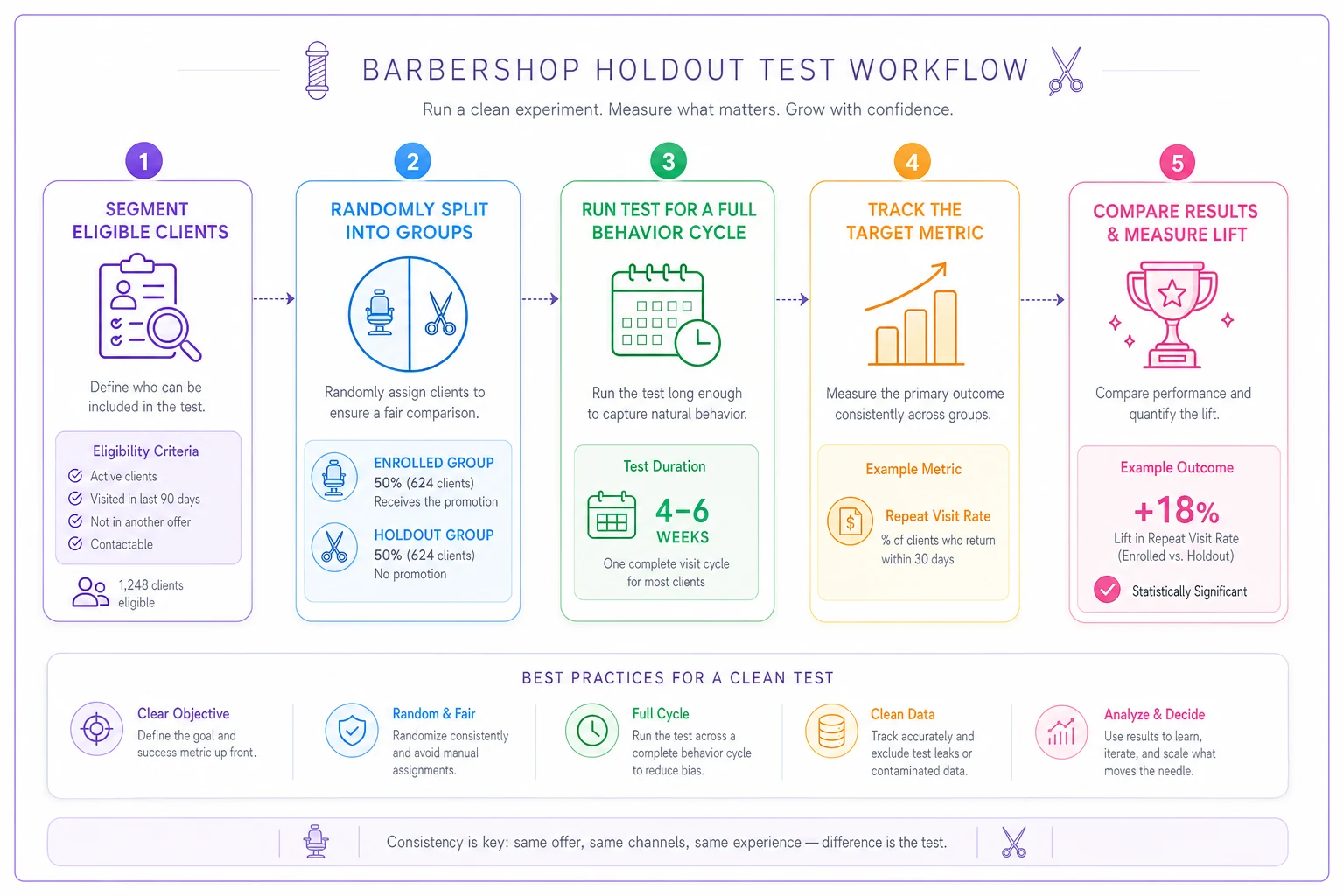
Randomize by client ID and keep assignment blinded to staff to avoid selection bias.
A churn-test variation for VIP: For VIP-tier specifically, you're testing retention, not activity. Track the churn rate of enrolled top clients against held-out top clients over 6+ months. If both groups retain at the same rate, your VIP program is decorative. If enrolled clients churn noticeably less, you've found something worth keeping—as long as the perk cost stays below the lifetime value of a retained top client.
A realistic pilot scenario
Take a two-chair shop doing around 330–360 cuts a month, average ticket about $34, with a soft retail attach rate near 20%. The owner suspects add-on revenue is the weak spot, so a spend-based pilot makes more sense than a punch card.
Setup: 1 point per service dollar, 3 points per retail dollar, redeemable only against product. Active clients from the last 90 days split 70/30 into enrolled and holdout.
After four months, the enrolled group's attach rate drifted up to roughly 27–28%, while the holdout stayed around 21%. That 6-point gap is the real signal. The credit paid out on the incremental product volume came to a fraction of the added retail margin. Visit frequency between the two groups barely differed—which correctly told the owner this program was doing its job on tickets, not visits, and that a separate frequency lever was still needed.
That's the whole point of piloting one behavior at a time. You learn exactly which lever moved instead of guessing.
When each prototype makes sense—and when it doesn't
Run visit-based when: you have a chunk of clients visiting every 7–10 weeks who could realistically come more often. Skip it when: most of your base is already on a tight 3–4 week cycle. You'll just discount loyalty you already own.
Run spend-based when: your attach rate and retail are underperforming and you want to nudge bigger tickets. Skip it when: your tickets are already strong—you'll be rebating existing behavior.
Run VIP-tier when: you're facing real competitive pressure at the top of your client base. Skip it when: your top clients are stable and nobody's poaching them. Recognition programs for people who aren't going anywhere are pure cost.
A note on who should not run any of these yet: if your booking and client data live in your head or scattered across a paper book, hold off. You can't run a holdout test if you can't cleanly tag who's enrolled, track visits and spend over months, and compare against a control group. This is where having client history and transaction data in one place actually matters—not because software makes loyalty magic, but because the test only works when you can measure both groups accurately. Without that, you're back to guessing, and guessing is how programs quietly eat margin for years while everyone assumes they're working.
The one rule to keep
Whatever you pilot, hold this line: a loyalty program has to change behavior, and you have to prove it changed behavior before you scale it. The holdout group is the difference between a program that pays for itself and one that slowly bleeds you while everyone smiles about "customer retention."
Pick one prototype. Target one behavior. Run one clean test with a real control group. Read the gap, not the raw numbers. If the lift covers the reward, roll it out. If it doesn't, you just saved yourself a discount you'd have paid forever—which, honestly, is its own kind of win.
Whatever you pilot, hold this line: a loyalty program has to change behavior, and you have to prove it changed behavior before you scale it. The holdout group is the difference between a program that pays for itself and one that slowly bleeds you while everyone smiles about "customer retention."
Pick one prototype. Target one behavior. Run one clean test with a real control group. Read the gap, not the raw numbers. If the lift covers the reward, roll it out. If it doesn't, you just saved yourself a discount you'd have paid forever—which, honestly, is its own kind of win.
Ready to elevate your barbershop operations?
Join 500+ barbershops using Trimzly to save time, reduce scheduling conflicts, and enhance client satisfaction.