



The fights over the schedule rarely start as fights. They start as a barber noticing they've pulled three Saturdays in a row while someone else keeps landing Tuesday afternoons. Then it's a comment in the group chat. Then it's someone "forgetting" to show up for a slow Monday. By the time an owner hears about it directly, the resentment has usually been building for weeks.
Scheduling conflict is one of the most underrated causes of barber turnover. Pay and commission get all the attention, but what actually pushes a solid barber to take a chair at the shop down the street is often simpler: they feel the schedule is rigged against them, and nobody will admit it. The frustrating part is that barbershop schedule fairness is mostly a math-and-process problem, not a personality problem — and you can fix a big chunk of it without buying anything.
This post is narrow on purpose. It's about one thing: distributing the good and bad shifts fairly, proving it's fair, and letting barbers have some say through a simple shift-bidding pilot. No broad "how to manage people" advice.
Why "the owner just decides" quietly breaks down
Most small shops start with the owner building the schedule in their head or on a spreadsheet. That works fine when you've got three barbers who are all friends. It stops working the moment the shop gets busy enough that shifts carry real financial weight.
What owners underestimate: shifts aren't equal, and barbers know exactly which ones pay. A Saturday from 10–4 in a walk-in heavy shop might be worth two or three times a slow weekday afternoon. So when you "just decide," you're not distributing time — you're distributing income. And any time income is handed out by gut feel, someone will eventually conclude the gut is biased.
The pattern usually looks like this: the owner isn't actually playing favorites, but they default to convenience. They put their most reliable barber on the busiest days because it's safer for the shop. That barber is thrilled for a while — until they realize the newer guy is getting the easy shifts and still clearing decent money with less pressure. Now your best person feels punished for being dependable.
A second version: the owner avoids conflict by giving the loudest barber whatever they ask for. The quiet, dependable ones absorb the leftovers. They don't complain. They just leave.
The real cost of unfair rotation
The damage shows up in three places, and none of them are obvious on a P&L.
Never miss a booking amidst the hustle.
Trimzly helps you schedule, confirm, and manage every client visit seamlessly.
- Unified appointment management
- Automated client reminders
- Optimized staff scheduling
No credit card required
Turnover. Replacing a barber who had a real book is brutal. You lose some of their clients, you spend weeks getting the new person revenue-ready, and the whole shop takes a productivity hit during the transition. A single avoidable departure can cost thousands in lost bookings before the replacement is pulling full weight.
Quiet quitting on slow shifts. When barbers feel stuck with the bad shifts, they stop hustling on them. They don't push rebooks, they don't upsell, they take long breaks. The slow shift gets slower, which "proves" it was a bad shift, which makes the next person resent it even more. It's a self-reinforcing loop.
Owner credibility. Once a barber decides the schedule is unfair, they reinterpret everything through that lens. A genuine mistake looks like favoritism. A reasonable request gets read as a power play. You lose the benefit of the doubt, and in a small team, that's expensive.
A points-based fairness system you can run on paper
The cleanest fix is to stop thinking about "who works when" and start thinking about points. Assign each shift a point value based on how desirable it is, then make sure everyone's totals balance out over a rolling window — usually four to six weeks.
Desirable shifts (high earning, convenient hours) cost points. Undesirable ones — slow traffic, late closings, holiday-adjacent — earn points. The goal is for everyone to land near zero over the window. Someone who grabbed a string of prime Saturdays owes the pool; someone who covered dead Tuesdays and a holiday-eve banks credit toward getting a prime slot next cycle.
Here's a sample point table for a typical six-chair shop. Adjust the values to match your actual traffic — your numbers will differ, and that's expected.
| Shift type | Example slot | Point value |
|---|---|---|
| Prime weekend | Saturday 10–4 | +4 (costs you) |
| Strong weekday | Friday 2–8 | +3 |
| Standard midweek | Wednesday 11–5 | +1 |
| Slow afternoon | Tuesday 1–5 | −2 (earns you) |
| Late closing shift | Thursday 6–9 | −2 |
| Holiday / holiday-eve | Day before a holiday | −3 |
Positive numbers are the shifts people want, so taking them draws down your balance. Negative numbers are the ones nobody wants, so covering them builds credit. Over a month, you want each barber's running total within a reasonable band — say, plus or minus 3.
Running the numbers in practice
Say you have four barbers on rotation. After four weeks, the totals look like this:
-
Marcus
+9 (grabbed a lot of weekend prime)
-
Dev
+1
-
Tasha
−4 (covered slow afternoons and a holiday-eve)
-
Rob
−2
Marcus is way over. Tasha is owed. For the next cycle, the rule writes itself: Tasha gets first pick of a prime weekend slot, and Marcus covers a couple of the slow shifts to bring his balance down. No argument needed — the sheet decided, not you. That's the whole point. You shift from "the owner chose" to "the system balanced," and that framing alone kills most of the resentment.
Here's a visual workflow for balancing points and resolving bids.
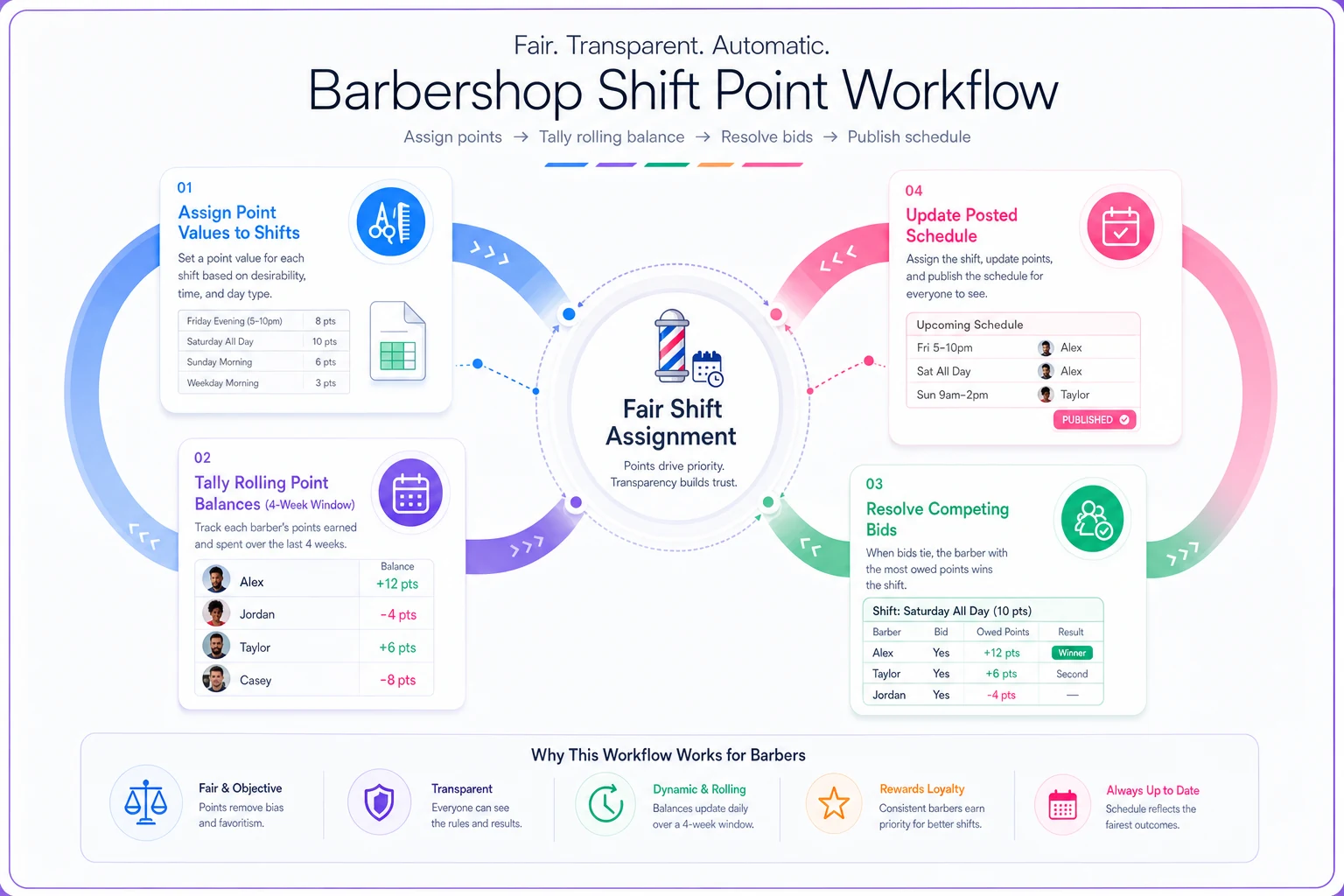
A spreadsheet with one tab per month and a running points column handles this fine for a single-location shop. You don't need software to start. You need a consistent point table and the discipline to tally it every week.
Shift-bidding: give barbers a voice without losing control
Points fix fairness. Shift-bidding adds agency — letting barbers express a preference instead of just receiving assignments. The combination works because people tolerate a bad shift far better when they chose it in exchange for something, versus when it got handed to them.
A simple shift-bidding pilot design
-
Publish the open shifts for the upcoming two-week block, each tagged with its point value.
-
Give barbers 48 hours to submit a ranked bid — their top three preferred shifts and any shifts they'd like to avoid.
-
Resolve the easy ones first. Any shift only one person bid on, they get it.
-
Break ties with points. When two barbers want the same prime slot, the one with the lower running balance wins.
-
Assign leftovers by owed-points. The slow shifts nobody bid on go to whoever has the most positive balance — they took the good stuff, they cover the gaps.
-
Post the final schedule with the updated point totals visible. Transparency is what makes the whole thing hold together.
That last step matters more than anything else. When barbers can see that the person who landed the coveted Saturday was also the one who covered two holidays and a string of dead afternoons, the fairness is self-evident. Hidden logic breeds suspicion even when the logic is sound.
When shift-bidding actually makes sense
This works well when you have four or more barbers, enough shift variety that preferences genuinely differ, and at least one or two people who already feel the current system is unfair. It also works when your barbers have different life situations — the parent who needs mornings, the night owl happy to close. Bidding lets those preferences surface instead of you guessing.
When it's a bad idea
Skip shift-bidding if you've only got two or three barbers — the overhead isn't worth it, just use points and a conversation. Skip it if traffic is so even across the week that no shift is meaningfully better than another; there's nothing to compete over. And don't run a bid when you're down a person and scrambling to cover — bidding assumes you have more supply than demand for the good slots. In a staffing crunch, assign directly and return to bidding once you're stable.
One more thing: don't start this if you're not willing to actually follow the point totals. If you run a bid and then override it because you want a specific barber on Saturday anyway, you've made the problem worse. You've proven the system is theater. Only run it if you'll respect the output.
The two-week fairness audit
Before changing anything, find out whether you actually have a fairness problem and how bad it is. A two-week audit gives you the baseline. It's tedious, but it's what turns every later conversation factual instead of emotional.
For two weeks, log the following for every shift worked:
-
Who worked it and the shift's point value from your table
-
Revenue generated during that shift per barber
-
Walk-in vs. booked split (prime shifts are usually walk-in heavy)
-
Any swaps or no-shows, and who initiated them
At the end of two weeks, total it up per barber. You're looking for two things: whether point balances are drifting, and whether revenue-per-shift confirms your point values are accurate. Sometimes the audit reveals a shift you thought was slow is actually solid — and the point table needs adjusting before it creates a new unfairness.
A real scenario
A four-chair shop kept losing newer barbers within their first six months. The owner assumed it was pay. The two-week audit told a different story: the two senior barbers were working nearly every Saturday and Friday evening, pulling the bulk of walk-in revenue, while the two juniors were stacked onto Tuesday and Wednesday afternoons averaging maybe a third of the volume.
The juniors weren't underperforming — they were structurally boxed out of the shifts where money gets made. One of them was clearing roughly $600–$700 less a week than they could have been, purely from slot assignment. No wonder they left.
The owner built a point table, ran a month of shift-bidding, and required the senior barbers to cover a rotation of slow and late shifts in exchange for their weekend picks. Within two cycles, the junior barbers' weekly take evened out noticeably, the Tuesday afternoons stopped feeling like punishment, and — the part the owner didn't expect — the senior barbers actually bought in. They could now see they weren't being quietly resented anymore. Nobody quit that quarter.
Common mistakes that wreck a fair rotation
A few patterns show up repeatedly when owners try this and it falls apart:
-
Point values that never get updated. Traffic shifts seasonally. A shift that was slow in winter might be your busiest in summer. Revisit the table every quarter.
-
Letting swaps happen off the books. If two barbers trade shifts privately and you don't adjust the points, the ledger drifts out of sync. Every swap has to update the tally.
-
Exempting yourself or the shop favorite. The second there's an exception, the system is dead. If the owner-barber takes all the prime slots "because it's my shop," you've rebuilt the original problem.
-
Running the audit once and never again. Fairness isn't a one-time fix. A quick two-week audit once a quarter keeps everyone honest and catches drift before it turns into resentment.
-
Over-engineering it. Some owners try to weight points by revenue, tenure, skill level, and several other factors simultaneously. It collapses under its own complexity. Keep the table to five or six shift types. Simple and consistently applied beats precise and abandoned.
Keep the table to five or six shift types. Simple and consistently applied beats precise and abandoned.
Where this connects to the rest of your scheduling
Fairness rotation sits on top of your underlying coverage plan — you still need the right number of chairs staffed at the right times, which is a separate problem. If the base schedule itself is wrong, no amount of fair point-balancing will fix it. It's worth pairing this with a solid chair-level scheduling framework so you're distributing shifts that are actually built around real demand, not just dividing up a schedule that was flawed to begin with.
As shops grow past four or five barbers, the manual tally gets heavy — tracking rolling point balances across weeks, handling swaps, resolving bids by hand. That's the point where a scheduling platform that logs shift assignments and flags imbalances automatically can save you from the spreadsheet becoming its own part-time job. AI-assisted operational software can handle the running totals, surface when someone's balance is drifting too far in either direction, and even send bid reminders automatically — the kind of low-level coordination work that's easy to let slide when you're busy cutting hair. But that's an upgrade for later. Start with paper. The discipline matters more than the tooling.
The takeaway
Unfair schedules don't announce themselves. They leak out as swaps, missed shifts, flat energy on slow days, and eventually a resignation that catches you off guard. The fix is boring and effective: assign honest point values to your shifts, balance them over a rolling window, let barbers bid with the owed-points rule breaking ties, and run a two-week audit to keep yourself honest.
Barbers don't need the schedule to be perfect. They need it to be visible and consistent — to see that the person getting the good shifts also carried the bad ones. Get that right and a surprising amount of the low-grade friction in your shop quietly goes away.
Ready to elevate your barbershop operations?
Join 500+ barbershops using Trimzly to save time, reduce scheduling conflicts, and enhance client satisfaction.