
Most barbershop retail sits in a sad little glass case near the register that nobody looks at, priced randomly, dusty on the top shelf, and touched maybe twice a week. Then the owner wonders why their attach rate — the percentage of haircuts that turn into a product sale — is stuck at 6% when the good shops run 20–30%.
Retail isn't a "nice to have" line item. It's the highest-margin thing you sell. A pomade you buy for $9 and sell for $22 beats a $35 haircut on pure margin, and it costs you zero chair time. If you've already read our take on the retail and add-on revenue system for barbershops, this is the ground-level execution piece: what the display actually looks like, where it goes, what price it's marked, and what the barber says.
This is a merchandising SOP. Not merchandising theory. The goal is that any barber on your floor could look at the shelf and know exactly what to do — without asking you.
Why most shop retail underperforms (it's not the products)
The products are almost never the problem. Retail gets treated like a passive thing — put it out, hope it sells — when it's actually a workflow that has to fit inside a haircut.
-
The display is out of the sightline. It's behind the client, or off to the side where they never look. The one place a client stares for 30 minutes straight — the mirror station — usually has nothing on it.
-
There's no price on anything. Clients won't ask. A shop with unpriced product loses the impulse buyer entirely, because nobody wants to feel the awkwardness of asking "how much is that."
-
The barber has no line to say. Selling feels uncomfortable to a lot of barbers, so they say nothing, and "say nothing" becomes the default policy.
Fix those three and you've done most of the work. The rest is just dialing it in.
Three shop archetypes, three starter kits
Not every shop should run the same display. A high-volume walk-in shop and a premium appointment-only shop have completely different buying psychology. Here are three archetypes and a starter kit for each.
Never miss a booking amidst the hustle.
Trimzly helps you schedule, confirm, and manage every client visit seamlessly.
- Unified appointment management
- Automated client reminders
- Optimized staff scheduling
No credit card required
Archetype 1: High-volume walk-in shop
Fast turnover, price-sensitive clients, lots of first-timers. People are in and out. You need retail that sells itself in the 20 seconds someone waits to pay.
Starter kit:
-
3 SKUs only — one matte paste, one strong-hold pomade, one beard oil
-
Small countertop riser at the register
-
Big, dead-simple price tags ($18–$24 band)
-
A "grab one" basket of travel-size items ($6–$8) right at the counter
The trap here is over-assortment. Walk-in clients don't want to compare eight pomades. Give them the one your barbers actually use and get out of the way.
Archetype 2: Appointment-based neighborhood shop
Regulars, relationships, mid-tier pricing. Your barbers know these clients by name. This is where consultative selling works, because there's trust and time.
Starter kit:
-
6–8 SKUs across styling, beard, and one shampoo/conditioner
-
A mirror-station shelf at each chair (this is the big one)
-
Mid-band pricing ($22–$32)
-
A small "used on you today" card per chair listing the two products that barber reaches for most
The mirror shelf matters because the sale happens during the cut, not at the register. When the barber finishes styling and the client sees the result, that's the buying moment — and the product is right there.
Archetype 3: Premium / appointment-only shop
Higher ticket, brand-conscious clients, slower pace. People here will pay for the story and the packaging. Under-pricing actually hurts you — a $14 pomade reads as cheap.
Starter kit:
-
8–12 SKUs including a small premium/luxury tier
-
A dedicated retail wall or lit shelf, treated like a display, not storage
-
Premium band ($30–$48)
-
One or two "signature" bundle sets (styling + beard) at a slight premium, gift-ready
For a premium shop, packaging and presentation are the product. A crowded shelf kills it. Fewer facings, more breathing room, good lighting.
Placement heatmap: where product actually sells
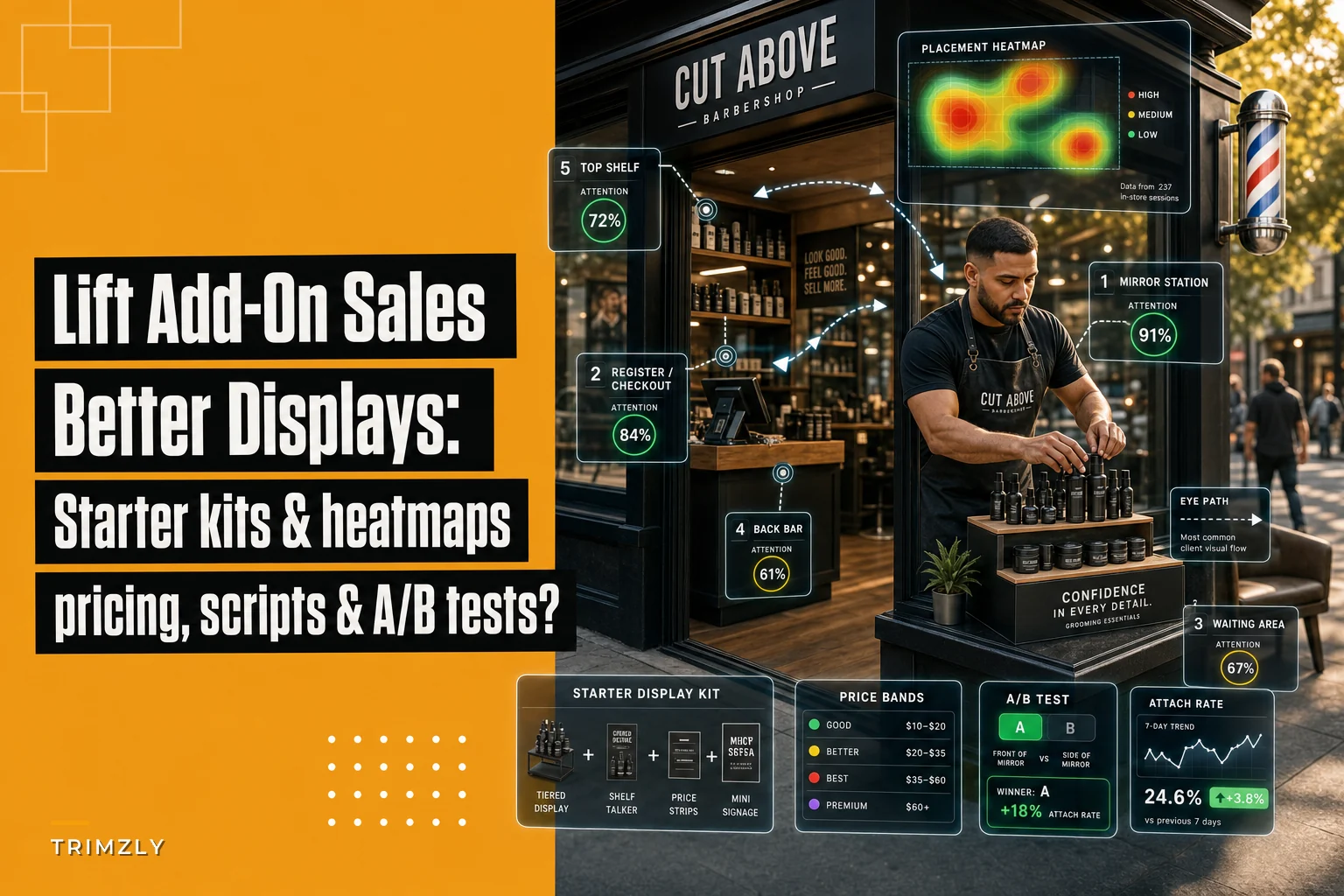
If you mapped where clients' eyes go during a visit, you'd see a clear pattern. Here's a rough heatmap of a typical shop, ranked by how much attention each zone gets — and how much retail actually moves from there.
| Zone | Client attention | Retail sell-through | What to put here |
|---|---|---|---|
| Mirror station (in front of chair) | Very high | Highest | Your 2–3 hero styling products |
| Register / checkout counter | High | High | Impulse + travel sizes |
| Waiting area (eye level) | Medium | Medium | Bundles, "staff picks" |
| Back bar shelf | Low | Low | Backstock, not selling |
| Top shelf anywhere above eye line | Very low | Near zero | Nothing you want to sell |
This workflow shows where to place products for maximum attach rate.
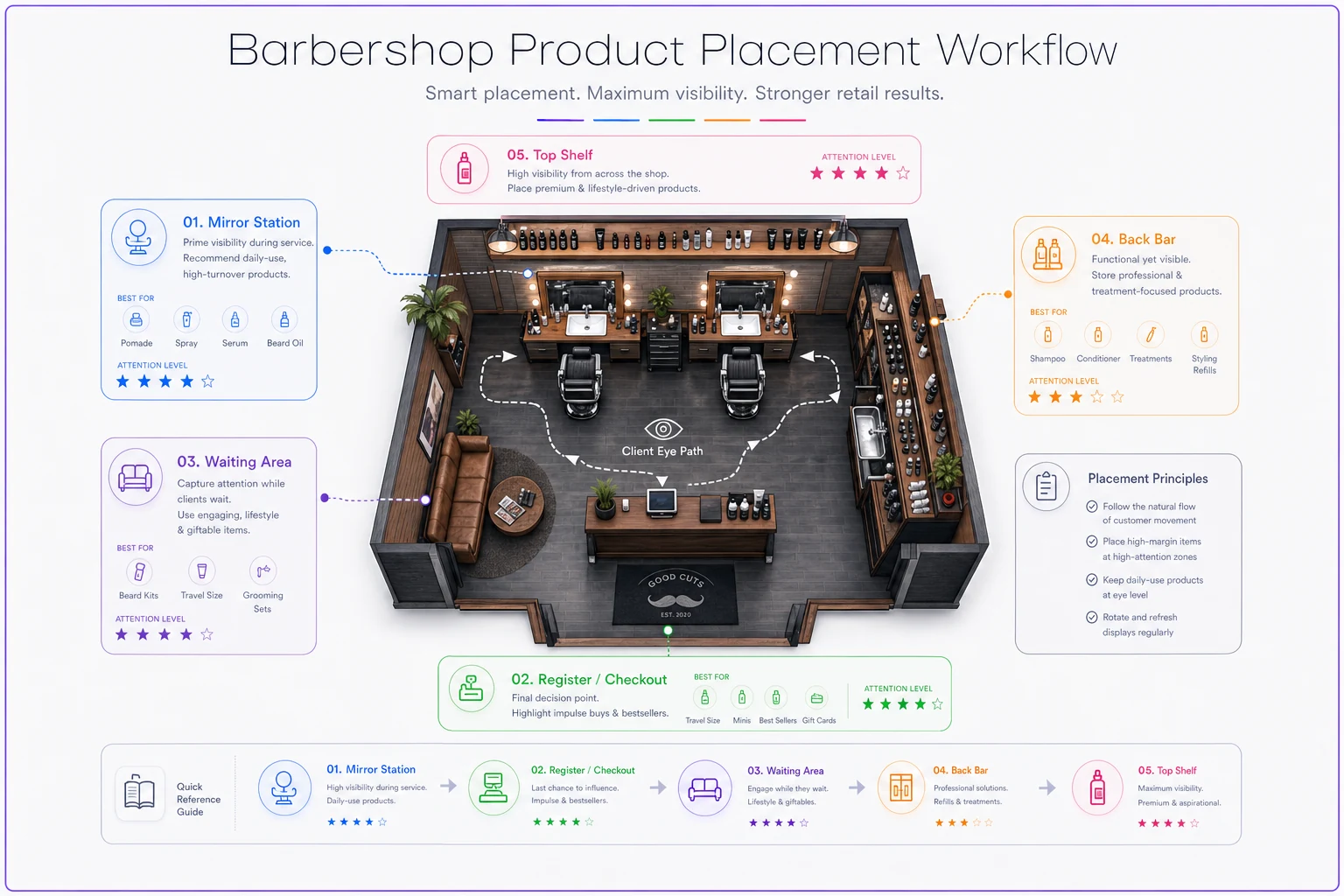
The single biggest miss is the mirror station. It's the highest-attention real estate in the entire shop and most shops leave it empty or cluttered with clipper guards. One clean product on a small shelf there — priced, with the barber saying one sentence about it — will outperform a whole glass case by the door.
The top shelf issue is worth calling out too. Anything above roughly 5'6" basically disappears. If your best margin product is up top because it "looks nice," you're hiding your money.
Pricing bands, not random prices
Random pricing signals amateur hour and makes barbers hesitate. Set three clear bands and slot everything into them. It makes the shelf look intentional, and it gives barbers a mental script ("that one's our mid-tier, $28").
-
Entry band ($6–$18) travel sizes, basic styling, impulse grabs
-
Core band ($20–$32) your bread-and-butter styling and beard products
-
Premium band ($34–$48) luxury tier, bundles, gift sets
Keep the entry band physically separate — usually at the register — so it reads as "add this on" rather than "compare this to the expensive one." And be careful running retail discounts the wrong way; there's a real risk of training clients to wait for a sale, which we get into in the piece on promotions and gift-card rules that don't cannibalize regular bookings.
Short staff-sale scripts (the part barbers skip)
Barbers won't sell if selling feels like selling. The fix is scripts short enough that they don't feel like a pitch — they feel like advice. Which they actually are. The barber genuinely used the product, so recommending it is honest.
One rule for every script: it has to reference something you actually did to their hair. Generic pitches die. Specific ones convert.
During styling (the strongest moment):
> "The hold you've got right now? That's this matte paste. A little goes a long way — want me to grab you one before you go?"
For a client fighting frizz or dryness:
> "Your ends are a little dry, that's why it's puffing up on the sides. This oil fixes that in about a week. It's the $22 one."
For a beard client:
> "You keep asking how to soften the beard — this is what I used today. Rub it in after a shower."
At the register, for the impulse buyer:
> "Throw a travel size in? It's six bucks, fits in a gym bag."
None of these say "would you like to buy." They assume the product is useful and offer it. That framing alone lifts attach rate more than any display change.
The other rule: one recommendation per client, max two. Barbers who pitch three things sell zero. Overselling reads as commission-hungry and clients shut down fast.
The A/B test plan tied to attach-rate benchmarks
Most merchandising advice falls apart here — nobody actually measures it. You put out a display, sales feel about the same, you give up. The fix is running actual A/B tests, one variable at a time, and watching attach rate.
Attach rate = (transactions with a product) ÷ (total haircut transactions). Track it weekly.
Rough benchmarks:
-
Under 8% — you basically have no retail motion
-
8–15% — display exists, but scripts are weak
-
15–25% — solid, most well-run shops live here
-
25%+ — strong, usually mirror-station displays + consistent scripts
How to run the test
-
Measure your baseline for 2 weeks. Don't change anything. Get your real current attach rate. Most shops are shocked it's lower than they thought.
-
Change ONE thing. Add a mirror-station shelf, or add price tags, or roll out the scripts. One variable, or you won't know what worked.
-
Run it 2–3 weeks. You need enough transactions for the number to mean something. A slow shop needs longer.
-
Compare attach rate, not total dollars. Total sales bounce around with traffic. Attach rate isolates whether merchandising actually improved.
-
Keep the winner, test the next thing. Stack improvements one at a time.
A test order that tends to work well:
-
Test 1 Price tags on everything (usually the fastest lift)
-
Test 2 Move one hero product to the mirror station
-
Test 3 Roll out the three staff scripts and actually hold barbers to them
-
Test 4 Add the register impulse basket
Tests 1 and 3 are almost always the biggest movers, and they cost basically nothing.
Start with price tags first — it's often the quickest low-cost lift to attach rate.
If your booking or POS system tags which transactions included retail, pulling attach rate weekly takes about two minutes. If you're tracking it by hand, keep a simple tally sheet at the register — even a rough count beats guessing.
A real scenario
A neighborhood appointment shop, three chairs, running around 340–360 cuts a month. Baseline attach rate sat at about 7%, mostly carried by one barber who liked selling while the other two never mentioned product. Retail was a glass case by the door nobody opened.
They ran the test order above. Price tags first — attach rate crept to around 10% just from removing the "how much is it" friction. Then a small mirror shelf at each chair with two hero products, priced. Then the three scripts became non-negotiable, printed on a card at each station.
Over about eight weeks, attach rate settled in the 19–21% range. On roughly 350 cuts, that's around 65–70 product sales a month instead of ~25, at an average margin of maybe $12–$14 a unit. Call it an extra $500–$600 in near-pure margin monthly, with no added chair time and no new clients. Nothing fancy — just product in the sightline, priced, with a barber saying one honest sentence.
When this is worth doing (and when it isn't)
This SOP makes sense when you've got steady traffic and barbers who are already reaching for product during most cuts. If you're styling with pomade and oil on the majority of clients anyway, you're leaving money on the table by not offering it to take home.
It's a bad idea if you force it. Barbers who feel pushed into hard-selling will do it badly, clients will feel it, and you'll trade a little retail revenue for a hit to the relationship. The scripts work because they're low-pressure and honest. The moment it becomes commission-chasing, kill it.
And if your foot traffic is very low — a brand-new shop doing a handful of cuts a day — fix traffic first. Retail multiplies volume; it can't replace it.
Bottom line
Put the product where clients already look, price it clearly, hand your barbers one honest sentence to say, and measure attach rate one change at a time. That's the whole SOP. A shop that goes from 7% to 20% attach rate is pulling real high-margin money out of chair time it's already paying for. Start with price tags and the mirror station this week — those two alone usually move the number more than anything else you'll try.
Ready to elevate your barbershop operations?
Join 500+ barbershops using Trimzly to save time, reduce scheduling conflicts, and enhance client satisfaction.