
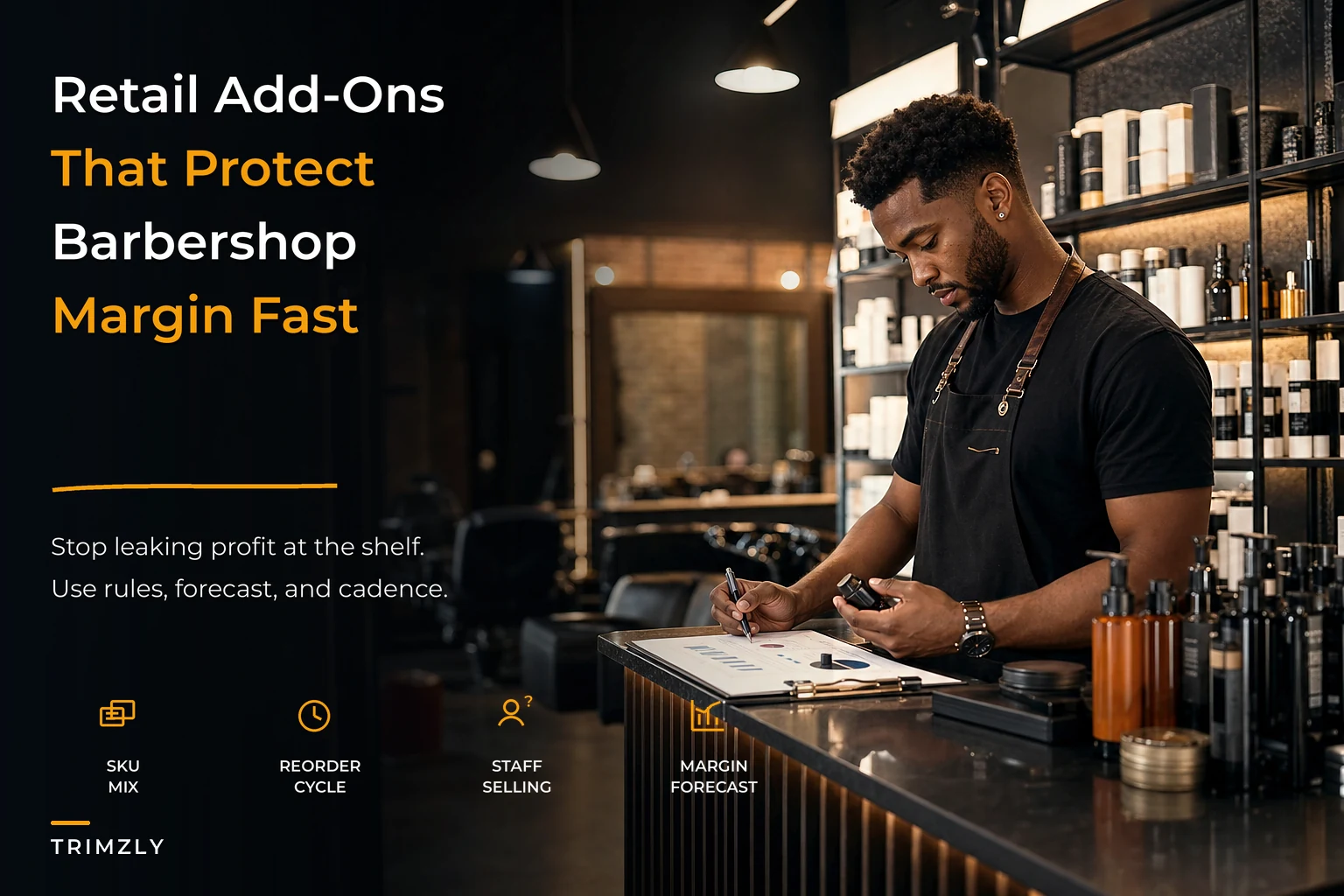

Walk into any barbershop and you'll spot the same retail display collecting dust in the corner. Maybe a few pomades, some beard oil, a lonely bottle of aftershave that's been there since 2019. The owner bought inventory once, marked it up, then wondered why nothing moves.
The shops actually making money from retail operate differently. They don't just have products — they have a system. When retail is structured correctly, it becomes a margin multiplier that flows naturally through every client interaction without anyone having to "sell" anything.
Why barbershop retail fails (and it's not about the products)
The typical setup looks like this: owner drops $800–1,200 on starter inventory, puts it near the register, tells barbers they get 10% commission on sales. Three months later, half the inventory is sitting there marked down or quietly expired.
This happens because retail gets treated as a side project instead of an integrated revenue stream. Barbers are focused on cutting hair. They're not thinking about recommending products unless you build that into their workflow. And even when they do mention something, there's usually no system tracking what works, what doesn't, and why.
The problem runs deeper than motivation, though. Most shops don't actually understand their inventory economics. They order randomly, without thinking about cash flow cycles or how fast products move. They pick items based on personal preference rather than what fits their client base. They price without accounting for shrinkage or expired stock eating into margins.
A shop doing 400 cuts monthly should realistically be moving around $1,800 in retail. Most barely crack $400. That gap isn't because clients don't want products — it's because the operational system to capture that demand doesn't exist.
Building your forecasted retail revenue model
Start with realistic targets based on your service volume. For every 100 haircuts, target 15–20 retail transactions averaging $18–25. That's conservative. Well-run shops hit 25–30% attachment rates.
Never miss a booking amidst the hustle.
Trimzly helps you schedule, confirm, and manage every client visit seamlessly.
- Unified appointment management
- Automated client reminders
- Optimized staff scheduling
No credit card required
Inventory turns matter more than markup. A product turning 6 times a year at 80% markup beats one turning twice at 150% markup. Cash stays liquid, products stay fresh, and you're not sitting on dead inventory.
Here's the math most shops miss: if you're carrying $2,000 in retail inventory and only turning it 3 times per year, you're generating $6,000 in retail revenue. Reduce that inventory to $1,200 and turn it 8 times, you hit $9,600 while freeing up $800 in cash. The key is matching inventory investment to your actual throughput.
Track your service-to-retail ratio weekly. If you're doing 100 cuts but only moving 8 retail items, something's broken. Either the product mix doesn't match your clientele, barbers aren't presenting options, or your pricing creates friction.
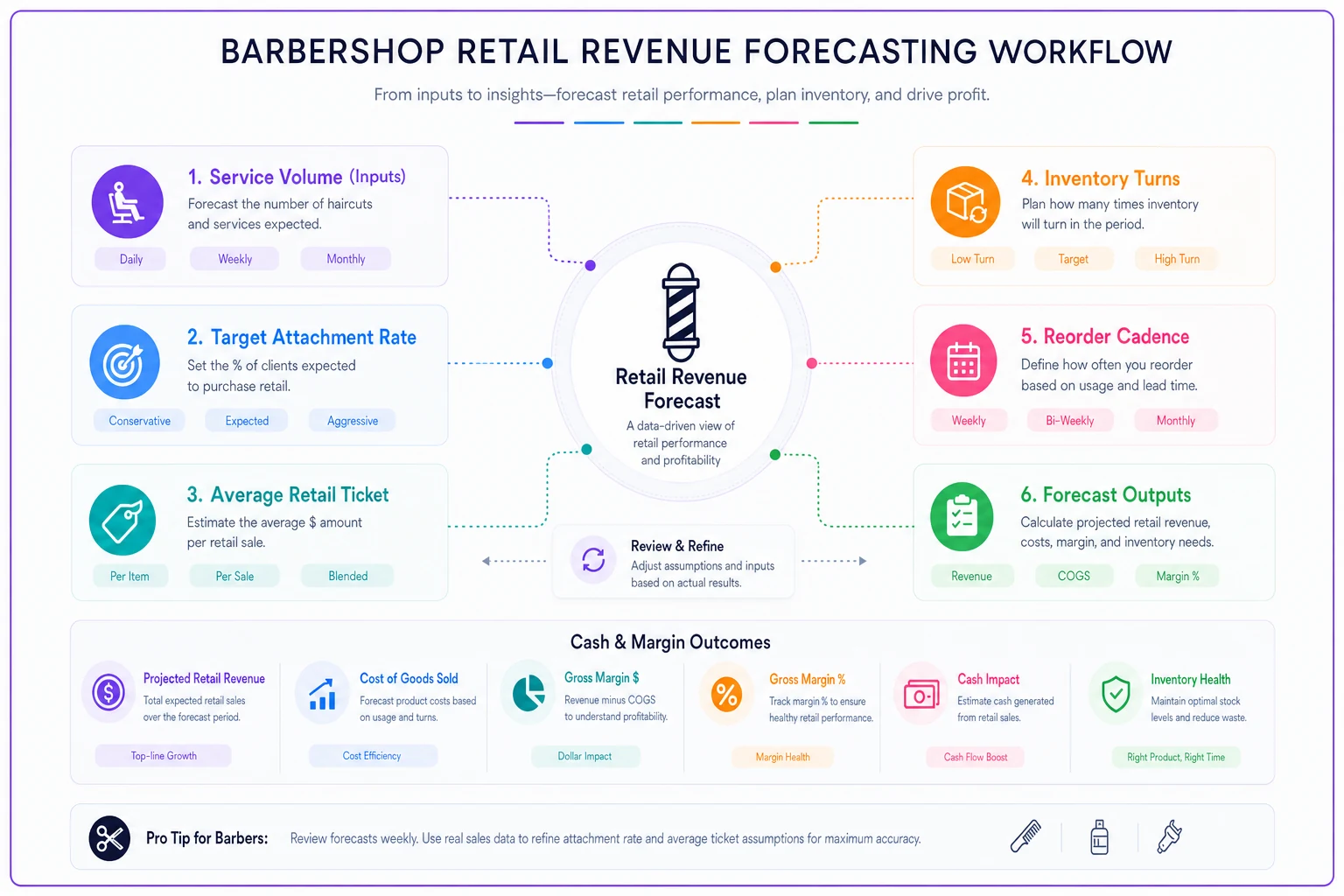
This flow highlights the practical steps: set targets, size inventory to turns, and tie reorder cadence to throughput so cash and stock stay aligned.
Starter SKU lists by shop profile
Your product selection should reflect your client base, not your personal taste. A shop serving mostly professionals needs different inventory than one catering to students or blue-collar workers.
Professional clientele shop (average ticket $45+):
-
Premium pomade (2–3 options, different holds)
-
Beard oil/balm combo sets
-
Travel-size versions of full products
-
Aftershave/cologne (higher-end brands)
-
Hair powder or sea salt spray
-
Shampoo/conditioner sets
-
Face moisturizer
-
Hair/beard brush sets
Start with 12–15 SKUs maximum. Depth in bestsellers beats breadth across categories.
Working-class neighborhood shop (average ticket $25–35):
-
Multi-purpose pomade (strong hold)
-
Basic beard oil (single scent)
-
Edge control/line enhancement products
-
Aftershave splash (traditional scents)
-
Durags/wave caps
-
Basic combs/brushes
-
Razors/blades for home maintenance
Keep it to 8–10 SKUs. Focus on essentials that solve immediate problems.
Mixed demographic shop:
-
Build a core of 6–7 universal products (pomade, beard oil, aftershave)
-
Add 4–5 products targeting your primary demographic
-
Rotate 2–3 seasonal or test products quarterly
The mistake shops make is trying to serve everyone equally. Pick your core customer and build around them. Secondary demographics get secondary shelf space.
Placement rules that drive impulse buys
Product placement determines whether items sell themselves or need constant pushing. The classic "products behind the register" setup kills impulse purchases because clients can't browse while waiting.
Create three retail zones. The waiting area gets your hero products — items clients can discover while sitting around. Position these at eye level when seated. The station mirror area holds styling products barbers can demonstrate during the cut. The checkout zone features small add-ons and travel sizes for last-second additions.
Your highest-margin items belong at eye level in the waiting area. These should be products clients understand without explanation. Pomade in clear containers works. Complex beard growth serums don't.
Station placement needs to support natural demonstration. When a barber finishes styling, the product they used should be within arm's reach. They grab it, show the client, mention the price, move on. No hard sell. The product demonstrates itself.
Keep checkout items under $15. These are low-friction purchases that don't trigger hesitation — travel-size pomades, single-use samples, combs, edge products. Easy yes when someone already has their wallet out.
Rotation matters too. Every couple weeks, shift product positions slightly. Stale displays become invisible. Regular clients who've walked past the same shelf a hundred times will notice a fresh arrangement.
Margin targets and real cost calculations
That 100% markup you're targeting? It's fantasy math once you factor in real costs. Shrinkage alone runs 5–8% in barbershops — product walks out, expires, gets damaged. Real margins account for this.
-
Wholesale cost
$10
-
Retail price
$22
-
Gross margin
$12 (120% markup)
-
Shrinkage/waste (7%)
-$0.70
-
Commission (10%)
-$2.20
-
True margin
$9.10
At those margins, you need to move around 220 units monthly to generate $2,000 in margin — roughly 11 units per working day across the whole shop.
| Item | Amount |
|---|---|
| Wholesale cost | $10 |
| Retail price | $22 |
| Gross margin | $12 (120% markup) |
| Shrinkage/waste (7%) | -$0.70 |
| Commission (10%) | -$2.20 |
| True margin | $9.10 |
Premium products can carry higher markups when positioned correctly. But your bread-and-butter items — the pomades and beard oils that move consistently — should target 80–100% markup after all costs. On everyday items, volume beats margin.
Bundle pricing increases margins without sticker shock. A beard oil that sells for $18 alone can become part of a $45 beard care set with balm and brush. Your margin jumps from $8 to $22 because clients perceive bundles as deals even when individual items aren't discounted.
Track margin by category, not just overall. Hair products might run 90% margins while tools and accessories barely hit 40%. That's fine if tools create upsell opportunities. But if low-margin items dominate your sales mix, you're doing a lot of work for not much payoff.
Cash flow-friendly reorder cadence
Most shops order retail wrong. They wait until shelves look empty, panic-order everything at once, then wonder why cash flow feels tight. Smart reordering follows predictable rhythms.
-
Average weekly sales per SKU × 2 (for two-week lead time)
-
Plus 30% safety stock
-
Equals your reorder trigger point
If you sell 6 pomades weekly, reorder when you hit 16 units (12 for lead time, 4 for safety stock). Keeps you from both stockouts and excess.
Payment terms matter more than discounts. A vendor offering net-30 beats one giving 10% off but requiring upfront payment. You'll sell most inventory before the invoice comes due, which improves cash flow even at slightly higher unit costs.
Set a bi-weekly review on every other Monday to check stock against par levels and record counts to avoid panic ordering.
Seasonal patterns are real. November through January, trim reorder quantities by 20–25%. February through May, add 15%. Summer typically holds flat depending on your market. September–October sees another small bump. Adjust early or you'll be fighting cash flow problems you could've seen coming.
Never tie up more than 8% of monthly revenue in retail inventory. Running $25,000 monthly? Keep retail inventory under $2,000. Keeps cash available for payroll, rent, and the inevitable surprises.
Staff sales scripts linked to throughput
Barbers won't naturally sell retail without specific moments and language that fit within their service flow. Generic "mention the products" training produces generic results.
During consultation (adds about 30 seconds):
"I'm noticing your beard's pretty dry today. After we shape it up, I'll show you something that'll keep it from getting scratchy between visits."
During styling (adds about 45 seconds):
Barber applies product to finish the cut. "This is what I'm using — medium hold, washes out easy. Want me to grab you one? It's $22."
At checkout (adds maybe 20 seconds):
"That pomade's $22. You good on beard oil? We've got a combo deal if you grab both — saves you $8."
None of these require extensive product knowledge or sales training. They're operational cues that fit within existing service patterns. Consistency is what matters — every barber using similar language at similar moments.
When you're running behind, skip the consultation mention. When you're filling last-minute openings, there's time for fuller product education. The system should flex based on throughput.
Common retail system failures
The biggest failure isn't poor sales — it's inventory distortion. Shops order 12 units of the bestseller and 12 units of everything else. Three months later, they're out of what moves and sitting on 11 units of something nobody wants.
This happens because they track revenue, not velocity. A $30 product selling once monthly looks similar on reports to a $15 product selling weekly. One's a dog, the other's a workhorse. Reorder quantities should reflect velocity, not price points.
Commission structures create weird incentives. Flat 10% on everything? Barbers start pushing high-ticket items clients don't need instead of solving actual problems. Better approach: 15% on items under $20, 10% on items over $20. Encourages volume on everyday products clients will actually use and reorder.
Product knowledge gaps kill credibility. A newer barber recommending something they've never touched sounds hollow because it is. Every barber should get samples of your top 5 products to use at home. They sell what they know.
Display maintenance gets neglected after the initial excitement fades. Dusty products don't sell. Faded price tags look cheap. Missing testers frustrate buyers. Assign retail zone upkeep to specific barbers — five minutes at open and close keeps things presentable.
Shrinkage blindness costs more than most shops realize. A lot of shops assume theft when really they're miscounting, giving away samples carelessly, or letting products expire unnoticed. Track every unit — what comes in, what goes out, what gets damaged. A simple count sheet handles this.
Training your team without disrupting service
Pulling barbers off the floor for training meetings they barely pay attention to doesn't work. Build micro-training into daily operations instead.
Start each day with a 2-minute product spotlight during your team huddle. One barber demos one product, says when they'd recommend it, states the price. Rotate through your catalog. After six weeks, everyone knows every product without a single formal training session.
Create product cheat sheets at each station — not lengthy descriptions, just trigger points and prices. "Dry beard = beard oil ($18). Frizzy texture = smoothing balm ($24). Wants stronger hold = clay pomade ($22)." Barbers glance at these between clients until recommendations become automatic.
Role-play during slow periods, not scheduled training blocks. Two barbers waiting for walk-ins? Have them practice on each other. Three minutes beats 30 minutes of slides.
Track individual retail performance weekly, but coach monthly. Daily feedback feels like micromanagement. Monthly feels too distant. Weekly numbers with monthly conversations hits the right balance.
New barbers should shadow your best retail performer for the first few shifts. They see how recommendations fit naturally within service delivery — and they watch clients say yes, which builds confidence faster than any training.
When retail makes sense (and when to skip it)
Not every barbershop should push retail. High-volume, low-price operations where speed is the entire value proposition — retail creates friction there. Those 30–60 seconds per transaction add up when you're trying to move people through quickly.
Retail works when your average service ticket exceeds $35 and appointment length allows for conversation. It works when clients value convenience. It works when barbers have real relationships with regulars.
Skip it if you're doing 15-minute cuts at $20. Skip it if your market is heavily price-sensitive and clients are already stretching for services. Skip it if you can't maintain inventory properly — half-empty shelves and expired products damage your brand more than having no retail at all.
Consider drop-shipping or affiliate programs if cash flow is tight. You lose margin but eliminate inventory risk entirely. Some shops generate $500–800 monthly from affiliate commissions without holding a single unit.
The sensible middle ground: start with 5 proven products, all under $25, all moving at least 8 turns annually. Build from proven success rather than launching 20 SKUs and hoping something sticks.
Building measurement discipline
Track three metrics consistently: attachment rate (retail transactions ÷ service transactions), average retail ticket, and inventory turns. Everything else is noise.
Attachment rate should hit 20% within six months of launching retail. Below that, the system is broken somewhere. Above 30% might mean you're overselling and leaving service money on the table.
Average retail ticket tells you whether you're solving real problems or just moving cheap add-ons. Target $18–25 per transaction. Below $15 and you're working hard for thin margins. Above $30 might suggest pushiness rather than natural recommendations.
Inventory turns show cash efficiency. Below 6 annually is dead money. Above 12 might mean you're understocked and missing sales. The sweet spot for most barbershop retail is somewhere between 8–10 turns.
Weekly tracking keeps small problems from becoming big ones. Month-old data is already stale in retail. You need to know this week what sold last week, what's stagnant, and what's running low.
Compare barber performance monthly, not daily. Daily variation is just noise. Monthly patterns reveal who needs coaching, who has natural retail instincts, and who might be better focused purely on services.
The compound effect of retail systems
A properly built retail system does more than move products. It increases client retention — clients using your products at home stay connected to your brand between visits. It smooths cash flow by adding revenue that isn't dependent on chair time. It even raises your shop's perceived quality. Shops with clean, professional retail displays just feel more established.
The math compounds fast. Add $2,000 monthly in retail at 40% true margin and that's $800 in additional profit. Enough to cover a part-time apprentice, upgrade equipment, or just put in your pocket. Scale across multiple locations and retail becomes a meaningful revenue stream.
But the real value is the discipline it creates. Building retail properly means creating standard operating procedures that extend well beyond products. You're teaching barbers to identify client needs, building recommendation habits, establishing inventory discipline. Those skills transfer everywhere else in the operation.
Shops struggling with retail treat it like an add-on. Shops succeeding treat it like an integrated revenue stream that deserves the same operational attention as service delivery. They forecast demand, manage cash carefully, train consistently, and actually measure what matters.
When retail is built correctly, recommendations flow naturally from service. Clients appreciate the convenience. Barbers earn more. The shop generates margin-rich revenue without adding a single chair. The gap between shops doing $400 monthly in retail and those doing $4,000 isn't better products or pushier barbers. It's operational systems that make retail inevitable rather than optional. Once those systems exist, retail revenue becomes as predictable as service revenue — just with better margins and less labor involved.
Ready to elevate your barbershop operations?
Join 500+ barbershops using Trimzly to save time, reduce scheduling conflicts, and enhance client satisfaction.