

Most second locations fail quietly. Not with a dramatic closure — with an owner who's suddenly working 70-hour weeks, driving between two shops, covering chairs at both, and watching the original location slip because the person who made it good is never there anymore.
The math on a second shop looked fine on paper. Rent, chairs, a lender who liked the numbers. What nobody stress-tested was whether the first location could survive the owner's attention getting cut in half.
That's the real question behind a barbershop second location checklist. Not "can I open one" — almost anyone with decent revenue and a willing landlord can open one. The question is whether the underlying business is mature enough to run without you standing in it. If it isn't, a second location doesn't double your business. It divides your competence.
This is a threshold model. You don't expand when you want to. You expand when specific numbers and systems clear specific bars. If they don't, you wait — even if you're bored, even if a perfect storefront just opened up two neighborhoods over.
The three thresholds that actually predict a good outcome
Forget vibes. There are three things that separate a second location that prints money from one that bleeds it, and they're all measurable before you sign anything.
Threshold 1: Profitability per chair (not total revenue)
Total shop revenue lies to you. A shop doing $40k/month with eight chairs is in worse shape than a shop doing $28k/month with four. When you expand, you're not cloning your revenue — you're cloning your chair economics. Weak chair economics get worse when they're duplicated and diluted by a new location's ramp period.
-
Chair generates roughly $9k–$11k/month in service and retail
-
Barber compensation (commission or booth mix) takes its cut
-
What's left after product, card fees, and direct costs sits around $2,800–$3,500 per chair, per month
If your average chair clears at least ~$2,000 after variable costs, you have real margin to fund a ramp. If it's scraping by at a few hundred dollars, opening a second location just multiplies a thin business by two and adds a second rent check.
The mistake owners make here: they look at the two star barbers pulling huge numbers and assume the new shop will be full of star barbers. It won't be. New locations get staffed with newer people. Model your second shop on your median chair, not your best one.
Threshold 2: Management bandwidth (the one nobody measures)
This is the threshold that kills the most expansions, and it never shows up in a spreadsheet.
Run a simple test: take a full week completely off the floor of your current shop. No cutting, no covering, no popping in. Only answer true emergencies.
-
If the shop runs fine and you come back to normal numbers — you have bandwidth to spare.
-
If bookings dip, staff text you constantly, retail stops moving, and something small breaks — you don't have a second location problem, you have a first location dependency problem.
A second shop needs roughly 15–20 hours a week of real management attention during its first few months — hiring, training, fixing scheduling gaps, handling whatever goes sideways in month one. If your current shop already consumes all of your working hours, where does that time come from? Usually the answer is "from the first shop's quality," and that's exactly how owners accidentally break the thing that was working.
When you run the week off-floor test, log every staff question and repeat issue; it reveals training gaps.
Bandwidth isn't just your time either. It's whether there's a second-in-command who can run the original location day-to-day. No lead barber or manager who can own the floor? Then you have to stay on it, which means you can't be at the new shop, which means the new location has no real owner during its most fragile weeks.
Threshold 3: SOP maturity (can the shop run on paper, not on you?)
Most single-location barbershops don't actually have a business. They have a person — the owner — surrounded by helpers. Everything that works, works because the owner is there to catch it.
SOP maturity means the shop runs on documented, repeatable processes that a new hire could follow without you translating. Opening, closing, cash handling, no-show follow-up, retail restocking, how a consultation gets done, how a re-do gets handled. If those live only in your head, you can't copy them to a second location — you can only re-teach them, one person at a time, indefinitely.
A practical check: could you hand a new manager a shared doc and have them run open-to-close for a week without calling you? If yes, you're ready to duplicate. If the honest answer is "they'd have a dozen questions," build the system first. This is the whole reason to build a proper barbershop operating system with roles, SOPs, and a real roadmap before you expand — expansion stress-tests your systems, it's not the time to invent them.
The go/no-go scorecard
Put the three thresholds together and you get a simple gate. Don't proceed until you clear all three — not two out of three.
Never miss a booking amidst the hustle.
Trimzly helps you schedule, confirm, and manage every client visit seamlessly.
- Unified appointment management
- Automated client reminders
- Optimized staff scheduling
No credit card required
| Threshold | Not ready | Borderline | Ready to expand |
|---|---|---|---|
| Contribution per chair (avg/month) | Under ~$1,200 | ~$1,200–$2,000 | Over ~$2,000 |
| Owner off-floor test | Shop struggles within days | Runs but numbers dip | Runs fine for a full week |
| Second-in-command | None | One person, partially trained | Trained lead who owns the floor |
| SOP maturity | In owner's head | Some written, inconsistent | Documented, followed daily |
| Cash cushion | Under 2 months fixed costs | 2–3 months | 3+ months across both shops |
The cash cushion row matters more than most owners want to admit. A second location typically doesn't break even for 4–9 months. You need to fund payroll and rent at both shops through a period where the new one isn't paying for itself. Owners who open with just enough cash to cover the build-out and nothing left for the ramp are the ones who panic-hire, overbook barbers who aren't ready, and burn goodwill in the neighborhood before the shop finds its footing.
When expansion actually makes sense
-
Your first shop consistently runs a waitlist you can't absorb with existing chairs
-
You have a lead barber ready for more responsibility who'd leave if you don't give them a growth path
-
Chair economics are strong and boringly predictable
-
You've got documented systems and 3+ months of combined operating cash
When it's a bad idea (even if you can afford it)
-
You're expanding because you're bored or because a competitor did
-
Your numbers depend on one or two star barbers who could walk
-
You've never successfully run the shop without being physically present
-
The new location is a "great deal" on rent but in a neighborhood you don't understand — cheap rent in the wrong spot is the most expensive mistake in this whole playbook
The reason to seed the new shop with a transplant rather than an all-new crew: a shop full of strangers in a new space with no established rhythm will invent their own version of your standards within two weeks. And it won't be your version.
The rollout template: what actually happens month by month
Once you clear the gate, the failure mode shifts from "should I do this" to "am I doing it in the right order." Most botched rollouts aren't botched at the decision — they're botched in sequencing. People hire before systems are copied, open before the schedule is built, or market before the chairs can handle the demand.
-
Pre-open (weeks -8 to -4) Duplicate your SOP set for the new location. Don't reinvent — copy your working docs and adjust only what's location-specific. Lock in your build-out timeline with a buffer, because it will run long.
-
Staffing the core (weeks -6 to -2) Move one proven person from your original shop to anchor the new one — a barber your regulars trust, who already knows your standards. Backfill their old chair at shop #1. This seed transplant is the single highest-leverage move in a rollout; a new shop with one person who already does it right trains everyone else by example.
-
Schedule design (weeks -4 to -1) Build the opening-week chair plan before you take a single booking. A half-full shop with barbers standing around drains morale and cash fast. Start intentionally under-staffed and add chairs as demand proves itself. The structure from a chair-level scheduling framework with sample day plans scales directly to a second location.
-
Soft open (weeks 1–2) Invite regulars, offer a limited menu, run at reduced capacity. Use this window to find the operational cracks — the ones that only appear when real clients are in real chairs. Fix them before you advertise.
-
Public open and local push (weeks 3–6) Now you market. Only now. Marketing an under-prepared shop just spends money teaching your neighborhood that the new location is disorganized.
-
Stabilize (months 2–4) Add chairs and hours as bookings justify them. Watch your original shop's numbers closely during this stretch — this is exactly when owner-attention drift shows up.
The reason to seed the new shop with a transplant rather than an all-new crew: a shop full of strangers in a new space with no established rhythm will invent their own version of your standards within two weeks. And it won't be your version.
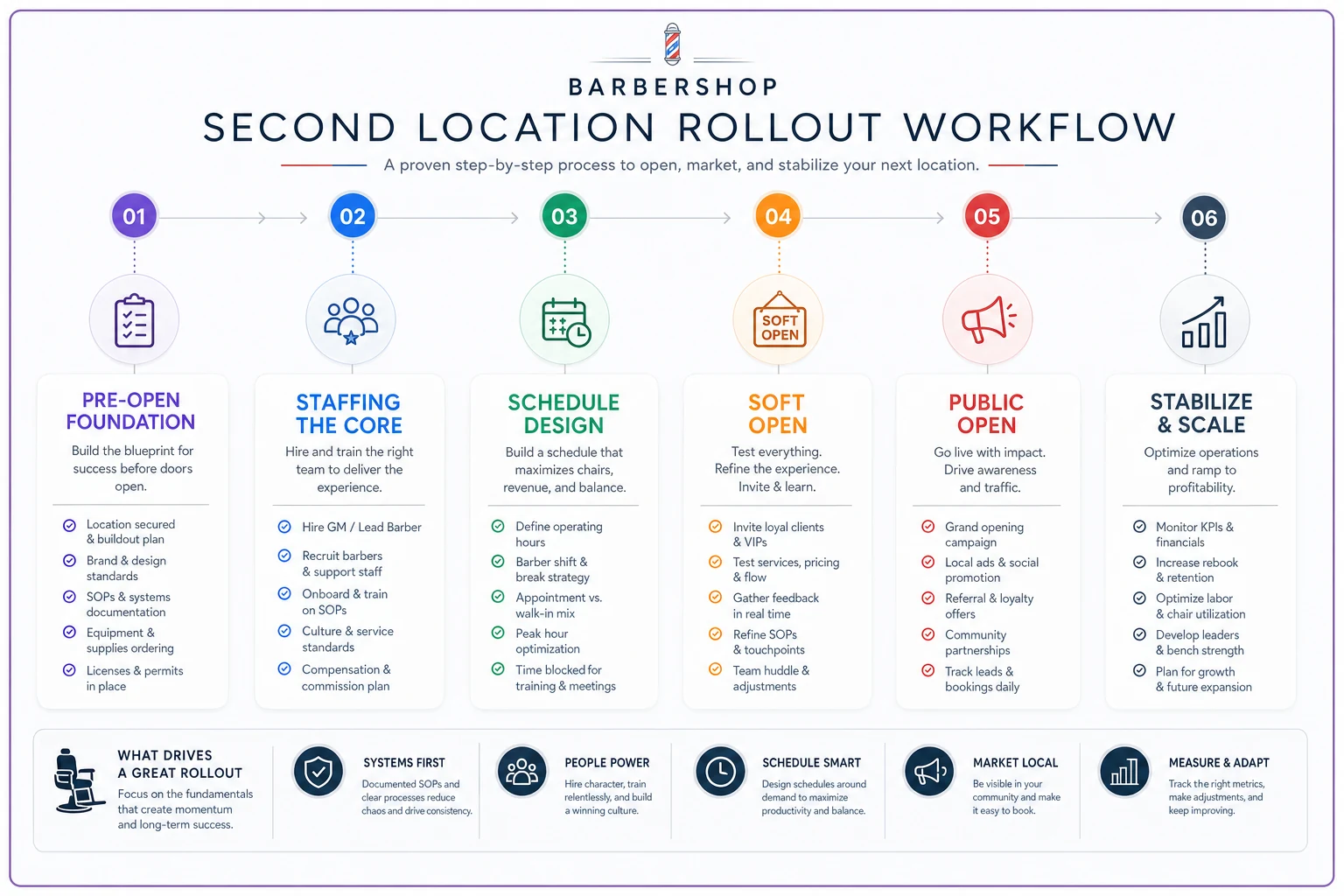
A simple visual that lays out the sequence helps keep priorities straight during a busy build and staff phase.
First-year KPI guardrails
Expansion goes wrong slowly, then all at once. Guardrails catch the slow part. Set these before you open and check them monthly:
-
Original location stability Rebook rate and monthly revenue at shop #1 should stay within ~5% of your pre-expansion baseline. If shop #1 drops more than that, your attention is drifting — pull back before it compounds.
-
New location ramp curve Chair utilization climbing toward ~60% by month 3 and ~75% by month 6. Flat utilization past month 4 is a marketing or location problem, not a patience problem.
-
Combined cash position Never let combined operating cash drop below one month of total fixed costs.
-
New-shop contribution per chair Should reach your median first-shop number by month 6–9. If it's stuck well below that, something structural is off.
-
Staff turnover at the new shop Losing more than one core person in the first six months is a warning sign — usually about training or management presence, not pay.
The guardrail people consistently skip is the first one. They obsess over the new shop's numbers and stop watching the shop that funds everything. A second location ramping nicely while your original quietly loses 12% of its regulars is not a win.
A realistic scenario
A three-chair shop in a mid-size suburb, doing roughly $32k–$36k/month, had a persistent waitlist and a lead barber — call him the anchor — who was clearly ready to run his own floor. Average contribution per chair sat around $2,600. The owner passed the off-floor test; the shop held steady during a week he was out for a family trip.
He opened a second location about 15 minutes away. Instead of hiring three new barbers, he moved his anchor to the new shop, promoted him to lead, and backfilled the original with one experienced hire and one apprentice. He soft-opened for two weeks with a trimmed menu, then marketed locally in week three.
The new shop lost money for the first five months — expected, and funded. By month six it hit around 70% chair utilization and roughly $2,100 contribution per chair. The important part: the original shop barely moved. Rebook rate dipped a couple points in month two, the owner caught it in his monthly review, spent an extra day a week back at shop #1 for about a month, and it recovered.
By month eleven the two shops combined were clearing meaningfully more than the single shop ever had. Not because the second location was a miracle, but because the first one never broke while the second one ramped. That's the whole game.
The point most expansion advice misses
A second location isn't a growth strategy. It's a systems test with a rent check attached. Everything that's slightly broken in your first shop — the undocumented processes, the dependency on you, the star-barber concentration risk — gets amplified, not averaged out.
The owners who succeed treat the year before expansion as the real work: getting the first shop to run without them, writing down what's in their head, growing a lead who can own a floor. By the time they actually open the second location, it's almost boring. The systems already exist. They're just being copied.
Clear the thresholds first, and expansion stops being a gamble — it becomes what it should be: a repeatable playbook you could run a third time.
Ready to elevate your barbershop operations?
Join 500+ barbershops using Trimzly to save time, reduce scheduling conflicts, and enhance client satisfaction.