


A promo at one shop is a marketing decision. Once you have a second location it becomes an operations problem, and by the third or fourth shop it's a finance problem that most owners never treat as one.
At one shop you can watch a promo happen. You see who comes in, you notice when regulars start asking for "the Tuesday deal," and you can tell if the retail bundle is flying or just sitting on the shelf. Across locations you lose that. You get a dashboard showing bookings went up, and that number is almost always misleading. It counts clients who would have come anyway, clients who slid from a full-price day to a discount day, and clients who drove across town to whichever shop had the better offer.
This article follows a cross-location promo or retail rollout from the idea to the quarterly review where you decide whether it lives. It goes in the order things happen, because most of the margin damage gets locked in early, usually before anyone has looked at a single result.
If you need the basics of designing a single test, the post on experiment governance for barbershops that prevents bad decisions covers that. This one is about what changes when the same promo runs across multiple shops with different clients, different capacity, and different managers.
Week zero: the idea arrives (and most of the damage starts here)
Promo ideas in multi-location barbershops usually come from three places. A manager wants to fill slow chairs. A product rep offers a co-op deal on a retail line. Or the owner sees a competitor running something. None of these is a bad source. The problem is that the idea goes straight to execution with no intake step, so nobody writes down what the promo is supposed to do or how you'd know it failed.
It usually starts as a text in the group chat: "Let's do $10 off beard trims for the next month at all shops." Two weeks later one manager has extended it to lineups, another is applying it to walk-ins who never asked, and the third shop never put up the signage. Now there are three different promos running under one name, and nobody can read the result.
So you need an intake. It doesn't have to be fancy. A one-page form that every promo or retail rollout has to pass through, covering:
-
The objective in one sentence. "Fill Tuesday/Wednesday 10am–2pm chairs" is an objective. "Drive traffic" is not.
-
Who is eligible. New clients, lapsed clients (no visit in 60+ days), everyone, or a specific segment.
-
The mechanic. Dollar off, percent off, bundle, free add-on, gift with purchase.
-
What it must NOT do. For example
must not move existing Saturday bookings into the discount window.
-
The kill criteria. The specific result that ends it early.
-
Which shops, and why those shops.
Most owners skip the "must not" line, and it does the most work. Writing it down forces you to think about cannibalization before launch instead of after the quarter closes.
The cannibalization patterns you're guarding against
Day-shifting. A regular who books every three weeks on Saturday sees a Tuesday discount and moves. You didn't gain a visit, you gave away $10. Whether this hurts depends on whether Saturday refills, and that's different at every shop. It's the most important idea in this article, so it comes back later.
Pull-forward. Clients who would have come in two weeks after the promo ends come in during it instead. Bookings spike during the promo and dip after, and if you only measure the promo window you miss the dip completely.
Location-hopping. If Shop A is running $8 off and Shop B isn't, some Shop B clients will book at A. Chain-level revenue looks flat, but you've discounted a client you already had, and maybe annoyed the barber at B who just lost a regular.
Retail substitution. A "pomade + beard oil" bundle at 15% off sells well. But a good chunk of buyers were going to buy the pomade at full price anyway. Now they get it cheaper, and the beard oil they "added" might never get reordered. Attach rate goes up while retail margin per client goes down.
Commission leakage. This one is quiet. If barbers earn commission on the menu price rather than the collected price, the shop absorbs 100% of the discount. A $10 discount on a 50% commission service costs the shop $10, not $5. Plenty of owners don't know which way their POS calculates it until they go check.
None of these shows up in a booking count. That's why the intake form has to name them before launch, because afterward they're mixed together in the numbers and very hard to pull apart.
Weeks 1–2: putting it on the calendar (guardrails before creativity)
A shared promo calendar sounds obvious. Most groups with 2–5 shops either don't have one or have a spreadsheet nobody opens. It matters because of how promos interact. Two back to back, or one on top of a price change, or one during a peak week, makes each of them unreadable and usually unprofitable.
Never miss a booking amidst the hustle.
Trimzly helps you schedule, confirm, and manage every client visit seamlessly.
- Unified appointment management
- Automated client reminders
- Optimized staff scheduling
No credit card required
These guardrails hold up in real shops:
No promo inside peak demand windows. The two weeks before major holidays, back-to-school weekend, prom and graduation weeks in your area. Chairs fill on their own then. Discounting them just hands money to clients who were coming regardless.
No stacking. One active offer per client per visit, chain-wide. If a gift card promo is running, the midweek service promo doesn't apply on top. The post on promotions and gift-card rules to boost revenue without cannibalizing regular bookings goes deeper on stacking logic for gift cards specifically.
Minimum gap between promos on the same service. Somewhere around 6–8 weeks works for most shops. Shorter and regulars learn to wait for the deal, which turns into a permanent discount you never meant to offer.
Quarantine around price changes. Don't launch a promo within about three weeks of a price increase at any participating shop. You can't tell whether booking changes came from the price or the promo, and clients tend to read a discount right after a price hike as "they're nervous."
No retail rollouts during inventory counts or supplier transitions. If shelf stock is being recounted or you're switching distributors, the rollout data will be garbage, and you'll probably run out of the bundled SKU at one shop while another is overstocked.
One calendar owner. Not "the managers coordinate." One person approves what goes on the calendar. At a 2-shop operation that's probably the owner. At 4+ it's often an ops lead or GM.
The mistake I see most is treating the calendar as a record of what's happening instead of a gate for what's allowed. Managers fill it in after they've already launched something. A calendar like that has no veto power, so it isn't governing anything.
Choosing the pilot shop (stop piloting at your best location)
Owners almost always pick their best shop for the pilot. Strongest manager, cleanest data, busiest chairs. It's also the worst place to test most promos, because it flatters every result.
A busy shop with a waitlist will show great numbers on a midweek promo. Clients shift from the overbooked weekend to the discounted weekday, the weekend slots get backfilled by people who couldn't get in before, and total revenue goes up. Then you roll the same promo to a shop where Saturday is only two-thirds full, clients shift the same way, and nothing backfills. Same promo, opposite outcome.
The pilot shop has to represent the shops you're going to scale to. If it doesn't, all you've learned is that the promo works at that one shop.
A pilot selection matrix keeps this honest. Score each candidate location 1–3 on each factor, but more importantly, look at which factors would make the result non-transferable:
| Factor | What to check | Why it matters for cross-location rollout |
|---|---|---|
| Peak-day fill rate | Saturday/Friday utilization over the last 8 weeks | Decides whether day-shifting backfills or bleeds. The biggest single predictor of whether a midweek promo transfers |
| Target-daypart slack | Utilization in the window the promo targets | No slack = no room to grow. You'll just discount existing clients |
| Client overlap with other shops | % of clients who've visited 2+ locations in the last year | High overlap = location-hopping risk and contaminated results |
| Data discipline | Are discounts coded properly in POS, or manually adjusted? | If the shop overrides prices by hand, you can't measure anything |
| Manager follow-through | Did they run the last initiative as designed? | A promo that's "kind of" executed produces a result that's kind of meaningless |
| Retail depth (for product rollouts) | Shelf space, current attach rate, SKU stock levels | A shop with weak retail habits will undersell any product rollout and you'll kill a good idea |
| Typical seasonality | Does this shop follow the chain's seasonal pattern? | A shop near a college or tourist area has its own calendar, so results won't generalize |
You don't want the highest-scoring shop overall. You want the one that most resembles the median of your chain on the factors that matter for this specific promo. For a midweek service promo, peak-day fill and target-daypart slack matter most. For a retail bundle, retail depth and data discipline matter most.
If your shops split into two clear types (say, two busy downtown shops and two quieter suburban ones), pilot at one of each, or at minimum at the type you're most worried about. Testing only at the busy shop and assuming it'll work at the quiet one is how chains lose money on promos that "worked."
Building a control that survives real barbers and real front desks
You need something to compare against. Bookings going up during a promo tells you nothing unless you know what bookings would have done without it. Spring always picks up. Paydays always matter. A competitor closing down the street can lift your numbers for a month.
With 2–5 shops you have too few locations for location-vs-location comparisons to mean much on their own, so it helps to know which control design fits which situation.
Client-level holdout. Take the eligible client list and randomly hold back around 10–20% who don't receive the offer. Then compare behavior between the two groups. This is the strongest design for anything delivered by text, email, or app message (win-back offers, rebooking incentives, birthday deals), and it handles seasonality automatically because both groups go through the same season.
Matched-location control. One shop runs the promo, a similar shop doesn't, and you compare the change at each shop against its own prior period. It works for in-shop stuff like retail displays or signage-driven offers, where you can't hide the promo from some clients in the same building. It's weaker, because two shops are never truly identical. Treat the result as directional.
Switchback (time-based). The promo runs on alternating weeks at the same shop: on, off, on, off. Useful when you only have one comparable shop. The catch is that clients figure out the pattern fast, and staff get confused too.
Daypart holdout. The promo applies to Tuesday but not Wednesday, even though both are slow, and you compare. Cheap and simple, but you'll get some spillover as clients move from Wednesday to Tuesday, which is itself the cannibalization you're trying to measure.
Where holdouts break
The design is usually fine. Execution in the shop is what breaks it.
-
Promo eligibility should be tied to the client record, not a code anyone can type in
-
Manual price overrides during a test should require a reason code, and someone should look at that report weekly
-
Barbers need to know a holdout exists and why. Not who is in it, just that it exists and that "giving it to everyone" wrecks the test. Most of them respect that once it's explained in terms of their own commission
Promo eligibility should be tied to the client record, not a code anyone can type in
That last point gets skipped constantly. If barbers think the promo is a gift to clients, they'll spread it around. If they understand that a failed promo gets killed and a passing one gets rolled out (which means more bookings in their slow hours), they'll protect the holdout.
The live window: running a 3–4 week test
Decide the run time in advance. For most barbershop promos, 3–4 weeks is the minimum to get past the first-week novelty spike and catch at least one full rebooking cycle for regulars on a 2–3 week cadence. Shorter than that and you're mostly measuring curiosity.
Information should move through the live window as a chain, and if any link is missing you usually find the problem at the end instead of in week one.
The workflow, start to finish: a client books → the booking system checks the client record for eligibility (test group, holdout, or not eligible) → if eligible, the offer applies automatically at checkout and the transaction is tagged with the promo ID → the POS records the discount amount, the commission calculated, and any retail items on the same ticket → at end of day, tagged transactions roll into a test log alongside the same metrics for the holdout group → once a week the calendar owner reviews redemption rate, manual override count, and whether redemptions are coming from new or existing clients → anything that crosses a pre-set threshold (overrides above a certain count, redemptions from existing regulars above a set percentage) gets flagged to the shop manager within a day, not at the end of the test.
Here's a quick visual of that workflow.
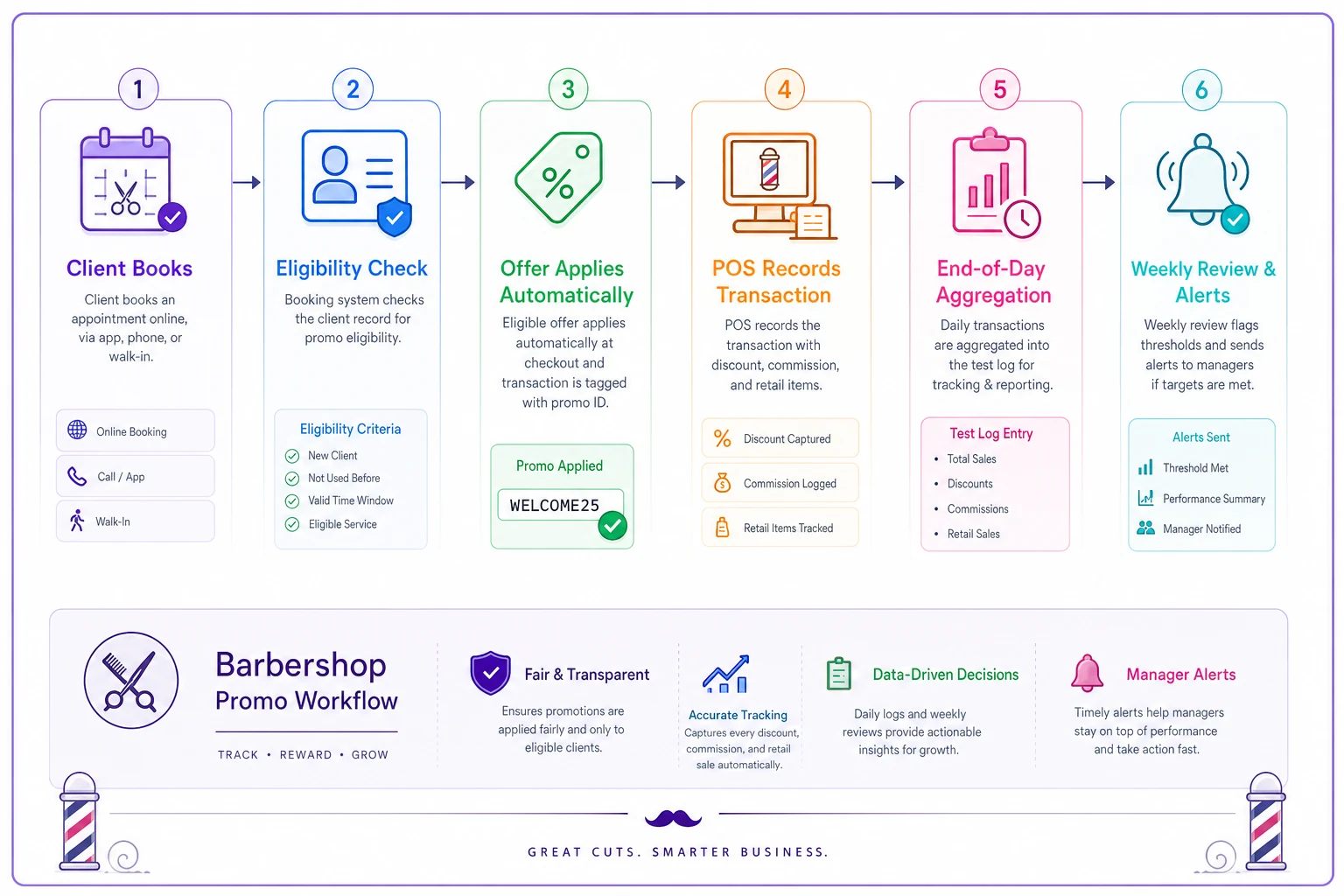
That last step is where ops usually fails. The data gets collected, but nobody looks at it until the test is over. By then a manager has been applying the discount to every walk-in for three weeks and the test is unrecoverable.
This is where AI-assisted operational software is actually useful. It doesn't make the decisions, it just does the boring watching. A platform that tags every promo transaction automatically and flags unusual patterns can catch problems in the first few days: one shop's override rate jumping, redemptions skewing heavily toward regulars, a single barber applying the discount way more than their peers. An owner running three shops isn't going to spot that scrolling a dashboard on Sunday night. The point is that problems surface early, while you can still fix the test.
-
Redemption mix
new clients vs lapsed vs active regulars
-
Booking shifts out of peak days for clients in the test group vs holdout
-
Manual overrides by shop and by barber
-
Retail units sold in bundles vs the same SKUs sold individually
-
Stock levels on any bundled product, by shop
Resist checking revenue daily and tweaking the promo mid-flight. Change the offer halfway through and you're running two different tests in one window, and neither will be readable.
The readout: margin, not bookings
When the window closes, most owners look at booking count and revenue. Those are the two numbers most likely to make a cannibalizing promo look like a winner.
What you want is incremental contribution margin per eligible client. In plain terms:
Take the average margin per client in the test group over the test window plus a few weeks after it (to catch pull-forward). Subtract the average margin per client in the holdout group over the same period. Multiply by the number of eligible clients. Then subtract any fixed promo costs: signage, extra product ordered, the paid text blast.
"Margin" here means revenue minus discount minus commission actually paid minus product cost. If your commission is calculated on menu price instead of collected price, this is where it shows up and hurts.
Measuring a few weeks past the promo end matters more than people expect. Pull-forward shows up as a test group that books heavily during the promo and then goes quiet. Stop measuring when the promo stops and you only see the good half.
A scenario: one promo, four shops, two very different results
Business: A 4-location barbershop group, about 26 chairs total. Two shops downtown with Saturdays basically booked out a week or more ahead. Two suburban shops where Saturday ran closer to 65–75% full.
The promo: $10 off cuts on Tuesday and Wednesday before 3pm, plus a pomade + beard oil bundle at 15% off. Piloted at the busiest downtown shop for a month.
The pilot result: Midweek bookings at the pilot shop went up around 20%. Saturday stayed full. Retail units sold were up. The owner rolled it to all four shops the following quarter.
-
At the two downtown shops, regulars who moved from Saturday to Tuesday were replaced on Saturday by clients who'd struggled to get in. Net positive.
-
At the two suburban shops, regulars moved from Saturday to Tuesday and Saturday just didn't refill. They were giving $10 to clients they already had. Around 40% of redemptions at those two shops came from clients with three or more visits in the prior six months.
-
The retail bundle sold well everywhere, but individual full-price pomade sales dropped by a comparable amount. Most bundle buyers were existing pomade buyers getting a discount, and the beard oil reorder rate afterward was low.
-
Commission was being calculated on menu price at two of the shops (a POS setting nobody had checked), so the shop was eating the entire discount there.
What they changed:
-
The midweek service promo stayed only at the two downtown shops, with a 15% client-level holdout to keep measuring it
-
At the suburban shops, they swapped it for a new-client-only offer on weekdays. No discount for anyone with a visit in the past 90 days
-
The retail bundle was restricted to clients who hadn't bought any product in 90+ days, which turned it into an acquisition tool instead of a discount for existing buyers
-
Commission settings were fixed to calculate on collected price
After: The next quarter's midweek lift was smaller, more like 9–12% at the downtown shops instead of 20%. But measured against the holdout, the promo was clearly margin-positive, somewhere around $2k–$3k of incremental contribution over the quarter across the two shops. The suburban new-client offer was slower to build but brought in first-visit clients who mostly weren't location-hoppers. Retail bundle volume dropped, but full-price single-product sales recovered.
The pilot wasn't wrong. It accurately showed that the promo worked at a capacity-constrained shop. The mistake was assuming that result transferred to shops with a completely different capacity profile.
Scaling in waves, with gates between them
Even when a pilot passes, rolling out to every location at once is how one shop's good result becomes a chain-wide problem. Waves let you confirm the result transfers before you've committed everywhere.
-
Pilot readout passes. Incremental margin is positive against holdout, measured through at least a couple of weeks after the promo ended. Manual overrides stayed under your threshold. Redemption mix matched the objective (if the goal was new clients, most redemptions came from new clients).
-
Classify every remaining shop by the factor that drove the pilot result. For a midweek promo, that's peak-day fill. For a retail bundle, it's existing attach rate and SKU velocity. Group shops into "looks like the pilot" and "doesn't."
-
Wave 2 goes to one shop that looks like the pilot and, if you're willing, one that doesn't. Keep the holdout running. The second shop is effectively a new pilot, and its result tells you whether you need a different version of the promo for that shop type.
-
Check operational load before wave 3. Did the promo create front desk confusion, barber complaints about discounting their regulars, stock-outs on bundled SKUs? A promo that's margin-positive but wears out the front desk will degrade fast.
-
Wave 3 goes to the remaining matching shops only. Shops that don't match get either a modified version (tested separately) or nothing.
-
Set a sunset date at rollout. Every scaled promo gets an end date or a scheduled re-review. Permanent promos without review dates become hidden price cuts.
Step 3 is the one people want to skip, because sending a promo to a shop you expect to struggle feels like wasting a wave. It's the cheapest way to find out whether you need a second version of the promo, and you'd rather learn that at one shop than at three.
Retail rollouts need their own version of this
Product rollouts behave differently from service promos, mostly because inventory is physical and doesn't move between shops easily.
The failure is usually allocation. A new product line gets split evenly across locations. The shop with strong retail habits sells through in two weeks and runs out. The shop with weak retail habits is still sitting on most of its stock two months later. Chain-wide sell-through looks mediocre, so the line gets dropped, even though it was working fine at the shop that actually sells retail.
For retail rollouts, pilot at a shop with average retail performance, not your best. Allocate wave 2 inventory based on each shop's existing attach rate, not evenly. And measure full-price sales of the SKUs the new product might replace, not just the new product's units. The retail merchandising system to scale attach rates and margins post covers displays and attach mechanics in depth. The governance layer here sits on top of that: deciding where and when a product goes, and whether it's adding margin or just shuffling it around.
Seasonal templates: deciding the rules before the season shows up
Most chains reinvent their seasonal promos every year, usually in a rush, usually two weeks before the season starts. So the same mistakes keep coming back. Holiday discounts land on fully booked December Saturdays. Back-to-school deals go to parents who were bringing their kids in anyway.
A seasonal template fixes the rules in advance so the only thing decided in the moment is creative. Here's a starting framework. Adjust the timing for your local calendar, because a shop near a university or in a resort town runs on a different clock.
| Season | Realistic objective | Allowed mechanics | Banned mechanics | Watch for |
|---|---|---|---|---|
| Back-to-school (late Jul–Aug) | Capture new youth clients and family accounts that rebook | First-visit kids' cut offer, family booking convenience (back-to-back slots) | Discounts on peak weekends right before school starts | Parents booking all kids the same Saturday and blocking adult regulars |
| Fall lull (Sept–Oct) | Reactivate lapsed clients | Win-back offers to clients with no visit in 60–90+ days | Blanket discounts to all clients | Regulars who are just slightly overdue getting the win-back deal |
| Holiday (mid-Nov–Dec) | Gift card and retail revenue, not service discounts | Gift card bonus value redeemable in Jan–Feb, retail gift sets | Any service discount in the last two weeks before the holidays | Gift set stock running out at high-retail shops while sitting at others |
| January slump | Fill midweek chairs, redeem gift cards in slow weeks | Midweek offers at shops with real slack, gift card redemption pushes | Offers at shops that stay busy in January anyway | Day-shifting at shops with soft weekends |
| Spring / prom / graduation | Premium services and add-ons | Bundled premium packages at full or near-full price | Discounting during event weeks | Overbooking event weeks and burning out barbers |
| Summer | Steady rebooking cadence, new client trial | New-client offers, referral-based offers | Deep discounts that train clients to wait for summer deals | Vacation coverage gaps making promo demand unserviceable |
The "banned mechanics" column is where the template earns its keep. Banned options are easy to forget once a season gets busy, and almost every cannibalizing promo I can think of was something that should have been on a banned list.
Templates also make year-over-year comparison possible. If you run roughly the same holiday structure two years in a row, you can see whether it's getting better or worse. If every year is different, you just have a pile of one-off anecdotes.
The quarterly review: where promos earn their keep or get cut
Everything above produces data. The quarterly review is where you make decisions with it. Most multi-location groups that do some kind of quarterly review spend it on revenue and staffing and skip promos entirely. Then a promo launched three quarters ago is still running, nobody remembers why, and it's quietly become part of the base price.
A promo-focused review doesn't need to be long. An hour, maybe less, with the owner, ops lead, and shop managers. The checklist:
-
Every active promo listed, with its start date, original objective, and scheduled review/sunset date
-
Incremental margin vs holdout for each promo, by shop, not chain-wide average
-
Redemption mix by client type (new / lapsed / active regular) for each shop
-
Peak-day fill rate trend at each shop, to check whether day-shifting is eating weekends
-
Post-promo booking dip, to see whether pull-forward erased part of the gain
-
Manual override counts by shop and barber over the quarter
-
Commission calculation check
is it still on collected price everywhere?
-
Retail
bundled SKU sales vs full-price single SKU sales for the same products
-
Retail
stock on hand and weeks of supply for promo SKUs at each shop
-
Any promo that ran at a shop where it wasn't approved (more common than owners expect)
-
Clients redeeming offers at more than one location
-
Next quarter's calendar against the seasonal template
what's approved, what's banned, what's being piloted
-
One decision per promo
keep, modify, restrict to certain shops, or kill
That last item matters most. A review that ends with "let's keep an eye on it" for every promo isn't governance. Each promo should leave the room with a decision attached, even if the decision is "run it another quarter and re-review with these specific numbers."
Also, managers will defend promos at their shop because the promo is visible and the margin cost isn't. A manager sees a busy Tuesday and feels good about it. They don't see the empty Saturday chair three weeks later. Putting shop-level incremental margin next to that shop's peak-day fill trend, on one page, usually ends the debate faster than any argument.
When this level of governance makes sense
For a group with two or more locations running more than a couple of promos or retail pushes a year, some version of this is worth it. One bad chain-wide rollout (a quarter of hidden margin loss, retail stock stuck at the wrong shops, regulars trained to wait for deals) usually costs more than the time it takes to set up an intake form, a calendar owner, and a holdout.
It's especially worth it if your shops have noticeably different capacity profiles. The busy-downtown-plus-quieter-suburban mix is where uniform promos do the most damage, because the same mechanic produces opposite results.
It also makes sense if you're preparing to sell, bring in a partner, or take on financing. Promo history with real incremental margin data is far more convincing than "we ran some promos and revenue went up."
When this is a bad idea (or at least overkill)
If you have one shop, most of this is too much. A lighter version (pre-set kill criteria, a simple holdout on text-based offers) is enough, no matrices or wave gates needed.
If you run maybe one promo a year, the infrastructure isn't worth building. Just measure that one carefully.
And if your POS can't tag promo transactions or tie offers to client records, holdout tests will be close to impossible to run cleanly. Fix the data setup first. Governance on top of messy data gives you confident-looking conclusions that are wrong.
Who should NOT run cross-location promos at all right now
Some groups are better off not running chain-wide promos until a few basics are sorted out. Otherwise the results won't tell you anything you can trust.
-
Groups where commission settings differ by shop and nobody's sure how each one calculates. Fix that first or every promo result will be distorted
-
Chains in the middle of a software migration or a pricing overhaul. You won't be able to separate the effects
-
Owners whose shops are all running near full capacity at peak and moderately full off-peak. You probably don't have a demand problem a discount will solve. Your constraint is chairs or barbers
-
Groups with high manager turnover, where nobody will still be around to run the readout at the end of the test
If that sounds like you, it's not a permanent verdict. Most of these are fixable in a month or two, and a clean setup makes every later test cheaper to run and easier to believe.
Pulling it together
The order matters more than any single tool here. Intake before launch, calendar before creative, pilot selection based on transferability, a holdout the barbers actually understand, weekly checks during the window, a margin-based readout that extends past the promo end, rollouts in waves, seasonal rules set in advance, and a quarterly review where every promo leaves with a decision.
Skip any one of those and the rest gets weaker. The most common skip is pilot selection. Testing at the best shop and rolling out everywhere is still the main way multi-location barbershops end up with a promo that looks great in the pilot report and loses money across the chain. If you only change one thing after reading this, pick your next pilot shop based on what the rest of your shops look like, not on which one is easiest to run it at.
From there, build the rest gradually. A shared calendar with one owner and a simple promo section in your quarterly review will catch a lot. The holdouts and wave gates can come once you're running promos often enough that you need them.
Ready to elevate your barbershop operations?
Join 500+ barbershops using Trimzly to save time, reduce scheduling conflicts, and enhance client satisfaction.