


Most barbershops don't have a testing problem. They have a deciding problem.
An owner tries a 20%-off Tuesday promo, sees a decent week, and calls it a win. Three months later nobody can tell whether that promo actually made money or just pulled forward bookings that would've happened anyway. Then someone suggests a membership, and the shop runs it the exact same way — gut feel, a few good weeks, and a permanent change nobody can unwind.
That's the real risk. Not that you experiment, but that you experiment loosely, keep the stuff that felt good, and quietly eat the margin damage for years. Barbershop experimentation governance is just the set of rules that stops a shop from making permanent decisions off noisy, short-term data.
This isn't about turning your shop into a lab. It's about having enough structure that a non-technical team can run a test, read the result honestly, and either roll it out or kill it — on purpose, not by default.
Why loose testing quietly destroys margin
Almost every "test" in a barbershop touches either price or capacity, and both are fragile.
When you discount, you're not just lowering price — you're changing who books and when. A Tuesday promo might show +18% bookings, but if a third of those were regulars who'd have paid full price on Thursday, you didn't grow anything. You gave money away and clogged a slower day with cheaper cuts.
When you launch a membership, the damage is slower and harder to see. The members who sign up first are almost always your most loyal, highest-frequency clients — the exact people already coming in monthly at full price. You've now locked your best revenue into a discount. The chairs look busy, top-line looks fine, and the margin erosion hides for two or three quarters until someone finally runs the numbers.
The pattern underneath both cases is the same: a change that "feels" positive is actually cannibalizing revenue you already had. Without a governance layer, you can't tell cannibalization from real growth, because you never defined what growth was supposed to look like before you started.
This is also why running a lot of experiments doesn't automatically make a shop smarter. Volume doesn't help if every result gets read optimistically. You just accumulate half-true beliefs — "clients love the membership," "the promo always works in summer" — that nobody can actually verify.
The five pieces every barbershop test needs
A governance system doesn't need to be heavy. It needs five things locked down before the test starts, because everything expensive happens when these get decided after you see results.
Never miss a booking amidst the hustle.
Trimzly helps you schedule, confirm, and manage every client visit seamlessly.
- Unified appointment management
- Automated client reminders
- Optimized staff scheduling
No credit card required
| Piece | What it does | What breaks without it |
|---|---|---|
| Hypothesis | Forces you to state what you expect and why | You reinterpret the result to fit whatever happened |
| Metric contract | Defines the one number that decides win/lose | Everyone argues over which metric to look at after the fact |
| Sample size | Tells you how long to run before reading results | You stop the test the moment it looks good |
| Holdout group | Keeps a comparison group that didn't get the change | You can't tell the test apart from normal seasonal swings |
| Go/stop rules | Pre-agreed decision thresholds | The loudest person in the room decides |
The order matters. If you skip the hypothesis and metric contract, the rest is theater. If you have those two and nothing else, you're already ahead of most shops.
The order matters—if you skip the hypothesis and metric contract, the rest is theater.
The order matters. If you skip the hypothesis and metric contract, the rest is theater. If you have those two and nothing else, you're already ahead of most shops.
## 1. The hypothesis template (one page, non-negotiable)
A hypothesis isn't a prediction you hope comes true. It's a sentence specific enough that it could be proven wrong. If your test can't fail, it isn't a test — it's a rollout with extra steps.
> We believe [change] > will cause [specific metric to move in a specific direction] > for [which clients or which days] > because [the actual reason]. > We'll call it a win if [metric] moves at least [threshold] over [time window], > and we'll stop it if [guardrail metric] drops below [floor].
> We believe offering a $15 beard-trim add-on at checkout will raise average ticket by at least $4 for walk-in clients, because most walk-ins currently book a single service and never hear the upsell. We'll call it a win if average ticket rises $4+ over six weeks without rebook rate dropping, and we'll stop it if rebook rate falls more than 3 points.
Notice the two metrics. There's a growth metric (average ticket) and a guardrail metric (rebook rate). Almost every barbershop test needs both, because the thing you're trying to grow usually has a quiet cost somewhere else. A membership grows frequency but can crush per-visit margin. A faster "express cut" grows throughput but can tank satisfaction. If you only track the number you want to move, you'll miss the damage.
The most common mistake isn't writing a bad hypothesis — it's writing none and letting the "because" stay unspoken. The "because" is what tells you whether the result will generalize. A promo that works "because we emailed our list" is a different lesson than one that works "because the price was lower."
## 2. Metric contracts: agree on the scoreboard before kickoff
A metric contract is a simple agreement that says: this exact number, measured this exact way, over this window, is how we score the test. Full stop.
It sounds trivial until you've watched a team relitigate a result. Half the room is looking at total revenue, half is looking at profit per chair-hour, and the promo "worked" or "failed" depending on who's talking. A metric contract kills that argument by making everyone pick before they have any emotional stake in the outcome.
-
Primary metric the single number that decides go/stop (e.g., gross margin per booked hour)
-
Guardrail metrics the things that can't get worse (e.g., rebook rate, no-show rate, average review score)
-
Measurement window start and end dates, no stopping early
-
Exclusions what doesn't count (e.g., ignore the holiday week, ignore comped cuts)
One detail that trips shops up: pick margin-based metrics, not revenue-based ones, whenever a test touches price. Revenue can rise while profit falls — that's the whole danger of discounting. If your primary metric is "total sales" during a promo, you've basically guaranteed the test will look like a win even if you lost money on every chair.
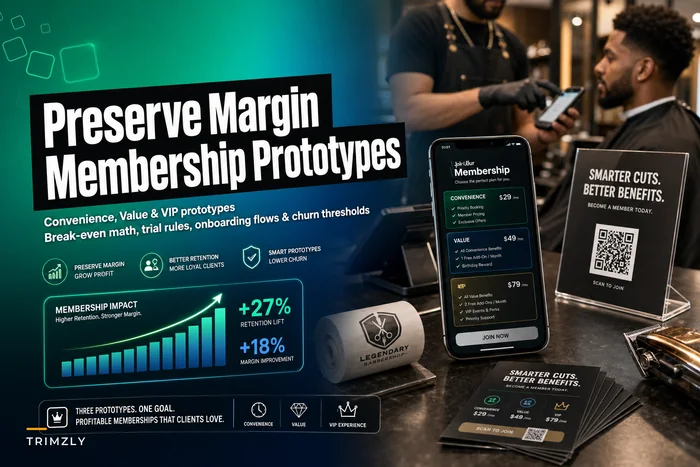
For membership and loyalty tests especially, the right primary metric is margin per client per month, not sign-up count. Sign-ups measure enthusiasm. Margin measures whether the thing is actually good for the business. If you're designing a membership, the margin-preservation logic in these three membership prototypes pairs directly with a metric contract — the prototypes keep you from building a money-loser, and the contract keeps you honest about whether it's working once it's live.
## 3. Sample size, without the math degree
Most barbershop promos get judged on way too little data. A good Saturday is not a trend. One strong week can easily be random noise, especially in a shop doing a few hundred cuts a month.
-
If you're measuring a rate (rebook %, no-show %, attach %), you want at least 200–300 relevant appointments in each group before reading results. Small shops often need 4–8 weeks to get there.
-
If you're measuring a dollar amount (average ticket), you want at least 150–200 transactions per group, because dollar amounts bounce around more than rates.
-
The smaller the change you're hoping to detect, the more data you need. Trying to prove a $1 ticket lift takes far longer than proving a $6 one. If the effect is small, either run it longer or accept you won't be able to tell.
Quick worked example: say your baseline rebook rate is around 40% and you want to know if a new checkout script pushes it to 45%. That's a 5-point move. To detect something that small with any confidence, you realistically need a few hundred clients per group — which for a 4-barber shop might mean running the test closer to 8 weeks, not two. If you stop at two weeks because it "looked up," you're reading noise.
The practical takeaway: set the run length up front, in the hypothesis, and don't touch it. The single most common way shops fool themselves is stopping a test the moment the numbers look good. That's called peeking, and it turns random luck into permanent policy.
## 4. Holdout design for promo and membership tests
A holdout is just a group of clients (or days, or chairs) that doesn't get the change, so you have something honest to compare against. Almost nobody does this, and it's the piece that separates a real result from wishful thinking.
Without a holdout: you run a March promo, bookings are up 12%, you declare victory. But March is up 12% most years because winter's ending. You credited the promo for weather. A holdout group — clients who didn't get the offer — would've shown you the baseline rose too, and the promo's real lift was maybe 3%.
-
Client holdout Randomly exclude roughly 20% of your eligible list from the offer. Everyone else gets it; this group doesn't. Compare the two groups' behavior over the window. Best for promos and loyalty tests tied to your client list.
-
Day/time holdout Run the change on certain days and not others (Tuesday/Wednesday get the add-on push, Thursday/Friday don't). Weaker, because days differ, but workable when you can't split your list.
-
Location holdout For multi-shop owners, run it in one or two shops and hold the rest as controls. Cleanest signal if your shops are similar in size and clientele.
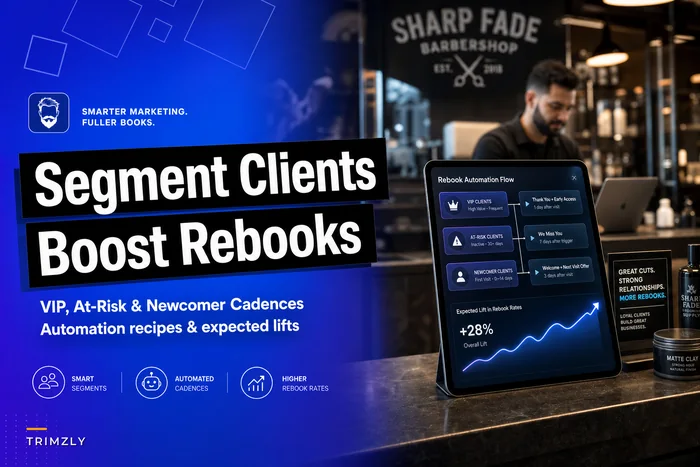
The client holdout is usually the strongest and easiest to run if your booking system can tag and segment clients. The same segmentation setup you'd use for targeted rebook cadences is exactly what lets you carve out a clean holdout — if you can already split clients by frequency or last-visit date, holding 20% of them back without touching the rest of your messaging is straightforward.
One warning: don't hold back your best clients from a genuinely good offer for too long. A test is temporary. If the membership is clearly working after the window closes, roll it out to the holdout group promptly. You're not trying to punish loyal regulars — you're just keeping the comparison clean while it matters.
## 5. Go/stop rules: deciding on purpose
Before the test runs, you write down exactly what result triggers what action. Three outcomes, decided in advance:
-
GO (roll it out) Primary metric beat its threshold, and no guardrail metric breached its floor.
-
STOP (kill it) Primary metric didn't beat threshold by the end of the window, or a guardrail breached at any point.
-
EXTEND (rare) The result is trending toward the threshold but the sample's still too thin to call. Allowed once, with a hard new end date — not an excuse to keep peeking indefinitely.
The reason to write these down early is that a live test generates pressure. The barber who loves the new upsell wants to keep it. The owner nervous about margin wants to kill it. If the decision rule only exists after you see results, whoever argues hardest wins — and that's not a system, that's just politics.
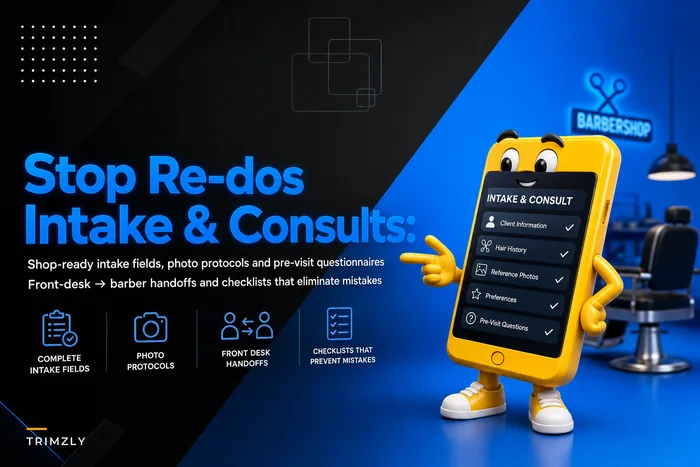
One guardrail worth hardcoding into almost every test: if re-do rates or complaints tick up, stop immediately, regardless of the revenue number. A promo that fills chairs but rushes cuts isn't a win; it's a future churn problem you haven't paid for yet. If your tests involve faster service or more volume per barber, the intake and consultation discipline from this re-do prevention workflow is what keeps a throughput experiment from quietly damaging quality while the top-line looks fine.
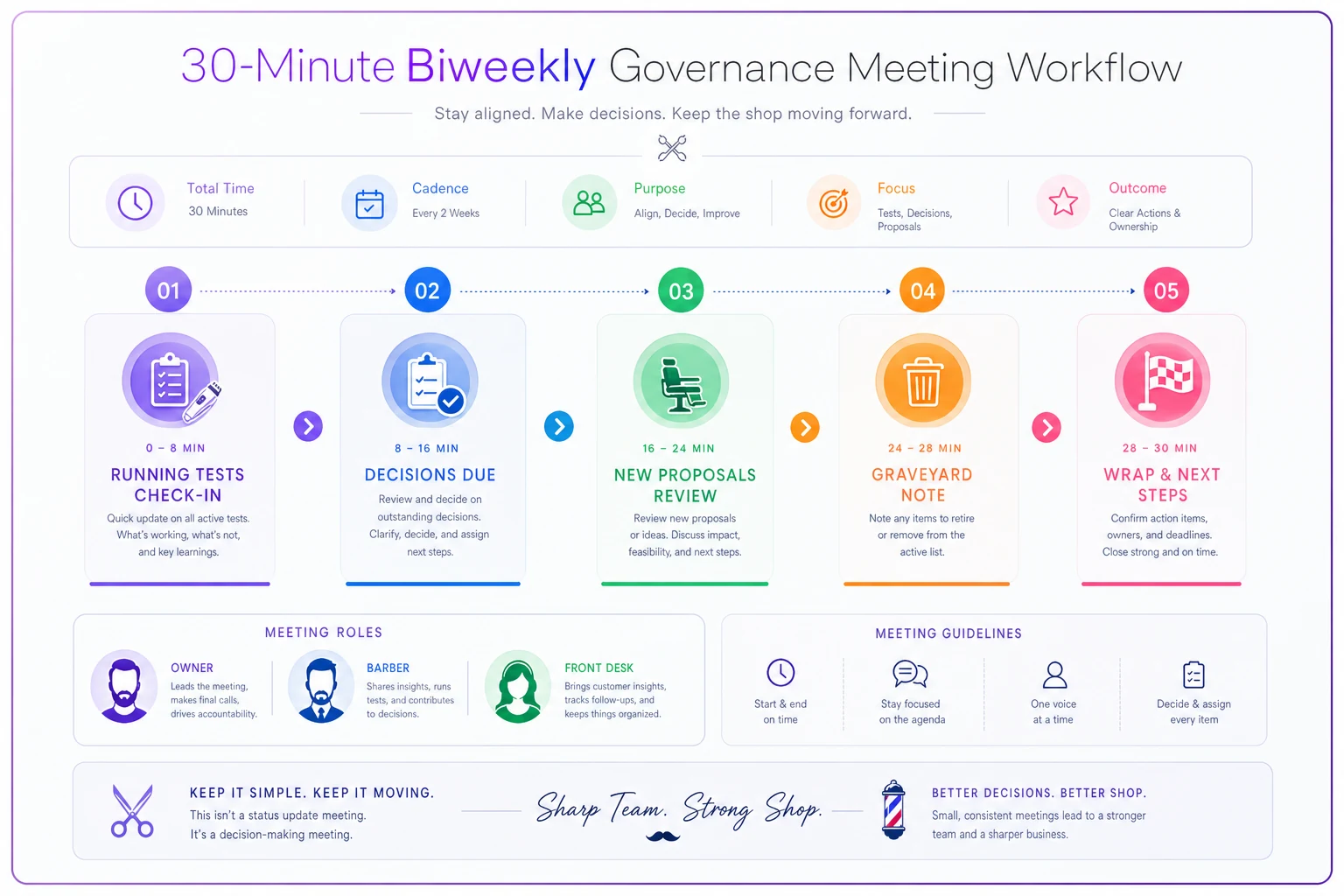
## The governance meeting: 30 minutes, every two weeks
You don't need a committee. You need a short, recurring meeting where tests get reviewed against their pre-written rules. Boring is the point — it means nobody's improvising.
-
Running tests check-in (10 min) For each live test, is it on track to hit its sample size? Any guardrail flashing? No decisions yet, just status.
-
Decisions due (10 min) Any test that hit its end window gets a GO / STOP / EXTEND call using the written rule. The rule decides, not the room.
-
New proposals (8 min) New hypotheses get a quick read. Does it have a metric contract, a holdout, and a stop rule? If not, it's not ready — send it back.
-
Graveyard note (2 min) Log what you killed and why. This is the most valuable record you'll build, because it stops the shop from re-running the same failed idea next year.
That last point matters more than it sounds. Shops without a governance habit forget their own failures. The same discount idea cycles back every 18 months because nobody wrote down that it lost money last time. A one-line graveyard log is cheap institutional memory.
A simple visual of the meeting flow.
That last point matters more than it sounds. Shops without a governance habit forget their own failures. The same discount idea cycles back every 18 months because nobody wrote down that it lost money last time. A one-line graveyard log is cheap institutional memory.
## A real scenario: the membership that looked great
A single-location shop, four chairs, around 330–360 cuts a month, wanted to launch a $45/month unlimited-cuts membership. The owner was confident it would lock in loyalty.
Before governance, the plan was simple: launch it, see how many sign up, keep it if people like it.
Instead they ran it as a proper test. Hypothesis: members would increase total margin per client per month. Primary metric: margin per enrolled client. Guardrail: overall chair utilization — they didn't want members crowding out full-price walk-ins at peak hours. Holdout: they offered it to roughly 70% of eligible regulars, keeping about 30% as a comparison group. Window: 8 weeks.
Sign-ups looked fantastic. Enthusiasm was high, which under the old plan would've locked it in permanently. But the metric contract told a different story. The members who enrolled were almost entirely the twice-a-month crowd already paying full price. At $45 flat, their margin per month dropped by roughly $12–$18 each compared to the holdout group of identical regulars still paying per visit. Meanwhile peak-hour utilization crept up as members grabbed prime Saturday slots they used to book sparingly.
The go/stop rule made the call automatic: primary metric down, guardrail pressured — STOP. They killed the flat membership and redesigned it with a visit cap and off-peak incentives before relaunching. Without the holdout, they'd have seen the sign-up numbers, called it a win, and slowly bled margin on their best clients for a year.
The lesson wasn't "memberships are bad." It was that the first version was a cannibalization machine dressed up as loyalty, and only the test structure caught it.
## When this makes sense — and when it doesn't
This is worth it when a change is hard to reverse or touches price. Memberships, pricing changes, new service tiers, loyalty programs, big promo commitments — anything you'd be stuck with for months deserves a real test with a holdout and a stop rule.
This is overkill when the change is small, cheap, and easily reversed. Trying a new shelf layout for retail? New hold music? A different follow-up text timing? Just try it, watch for a week, and move on. Applying full governance to tiny reversible stuff is just bureaucracy, and it'll make your team resent the whole process.
Who should skip the holdout specifically: very small shops where you genuinely can't get 150+ observations per group in a reasonable window. In that case, lean on a day/time or before/after comparison and accept more uncertainty — just be honest that you're reading a weaker signal, and don't make anything permanent off one cycle.
## Where software quietly makes this doable
None of this requires fancy tooling, but the practical bottleneck for most shops is measurement. Splitting clients into a holdout, tagging who got the offer, and pulling margin-per-client over a clean window is tedious by hand — tedious enough that most owners skip it and fall back on gut feel.
This is where a booking and management platform earns its keep. If your system can segment clients, tag a holdout group, track add-on attach rates, and report margin (not just revenue) by cohort, then running a governed test stops being a spreadsheet project and becomes something your front desk can actually maintain. The point isn't the software — it's that automated measurement removes the excuse not to test properly. When pulling the numbers is easy, teams actually follow the governance instead of abandoning it halfway through.
## Bringing it together
Barbershop experimentation governance isn't about running more tests. It's about making sure the tests you run actually change your beliefs — and that the changes you keep are the ones that genuinely made money, not the ones that happened to feel good for a few weeks.
The whole system is five disciplines working together: a hypothesis that can fail, a metric contract that scores margin not just revenue, a sample size you commit to up front, a holdout that separates real lift from seasonal luck, and go/stop rules that decide for you when emotions run high. Add a 30-minute recurring meeting and a graveyard log, and you've built something most shops never have — a way to change the business on purpose.
The shops that grow steadily aren't the ones that never make bad bets. They're the ones that catch the bad bets in week six instead of year two.
Ready to elevate your barbershop operations?
Join 500+ barbershops using Trimzly to save time, reduce scheduling conflicts, and enhance client satisfaction.