
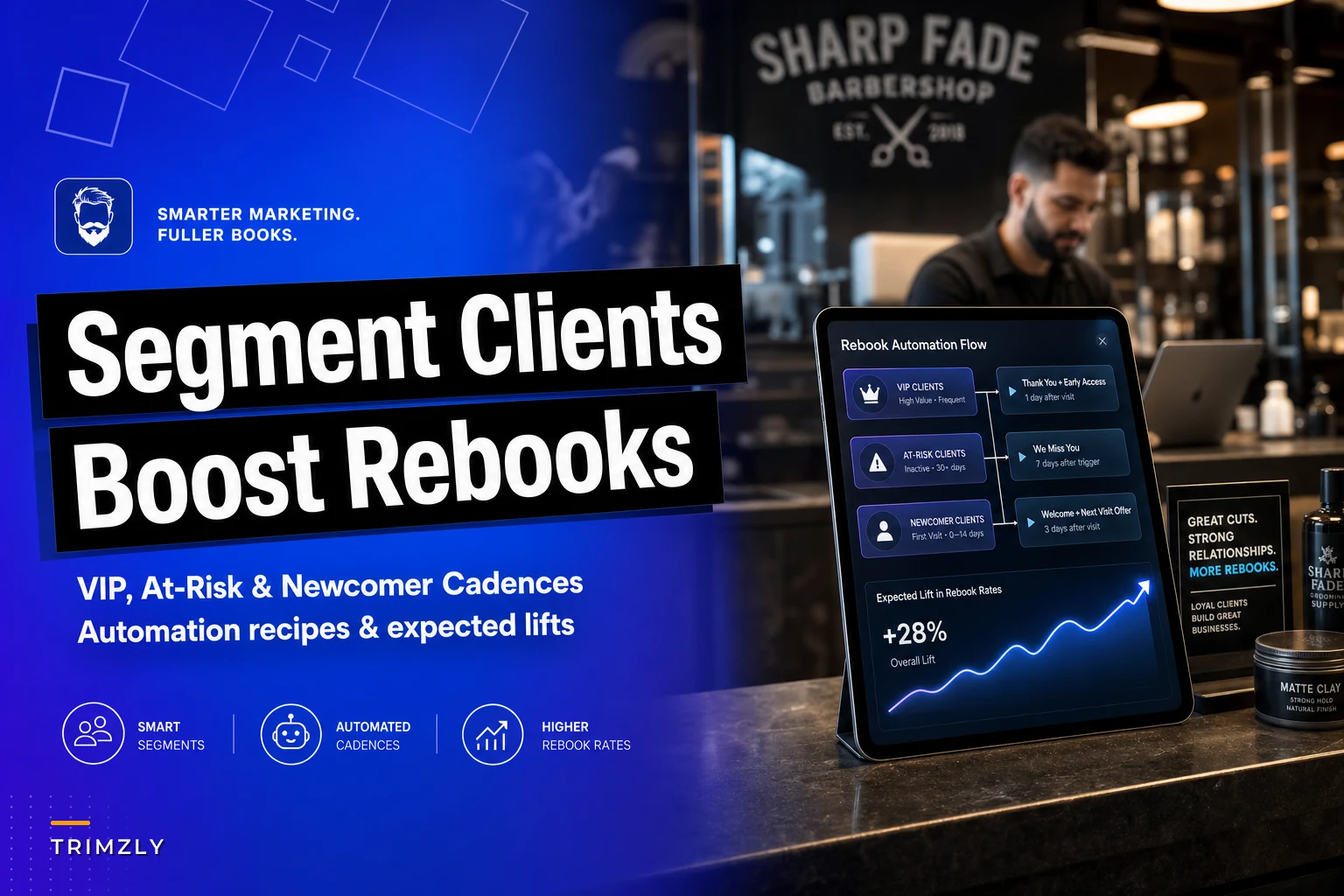

Most barbershops treat every client the same when it comes to rebooking. Same "time to book again!" text, same 30-day trigger, same message for everyone. Then they wonder why rebooking rates stay stuck around 40%.
Why treating every client the same is killing your rebooking numbers
Most barbershops treat every client the same when it comes to rebooking. Same "time to book again!" text, same 30-day trigger, same message for everyone. Then they wonder why rebooking rates stay stuck around 40%.
Shops pulling 65-70%? They've figured out something different. They split their client base into three groups that actually matter for revenue, then run completely different playbooks for each one.
Why generic rebooking messages fail
Generic rebooking attempts fail because they ignore basic client psychology. Your VIP who comes every two weeks doesn't need the same nudge as someone who visited once three months ago. The guy who usually books monthly but hasn't shown up in six weeks might be shopping around. Meanwhile, that new client who just had their second great cut needs reinforcement, not reminders.
Never miss a booking amidst the hustle.
Trimzly helps you schedule, confirm, and manage every client visit seamlessly.
- Unified appointment management
- Automated client reminders
- Optimized staff scheduling
No credit card required
When you send everyone the same message at the same cadence, you're basically admitting you don't actually know your clients. And they can tell.
The operational cost compounds beyond just lost bookings. Your front desk spends time calling through lists without any real prioritization. Barbers lose predictable income from regulars who slowly drift away. New clients who could've become long-term customers never establish the habit.
The three segments that drive 80% of rebooking revenue
Three client segments consistently separate shops hitting 40% rebooking rates from those hitting 70%.
VIP Clients — Your every-2-to-4-week regulars who've been coming for 6+ months. Usually 15-20% of your client base, but driving 35-45% of monthly revenue. Missing even one of their usual appointments is worth paying attention to.
At-Risk Regulars — Previously consistent clients (5+ visits) who've broken their pattern. Maybe they usually book every 3 weeks but it's been 5 weeks. Or they were monthly for six months and then just stopped. This group typically makes up 25-30% of your client list.
High-LTV Newcomers — New clients in their first 90 days who've already rebooked at least once. Whether they become VIPs or churn entirely is largely decided in months 2-4. Usually around 10-15% of your base at any given time.
Everyone else? They matter less for rebooking campaigns. The guy who comes twice a year for special occasions isn't going to become a monthly regular because of your text campaigns.
Campaign cadences by segment
VIP Protection Protocol
Week 3 after usual interval: Gentle check-in
-
"Hey [Name], noticed it's been a minute! Everything good? Your usual Thursday 2pm is open if you want it"
-
Personal tone, acknowledge the relationship
-
Make rebooking frictionless
Week 4: Service quality probe
-
"Quick check — was everything good with your last cut with [Barber name]? Want to make sure we're keeping you looking sharp"
-
Opens the door to address any issues
-
Shows you're actually paying attention
Week 6: VIP re-engagement
-
"[Name], missing you in the chair! Here's 15% off your next cut, valid for 7 days. Reply YES to book your usual spot"
-
Limited-time incentive
-
Acknowledges their VIP status
Expected lift: 85-90% of VIPs should rebook before hitting week 6. If they haven't responded by week 8, something's wrong beyond scheduling.
At-Risk Recovery Sequence
Week 1 past pattern: Friendly nudge
-
"Time for your fresh look! Your barber [Name] has openings this week. Reply with preferred day"
-
Assumes they're coming back
-
Mentions their specific barber
Week 3: Value reminder
-
"Been a minute since your last cut! Grab any weekday appointment before 3pm for $5 off"
-
Incentive for off-peak booking
-
Lowers the friction to return
Week 5: Personal outreach
-
Phone call from their usual barber
-
"Hey [Client], it's [Barber]. Haven't seen you in a while, wanted to check if you need anything different with your cut"
-
Builds on the existing relationship
Week 8: Win-back offer
-
"We miss you! Here's 25% off your next cut, no strings. Reply BOOK and we'll get you scheduled"
-
Significant discount signals you actually value them
-
Easy response mechanism
Expected lift: 40-45% should rebook within the sequence. Another 15-20% might come back later on their own.
High-LTV Newcomer Nurture
Day 3 after second visit: Reinforcement
-
"Great seeing you again yesterday! Quick tip
most guys with your hair type find 3 weeks is the sweet spot for maintaining that look"
-
Educational, not salesy
-
Plants the rebooking interval early
Week 2.5: Convenience play
-
"Want to lock in your next few cuts? Book your next 3 appointments now and get $5 off the third one"
-
Encourages commitment
-
Small incentive for bulk booking
Week 3.5: Social proof
-
"Your barber [Name] just had a cancellation for [Day]. Lots of your neighbors book this slot — want it?"
-
Creates a little urgency
-
Mentions community without being weird about it
Week 5: Preference check
-
"How's the cut holding up? If you want to try something new next time, reply and tell [Barber] what you're thinking"
-
Engagement without pushing the booking directly
-
Personalizes the experience
Expected lift: 55-60% of high-LTV newcomers should establish monthly or better frequency within 90 days using this sequence.
Automation recipes you can implement
The difference between shops that actually run these campaigns and those that don't isn't strategy — it's operational capacity. Manual execution means someone tracking spreadsheets, setting calendar reminders, sending individual texts. That lasts about two weeks before it falls apart entirely.
VIP Automation Setup
Trigger: Client hasn't booked within their usual interval + 7 days
Filter: 6+ visits in past 6 months, regular interval established
Actions:
-
Day 1
Send check-in SMS
-
Day 8
If no response, send quality probe SMS
-
Day 22
If still no booking, create task for barber to call
-
Day 29
Send VIP discount SMS
-
Day 36
Alert manager for personal outreach
Key data needed: Visit history, typical booking interval, preferred barber, response tracking
At-Risk Automation Flow
Trigger: Client with 5+ historical visits hasn't booked in pattern + 14 days
Filter: Not VIP, was regular (monthly or more) for 3+ months
Actions:
-
Day 1
Friendly nudge SMS
-
Day 14
Value reminder SMS with off-peak discount
-
Day 28
Generate call task for their last barber
-
Day 42
Send win-back offer
-
Day 56
Move to general reactivation campaign
Key data needed: Historical pattern, last barber, visit count, response rates
Newcomer Nurture Automation
Trigger: Second visit completed
Filter: First visit within last 90 days
Actions:
-
Day 3
Send reinforcement SMS
-
Day 18
Send multi-booking offer
-
Day 25
Send social proof/urgency SMS
-
Day 35
Send preference check message
-
Day 42
If no third visit, move to at-risk flow
Key data needed: First visit date, visits within 90 days, barber assignment
Below is a rough view of how clients should move through the three segments over time:
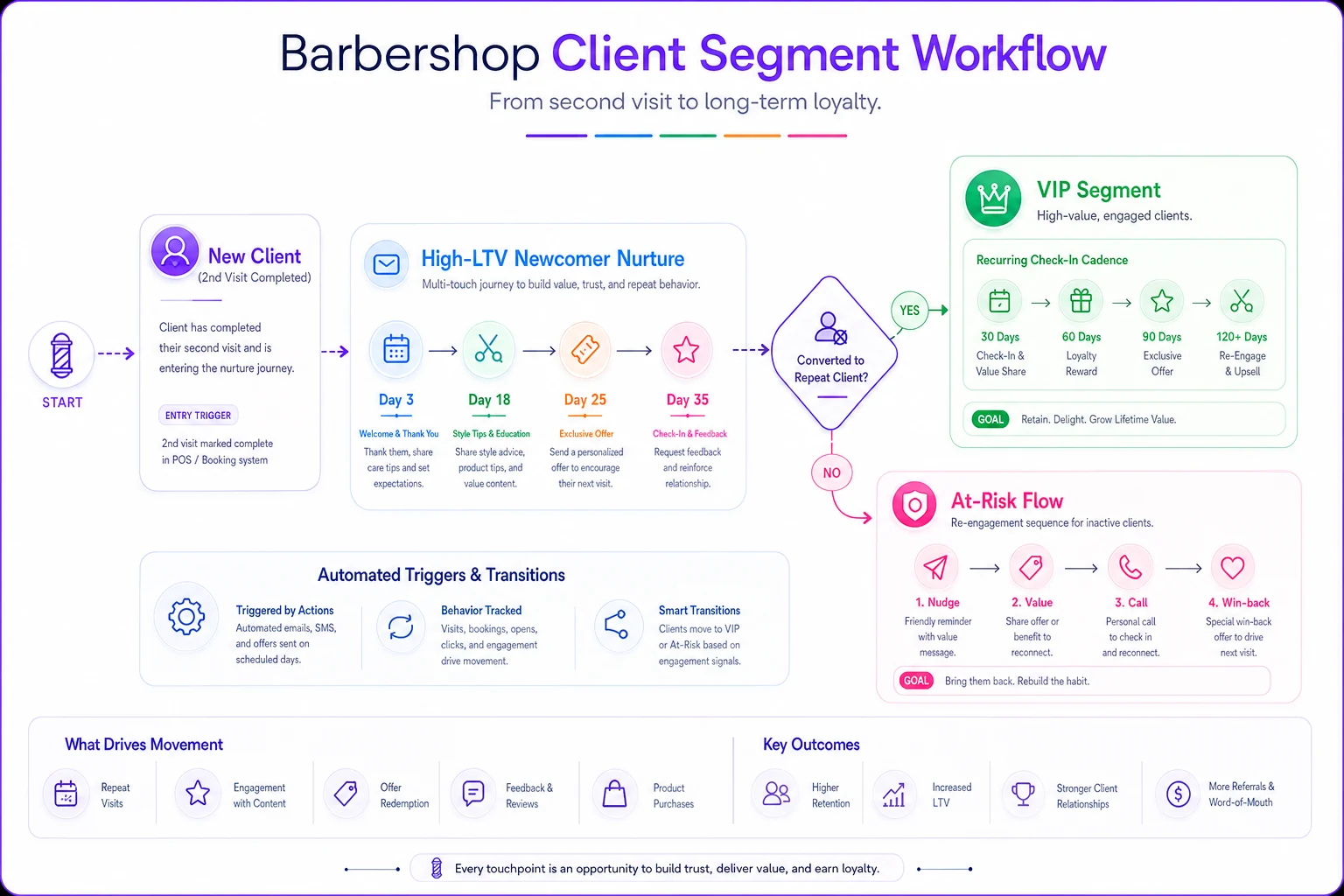
The movement between segments is what most shops miss entirely. A client doesn't stay a VIP forever just because they were one last quarter.
The rebooking metrics that actually matter
Most shops track overall rebooking rate and call it done. That's like checking your bank balance without knowing where the money's actually going.
| Metric | Poor | Average | Excellent | Why It Matters |
|---|---|---|---|---|
| VIP 30-day rebooking | <70% | 70-85% | >85% | Revenue stability indicator |
| At-risk recovery rate | <25% | 25-40% | >40% | Churn prevention effectiveness |
| Newcomer-to-regular conversion | <30% | 30-50% | >50% | Growth trajectory |
| Segment response rate | <15% | 15-30% | >30% | Campaign relevance |
| Revenue per reactivated client | <$150 | $150-300 | >$300 | Recovery value validation |
The shops hitting excellent numbers aren't just sending more messages. They're sending the right message to the right person at the right time. That distinction matters more than volume.
Common segmentation mistakes
Over-segmenting too early. Trying to manage 10 segments before mastering three basic ones kills execution. One shop tried splitting clients into beard-only, fade specialists, and seven different frequency brackets. Their staff gave up after two weeks.
Ignoring barber preference. Sending Terry's clients messages about booking with whoever's available. VIPs especially want their specific barber. Generic availability messaging erodes trust fast.
Discount escalation addiction. Starting at-risk recovery with 30% off instead of building value first. Once clients figure out they can wait for a deal, you've permanently damaged your margins.
Confusing new clients with VIP treatment. Sending "we miss you!" to someone who's been in twice. They don't miss you back yet. Build the relationship before treating them like a long-term regular.
Static segmentation. Not moving clients between segments as behavior changes. The monthly regular who starts coming every two weeks should graduate to VIP treatment. The VIP who drops to quarterly needs at-risk attention.
Real shop transformation
A shop in Austin was stuck at 38% rebooking despite solid barbers and good reviews. Around 850 active clients, all treated identically — one monthly "book your next cut!" email blast to everyone.
After implementing three-tier segmentation:
-
Identified 140 VIPs generating $7,800 monthly
-
Found 230 at-risk clients who'd visited 5+ times
-
Tagged 95 promising newcomers from the past quarter
Month one focused entirely on VIPs. Simple check-ins for anyone past their usual interval. VIP rebooking jumped from 72% to 86% — roughly $1,000 in recovered monthly revenue from one segment alone.
Month two added at-risk recovery. Using the sequence above, they brought back 78 clients who hadn't visited in 6-8 weeks. At $45 per visit, monthly, that's around $3,500 in recovered monthly revenue.
Month three brought in newcomer nurturing. Of the 95 tagged newcomers, 46 became monthly or more frequent within 60 days. Their previous conversion rate was somewhere around 25%.
Total: rebooking rate climbed to 58%. Monthly revenue increased by roughly $5,800 without adding a single new client. Just better treatment of the ones they already had.
When sophisticated segmentation backfires
Not every shop needs complex segmentation. If you're running two chairs with 200 total clients, you probably know most of them personally. Three formal segments might genuinely be overkill.
Segmentation can also mask service problems. If VIPs are churning despite perfect campaigns, you've got bigger issues than marketing. One shop was running elaborate win-back campaigns while their newest barber was consistently running 20 minutes late.
High-growth phases might need simpler systems too. When you're adding 50+ new clients monthly, focus on basic onboarding before building complex nurturing sequences. Get the fundamentals right first.
Building your segmentation system
Start manual before automating. Track 20 VIPs in a notebook for a month. Understand their patterns, see what messages actually work, then systematize from there.
Most POS systems can export client visit data. That's your starting point. Look for:
-
Visit frequency over the past 6 months
-
Average days between visits
-
Total visit count
-
Last visit date
From there, basic spreadsheet formulas can identify your three segments. No fancy software required initially.
Once you understand your segments, automation helps with consistency. Whether through your booking system, a simple SMS platform, or operational software that centralizes client data and automates outreach, the point is removing the manual tracking burden. AI-powered platforms can analyze visit patterns automatically and trigger the right messages without someone managing it every day.
The shops seeing the best results use operational software that handles complex client workflows beyond just rebooking. When your waitlist system connects to your rebooking campaigns, you can fill last-minute VIP cancellations with at-risk clients who are already primed for an incentive.
Making segmentation sustainable
The biggest failure point isn't technology or strategy — it's maintenance. Segments need monthly review. Campaign performance needs tracking. Messages need updating based on what's actually working.
Set a monthly segment review:
-
How many VIPs slipped into at-risk?
-
Which at-risk clients recovered?
-
What percentage of newcomers are converting?
-
Are response rates dropping?
Adjust timing based on real behavior. If VIPs typically rebook around day 17, don't wait until week 3 to reach out. If at-risk clients respond better to calls than texts, shift the medium.
Keep messages fresh. The same "we miss you!" text every month trains clients to ignore you. Rotate through 3-4 variations per segment. Test different incentive levels.
Review segment membership monthly and adjust triggers based on observed visit intervals.
Train your team on why this matters too. When your front desk understands that VIP #47 generates $2,400 annually, they'll approach that "just checking in" call completely differently. When barbers see their newcomer conversion rate, they invest more in those early relationships.
The gap between 40% and 65% rebooking isn't magic or marketing budget. It's knowing that Mike comes every 18 days and catching him on day 20, while recognizing that Sarah's quarterly visits are intentional. It's recovering the at-risk regulars who'd definitely return with the right nudge, while building habits in the newcomers who are clearly showing promise.
Stop treating every empty slot in next week's book as the same problem. Your clients aren't the same, so stop pretending your outreach can be.
Ready to elevate your barbershop operations?
Join 500+ barbershops using Trimzly to save time, reduce scheduling conflicts, and enhance client satisfaction.