

Most re-dos don't happen because a barber can't cut hair. They happen because the client and the barber were working from two different pictures in their heads. The client said "just clean it up." The barber heard "tighten the sides and take a little off the top." Ten minutes later there's a length disagreement, a redo, and a chair that's now running 25 minutes behind for the rest of the day.
The fix isn't teaching barbers to cut better. It's closing the gap between what the client wants and what the barber understands before the clippers ever come out. That's what a real barbershop consultation workflow does — it forces the ambiguity out of the conversation and turns "clean it up" into something specific, repeatable, and documented.
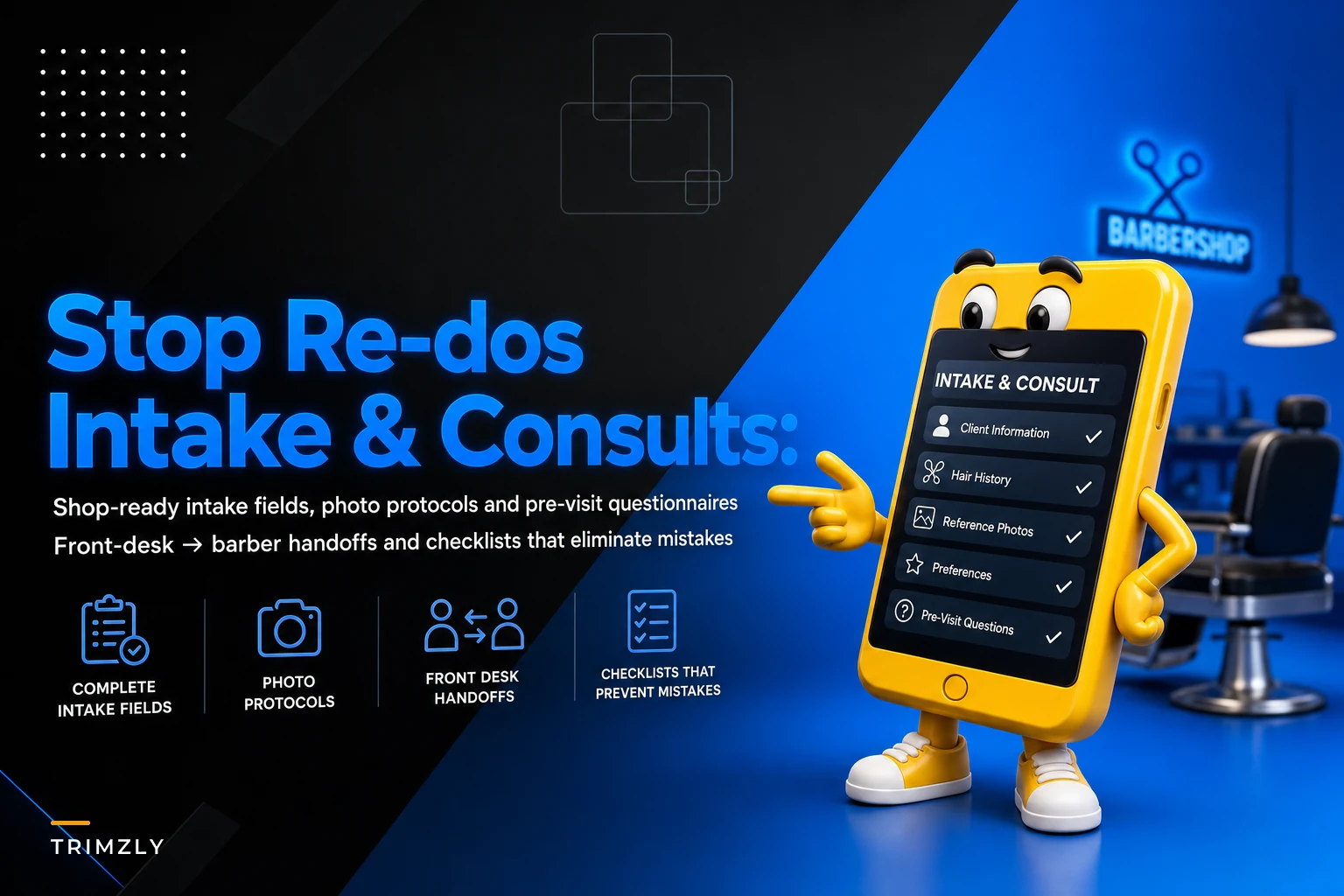
Below is a practical system: exact intake fields, a photo protocol that actually gets used, a pre-visit questionnaire, and a front-desk + barber checklist you can print and tape to the station tonight.
Where re-dos actually come from
If you track redo requests for a month and write down the reason each time, the list is shorter than you'd expect. The same handful of causes keep showing up:
-
Length ambiguity — "short," "medium," and "not too short" mean different numbers to different people.
-
No reference point — no photo, no prior history, barber guesses based on the last guy in the chair.
-
New barber, regular client — the client assumes the new barber knows their usual and doesn't re-explain.
-
Guard number drift — the client got a 2 last time, remembers it as "the short one," and the barber uses a 1.5.
-
Beard and neckline assumptions — the most common silent redo. Nobody discusses the neckline shape until it's already cut.
Notice what's not on that list: skill. A talented barber with no reference point will still produce a redo if the client's expectation lives only in their memory. The problem is information, not ability.
Think of every haircut as a spec being handed off between two people. When manufacturing hands off a spec with missing fields, you get defects. Same thing here.
The exact intake fields (don't skip the boring ones)
The intake is where you capture the spec. Most shops either capture nothing or capture way too much and nobody fills it in. The trick is a small number of fields that actually change the cut.
Never miss a booking amidst the hustle.
Trimzly helps you schedule, confirm, and manage every client visit seamlessly.
- Unified appointment management
- Automated client reminders
- Optimized staff scheduling
No credit card required
Here's the field set worth capturing on every client, with why each one earns its place:
| Field | What to capture | Why it prevents re-dos |
|---|---|---|
| Top length | Actual measurement or clear reference ("finger length," "1 inch") | Kills the "not too short" problem |
| Sides/back guard | Guard number + taper vs. blend | Stops guard drift between visits |
| Neckline shape | Rounded / squared / natural | The #1 silent redo cause |
| Part / style direction | Which side, or none | Prevents styling mismatch |
| Beard spec | Length, line-up yes/no, cheek line height | Beard redos are hard to fix |
| Cowlicks / growth patterns | Location and how to handle | Barber stops fighting the hair |
| "Never do this" note | Client's hard no's | One line that saves the relationship |
That last field — the "never do this" note — is underrated. A client who once got their sideburns cut too high will tolerate almost anything except that same mistake again. Write it down once and no barber in your shop ever repeats it.
Keep the intake to these fields. If the form takes more than 90 seconds to fill in, front desk will start skipping it — and a form that isn't filled in is worse than no form because it creates false confidence.
Keep the intake under 90 seconds so front desk actually fills it.
Keep the intake to these fields. If the form takes more than 90 seconds to fill in, front desk will start skipping it — and a form that isn't filled in is worse than no form because it creates false confidence.
The photo protocol that people actually follow
Everybody agrees photos help. Almost nobody does them consistently, because the protocol is usually vague ("take a before pic") and dies within two weeks.
-
When Right after the client sits down, before the cape goes on, during the consultation — not after.
-
What Three shots — front, one side, back of the head. Every time, same order.
-
Result photo One "after" shot at the end, front only, so you build a style history over time.
-
Attach to client, not to nothing The photos need to live on the client's profile, not in a random camera roll where they're useless next visit.
The reason "attach to the client" matters so much: a before-photo that isn't tied to a searchable client record is just a photo. The value comes six weeks later when the client returns, a different barber has the chair, and that barber can pull up exactly what was done last time and match it.
This is where a barbershop management platform earns its keep — not because photos are magic, but because the software attaches images to the client automatically and any barber can pull the history in two taps. The protocol only works if retrieving the photo is faster than asking the client "so what did we do last time?" If it's slower, staff will just ask and you're back to memory-based cutting.
A note on consent: tell clients the photos stay internal for matching their cut. Most appreciate it. A one-line note at intake covers it.
The pre-visit questionnaire (for new and returning clients)
The consultation shouldn't start when the client sits down. For a lot of the mistakes above, the information could've been captured before they walked in. A short pre-visit questionnaire — sent when the appointment is booked or confirmed — does two things: it front-loads the spec, and it flags the high-risk appointments so you can plan for them.
Keep it to five questions or fewer:
-
Is this a trim of your current style, or are you changing it up?
-
If changing
do you have a photo of what you're going for? (attach)
-
First time with us, or returning?
-
Any strong preferences we should know? (length, beard, neckline)
-
Anything that went wrong at a previous shop you want us to avoid?
The changing-vs-trim question is the most valuable one on the list. A "trim of current style" appointment is low risk and can run on time. A "changing it up" appointment is where redos and overruns cluster — and knowing that before the day starts lets you build in extra minutes and assign it to the right barber.
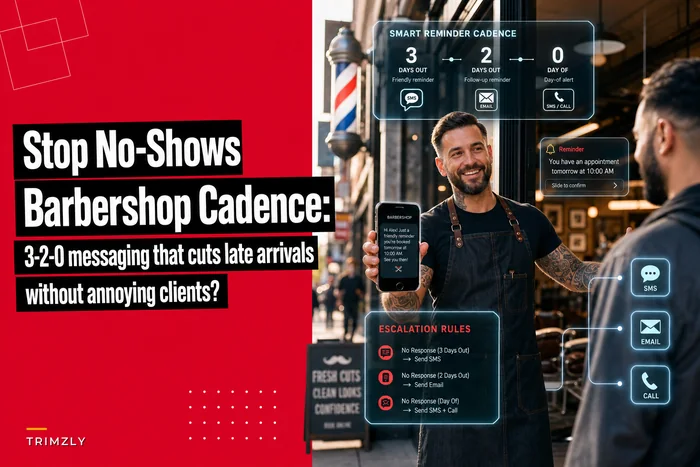
If you already send appointment confirmations, the questionnaire piggybacks on that flow naturally. Shops that run a structured messaging cadence to cut no-shows and late arrivals can bolt the questionnaire onto the same confirmation message rather than sending a separate one — one touchpoint, two jobs done.
Front-desk + barber checklist
Here's the part you print. Split it so each person owns their half and nothing falls through the gap between them.
Front desk (before the client reaches the chair):
-
[ ] Pull up client profile; confirm it's the right person
-
[ ] Check for prior photos and last recorded guard/length
-
[ ] Confirm the pre-visit questionnaire was completed; if not, ask the 2 key questions (trim vs. change, any hard no's)
-
[ ] Flag "changing it up" appointments to the barber verbally
-
[ ] Note any beard/line-up add-ons so the barber budgets time
Barber (before clippers):
-
[ ] Take the three before-photos
-
[ ] Read back the spec out loud
"So we're doing a 2 on the sides, blended, rounded neckline, about an inch on top — that right?"
-
[ ] Confirm the neckline shape explicitly (don't assume)
-
[ ] Confirm beard cheek line height by pointing, not describing
-
[ ] For style changes
agree on the first checkpoint ("I'll take it to here, then we check before going shorter")
That read-back line is the single highest-leverage habit on this list. Saying the spec out loud and getting a "yeah" takes eight seconds and catches the length disagreement while it's still fixable. It feels slightly awkward the first week and then becomes automatic.
Pointing to the neckline and beard line matters because verbal descriptions of shape are unreliable. "Squared off" means different heights to different clients. Touching the spot removes the ambiguity entirely.
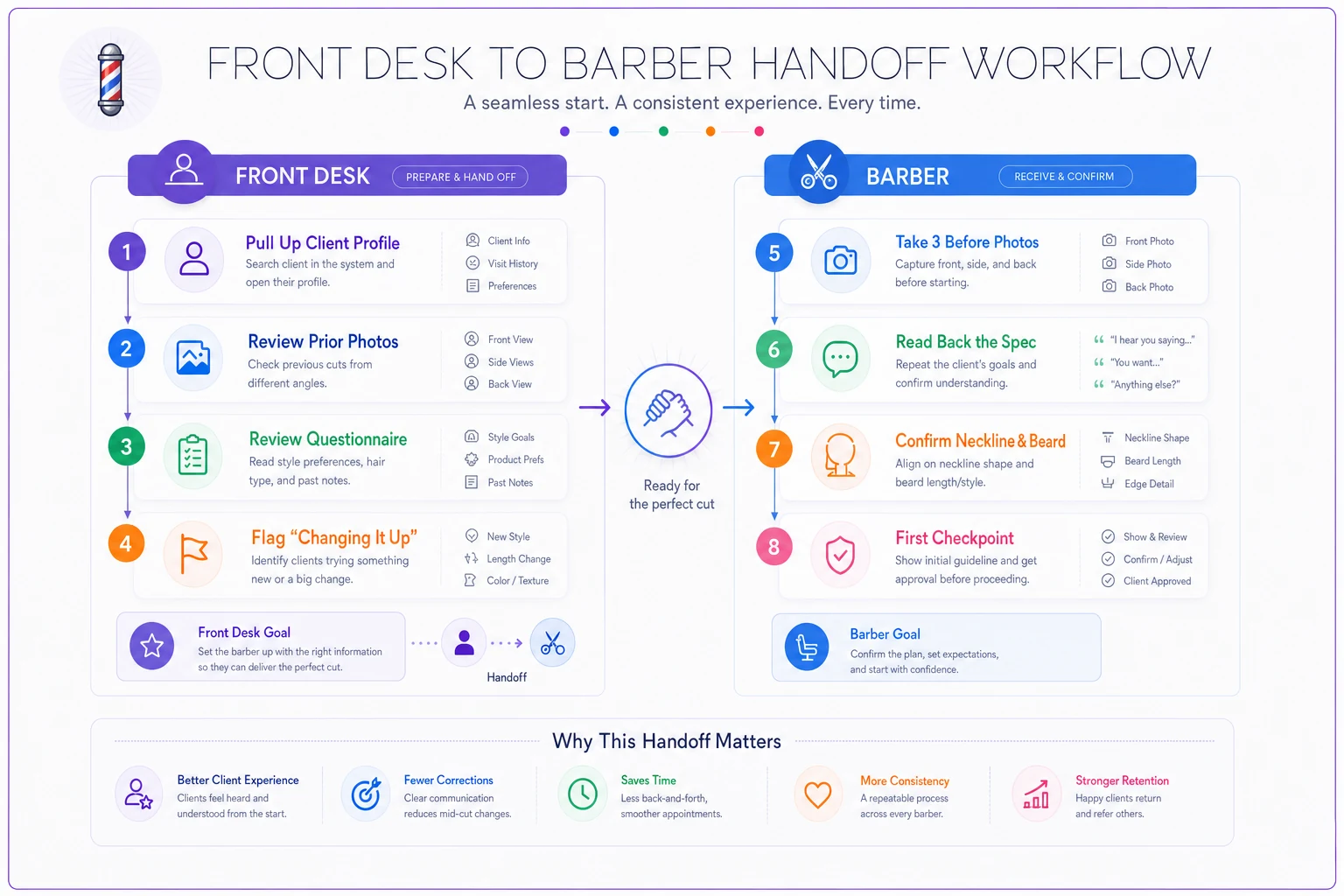
A quick diagram of the handoff makes it easier to train the team.
A real scenario
A two-chair shop running around 300 cuts a month was averaging what the owner estimated at four to six redos a week — mostly "too short on top" and neckline complaints, with a couple of beard ones mixed in. Each redo cost roughly 15–20 minutes and pushed the rest of that barber's day back, which turned into occasional late-arrival apologies and a few walkouts on busy Saturdays.
They didn't change anything about how the barbers cut. They added the intake fields, the three-photo protocol tied to client profiles, and the read-back habit. The awkward part was the first two weeks — the barbers felt like they were slowing down.
By the second month, redos were down to roughly one or two a week, and most of those were genuine "client changed their mind" situations rather than miscommunication. The bigger win wasn't the redo count — it was the schedule holding together on Saturdays because chairs stopped running 20 minutes behind by noon. The owner's rough math put the recovered chair time at close to a cut-and-a-half per barber per week that had previously been eaten by rework.
When this is worth the effort — and when it isn't
When it makes sense:
-
You have more than one barber and clients who float between them
-
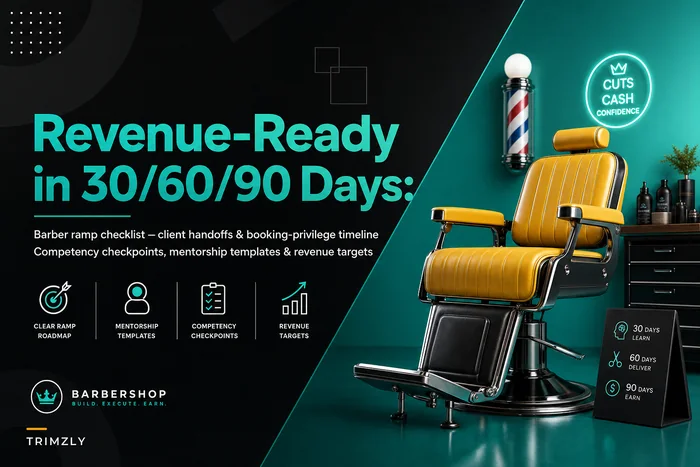
You're onboarding new barbers who don't know the regulars yet (pair this with a solid new-barber ramp checklist so the intake habits get built in from day one)
-
You do a meaningful share of style changes, not just trims
-
Saturdays fall apart when one chair runs behind
When it's overkill:
-
Single-barber shop with a fully regular book where the barber knows every head — the memory is the system, and forcing forms just adds friction
-
Pure walk-in high-volume "number 2 all over" shops where there's genuinely nothing to spec
One thing worth saying clearly: any shop that won't actually enforce the read-back and photo steps shouldn't bother rolling this out. A half-adopted protocol is worse than none, because front desk stops trusting the profile data and starts double-asking the client, which is slower than the old way. If you can't get the team to commit for a month, wait until you can.
The honest part about adoption
The hardest thing here isn't designing the workflow — it's the two weeks where it feels slower before it feels faster. Barbers who've cut for years trust their read of a client, and being asked to photograph and read back a spec can feel like a knock on their skill. It isn't. It's insurance against the client who thinks they explained clearly and didn't.
Frame it that way to the team. The read-back and the photo aren't there because anyone doubts the cut. They're there because the client's expectation lives in the client's head, and the only way to get it out is to say it back to them and write it down. Do that consistently, and the redos that were quietly eating a chair every week mostly disappear — not because anyone got better with clippers, but because everyone finally started working from the same picture.
Frame it that way to the team. The read-back and the photo aren't there because anyone doubts the cut. They're there because the client's expectation lives in the client's head, and the only way to get it out is to say it back to them and write it down. Do that consistently, and the redos that were quietly eating a chair every week mostly disappear — not because anyone got better with clippers, but because everyone finally started working from the same picture.
Ready to elevate your barbershop operations?
Join 500+ barbershops using Trimzly to save time, reduce scheduling conflicts, and enhance client satisfaction.