
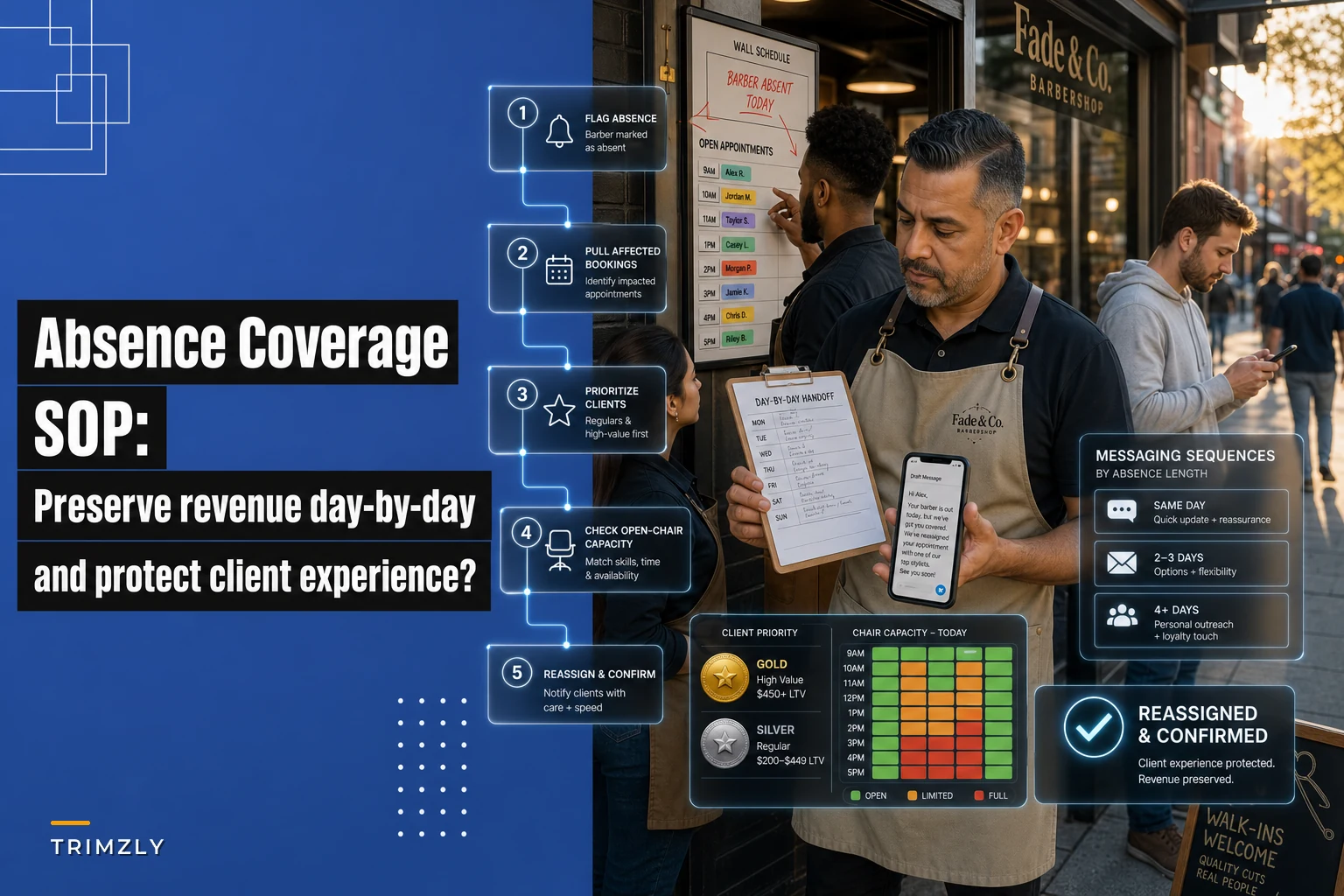

Most shops handle absences the same way: a text comes in at 6:40am, someone groans, and whoever opens that day starts calling clients off a screenshot of the appointment grid. By 9am half the bookings are rescheduled, three regulars are annoyed, and the covering barber inherited a full day of work with zero context about who these people are or what they expect.
The problem isn't that barbers get sick or take vacation. That's just part of running a shop with people in it. The problem is that almost nobody has written down what actually happens when a chair goes dark, so every absence gets improvised — and improvisation at 6:40am is how you lose a $90 standing client to the shop down the street.
This is a tight, activate-it-today SOP for covering absences without bleeding revenue or wrecking client relationships. Four pieces: day-by-day handoff templates, billing rules for temporary chairs, booking reassignment logic, and client messaging sequences keyed to how long someone's out. Not a general "how to run your shop" guide — just the coverage stuff.
Why absence coverage quietly costs more than you think
The visible cost of an absence is the empty chair. That's what owners fixate on. But the empty chair is usually the smallest part of the loss.
Here's what actually leaks when a barber is out and there's no system:
-
Client attrition. A regular who gets a "we need to reschedule you" text with no good alternative doesn't always come back. Some book elsewhere "just this once" and that once becomes permanent.
-
Botched coverage work. When another barber covers blind, re-dos and unhappy clients go up. The covering barber didn't know the client wanted it left longer on top, or that they're sensitive about the neckline.
-
Pay disputes. Who gets the money when someone else cuts your client? If this isn't written down, you get resentment — and in a commission shop, resentment spreads fast.
-
Front-desk chaos. Whoever's scrambling to reassign bookings isn't doing the ten other things they should be doing that morning.
A typical example: a four-chair shop where one barber runs around 32–38 appointments a week at an average ticket near $45. If that barber is out for a week with no coverage plan and maybe 40% of those clients quietly don't rebook, you're not looking at one slow week. You're looking at a recurring hole. Lose five standing clients permanently and that's several thousand dollars of annual revenue that walked out over a single poorly-handled absence.
Absence coverage is a retention problem wearing a scheduling costume.
The core idea: coverage depth should match absence length
The biggest mistake shops make is treating every absence the same way. A barber running 20 minutes late, calling out sick for a day, and taking a two-week vacation are three completely different situations requiring completely different responses.
Never miss a booking amidst the hustle.
Trimzly helps you schedule, confirm, and manage every client visit seamlessly.
- Unified appointment management
- Automated client reminders
- Optimized staff scheduling
No credit card required
The whole SOP hangs on one simple classification. When an absence happens, you answer one question first: how long?
| Absence length | Primary goal | Booking approach | Client messaging tone |
|---|---|---|---|
| Same-day / < 1 day | Keep as many appointments in-shop as possible | Reassign to available chairs | Light, "we've got you covered" |
| 2–4 days | Protect regulars, minimize reschedules | Reassign where possible, waitlist the rest | Reassurance + specific option |
| 1 week+ (planned or unplanned) | Preserve relationships, keep revenue moving | Pre-planned coverage barber or structured reschedule | Personal, name the covering barber |
| Extended (2+ weeks) | Hold the book together, protect the brand | Temp chair or dedicated coverage plan | Proactive, "here's the plan" |
Everything else in this SOP is just the detail under those four rows. Once you internalize that coverage depth scales with absence length, the rest becomes mechanical — which is exactly what you want at 6:40am.
Day-by-day handoff templates
The handoff is where coverage usually falls apart. The covering barber shows up with a list of names and nothing else. They don't know the clients, the clients don't know them, and every appointment becomes an awkward first-time consultation that eats an extra ten minutes.
-
Client name and whether they're a regular or occasional
-
Their usual service and ticket
-
One or two notes on preferences or sensitivities (fade height, part side, "doesn't like it short on top," talkative vs. quiet)
-
Last visit date and anything flagged from that appointment
-
Whether they've been told their regular barber is out
That's it. Five lines per client. If you already capture photos and style history, this is where it pays off — the covering barber glances at the last cut and knows the target instead of guessing.
For a planned absence, the outgoing barber fills this out before they leave. Fifteen minutes of prep the day before saves hours of friction across the week. Make it a hard rule: no approved time off until the handoff sheet is done.
For an unplanned absence, you can't get notes from someone who's home with the flu. This is where having client history stored somewhere central matters. Shops that keep notes in a shared system can pull a usable handoff in a few minutes. Shops that keep everything in one barber's memory are stuck making phone calls and hoping for the best.
> Marcus D. — Regular, every 3 wks. Skin fade + beard line-up, ~$55. Likes it tight on sides, scissor on top, leave some length. Quiet, doesn't love small talk. Last in 10/14. Knows James is out, okay with coverage.
Ten seconds to read, and the covering barber walks in already knowing more than they'd learn in a two-minute consultation.
Temporary-chair billing rules
This is the part shops avoid writing down because it feels awkward, and that's exactly why it causes the most friction. When Barber A is out and Barber B cuts Barber A's clients, who gets paid what?
There's no single right answer, but there is a right process: decide it in advance, write it down, and apply it consistently every time. Ambiguity is the enemy here, not any particular split.
-
Coverage barber keeps it. Barber B cut it, Barber B gets the full commission. Simple, fair to whoever did the work, and it motivates people to cover willingly. This is the cleanest option for most shops.
-
Split for standing clients. For a regular who "belongs" to Barber A, some shops do a split (say 70/30 to the covering barber) so the absent barber doesn't feel their book is being raided. Use this sparingly — it gets complicated fast.
-
Temp/float barber at a set rate. If you bring in an outside barber to cover extended leave, pay them a day rate or a higher commission for the temp window, and the shop keeps the retail and the relationship.
Whatever you pick, settle these edge cases in writing before they come up:
-
Who gets the retail commission on products sold during coverage
-
Who the tip goes to (almost always the person who did the cut — don't overthink this one)
-
How a re-do is handled if the covered client comes back unhappy
-
Whether the covering barber gets credit toward their own performance metrics
Shops that pay the covering barber the full commission almost never have coverage disputes. Shops that protect the absent barber's earnings with complicated splits end up with people quietly refusing to cover. The money you think you're saving with a clever split is usually smaller than the goodwill you burn trying to protect it.
For a deeper framework on tying pay and responsibility to chairs, the breakdown in From operator to owner: a delegation playbook that ties role handoffs to profit‑per‑chair lines up well with how coverage economics should work.
Booking reassignment rules
When a barber goes down, you've got three options for each appointment: reassign it to another chair, move it to the waitlist, or reschedule it. Which one depends on the absence length and on who the client is.
The reassignment workflow:
-
Flag the absence and pull the affected appointments. Everything on that barber's book for the absence window.
-
Sort clients into tiers. Standing regulars first, occasional clients second, one-off or walk-in-style bookings last. Your best clients get the most effort.
-
Check open capacity across other chairs. Look for gaps that match the service length. A 20-minute buzz can slot into almost anything; a longer appointment can't.
-
Reassign regulars into open slots first. These are the relationships you can't afford to lose. Match them to a barber whose skill set fits the service.
-
Push the rest to the waitlist or offer a reschedule. If there's no good slot, give the client a specific alternative — not a vague "we'll call you."
-
Confirm every reassignment. No silent moves. The client always knows who they're seeing and when.
The ordering matters. The instinct is to go top-to-bottom through the appointment list, which means your 6pm standing client gets handled after three walk-ins just because they were lower on the grid. Sort by client value first. Chair order never.
Shops that reassign well already treat their schedule as flexible capacity, not fixed territory. If you're running a tight scheduling operation, reassignment is just a special case of filling gaps — the same muscle you use for no-shows and waitlist management. The chair‑level scheduling framework with sample day plans for small barbershops gives you the base capacity map that makes fast reassignment possible when you actually need it.
A quick workflow sketch:
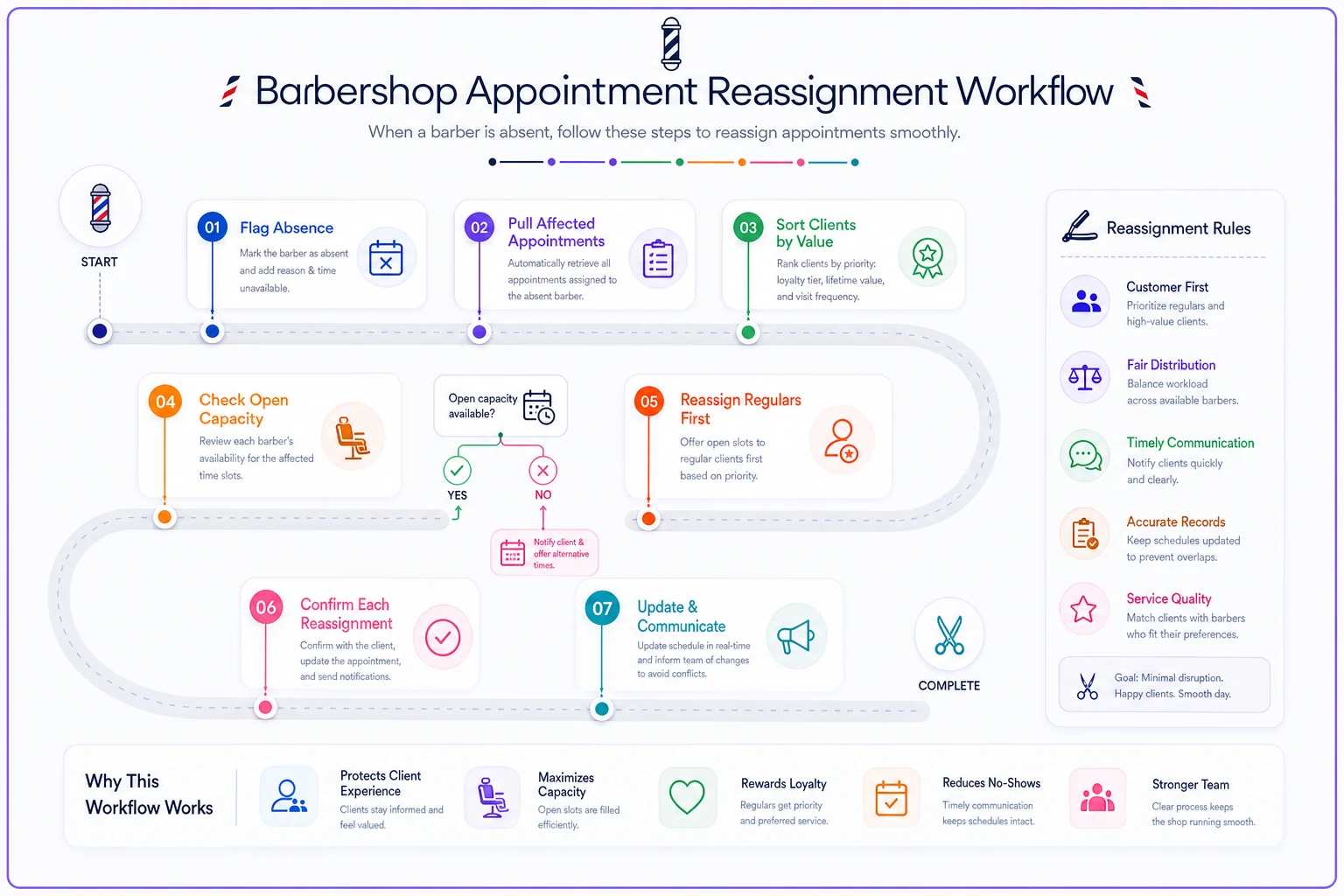
This visual maps the steps above.
Who should not try to reassign aggressively: solo barber shops have nowhere to reassign to — your absence SOP is entirely about rescheduling and messaging. And shops where every barber is already booked solid at peak have no slack to absorb another chair's clients. In those cases, don't force bad matches. Lean on the waitlist and honest rescheduling instead.
Client-facing messaging sequences by absence length
The message you send is the part the client actually experiences. Get this wrong and even perfect reassignment feels like a disruption. Get it right and most clients barely register that anything changed.
The governing principle: the longer the absence, the more personal and proactive the message. A same-day shuffle can be light and operational. A two-week absence needs a human, reassuring note that names the plan.
Same-day / under a day: > "Hi Marcus — quick heads up, James is out today but we've got you covered with Dre at your 2pm, no change to your time. See you then!" Short, confident, zero drama. You're informing, not apologizing. Over-apologizing actually makes clients nervous.
2–4 days: > "Hi Marcus — James is out until Thursday. I can get you in with Dre at the same 2pm today, or hold your spot with James for Friday. Which works better?" Give a real choice. The default should be "stay in-shop now," but letting a loyal client wait for their barber respects the relationship.
1 week+: > "Hi Marcus — James is out this week. I know you two have a routine, so I wanted to reach out personally. Dre's covered James's book before and does great fades — happy to get you in this week, or we can hold you for James next week. Just let me know." Name the covering barber, acknowledge the relationship, give agency. This is the message that keeps a standing client from drifting.
Extended (2+ weeks): > "Hi Marcus — James is out for the next few weeks. We want to make sure you're taken care of while he's away. I'd recommend Dre, who's been covering his clients and knows the kind of cut you like. Want me to book you in with him for your usual cadence until James is back?" Here you're not just filling one appointment — you're proposing a plan for the whole absence window so the client doesn't have to think about it each time they'd normally book.
A few rules that apply across all four:
-
Send proactively, not reactively. The client should hear from you before they'd normally be booking, not when they're already wondering why nobody confirmed.
-
Never make the client do the problem-solving. "Call us to reschedule" shifts the work onto them. Offer a specific slot.
-
Match the channel to the client. Regulars who always text get a text. Don't force an email on someone who never opens them.
For a planned vacation, these messages can go out on a schedule days before. For a surprise call-out, the whole sequence has to fire in the first hour. The shops that handle surprise absences without drama are the ones where the templates already exist and nobody's writing a thoughtful message from scratch while the phone's ringing.
A short real scenario
A three-chair shop running roughly 310–340 appointments a month, average ticket around $42. One of their barbers took sudden medical leave for two weeks. Before they had any system, the old pattern was: cancel the week, tell clients "sorry, he's out," and hope they rebooked later.
This time they ran a basic version of the SOP. They pulled the absent barber's book, sorted clients into regulars and occasionals, and reassigned regulars into the other two chairs' open slots. Clients got a personal message naming the covering barber. The covering barbers got a five-line handoff on each regular pulled from the shop's stored client notes.
The numbers weren't dramatic — and that's kind of the point. Instead of losing most of two weeks of that chair's revenue, they recovered the large majority of it. The covering barbers absorbed most of the regulars, and only a handful of appointments slipped to the following week. More importantly, almost none of those regulars churned. When the barber came back, his book was basically intact.
The owner said it was the first absence in years that didn't feel like a fire. That's what a documented system buys you — not a perfect outcome, just a predictable one.
Activate it: the one-page checklist
You can stand this up in an afternoon. Here's the whole thing in checklist form:
-
- [ ] Write your four-tier absence classification (same-day, 2–4 days, 1 week+, extended) and post it where the front desk can see it
-
- [ ] Create a handoff template (5 lines per client) and make it required before any approved time off
-
- [ ] Decide and write down your billing rule for coverage — commission, splits, tips, retail, re-dos
-
- [ ] Document the reassignment workflow
pull, sort by client value, match to open chairs, confirm
-
- [ ] Draft the four messaging templates and save them somewhere whoever opens can grab them fast
-
- [ ] Make sure client notes live somewhere central, not just in each barber's head, so handoffs work even on surprise call-outs
-
- [ ] Decide your extended-absence plan in advance — do you have a float barber or a coverage arrangement, or do you reschedule?
Having this documented is what turns a surprise call-out from a scramble into a procedure. Keeping client history and schedules in a shared system rather than scattered across individual barbers' memories is what makes the handoff and reassignment steps fast when you actually need them — but the templates and rules matter more than any tool. Write them first.
The takeaway
Absences will keep happening. Vacations, sick days, emergencies — that's just running a shop with humans in it. The difference between shops that lose clients every time a chair goes dark and the ones that barely feel it comes down to whether coverage is improvised or documented.
The gap is maybe an afternoon of writing things down: four tiers, a handoff template, a billing rule, a reassignment workflow, and four message templates. Build it once, and the next time a 6:40am text comes in, nobody groans. They just open the folder and run the play.
Ready to elevate your barbershop operations?
Join 500+ barbershops using Trimzly to save time, reduce scheduling conflicts, and enhance client satisfaction.