



Most barbershop owners have no idea what their shop is worth until they need to know — and by then it's too late to fix the things that would've raised the number. A broker asks for three years of clean books, a buyer wants chair-level margins, a bank wants collateral and cash flow coverage, and suddenly the owner realizes the business runs almost entirely inside their head. The shop makes money. It just isn't valuable in the way anyone financing or buying it actually cares about.
That gap — between a shop that earns and a shop that's worth something — is the whole game. This isn't about slapping a multiple on your revenue. It's about understanding which everyday operating numbers move the valuation needle, and which ones the person writing the check doesn't care about at all.
Why a profitable shop can still appraise low
There's a strange thing that happens with owner-operated barbershops. The owner cuts hair 30 hours a week, holds the biggest book of regulars, handles ordering, manages the schedule, and personally owns the client relationships. The shop clears solid money. But almost none of that value transfers.
A buyer looks at that setup and sees risk, not a business. If the owner is the reason 40% of revenue walks in the door, then the day they leave, that revenue is a coin flip. Valuation reflects transferable, repeatable cash flow — not the hustle of whoever's selling.
Shops with the highest owner effort often get the lowest multiples. It feels backwards. You worked harder, so it should be worth more. But the appraiser is pricing what the next owner inherits — and what they inherit is a job with your face removed from it.
So before touching a single financing or exit decision, understand this: valuation rewards systems, documentation, and predictable retention. It punishes dependence on any one person — especially you.
The KPIs that actually become valuation levers
Barbershops track a lot of numbers. Only a handful of them translate into what a buyer or lender will pay. Here's the honest version.
Never miss a booking amidst the hustle.
Trimzly helps you schedule, confirm, and manage every client visit seamlessly.
- Unified appointment management
- Automated client reminders
- Optimized staff scheduling
No credit card required
Profit-per-chair. This is the cleanest signal of operational health you have. Not revenue-per-chair — profit. A shop running six chairs at roughly $1,400–$1,800 monthly profit each tells a very different story than one running eight chairs at $700 each. The first is dense and efficient. The second is spreading itself thin and probably has chairs that don't cover their own overhead. Buyers pay for density because it means the model works without requiring endless square footage.
Churn / retention. Client retention is the single most underrated valuation lever in this industry. A shop where 65% of clients rebook within six weeks is worth meaningfully more than one at 40%, even at the same revenue — because the 65% shop has predictable forward cash flow. Retention is future revenue you can basically see coming. When a buyer models what they're purchasing, they're really modeling how long your existing clients keep showing up after you leave.
Growth runway. This is the "is there room to grow without me pouring in more of myself" question. Underused chairs at peak hours, a service menu that hasn't been repriced in years, a location with foot traffic you haven't captured — these are runway. A maxed-out shop with no obvious upside is worth less than an identical shop where growth is fundable and visible.
Here's how those shop-level metrics map to the levers that actually move the number:
| Shop-level KPI | What it signals to a buyer/lender | Valuation lever it moves |
|---|---|---|
| Profit-per-chair | Operational efficiency, real margin | Higher earnings multiple |
| Rebook / retention rate | Predictable forward revenue | Lower perceived risk, higher multiple |
| Owner-worked hours | Transferability of the business | Dependence discount (or premium) |
| Growth runway | Upside a new owner can fund | Justifies premium pricing |
| Revenue concentration (top barber) | Fragility if a key person leaves | Discount if too concentrated |
| Documented SOPs & clean books | How easily it transfers | Faster close, fewer price cuts |
Track profit-per-chair monthly to spot underperforming seats before they drag down your multiple.
The pattern worth noticing: almost every lever comes back to risk and transferability. High profit-per-chair with terrible retention still gets discounted, because next month's chairs might be empty. Modest profit-per-chair with 70% retention and clean systems often prices better than most owners expect.
Financing decisions: debt vs equity vs owner-financed
Before you get to an exit, most owners hit a financing decision — usually to expand, renovate, or add a location. The path you choose has knock-on effects for what your shop eventually sells for and how clean the transaction is. These aren't separate decisions.
Debt (bank loan, SBA, line of credit). You keep 100% ownership and pay it back with interest. This makes sense when you have steady, documentable cash flow and a specific use for the money with a clear return — a second location with a proven model, equipment that raises throughput. Debt punishes shops with lumpy cash flow and rewards shops with tight financial controls. If your books are messy, a lender either says no or prices you badly. That's one reason getting your cashflow and financial controls tightened up matters long before you ever apply.
Equity (bringing in a partner or investor). You give up a slice of ownership in exchange for capital you don't repay. This fits when the growth is bigger than what your cash flow can safely fund with debt, or when the partner brings something beyond money — a location, a client book, real operational skill. The downside is permanent: you've sold a piece of every future dollar. Owners consistently underestimate how expensive equity is over a long horizon.
Owner-financed (seller financing, usually at exit). Here you are the financing — when you sell, the buyer pays you over time instead of all upfront. This shows up constantly in barbershop sales because buyers rarely have full cash and banks are cautious about businesses tied to a departing owner. Structured right, seller financing can actually raise your total sale price, because you're taking on risk and getting compensated for it. Structured wrong, you're an unsecured lender to someone who may run your old shop into the ground.
Quick decision frame:
-
Steady cash flow, clear ROI, want to keep everything? → Debt
-
Big leap, need skills or assets you don't have? → Equity
-
Selling, buyer's short on cash, business is transferable? → Owner-financed
-
Messy books, unpredictable months? → Fix that first; none of these price well yet
When each is a bad idea
Debt is a bad idea when your revenue leans hard on one or two barbers — a single departure can blow the loan coverage. Equity is a bad idea when you're only a year or two from selling; you'll dilute the exact upside you're about to cash out. Owner-financing is a bad idea when the buyer has no operating experience and no real skin in the game beyond your note — there's a decent chance you'll be back running the shop inside a year, except now you don't own it.
A realistic scenario
Consider a three-chair shop clearing somewhere around $95k–$110k in annual owner earnings. Solid, but the owner cuts full-time and personally holds the top book. When a broker ran the numbers, the shop appraised at roughly 1.8x earnings — dragged down by owner dependence and a retention rate hovering near 45%.
The owner spent about 14 months doing unglamorous work. Documented the ordering and scheduling. Moved top clients onto a rebooking cadence so retention climbed into the low 60s. Trained a second barber to carry more of the book so the owner's personal revenue share dropped from around 45% to under 30%. Repriced a stale menu, which nudged profit-per-chair up.
Earnings barely moved during that stretch — a modest bump at best. But the multiple moved. Same shop reappraised closer to 2.7x, because the risk profile changed. The business now ran without the owner being the business. On roughly $110k in earnings, that shift in multiple translated to close to six figures in additional sale price — from work that cost almost nothing but attention and discipline.
Earnings are what you make. The multiple is what you built.
Getting investor and buyer-ready: the templates that matter
Buyers and lenders don't want a story. They want a small, clean stack of documents that lets them model the business without trusting your memory. Hand these over on request and you're already ahead of most shops on the market.
The core set:
-
Trailing 24-month P&L, monthly, add-backs clearly noted (personal expenses run through the business, one-time costs)
-
Chair-level revenue and profit breakdown — this is where profit-per-chair lives, and buyers pay close attention to it
-
Retention / rebook report showing rolling rebook rates, ideally by barber
-
Revenue concentration summary — what % of revenue each barber owns, especially you
-
Service and price menu with the date of the last repricing
-
Client count and active-client definition (active = visited in last 90 days, or whatever you use — just be consistent)
-
Lease terms and any transferability clauses — a lease that doesn't transfer can kill a deal
-
A simple one-page ops overview
how scheduling, ordering, and payroll actually run
The format signals competence. A buyer who receives clean, chair-level numbers assumes the rest of the operation is run tightly and prices accordingly. A buyer who gets a shoebox of receipts assumes chaos and builds in a discount for the surprises they can't see.
This is also where running a proper booking and management platform pays off years down the road. Shops using a system that tracks per-chair revenue, rebook rates, and client history can generate most of these reports in an afternoon. Shops running on a paper book and a card reader spend months reconstructing numbers that may never fully add up — and buyers discount uncertainty.
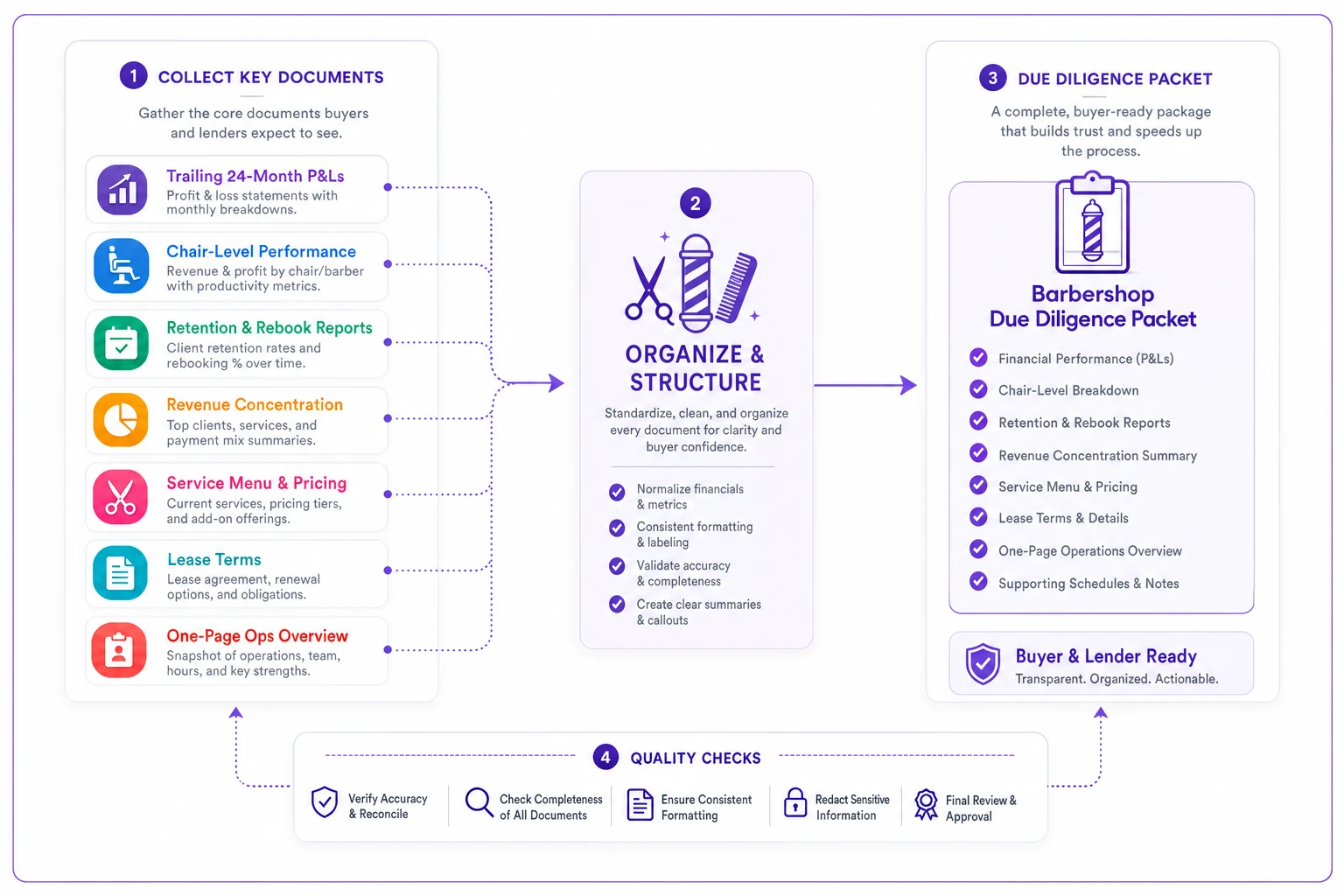
A simple visual like this helps teammates and advisors understand the handoff timeline and who owns each report.
This is also where running a proper booking and management platform pays off years down the road. Shops using a system that tracks per-chair revenue, rebook rates, and client history can generate most of these reports in an afternoon. Shops running on a paper book and a card reader spend months reconstructing numbers that may never fully add up — and buyers discount uncertainty.
The 8-step exit checklist
Whether you're selling next year or in five, work these in order. Each step raises the number the next one can reach.
-
Reduce owner dependence. Get your personal share of revenue down and train someone to carry a real book. This is the highest-leverage move and the slowest, so start here.
-
Clean the books. Two years of accurate, monthly financials with add-backs documented. If personal expenses run through the business, separate them clearly — buyers add them back, but only if they can see them.
-
Lift and prove retention. Move clients onto consistent rebooking so your rebook rate is both higher and documented. A rising retention trend is worth more than a flat high number.
-
Density over sprawl. Fix or cut underperforming chairs. Better to show four strong chairs than six mediocre ones — profit-per-chair drives the multiple.
-
Document the SOPs. Scheduling, ordering, opening/closing, complaint handling. The goal is a business a stranger could run from the binder. This is also what makes owner-financing safer if you go that route.
-
Show the runway. Write down the specific, fundable growth a new owner could pursue — repricing, an underused evening block, a second location using your proven model. If you've mapped what a threshold-based second location looks like, that's exactly the kind of upside buyers pay a premium for.
-
Secure the lease. Confirm the lease transfers or can be renegotiated. Handle this early — it's a silent deal-killer that tends to surface at the worst possible moment.
-
Model your financing structure. Decide before you list whether you want all cash, seller financing, or a mix — and understand how each choice affects your total take and your risk after closing.
These steps compound. Reducing owner dependence (step 1) is what makes owner-financing (step 8) survivable. Clean books (step 2) are what let a bank fund your buyer. Documented retention (step 3) is what turns your earnings into a defensible multiple. You're not checking boxes — you're removing, one at a time, every reason a buyer has to pay you less.
Who should slow down before selling
Not everyone reading this should exit right now. If your shop can't run a full week without you physically present, you don't have a sellable business — you have a job with equipment. Selling in that condition means accepting the dependence discount, which is usually brutal.
Same goes if your retention is low and undocumented. A buyer can't price forward revenue they can't see, so they'll assume the worst. Six to twelve months of tracking and improving retention will often pay for itself several times over in the final price.
And if your growth runway is genuinely tapped — maxed chairs, no pricing room, no expansion path — think hard about whether a year of building that runway would move the number more than selling flat. Sometimes the most valuable thing you can do before an exit is create the upside someone else gets to fund.
Bringing it together
A barbershop valuation playbook isn't a spreadsheet you fill out at the end. It's a way of running the shop so that the numbers you already track — profit-per-chair, retention, owner hours, runway — quietly build a business worth more than the sum of its haircuts.
The owners who exit well aren't the ones who hustled hardest in the final year. They're the ones who spent a couple of years making themselves unnecessary, documenting the boring parts, and turning loyal clients into visible, provable, transferable cash flow. Earnings get you in the door. The multiple is where the real money in a sale lives.
If you're not selling for a while, even better. The same moves that raise your eventual sale price also make the shop easier and more profitable to run right now. Tightening how you allocate capital and protect free cash flow does double duty — it funds growth today and it's exactly what a buyer or bank inspects tomorrow. Build the valuable version of the shop, and the exit takes care of itself.
Ready to elevate your barbershop operations?
Join 500+ barbershops using Trimzly to save time, reduce scheduling conflicts, and enhance client satisfaction.