


Most barbershop owners don't have a spending problem. They have a sequencing problem. Cash comes in, and there's always something obvious to spend it on — a fourth chair, a payroll bump to keep a good barber, another round of Instagram ads, a shelf full of pomade that "everybody's asking for." Each decision feels reasonable in isolation. The trouble is these decisions rarely get compared against each other, and almost never get compared on the one axis that actually matters: how fast does this money come back, and what does it do to my cash position in the meantime?
That's the gap a real capital allocation playbook fills. Not budgeting. Not forecasting. Allocation — the discipline of ranking every possible use of a dollar and only funding the ones that clear a bar you set in advance.
What follows is a decision framework, not a list of tips. It maps the five big categories owners actually spend on to payback windows, cashflow triggers, and risk tiers, then runs them through a 90/180/365 gating process with worked math by shop type. The goal is straightforward: stop letting the loudest problem win the money.
Why barbershops leak cash even when they're busy
Busy shops go broke in a very specific way. Revenue looks healthy, the chairs are full at peak, and then somehow the operating account is thinner every quarter. When you trace it back, the leak almost never comes from one bad purchase. It comes from a pattern — money gets allocated reactively, to whatever hurts most that week.
A barber threatens to leave, so you raise their split. A competitor opens down the street, so you dump $1,500 into ads. A slow Tuesday makes you nervous, so you launch a discount. None of these are wrong on their own. Stacked on top of each other with no gating logic, they quietly consume the free cash flow that should be building your cushion or funding the one investment that would actually move the needle.
The deeper issue is that different investments behave completely differently over time, and owners tend to treat them all the same — as "expenses" or "things I want." A new chair and a marketing campaign both cost roughly $2k, but one is a durable asset that pays back over years while the other either works in 60 days or it's gone. Judging them by price tag alone is how shops end up asset-rich and cash-poor.
The five categories, and how each one actually behaves
Before you can gate anything, you need to understand the shape of each investment — how quickly it returns cash and how badly it hurts you if it doesn't. Here's the pattern across the categories most single-location shops face.
Never miss a booking amidst the hustle.
Trimzly helps you schedule, confirm, and manage every client visit seamlessly.
- Unified appointment management
- Automated client reminders
- Optimized staff scheduling
No credit card required
| Investment | Typical cash outlay | Payback window | Cashflow behavior | Risk tier |
|---|---|---|---|---|
| Staffing (new barber / pay bump) | $0–$4k upfront, ongoing | 60–120 days to net-positive | Negative first, drains weekly until ramped | High — ongoing liability |
| Marketing (local, paid) | $500–$2,500 | 30–90 days | Fast in, fast out — no residual | Medium |
| Chairs / stations | $1,200–$3,000 each | 6–14 months | Slow, steady, durable | Low |
| Retail inventory | $800–$3,000 | 45–120 days (turn-dependent) | Cash trapped on shelf until sold | Medium |
| Tech / software | $50–$400/mo | 2–6 months | Small ongoing cost, compounding return | Low–Medium |
Two things jump out when you lay it out this way.
First, staffing is the highest-risk category by a wide margin, and it's the one owners most often fund on emotion. A pay bump isn't a one-time cost — it's a permanent increase to your weekly nut. If a barber earning you $1,100/week in gross margin gets a raise that costs $200/week, you've committed roughly $10k a year against a hope that they'll stay and stay productive.
Second, chairs and tech are the lowest-risk, most predictable returns — and they're the categories owners consistently underfund because they're not urgent. A station that costs $2,000 and generates even a modest $180/week in incremental service revenue once utilized pays back in three to four months and then keeps producing for years. Nobody's banging on your door about it, so it waits.
The mistake isn't spending in any single category. It's that the urgent categories — staffing panic, competitive marketing — crowd out the boring, high-return ones.
Setting your gates: the 90 / 180 / 365 rule
Every proposed investment gets sorted by its honest payback window into one of three gates. Each gate has a different funding rule, because your tolerance for a slow return should depend directly on your cash position.
The 90-day gate — fast payback, funded from operating cash. Anything you genuinely expect to return within 90 days can be funded out of normal operating cash flow, if you're holding at least your minimum cash buffer (more on that below). This is where most marketing and quick retail bets live. The rule: payback has to clear in 90 days on realistic — not best-case — assumptions.
The 180-day gate — medium payback, funded only after a buffer test. Investments returning in three to six months — a mid-tier tech rollout, a larger inventory position, ramping a part-time barber to full-time — require a buffer check first. You do not fund these if covering them would drop your operating account below 6–8 weeks of fixed costs.
The 365-day gate — long payback, funded from surplus or financed deliberately. Chairs, buildouts, major equipment, a full-time senior hire — anything that takes six months to a year to return should come from accumulated surplus or intentional financing, never from the account you use to make payroll. This is the gate where "we had a good month" spending does the most damage, because a good month feels like surplus when it's really just timing.
The gating question for every dollar: which gate does this fall into, and do I currently meet the funding condition for that gate? If the answer is no, it waits — regardless of how loud the problem is.
The cashflow trigger that overrides everything
None of the gates open unless you clear one number first: your minimum operating buffer, which for most single-location shops sits around 6–8 weeks of fixed costs — rent, base wages, software, utilities, insurance. Below that line, every gate is closed except emergency operational spending. Above it, gates open in order — 90 first, then 180, then 365 — as surplus accumulates.
This one rule prevents the most common failure mode: funding a durable asset with cash you needed for a soft month. If you don't already track fixed costs cleanly, that's the prerequisite work. Our cashflow & financial-controls checklist for single-location barbershops walks through separating fixed from variable so this buffer number is actually trustworthy.
Worked payback math by shop archetype
The same investment behaves differently depending on the shop. Here's how the gating plays out across three common setups.
Archetype 1: The lean 3-chair shop (owner + 2 barbers)
Say fixed costs run roughly $9k–$10k/month, so the minimum buffer target is around $14k. The owner has $18k in the operating account and is deciding between two things: a $1,800 chair to add a part-time barber station, or $1,600 in paid local marketing.
Run the gates. The marketing sits in the 90-day gate — but realistically, a cold ad spend at this scale might drive 15–25 new bookings, worth maybe $600–$900 in first-visit revenue. That's not 90-day payback; that's a bet on rebooking, which pushes the real return past 90 days and lowers confidence. The chair sits in the 365-day gate on paper, but if the owner already has a part-timer ready to fill it, incremental revenue of even $150/week clears payback in about 12 weeks — effectively a 90-day return.
The counterintuitive answer: the "long-payback" chair is actually the faster, safer money here, because the demand already exists. The marketing only makes sense once there's a chair to seat the new clients in. Sequencing beats category assumptions every time.
Archetype 2: The 5-chair growth shop
Fixed costs around $18k/month, buffer target near $27k, and the owner is holding $40k after a strong summer. Real surplus above buffer: roughly $13k. The 365 gate is legitimately open.
The decision is between financing a sixth station buildout (~$4k) and a $6k retention pay restructure across the team. The buildout is low-risk, durable, and clears the 365 gate cleanly with surplus to spare. The pay restructure is a permanent $6k+/year liability that never "pays back" in the asset sense — it only makes sense if you can tie it to reduced turnover or higher productivity, both of which are hard to guarantee.
The pattern in growth shops: they over-invest in retention spend during good months and under-invest in capacity. Then when demand spikes, they have loyal barbers and no chairs to grow into. Fund the capacity from surplus; treat pay changes as a separate, carefully-modeled operating decision, not a "we can afford it right now" impulse.
Archetype 3: The high-volume, thin-margin shop
Fixed costs near $22k/month, buffer target around $33k, but the account only holds $30k — below buffer. Every gate is closed except operations.
This is the hardest and most common trap. The shop is busy, revenue is strong, but margin is thin and the buffer isn't there. The right move isn't to spend — it's to fix the leak before allocating anything. That usually means a pricing or menu adjustment and tightening the operating system so more of the revenue actually converts to cash. Building that backbone first is what our barbershop operating system guide is built for. You don't allocate your way out of a margin problem.
A repeatable allocation process you can run every month
Here's the actual sequence to run when cash builds up and the "what should I spend on" question hits.
-
Confirm your buffer number. Recalculate 6–8 weeks of fixed costs. This shifts as rent and wages change — don't use last year's figure.
-
Check current cash against the buffer. Below it? Stop. Fix margin and operations before allocating a dollar.
-
List every candidate investment. Write down the real cash outlay and your honest payback estimate for each. Not best-case.
-
Sort each into a gate. 90, 180, or 365 based on realistic payback.
-
Check demand and readiness, not just category. A "slow" chair with a ready barber beats a "fast" ad with no capacity. Sequence accordingly.
-
Fund only what clears its gate condition. Surplus above buffer funds 90 first, then 180, then 365. Everything else waits until next month.
-
Track the actual payback. Note when each investment turned net-positive. Your estimates sharpen over time, and you stop repeating the bets that never actually paid back.
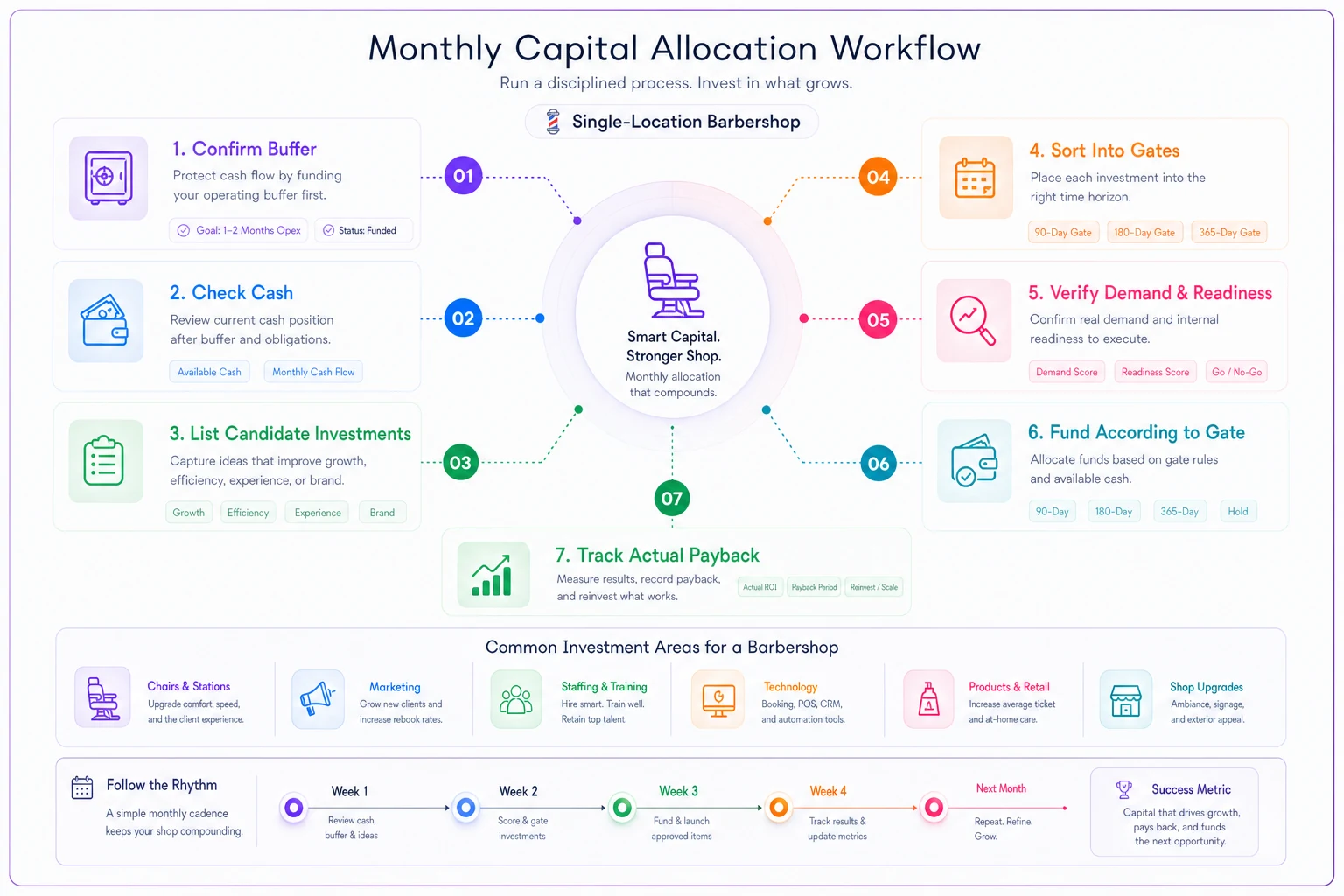
A simple visual like this makes it easy to run the sequence at a glance.
Run this monthly and the reactive "loudest problem wins" pattern breaks on its own, because now every request competes on the same axis.
A quick self-audit checklist
Before your next spend, run through this:
-
Do I know my exact buffer number this month?
-
Is my operating account above that buffer right now?
-
Which gate does this purchase fall into on honest assumptions?
-
Is there existing demand and capacity to make this return quickly, or am I hoping demand shows up?
-
Is this a one-time cost or a permanent liability? (Pay bumps and subscriptions are permanent.)
-
If this fails completely, does it threaten payroll?
-
Have I compared it against the other things I could fund this month — or am I judging it in isolation?
If you can't answer the first three cleanly, that's the real work — not the purchase.
When aggressive allocation makes sense — and when it doesn't
When it makes sense: You're consistently above buffer for three-plus months, your chairs hit capacity at peak, and you have a clear demand signal — waitlists, turned-away walk-ins, rebooking pressure. That's the profile where funding capacity and moderate marketing together compounds fast.
When it's a bad idea: You're below buffer, margin is soft even when you're busy, or you're funding staffing changes on emotion rather than an actual productivity or turnover model. Spending into a margin problem just moves the crisis one quarter down the road.
Who should not run an aggressive playbook at all: Shops still leaking cash on a busy week. If revenue is up but the account keeps shrinking, no allocation strategy fixes that — it's an operations and pricing problem first. Owners genuinely weighing a second location should be gating against expansion reserves specifically; the threshold logic in our second-location expansion playbook is a different and much larger gate than anything covered here.
Where software quietly earns its place
One category worth its own note: the low, ongoing cost of tech tends to score well in this framework precisely because its return compounds while its cost stays flat. A booking and operations platform that trims no-shows, tightens rebooking, and gives you clean numbers on chair utilization doesn't just pay for itself — it makes every other allocation decision more accurate, because you're running the gates on real data instead of gut feel.
AI-assisted scheduling and automated reminders cut down the manual chasing that eats owner hours, and centralized reporting means your buffer number and payback tracking aren't a monthly spreadsheet scramble. That's the point where a modest subscription stops being a cost line and starts being the instrument you allocate with.
If you're manually chasing rebooks, automating reminders and confirmations often reduces no-shows more reliably than short-term ad spend.
The real shift
The owners who build durable free cash flow aren't smarter about individual purchases — they're more disciplined about the order of purchases. They've decided in advance what a dollar has to prove before it gets spent, and they've made the buffer non-negotiable. Everything else is just applying the gates, month after month, and letting the quiet, high-return investments finally win against the urgent ones. Do that consistently, and the account stops shrinking on your good months — which is exactly when it should have been growing all along.
Ready to elevate your barbershop operations?
Join 500+ barbershops using Trimzly to save time, reduce scheduling conflicts, and enhance client satisfaction.