

Walk into most barbershops on a Tuesday afternoon versus a Saturday morning and you're basically dealing with two different businesses. Same chairs, same menu, same logo on the wall — completely different experience. On Tuesday the phone gets answered on the second ring, the consultation is thorough, the barber sweeps your neck and walks you to the counter. On Saturday you're a number, the barber's rushing, checkout is a scramble, and nobody mentions your next appointment.
That gap is the real problem most owners never actually name. They think they have a "quality" issue or a "training" issue. What they actually have is the absence of a barbershop customer experience operating model — a defined standard for what happens at each stage, plus the enforcement mechanism to keep it consistent when the shop gets slammed, when a new barber starts, or when the owner's not around.
This isn't about being fussy. Inconsistency quietly kills rebook rates and referrals more than any single bad haircut ever will. A client who gets a great cut but a forgettable everything-else has no real reason to feel loyal. A client who gets a decent cut wrapped in a consistent, memorable experience comes back on autopilot. The experience is the retention engine — and in most shops, it's running without a governor.
Why experience drifts even in good shops
The frustrating part is that this usually isn't a talent problem. Most barbers are perfectly capable of delivering a strong client experience. They just don't have a shared definition of what that experience is supposed to look like, so each person improvises based on their own habits, their mood, and how slammed the day is.
The pattern that keeps showing up: the owner has the standard in their head. They personally answer the phone well, consult well, close well. But it lives nowhere except their own behavior. So when they add a second chair, a front-desk person, or a Saturday-only barber, that person invents their own version. Multiply that across four barbers and two locations and you don't have a brand anymore — you have four brands sharing a rent payment.
A few forces make this worse as you grow:
-
Volume compresses the experience. When a barber's behind, the first things to disappear are the consultation and the post-cut walk-through — exactly the parts that drive rebooking.
-
Channels multiply. Phone, walk-in, Instagram DMs, online booking, text — each one becomes its own place for a different tone and a different set of promises.
-
Nobody owns the handoffs. The client moves from booking to chair to checkout, and each transition is where something gets dropped: the note about client preferences, the rebook prompt, the product recommendation.
The takeaway isn't "hire better people." Experience will always drift toward whatever's easiest under pressure — unless you build a system that makes the right behavior the default.
The four-stage standards library
The backbone of the whole model is a standards library that covers the client's actual journey, broken into four stages. Writing this down isn't bureaucracy — it's so every person in the shop is delivering the same thing, and so you can actually measure whether they are.
Never miss a booking amidst the hustle.
Trimzly helps you schedule, confirm, and manage every client visit seamlessly.
- Unified appointment management
- Automated client reminders
- Optimized staff scheduling
No credit card required
1. Booking
The first impression and the most neglected stage. Whether the client is calling, DMing, or booking online, the standard should define how fast you respond, what information you confirm, and what you set up for the visit.
A tight booking standard captures the client's name, the service, whether they're new or returning, and — critically — any style notes or requests before they ever sit down. A shop that confirms "cut plus beard, and I've noted you wanted to grow the top out from last time" is already ahead of most competitors, and it hasn't touched a pair of clippers yet.
2. In-shop
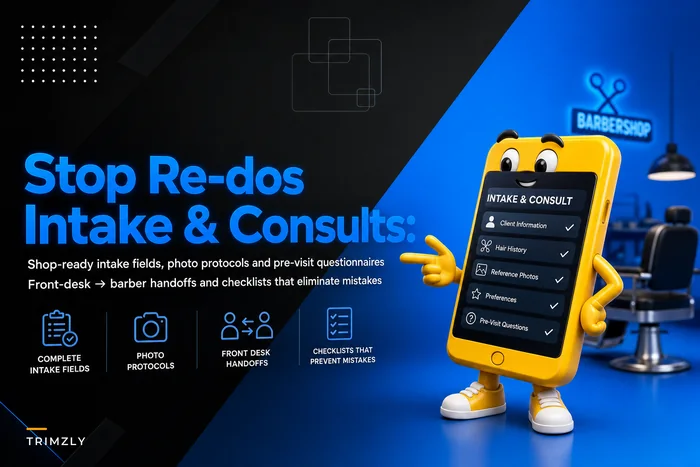
This covers arrival through the cut itself: the greeting, where they wait, the consultation, the service. The consultation is where most re-dos and disappointed clients originate, and it deserves a real standard rather than a "how do you want it?" shrug. If you've worked on tightening this specifically, the logic behind intake and consultation workflows that eliminate mistakes plugs directly into this stage — the in-shop standard should treat that consultation as a required step, not an optional one.
3. Checkout
The most under-monetized moment in the entire visit. This is where rebooking, product recommendation, and the payment experience live. A standard checkout confirms the client was happy, books the next appointment before they leave, and makes a relevant product suggestion tied to what was actually done to their hair. Shops that skip the rebook prompt at checkout are re-acquiring the same client every single visit instead of locking them in.
4. Post-visit
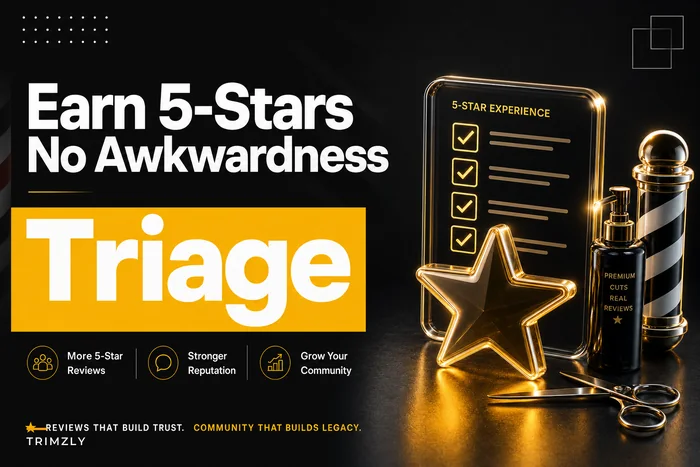
Everything that happens after they walk out: the thank-you, the review ask, the reminder cadence, the win-back if they go quiet. Done well, post-visit is nearly invisible and does a lot of quiet work. The review portion especially benefits from a defined workflow — the approach in an automated review & triage workflow belongs in your post-visit standard so five-star asks aren't left to whoever happens to remember.
Here's a compact way to see the four stages, what each one owns, and the KPI it moves:
| Stage | Standard owns | Common failure | Retention KPI it drives |
|---|---|---|---|
| Booking | Response time, info capture, pre-visit notes | Slow replies, no client history | Booking conversion, new-client show rate |
| In-shop | Greeting, consultation, service quality | Skipped consultation, rushed cut | Satisfaction, re-do rate |
| Checkout | Rebook prompt, product rec, payment | No next appointment booked | Rebook rate, average ticket |
| Post-visit | Thank-you, review ask, reminders | Client forgotten after they leave | Review volume, lapsed-client win-back |
A quick visual of the four-stage workflow:
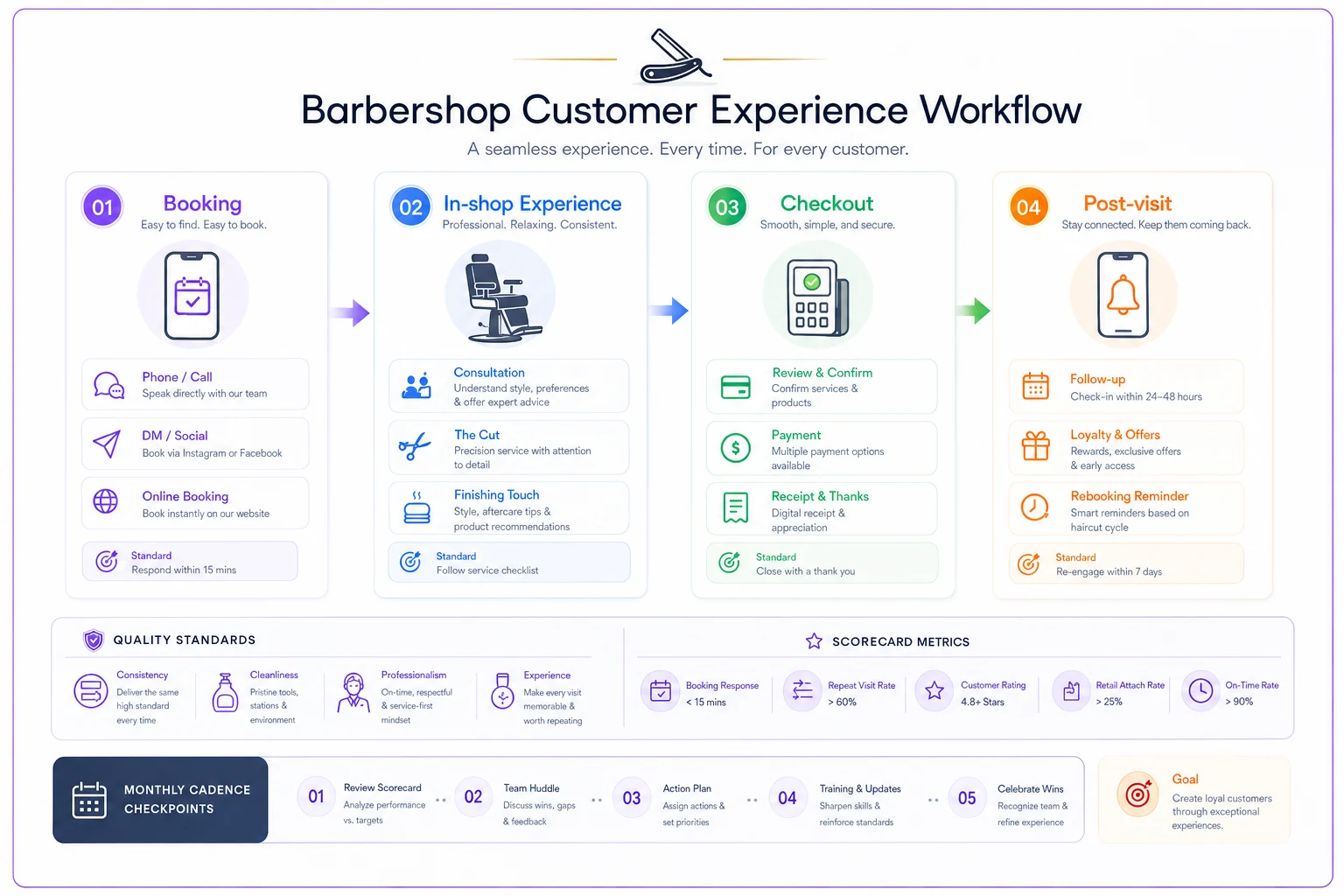
The value of laying it out this way is that every complaint or missed number traces back to a specific stage. "Our rebook rate is low" stops being a mystery — it becomes a checkout-standard problem you can actually fix.
Channel-specific scripts (because tone breaks by channel)
One standard delivered across five channels still comes out inconsistent unless you write for each channel. The way you handle a walk-in isn't the way you handle an Instagram DM, and a phone booking has a different rhythm than an online one.
You don't need scripts in the theatrical sense — just a few anchor points per channel so nobody's winging the important parts:
-
Phone Answer within a set number of rings, confirm service + barber + time back to the client, capture any style note verbally, and always end with next available options if their preferred slot is gone.
-
DMs / social Set a response-time expectation, keep the tone matched to the shop's vibe, but always move the conversation toward a booked slot rather than an open-ended chat.
-
Walk-in Greet within a defined window even if you can't serve them yet, give an honest wait estimate, and offer to book ahead if the wait is long.
-
Checkout in person The rebook and product moment, scripted so it feels natural rather than pushy.
The fastest ROI is almost always on whichever channel currently has no standard at all. For a lot of shops that's social DMs — messages sit for hours, get answered inconsistently, and a chunk of ready-to-book clients drift to whoever replied first. Writing even a rough DM standard often recovers bookings you didn't know you were losing.
Mystery-shop scorecards: how you actually measure it
A standard nobody checks is just a wish. This is where most experience initiatives collapse — the owner writes a solid SOP, tapes it to the break room wall, and never looks at it again. Six weeks later everyone's back to improvising.
The fix is a lightweight mystery-shop scorecard run monthly. You don't need a hired secret shopper; you can call your own shop as a "new client," book online yourself, walk through as an observer, or have a friend do it. What matters is scoring against the written standard, not a gut feeling.
A usable scorecard is short — one line per standard, scored pass/partial/fail:
-
Phone answered within target time
-
Style notes or preferences captured at booking
-
Greeting delivered within the window
-
Consultation completed before the cut
-
Client asked if they're happy before checkout
-
Next appointment offered at checkout
-
Relevant product mentioned
-
Review or thank-you sent post-visit
Score it, total it, track the number month over month. The point isn't to catch people out — it's to turn a vague sense of "we've gotten sloppy" into a specific list of two or three stages that need attention.
Focus scorecards on the bookends — booking and checkout — since they move retention most.
One pattern worth noting: shops almost always score well on the cut and poorly on the bookends — booking and checkout. That's backwards from a retention standpoint, because the bookends are what drive clients coming back. If your scorecard keeps flagging checkout, that's not a coincidence — that's your biggest retention leak.
Enforcement and escalation: the part everyone skips
Measuring gets you awareness. Enforcement gets you consistency. And enforcement doesn't mean punishment — it means a clear, predictable response when a standard is missed, so barbers understand the standards are real.
The key is having tiers, so a first miss and a repeated pattern don't get treated the same way:
-
First miss Note it, mention it in passing, no drama. Everyone has off days.
-
Pattern (same miss across 2–3 scorecards) A short, specific coaching conversation tied to the standard — not "be better," but "you're skipping the rebook prompt, here's the line to use."
-
Persistent pattern A structured coaching plan with a check-in date and a clear expectation of what "fixed" looks like.
-
Standard-wide slippage across the whole team That's not an individual problem — that's a signal the standard is unrealistic, under-resourced, or the shop's too slammed to execute it. Fix the system, not the person.
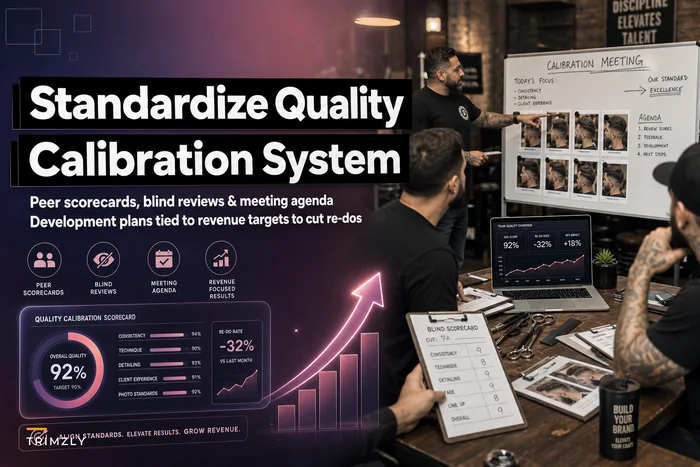
That fourth tier is the one owners forget. If everyone's failing the consultation standard, the answer usually isn't discipline — it's that barbers don't have the time, the tool, or the calibration to pull it off. Keeping quality consistent across a team is closer to the barber mentoring and calibration system to standardize quality than it is to a warning system. Enforcement and calibration are two sides of the same coin: one keeps the floor from dropping, the other raises the ceiling.
Cadence: how often to run the whole thing
Experience programs die because they get run once, in a burst of motivation, and then never again. The model only works as a monthly rhythm:
-
Weekly Quick pulse — glance at rebook rate and any client complaints, no formal scorecard needed.
-
Monthly Run a few mystery shops across different channels and different barbers, score them, review as a team, action the top one or two gaps.
-
Quarterly Review the standards themselves. Are they still right? Did a new service or channel appear that has no standard yet? Recalibrate.
Tie each cadence to a retention KPI so the effort connects to money, not just tidiness. Monthly scorecards map to rebook rate and average ticket. Post-visit standards map to review volume and win-back rate. When the owner can point to rebook rate climbing after fixing checkout, the program funds itself and nobody questions why you're doing it.
A real scenario
A two-location shop, five barbers total, was doing roughly 320–360 cuts a month per location. Cut quality was genuinely good — Google reviews mentioned the barbers by name. But rebook rate was stuck around 34%, and the owner couldn't figure out why happy clients weren't scheduling ahead.
They built the four-stage standards library and started running monthly mystery shops. The scorecard made it obvious quickly: the cut and consultation scored well, but checkout was a mess. Only around half of clients were being offered a next appointment, and product recommendations were basically nonexistent because barbers "didn't want to seem salesy." Social DMs were another hole — messages sat unanswered for hours at the busier location.
They didn't overhaul anything dramatic. They wrote a two-line checkout script, added the rebook prompt as a scored standard, gave the front desk a DM response standard, and started reviewing scorecards at the monthly team meeting. Over the next quarter, rebook rate climbed into the low-to-mid 40s, average ticket ticked up from product attach, and the busier location stopped losing DM bookings to the shop down the street. Nothing about the haircuts changed. The experience around the haircuts got consistent.
When this model makes sense — and when it doesn't
This isn't for everyone.
When it makes sense: You have more than one barber, a front desk, or multiple booking channels — anywhere consistency depends on more than just you. It also makes sense the moment you're planning to add a chair, a location, or a new hire, because that's exactly when experience drift accelerates.
When it's overkill: If you're a solo barber running your own book, you basically are the standard. Writing a full standards library for a shop of one is effort better spent elsewhere. A loose checklist is plenty until you add a second person.
Who should not do this yet: Owners whose core cut quality is genuinely inconsistent. If the actual haircuts are hit-or-miss, fix that first through calibration and training. A polished checkout script wrapped around a bad cut just makes the disappointment more organized.
Where the tools quietly help
Once the standards exist, keeping them alive by memory is the part that fails. This is where operational software earns its keep in this model — not as the strategy, but as the thing that makes the standard the path of least resistance.
Client notes and style history that surface automatically at booking. Rebook and review prompts that fire without anyone having to remember. Message templates per channel so tone stays consistent whether it's the owner or a Saturday hire replying. A well-designed platform removes the friction that causes drift in the first place — the barber doesn't have to remember to check preferences or send the review ask, because the system puts it in front of them at the right moment. The standard stops being a thing on the wall and becomes the way the shop actually runs.
The real point
Consistent service isn't a personality trait a shop either has or doesn't. It's the output of a defined experience across four stages, written scripts per channel, a scorecard that measures reality, an escalation ladder that keeps standards real, and a monthly cadence that ties all of it to rebook rate and average ticket.
Most shops lose more revenue to quiet inconsistency than to any dramatic failure. The client who never comes back rarely complains — they just don't rebook, and you never find out why. A barbershop customer experience operating model exists to close that gap: to make sure the Tuesday-afternoon experience and the Saturday-morning experience are the same shop, run by whoever happens to be working, on the busiest day of the month.
Consistent service isn't a personality trait a shop either has or doesn't. It's the output of a defined experience across four stages, written scripts per channel, a scorecard that measures reality, an escalation ladder that keeps standards real, and a monthly cadence that ties all of it to rebook rate and average ticket.
Most shops lose more revenue to quiet inconsistency than to any dramatic failure. The client who never comes back rarely complains — they just don't rebook, and you never find out why. A barbershop customer experience operating model exists to close that gap: to make sure the Tuesday-afternoon experience and the Saturday-morning experience are the same shop, run by whoever happens to be working, on the busiest day of the month.
Ready to elevate your barbershop operations?
Join 500+ barbershops using Trimzly to save time, reduce scheduling conflicts, and enhance client satisfaction.