



Most barbershop owners who blow up during expansion don't do it because they picked a bad location or hired the wrong manager. They do it because they signed financing they didn't fully understand, on unit economics that looked fine on a napkin but fell apart under real cash timing.
Expansion is where the clean, forgiving economics of a single profitable shop meet the unforgiving world of lenders, covenants, personal guarantees, and payback math. A single location can carry a lot of operational sloppiness and still survive. Add debt and a second rent payment, and the margin for error shrinks hard.
This piece ties the money side together — worked unit economics, payback periods that actually matter to a bank, the clauses in a term sheet that can quietly take your business away from you, and the covenant traps that look harmless until the month your sales dip 12%.
If you haven't nailed down what your current shop is actually worth and how it throws off cash, start with the barbershop valuation playbook for owners and the capital‑allocation playbook. This article assumes you already know your numbers and are ready to borrow against them.
Start with the only unit economics a lender actually cares about
Owners pitch expansion with revenue. Lenders underwrite on cash flow after everything. Those are very different numbers, and the gap between them is where deals go sideways.
Below is a worked example of a realistic second-location model for a 6-chair shop in a mid-size market. These are the numbers you want in front of you before you ever walk into a bank.
| Line item | Monthly | Notes |
|---|---|---|
| Gross service revenue | ~$42,000 | 6 chairs, ramping to ~75% utilization by month 9 |
| Retail/add-on revenue | ~$3,500 | roughly 8% of service rev |
| Total revenue | ~$45,500 | |
| Chair pay / commissions | ~$20,000 | blended ~44% of service rev |
| Rent + CAM | ~$6,800 | triple-net, includes common area charges |
| Payroll taxes + benefits | ~$2,400 | |
| Supplies + retail COGS | ~$2,600 | |
| Marketing | ~$1,500 | heavier in first 6 months |
| Software, POS, misc overhead | ~$1,200 | |
| Manager salary (if not owner-run) | ~$3,800 | |
| Total costs | ~$38,300 | |
| Monthly cash flow (pre-debt) | ~$7,200 | this is what services debt |
That ~$7,200 is the number. Not the $45k revenue line. When a lender sizes your loan, they're asking one question: after you pay everybody and keep the lights on, how much is left to pay us, and how much cushion is there if you have a bad quarter?
The mistake owners make constantly is modeling month one at full utilization. New shops don't open full. A realistic ramp for a second location — even with an established brand and transferred clients — looks more like 40% utilization in month one, crossing breakeven somewhere around month 4 to 6, and hitting stabilized numbers around month 9 to 12. If your model shows breakeven in month two, you're not being optimistic — you're being wrong, and a sharp lender will see it.
Model month one at ~40% utilization and build a 9–12 month ramp into your projections.
Payback period: the number that separates good expansion from ego expansion
-
$165,000 invested ÷ ~$7,200/mo stabilized ≈ 23 months to nominal payback
But that's the lazy version. The honest version accounts for the ramp. During months one through nine you're not generating $7,200 — you're generating a fraction of it, sometimes nothing. Fold in the ramp losses and your real payback often stretches to 30–38 months on a shop that looked like a two-year payback on paper.
Why this matters for financing: if your loan amortizes over five years and your real payback is three, you've got roughly two years of genuine profit before the debt clears. Workable. If your real payback creeps toward four years on a five-year note, you're borrowing to stay alive, not to grow. That's the line you don't want to cross.
What breaks when you add a second shop and a loan at the same time
A single location forgives timing problems. You can be two weeks late on a supplier, cover a slow week with a good one, and nobody notices. Debt removes that slack entirely.
Never miss a booking amidst the hustle.
Trimzly helps you schedule, confirm, and manage every client visit seamlessly.
- Unified appointment management
- Automated client reminders
- Optimized staff scheduling
No credit card required
-
Working capital gets split two ways while fixed costs double. The cash that used to float your one shop now has to float two, and one of them isn't producing yet.
-
Rent is now non-negotiable and personally guaranteed. Most commercial leases on a second unit come with a personal guarantee. So does the loan. You've double-stacked personal liability.
-
Your best barbers get pulled to the new location to seed quality, which dents revenue at your profitable original shop right when you need it most.
-
Debt service hits on a fixed date regardless of whether the new shop had a good month. Lenders don't care that December was slow.
-
Covenants start measuring you — quarterly or monthly — and a bad stretch can trip a technical default even while you're paying on time.
That last one is the silent killer. Almost nobody reading their term sheet for the first time actually understands what they're agreeing to.
Covenant red flags: the clauses that can take your business
A covenant is a promise you make to the lender about how you'll run the business while you owe them money. Break it and the lender can — technically — call the entire loan due immediately, even if every payment has been on time. Owners sign these without reading them because the interest rate looked good. Then a soft quarter trips a ratio and suddenly the bank is "renegotiating."
Here are the covenants to fight over, soften, or walk away from.
1. Tight DSCR (Debt Service Coverage Ratio) covenants
DSCR measures your cash flow against your debt payments. A 1.25x covenant means your cash flow must stay at least 25% above your debt service at all times.
The problem isn't the ratio itself — it's a tight ratio tested monthly on a business with seasonal swings. Barbershops have slow Januaries and sluggish mid-summers. If you're averaging 1.30x but dip to 1.15x in a slow month, a monthly-tested 1.25x covenant puts you in technical default.
What to negotiate: quarterly testing instead of monthly, and a trailing-twelve-month average rather than a single-month snapshot. That smooths out seasonality and lets you run the business like a barbershop instead of a bond portfolio.
2. Cross-default clauses
This one is brutal and easy to miss. A cross-default says that if you default on any other obligation — a different loan, an equipment lease, even a large supplier line — this loan is automatically in default too. One stumble becomes three.
What to negotiate: carve-outs for small obligations, a materiality threshold (so a $4k equipment lease dispute doesn't trigger your $180k loan), and cure periods before any default is declared.
3. Cash sweep / excess cash flow recapture
Some loans require you to hand over a percentage of "excess cash flow" to pay down principal faster. Sounds reasonable until you realize it strips the exact cash you need to fund shop number three — or just survive a rough stretch. Profitable on paper, broke in the bank account.
What to negotiate: cap the sweep percentage, carve out a reserved amount for capex and working capital, and step the sweep down as you deleverage.
4. Capex restrictions
A covenant limiting how much you can spend on equipment or buildout without lender approval sounds fine until your busiest shop's HVAC dies and you need to replace it fast. Now you're asking a loan officer for permission to fix your own business.
What to negotiate: an annual capex allowance you can spend freely, with approval only required above that threshold.
5. The personal guarantee with no burn-off
Nearly every small-business expansion loan requires a personal guarantee. That's just reality. What's negotiable is whether it ever goes away.
What to negotiate: a burn-off provision — the guarantee reduces or disappears once you hit certain performance milestones or pay the balance below a set threshold. Good operators should be able to earn their way out of personal liability over time. Weak term sheets keep you on the hook forever.
A quick comparison: what good vs. dangerous terms look like
A quick comparison: what good vs. dangerous terms look like
| Term | Dangerous version | What to push for |
|---|---|---|
| DSCR covenant | 1.35x tested monthly, single-month | 1.20–1.25x tested quarterly, TTM average |
| Default trigger | Full cross-default, no threshold | Materiality threshold + cure period |
| Cash sweep | 75% of excess cash flow, no reserve | ≤25%, with working-capital reserve carved out |
| Personal guarantee | Unlimited, permanent | Limited, with burn-off milestones |
| Prepayment | Heavy penalty for 5 years | Penalty burns off by year 2–3 |
| Capex approval | All capex needs lender sign-off | Annual free allowance, approval above it |
A quick comparison: what good vs. dangerous terms look like
A workable negotiation sequence
Term sheets feel take-it-or-leave-it, but there's almost always room if you know where to push. Here's the order that tends to work.
-
Anchor on the structure, not the rate. New borrowers obsess over interest rate. Experienced ones know covenants and the guarantee cost you far more if the business hits a rough patch. Lead with questions about testing frequency and the guarantee structure.
-
Bring your own model. Show up with ramp-adjusted cash flow projections and trailing numbers from the existing shop. Lenders loosen terms for borrowers who clearly understand their own economics.
-
Ask for quarterly, TTM-based covenant testing first. It's the highest-impact ask and often the easiest for a lender to grant.
-
Trade, don't just resist. If they won't drop the DSCR covenant, ask for a longer cure period and a one-time waiver right. Give them something — a slightly higher rate — in exchange for softer covenants if the trade protects your downside.
-
Get the burn-off on the guarantee in writing. Verbal assurances mean nothing.
-
Read the default and cross-default sections last and hardest. That's where the real risk lives, and it's exactly what most owners skim.
Read the default and cross-default sections last and hardest. That's where the real risk lives, and it's exactly what most owners skim.
When expansion financing actually makes sense
Borrowing to grow is the right move when the fundamentals are actually there:
-
Your existing shop runs at healthy utilization without you behind a chair full-time, and has for at least a year.
-
You have a manager or lead barber ready to actually run the new location — not a hope that you'll somehow clone yourself.
-
Your stabilized cash flow projection services the debt at 1.4x or better, giving you real cushion above the covenant floor.
-
You've got working capital to cover ramp losses on top of the loan, not buried inside it.
If you've worked through a threshold-based expansion playbook and hit the operational triggers, the financing becomes the last piece — not the first.
When it's a bad idea
Expansion financing is the wrong move when you're borrowing to escape a cash problem at your current shop. Debt doesn't fix a leaky business — it accelerates the leak. If your original location only works because you're the busiest chair in it, a second shop doesn't double your income. It splits your attention and puts pressure on both locations simultaneously.
You also shouldn't take on covenant-heavy debt if your revenue is seasonal and you have no cash reserve to ride out the slow months. A single bad quarter plus a tight monthly covenant equals a technical default, and a technical default puts the lender in control of a business you still technically own.
And if the term sheet comes back with permanent unlimited personal guarantees, full cross-default, and an aggressive cash sweep — and they won't budge on any of it — that's not a lender looking for a partner. That's a lender pricing in your failure. Walk.
A real scenario: the covenant nobody read
A two-shop owner we'll keep anonymous took a roughly $175k loan to open location three. Good rate, 1.30x DSCR covenant, tested monthly. The first two shops threw off solid cash, and the model showed comfortable coverage on an annual basis.
Then a road construction project blocked the entrance to his busiest original shop for about ten weeks. Revenue at that location dropped close to 30% during the project. Blended cash flow dipped, and in two of those months his DSCR landed around 1.18x — below the 1.25x floor.
Every loan payment was made on time. He was never actually short on debt service. But the monthly single-month testing tripped a technical default, and the lender used it to force a renegotiation: higher rate, a cash sweep added, tighter reporting requirements. It cost him somewhere in the range of $9k–$12k over the following year in added interest and fees — all because of a testing-frequency clause he could have pushed to quarterly-TTM at signing, probably for free.
The lesson isn't "don't borrow." It's that the clause he skimmed was worth more than the rate he spent all his energy negotiating.
Keeping the deck honest for investors or partners
If you're raising from a partner or investor rather than a bank, the discipline is the same but the storytelling changes. A clean deck for a barbershop rollout isn't flashy — it's credible. The sections that actually matter:
-
Proven unit economics from your existing shop — real trailing numbers, not projections.
-
Ramp-adjusted projections for the new unit, showing the slow first months honestly. Overly smooth hockey-stick projections kill credibility faster than conservative ones do.
-
Use of funds broken down line by line — buildout, equipment, working capital reserve, pre-opening payroll.
-
The operating system that makes the shop repeatable — your SOPs, your manager, your quality controls — because investors are betting you can reproduce the first shop, not just get lucky twice.
-
Downside case. Show what happens if utilization stalls at 60%. Sophisticated money trusts operators who've already stress-tested their own plan.
The owners who raise cleanly are the ones who present the boring version — honest ramps, real covenants, modeled downside. The ones who struggle are selling a dream with no stress test behind it.
Bringing the money side and the operations side together
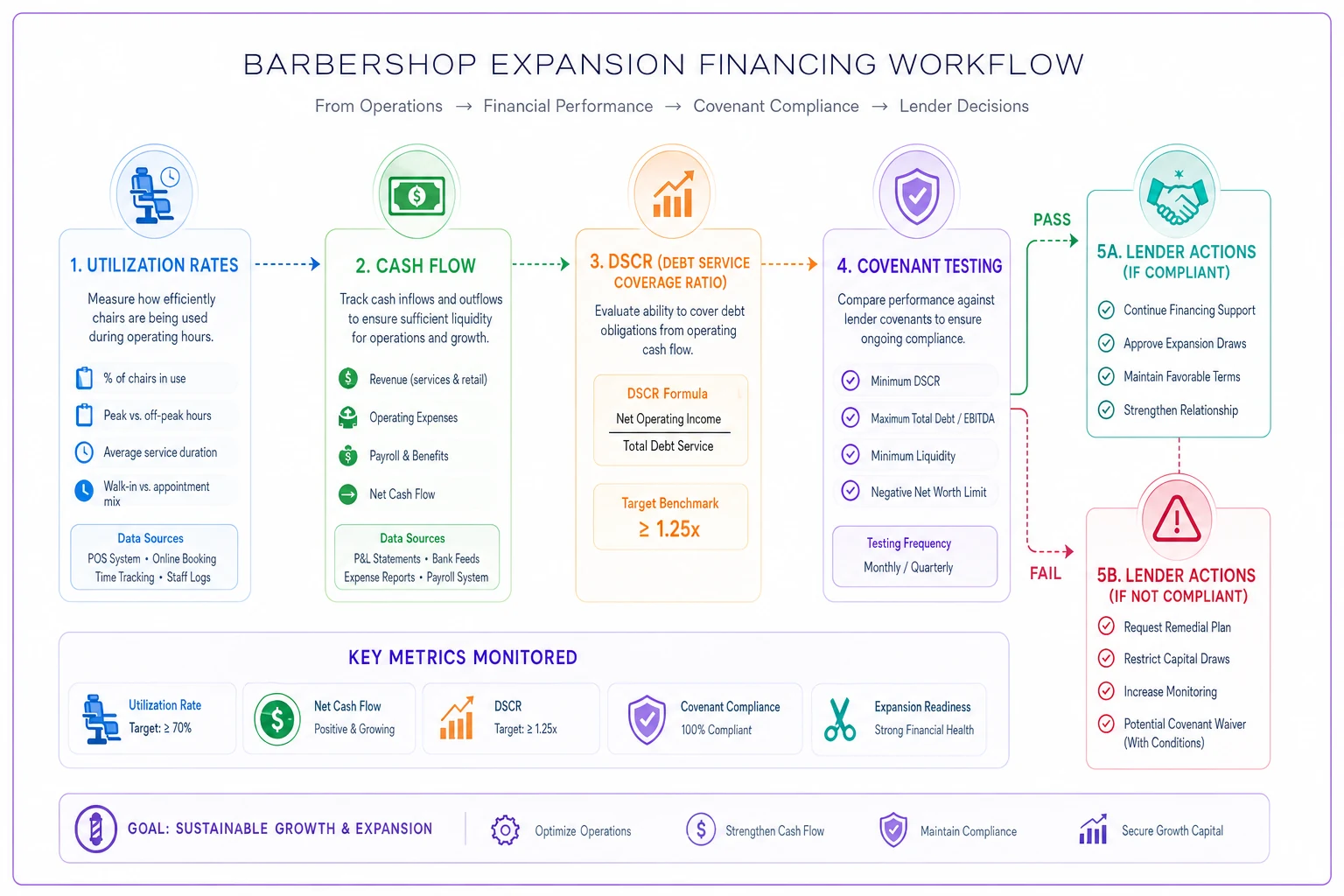
Expansion financing isn't a finance problem sitting off to the side of your business. It's woven into everything — your utilization rates feed your cash flow, your cash flow feeds your DSCR, your DSCR determines whether a slow quarter is a minor dip or a technical default. The operational discipline that makes a single shop profitable is exactly what keeps your covenants safe once you're leveraged.
That's why the sequence matters: get the shop economics clean, understand your real cash generation, model the ramp honestly, and then go borrow — with your eyes open on the clauses that quietly decide your downside. A good rate on bad covenants is still a bad deal. A slightly higher rate with quarterly testing, a burn-off guarantee, and a reasonable cure period is how experienced operators grow without betting the whole business on every slow month.
Here's a simple workflow to keep in mind.
Read the default section twice. Negotiate the structure before the rate. And never model month one at full chairs.
Read the default section twice. Negotiate the structure before the rate. And never model month one at full chairs.
Ready to elevate your barbershop operations?
Join 500+ barbershops using Trimzly to save time, reduce scheduling conflicts, and enhance client satisfaction.