

Most barbershop owners buy software backwards. They pick the tool with the nicest booking screen, sign up, and then discover six months later that it can't split commission the way they pay their barbers, or that pulling a simple end-of-month report means exporting three CSVs and fighting with a spreadsheet.
The problem isn't that there's bad software out there. It's that the feature that matters most for a solo barber renting a chair is nearly irrelevant for a three-location operation, and vice versa. A tool that's perfect at 2 chairs becomes a bottleneck at 8. So the real question isn't "what's the best barber shop software" — it's "what do I actually need right now, and what will I need in eighteen months?"
This guide breaks that down by shop size and business model, gives you a prioritized checklist, a decision matrix, a vendor scorecard you can print, and a payback calculator so you're not guessing whether the monthly fee is worth it.
Start with your business model, not the feature list
Before you look at a single demo, get clear on how your shop actually makes money and pays people. This determines about 80% of what you need.
Three questions decide everything:
-
How do your barbers get paid? Booth rent, commission split, hourly, or hybrid? This is the single biggest factor most owners underestimate.
-
Who owns the client? If barbers keep their own book and could walk with their clients, your needs are different than a shop where the brand owns the relationship.
-
Are you selling retail and add-ons? If product sales are more than a rounding error, POS and inventory stop being optional.
A booth-rent shop where every barber runs their own book barely needs shared client records — but they do need clean individual reporting and a way to handle rent collection. A commission shop needs airtight commission math or you'll be recalculating pay by hand every two weeks. Get this part wrong and you'll end up with a tool that fights your business model every single day.
The prioritized feature checklist
Not all features carry equal weight. Here's how they actually rank in day-to-day operations, roughly in the order they start to matter as you grow.
Never miss a booking amidst the hustle.
Trimzly helps you schedule, confirm, and manage every client visit seamlessly.
- Unified appointment management
- Automated client reminders
- Optimized staff scheduling
No credit card required
Tier 1 — you cannot operate without these:
-
Scheduling / online booking — self-service booking, barber-specific calendars, buffer times, and the ability to block or adjust in seconds. If clients can't book without calling, you're leaking bookings after hours.
-
Client records — contact info, visit history, notes, and formula/style history. Even solo barbers benefit here; it's what stops the "what did we do last time?" fumble.
-
POS / checkout — take payment, handle tips, split payment types. If it doesn't handle tip-out cleanly, your barbers will notice fast.
Tier 2 — matters once you have staff or retail:
-
Payroll / commission support — automatic commission splits, tip tracking, booth rent handling. This is where most shops with 2+ barbers get burned.
-
Reporting — revenue by barber, service mix, retail attach rate, rebook rate. You can't fix what you can't see.
-
Inventory — SKU tracking, reorder points, retail vs. back-bar separation. Becomes real the moment retail is a revenue line rather than a shelf decoration.
Tier 3 — growth and retention features:
-
Memberships / packages — recurring billing, package redemption tracking. Great for smoothing cash flow, but only if you've actually designed a membership that makes sense.
-
Marketing / automation — rebook reminders, no-show reduction, review requests.
-
Integrations — accounting (QuickBooks/Xero), payroll providers, Google Booking, and any tools you already use.
Quick sanity check: if a vendor leads their pitch with Tier 3 features but goes vague when you ask how commission splits work, that tells you exactly who they built the product for.
The 3×3 decision matrix
What you should prioritize depends heavily on where you sit. This matrix maps feature priority against shop type.
| Feature Area | Solo (1 chair / booth rent) | Small (2–6 chairs) | Multi-location |
|---|---|---|---|
| Scheduling | Critical — self-booking is your front desk | Critical — multi-calendar and resource views | Critical — cross-location visibility |
| Client records | Nice to have, keeps you organized | Important — shared vs. private book decision | Critical — unified client profile across sites |
| POS | Important — simple checkout and tips | Critical — must handle tip-out | Critical — consolidated and location-level |
| Commission / payroll | Low (unless subletting) | Critical — this is your headache | Critical — plus role and permission control |
| Inventory | Low unless you sell retail | Important if retail matters | Critical — per-location stock and transfers |
| Reporting | Basic revenue view is fine | Important — by-barber breakdowns | Critical — location comparison and roll-up |
| Memberships | Optional | Optional — depends on model | Useful — standardize across sites |
| Integrations | Minimal | Accounting and payroll | Deep — the whole stack must connect |
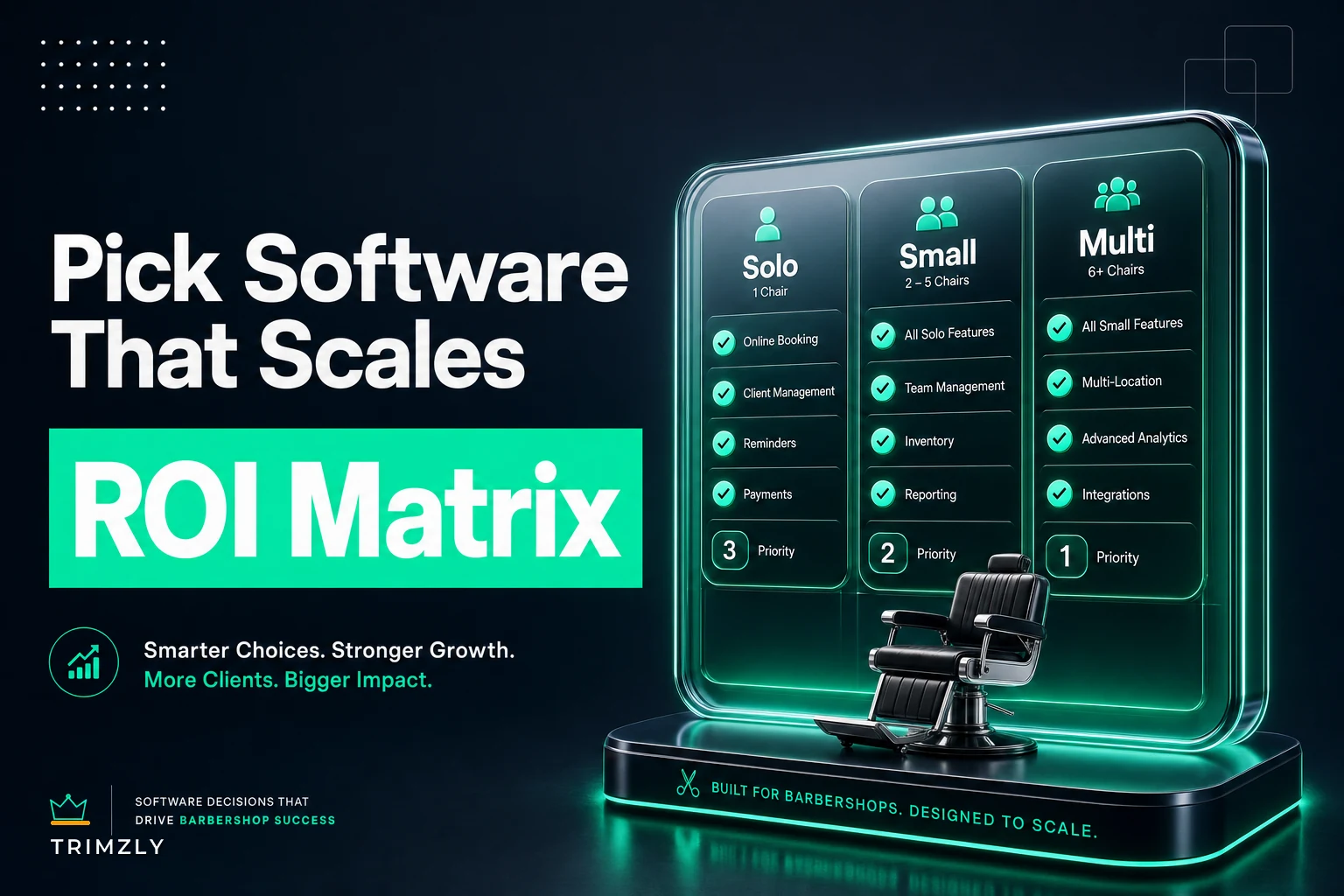
The pattern worth noticing: for solo barbers, scheduling and simple checkout are everything, and half the feature list is noise. For small shops, commission and tip handling quietly become the thing eating your Sunday nights. For multi-location, almost everything becomes critical, but the real differentiator is consolidation — can you see all locations in one view without logging into three separate accounts?
Owners get into trouble when they buy for the tier above them "to grow into it." Sometimes that's smart. Often it's two years of paying for complexity your team never touches and features that just add friction.
When more software is a bad idea
A few honest calls:
-
A solo booth renter probably shouldn't pay for a full multi-location platform. You need booking, a client list, and a way to take card payments. That's it. The rest is overhead.
-
A shop that's about to switch pay models shouldn't lock into a tool now. Wait until your commission structure is settled, or you'll migrate configs twice.
-
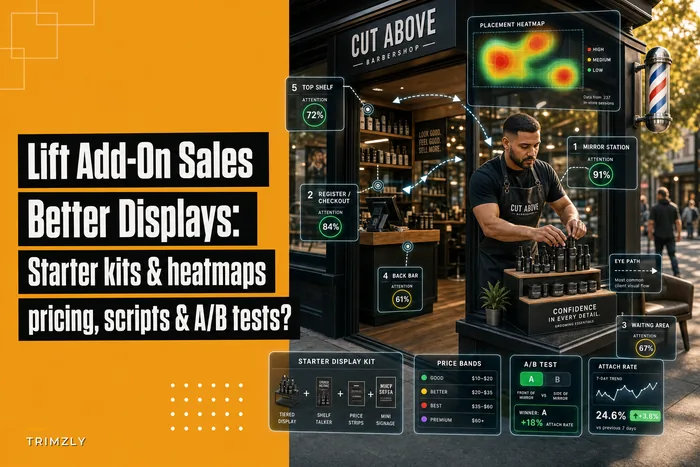
If your retail is genuinely tiny, don't let inventory features drive your decision. Get the retail engine going first — better product placement and attach-rate discipline matter more than SKU software when you're just starting to sell. There's a full breakdown in the retail merchandising SOP for barbershops if that's the gap.
Don't over-index on future features before your current ops run smoothly.
The one-page vendor scorecard
Use this during demos. Score each vendor 1–5 and force yourself to fill in the notes column — vague answers during a demo are actually the most useful signal you'll collect about how a tool performs in real life.
| Criteria | Weight | Score (1–5) | Notes |
|---|---|---|---|
| Handles our pay model (commission / rent / hybrid) | ×3 | ||
| Booking experience (client-facing) | ×3 | ||
| Tip and tip-out handling | ×2 | ||
| Reporting we'd actually use | ×2 | ||
| Inventory (if retail matters) | ×2 | ||
| Integrations with existing tools | ×2 | ||
| Ease of daily use for barbers | ×3 | ||
| Support responsiveness and onboarding | ×2 | ||
| Data export and data ownership | ×2 | ||
| Total price vs. value | ×2 |
Multiply score by weight, add it up, compare vendors. The weighting matters more than raw scores — a tool that nails booking and pay handling but has mediocre marketing tools will still beat a flashy platform that fumbles payroll.
One thing barbers consistently forget to score: ease of use for the person actually standing behind the chair. A tool that owners love and barbers hate will get worked around, and then your data is garbage.
Sample pricing thresholds
Pricing varies, but here's a rough map of what's reasonable so you can spot when you're overpaying.
-
Solo roughly $0–$40/month. Plenty of capable tools live in this range. If you're paying more than $50 as a single chair, you're probably paying for features you never open.
-
Small (2–6 chairs) commonly $60–$200/month, often priced per barber or per chair. Watch the per-seat math — a tool at $30/barber gets expensive at 6 chairs fast.
-
Multi-location usually custom or tiered, often $250+/month per location or a negotiated bundle. At this level, integration depth and support quality matter more than raw feature count.
Watch for the hidden costs: payment processing rates (this can dwarf the subscription fee), SMS and marketing message charges, add-on module fees, and onboarding costs. A "cheap" plan with a 3.5% processing rate can cost you far more than a pricier plan at 2.6%.
The ROI / payback calculator
Here's a simple way to figure out if a tool actually pays for itself. Five numbers, no spreadsheet required.
-
Monthly cost of the tool — subscription plus realistic add-ons. Say $150.
-
Hours saved per month on admin — scheduling, payroll math, chasing no-shows. For a small shop switching from paper and spreadsheets, this is usually somewhere between 8 and 15 hours.
-
Value of that time — even at $25/hour, 10 hours saved is $250/month.
-
Recovered revenue — from fewer no-shows and better rebooking. If automated reminders cut no-shows by even a handful a month at roughly $35 each, that's another $150–$250.
-
Add it up against the cost.
A rough example for a 4-chair shop: $150 cost against roughly $250 in time saved plus $200 in recovered no-show revenue comes out to around $300/month net. Pays back almost immediately. The math gets fuzzier for solo barbers, where time savings are smaller — which is exactly why cheaper tools make more sense at that level.
The number most owners miss is commission-calculation time. A shop paying five barbers on split commission can easily burn half a day every pay period on manual math and disputes. Software that handles that correctly isn't a convenience — it basically is the ROI.
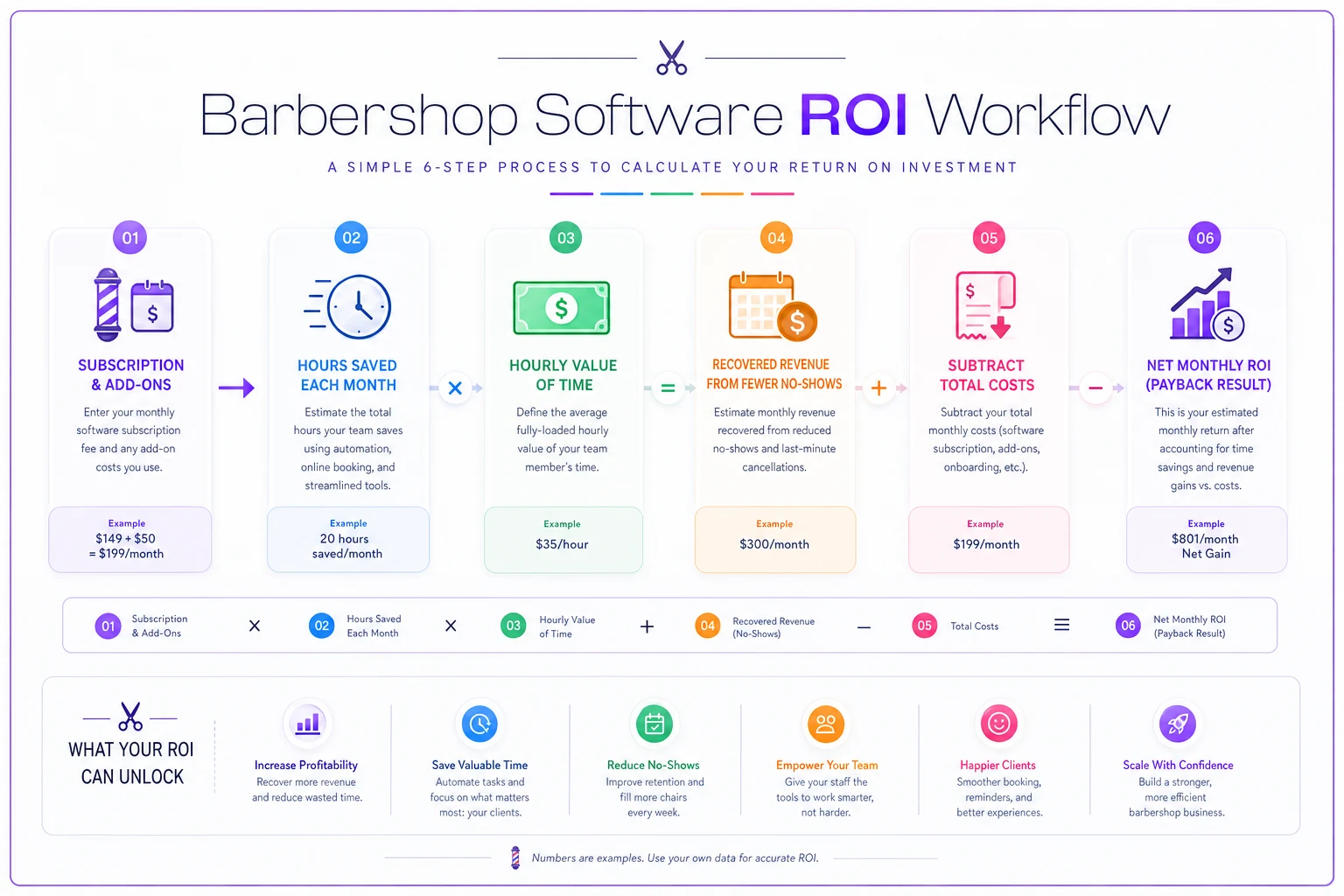
Here's a quick visual workflow of the calculator.
A real scenario
A three-barber shop running commission splits was on a booking-first tool that didn't handle pay. Every two weeks the owner spent most of a Sunday exporting transactions, sorting by barber, applying different split percentages, subtracting product costs, and reconciling tips. Roughly 6–8 hours a pay period, plus the occasional dispute when a barber's math didn't match hers.
They switched to a platform that handled commission natively. Reconciliation dropped to about an hour of review. Just as importantly, the disputes mostly stopped because barbers could see their own numbers in real time. The owner got roughly two full days a month back and stopped dreading payday.
The subscription cost more than the old tool. Still an easy win.
The lesson isn't "buy the expensive one." It's that the feature matching your biggest time sink is worth paying for, and features that don't touch your actual operation aren't worth a cent.
Vendor interview questions
Ask these directly during the demo. Push for specifics, not slides.
-
"Walk me through exactly how you'd handle my pay model — here's how I split." Make them show you. Don't accept "yes we do that."
-
"How does tip-out work at checkout?"
-
"If I leave, how do I export my full client list and history — and in what format?"
-
"What's the real, all-in monthly cost including processing and messaging?"
-
"What does onboarding look like, and who handles the data migration?"
-
"How long does support typically take to respond — and is it phone, chat, or email only?"
-
"What happens to my bookings and data during a plan change or price increase?"
Don't accept vague answers — get them to demonstrate with your actual numbers where possible.
Red flags
These are worth taking seriously — not as a checklist to run through, but as genuine signals that a vendor hasn't thought through the operational side of running a barbershop.
-
Vague answers on pay and commission handling. If they dodge the specifics, it's because the answer is "not well."
-
They won't let you export your own data, or make it deliberately painful. Your client list is your business — never rent it.
-
Processing rates buried in fine print or "we'll tell you after signup."
-
No real onboarding support for anything above solo tier.
-
Long contracts with early-termination fees. Good tools keep you by being good, not by trapping you.
-
A sales rep who can't answer operational questions and keeps redirecting to marketing features.
One more subtle one: if the tool doesn't support how your team actually works — say, tracking style history for repeat clients or handling the range of services you offer — it'll create workarounds that cost you more than the tool saves. Shops offering a broad service range across different hair types especially need a tool that fits their real menu, which ties back to having clear SOPs in the first place, like the ones in the inclusive services playbook. And if you're relying on software to help standardize quality across barbers, make sure the client-notes and history features are actually usable day to day — that's the backbone of any real mentoring and calibration system.
Making the call
Pick your tier honestly. Match the software to your single biggest operational pain — for most small shops that's commission and payroll math, for solo barbers it's frictionless booking, for multi-location it's consolidation. Score your finalists on the weighted scorecard, run the payback numbers, and don't buy complexity you won't use for two years.
If you're switching from an existing tool, don't just flip the switch mid-week and hope your bookings survive the transfer. Moving vendors is where shops lose appointments, client history, and a fair amount of their sanity — do it in stages with a real plan. When you're ready for that, work through the staged migration playbook so you can move without breaking a single booking.
The right barber shop software isn't the one with the most features — it's the one that disappears into your day and quietly kills the task you hate most.
Ready to elevate your barbershop operations?
Join 500+ barbershops using Trimzly to save time, reduce scheduling conflicts, and enhance client satisfaction.