


Most barbershop owners who open a second or third shop don't fail because demand dries up. They fail because they never decided who owns what. The first shop worked because one person — usually the owner — held everything in their head: the ordering, the schedule, the hiring standards, the "we don't do that here" rules that never got written down. Then a second location opens, and suddenly that mental operating system doesn't copy across town.
The question that actually determines whether your group survives is deceptively simple: which functions should be run centrally, and which should stay with the shop? Get that wrong and you either drown every location in head-office bureaucracy, or you let each shop drift into its own little kingdom with its own pricing, its own vibe, and its own version of the truth about how much money it makes.
This piece is about building a real barbershop multi-location operating model — a practical framework for splitting ownership of functions, allocating shared costs fairly, writing job descriptions for the people who run the shared work, and rolling it all out across your first three to five shops without setting your P&L on fire.
The core tension: consistency vs. local judgment
Every multi-location decision lives on a spectrum between two failure modes.
On one end, you over-centralize. Head office controls the schedule, so the manager three miles away can't move a barber's shift when someone calls in sick without emailing corporate. Ordering runs through a central buyer, so a shop runs out of a popular pomade for two weeks because the reorder didn't clear approvals. The staff stop thinking. Why would they? Nothing they decide sticks.
On the other end, you under-centralize. Each shop sets its own prices, runs its own promotions, hires to its own standard, and reports numbers in whatever format the manager feels like. You think you own three shops. You actually own three separate businesses that happen to share a logo. When one starts slipping, you can't tell until it's a crisis, because there's no common yardstick.
The right answer is almost never "everything central" or "everything local." It's a deliberate split. Some functions genuinely benefit from scale and standardization. Others depend on being close to the client and the chair, and centralizing them just adds latency and kills accountability.
A rule of thumb that holds up well in practice: centralize things that get cheaper or safer with scale, and localize things that depend on being in the room.
A decision framework for who owns what
Before you assign a single function, run it through four questions:
Never miss a booking amidst the hustle.
Trimzly helps you schedule, confirm, and manage every client visit seamlessly.
- Unified appointment management
- Automated client reminders
- Optimized staff scheduling
No credit card required
-
Does this get meaningfully cheaper or better when done once for all shops? (Bookkeeping, payroll processing, bulk supplier contracts, brand marketing.)
-
Does doing this well require being physically present or knowing the local clientele? (Chair scheduling, walk-in flow, day-of staffing swaps, local community relationships.)
-
Does inconsistency here hurt the brand or create legal/financial risk? (Pricing structure, hiring standards, cash handling, health and safety compliance.)
-
How fast does a decision need to happen? (A sick-call swap needs a two-minute local decision. A new supplier contract can wait a week.)
If something is cheaper at scale, low on local knowledge, high on consistency risk, and not time-sensitive — centralize it. If it needs local presence and fast decisions — leave it with the shop.
Here's how that typically shakes out across a small barbershop group:
| Function | Recommended owner | Why |
|---|---|---|
| Bookkeeping & payroll | Central | Cheaper once, high accuracy risk, not time-sensitive |
| Supplier contracts & bulk buying | Central | Volume pricing, but let shops trigger reorders |
| Brand, website, Google profiles | Central | Consistency matters, scales well |
| Pricing architecture | Central (with local caps) | Protects margin, but allow small regional adjustments |
| Hiring standards & pay bands | Central | Consistency and legal risk |
| Actual hiring decisions | Shared | Central sets the bar, shop picks the person |
| Day-to-day scheduling | Local | Needs presence and speed |
| Walk-in & waitlist flow | Local | Pure floor judgment |
| Local marketing & community | Local (with a central budget) | Manager knows the neighborhood |
| Inventory reorder triggers | Local | Shop sees what's running low first |
| Financial reporting format | Central | You need one common yardstick |
Notice how many rows say "shared." That middle column is where most groups get sloppy. Hiring is the clearest example: if head office picks every barber, you get resentful managers who feel no ownership when a bad hire underperforms. If shops hire with no standard, quality drifts. The clean split is central owns the criteria and the pay band, the shop owns the choice.
This diagram shows the decision flow from the four questions to a central/local/shared outcome:
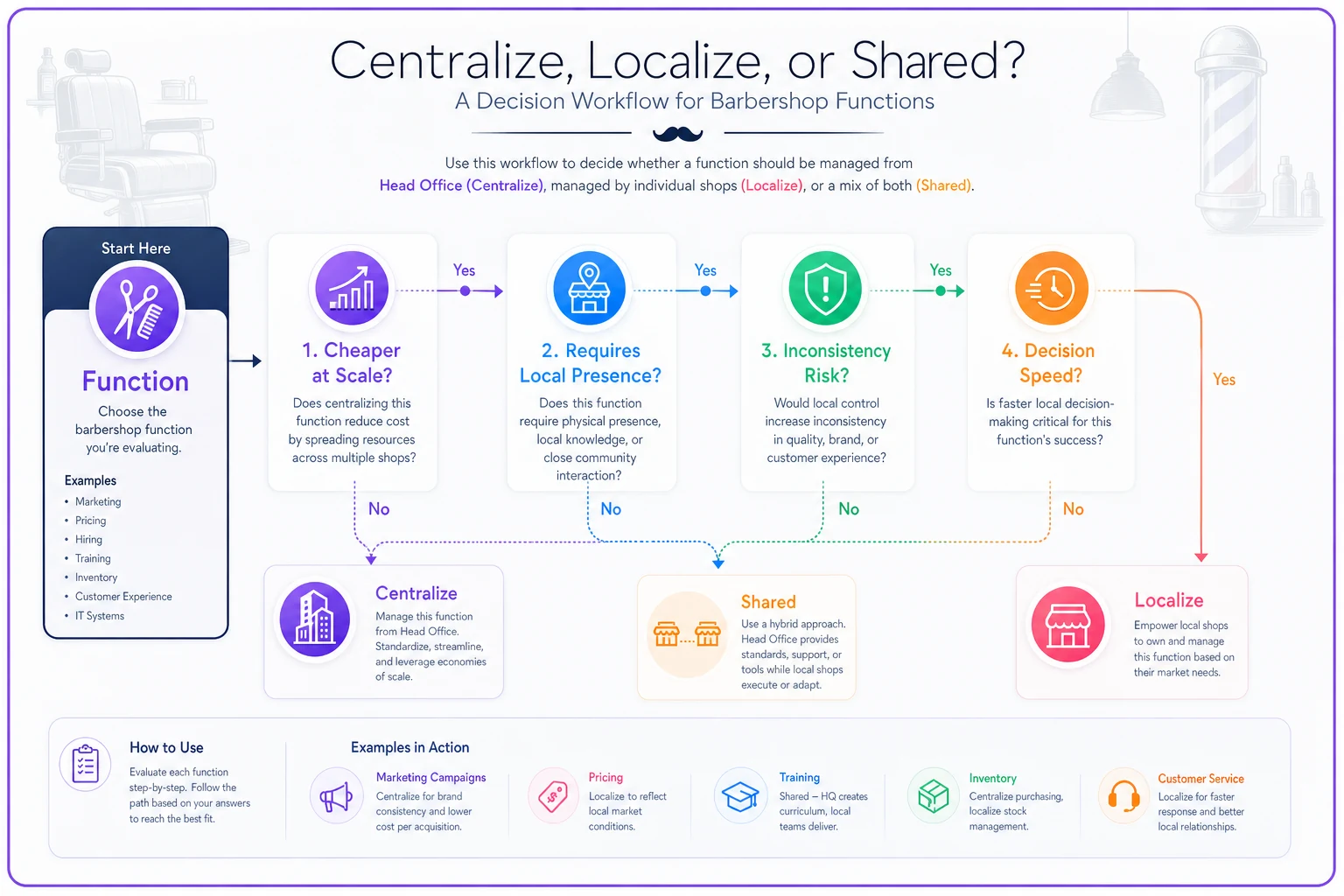
This flow visualizes how the four questions lead to a clear ownership decision for each function.
What breaks first when you scale
The numbers stop being comparable. Shop A counts product sales in service revenue. Shop B breaks them out. One manager expenses cleaning supplies as "misc," another as "shop supplies." Within a quarter you can't answer a basic question like "which shop has the best profit per chair?" This is why a shared reporting format has to exist before the second shop opens, not after.
Cash handling gets inconsistent. One shop reconciles daily, another "when it's busy." Small leaks turn into real money, and you have no baseline to spot them. A lot of this connects to the same discipline covered in building a proper foundation — the kind of thing laid out in building a barbershop operating system with roles, SOPs, and a 90-day roadmap. If the single-shop version of that isn't solid, the multi-shop version will be chaos.
Quality drifts silently. No one location wakes up bad. It erodes. A skipped consultation here, a rushed clean-down there. Without a common quality standard and someone whose job is to check it, you find out through a bad review three months late. This is exactly the gap a real audit system fills — worth reading the governance and audit approach for multi-location barbershops alongside this framework, because an operating model without QA is just a nicely drawn org chart.
Overhead outruns revenue. This is the quiet killer. You hire a central bookkeeper, a marketing person, maybe a district manager — but you've only got three shops carrying that cost. Allocate it wrong and one shop looks unprofitable on paper, the manager gets discouraged, and you make a bad call about a perfectly healthy location.
That last one is worth its own section.
Cost allocation: the part everyone gets wrong
Shared services cost money, and that money has to land somewhere on each shop's P&L. Do it arbitrarily and you'll poison the numbers you use to manage the business.
Three common methods, from crude to fair:
-
Even split. Divide central costs equally across shops. Simple, but punishes your smallest location and lets your biggest one under-pay for the support it consumes.
-
Revenue-based. Allocate central cost as a percentage of each shop's revenue. Better. A shop doing roughly $28k a month carries more of the bookkeeping cost than one doing $16k. This is the default most small groups should start with.
-
Usage-based. Allocate based on actual consumption — number of transactions bookkept, marketing spend per shop, headcount for HR support. Most accurate, most work to track. Worth it once you're past four or five locations.
A practical middle path: allocate marketing by where the spend goes, and allocate everything else (bookkeeping, admin, software, district oversight) as a flat percentage of revenue. Somewhere in the 6–9% range for combined central overhead is reasonable for a small group; if it's creeping toward 12%+, your central team is too heavy for your shop count.
Write your chosen allocation method in the operating manual and lock it for the year to avoid political disputes over P&L numbers.
One rule that saves a lot of arguments: whatever method you pick, write it down and don't change it mid-year. The moment allocation feels political — like head office is dumping cost on a shop the owner likes least — managers stop trusting the P&L, and a P&L nobody trusts is worthless.
A quick worked example
Say you run three shops. Combined monthly revenue is around $66k, split roughly $28k / $22k / $16k. Central overhead — a part-time bookkeeper, software subscriptions, and a portion of your own time as a district-level role — runs about $4,600 a month.
-
Under revenue-based allocation, that's roughly 7% of revenue. So
-
Shop 1 absorbs about $1,950
-
Shop 2 about $1,540
-
Shop 3 about $1,120
Now each shop's P&L reflects a fair slice of the support it gets, and you can compare true profit per chair on an even footing. If Shop 3 still clears a healthy margin after its $1,120 hit, it's a keeper. If it doesn't, you've learned something real instead of blaming an arbitrary even split.
Sample shared-services job descriptions
The functions you centralize need actual people accountable for them, with clear boundaries. Vague roles are how you end up with a "central team" that everyone blames and no one owns. Here are three roles most small groups need, described in plain terms.
Group Operations Lead (district manager, effectively) Owns consistency across shops. Runs the weekly numbers review, visits each location on a set cadence, checks quality against the standard, and is the escalation point for shop managers. Owns the reporting format and the audit calendar. Does not run day-to-day scheduling — that stays with shop managers. Typical comp for a small group: often a base plus a bonus tied to combined profit per chair, not just revenue.
Central Bookkeeper / Finance Admin Owns payroll processing, daily reconciliation review, supplier payments, and producing the per-location P&L on a fixed monthly close date. Enforces the chart of accounts so every shop codes expenses the same way. Flags variances — a shop whose product cost jumps from 8% to 13% of revenue gets a question, not a shrug. This is the role where standardized numbers actually get made or broken.
Brand & Marketing Coordinator Owns the brand assets, the group website, and the Google Business Profiles for every location. Manages central campaigns and sets the guardrails for what shops can and can't do locally. Distributes a local marketing budget and reviews what each shop spends it on. The line to hold: brand and platforms are central, but the local relationships and neighborhood knowledge stay with the shop manager.
For each role, write down three things explicitly: what they decide, what they only recommend, and what they must escalate. That single clarification prevents most turf wars.
A 12-month rollout for your first 3–5 shops
You don't build all of this at once. You sequence it so the plumbing exists before the water's turned on. Here's a realistic month-by-month path, assuming you're going from one shop to three-to-five over the year.
-
Months 1–2
Standardize the single shop.
Lock your chart of accounts, your reporting format, your cash-handling SOP, and your hiring standard in the shop you already have. You can't replicate a system you haven't defined. If you're not sure your first location is ready to be copied, the threshold checks in the profitable second-location expansion playbook are the honest gut-check to run first. -
Month 3
Build the P&L template and allocation rule.
Decide central vs. revenue-based allocation now, on paper, before there's a second shop to fight about it. -
Months 4–5
Open (or convert) shop two.
Run it on the exact reporting format and SOPs from shop one. Resist the urge to "customize" — you're testing whether the system copies. -
Month 6
First real comparison.
Produce side-by-side per-location P&Ls. This is your first honest look at whether the model holds. -
Months 7–8
Hire the first shared-services role.
Usually the bookkeeper/finance admin, because standardized numbers are the foundation everything else leans on. Start allocating that cost across both shops. -
Months 9–10
Open shop three.
Now you're validating that the system works with someone other than you running the reporting. -
Month 11
Add the operations lead cadence.
Even if that's still you wearing the hat, formalize the weekly review and the audit calendar. Layer in the QA discipline before quality has a chance to drift. -
Month 12
Review and decide on shops four and five.
With clean, comparable numbers and a working allocation model, expansion becomes a math decision instead of a gut bet.
The pattern here is deliberate: standardize, replicate, measure, then add central overhead only once the shop count justifies it. Hiring a full central team when you have two shops is how groups go broke looking organized.
A per-location P&L template you can copy
Every shop should report on the same lines, in the same order, every month. Here's a clean skeleton:
-
Revenue - Service revenue - Product/retail revenue - Membership/other
-
Direct costs - Barber compensation (wages + commission) - Product cost of goods
-
Gross profit (Revenue − Direct costs)
-
Shop operating costs - Rent & utilities - Supplies & consumables - Local marketing - Repairs & maintenance
-
Allocated central overhead (your chosen % of revenue)
-
Net profit
-
Key ratios - Profit per chair - Barber comp as % of revenue - Product cost as % of product revenue - Central allocation as % of revenue
The ratios at the bottom matter as much as the dollars. Profit per chair is the single best cross-shop comparison you have — it normalizes for size and tells you which locations are actually efficient versus just large.
Where the software layer quietly earns its keep
None of this framework requires fancy tools. But it does require the same data, formatted the same way, flowing off every shop's floor without someone manually re-typing it. That's where most small groups grind to a halt — the operations lead spends their week chasing spreadsheets instead of improving shops.
This is the practical case for running your locations on a shared operational platform rather than three disconnected systems. When booking, checkout, inventory triggers, and staff hours all live in one place across shops, the per-location P&L stops being a monthly archaeology project. AI-assisted reporting can flag the outliers automatically — the shop whose product margin slipped, the location whose no-show rate crept up — so your operations lead is reviewing exceptions instead of re-keying rows. The point isn't automation for its own sake; it's that a multi-location model only works if the numbers are trustworthy and current, and manual consolidation across shops is exactly where that trust dies.
When central ownership is actually a bad idea
A few honest counterpoints, because over-centralizing is as dangerous as the opposite.
Don't centralize scheduling. The person moving a shift needs to see the floor and know the barbers. Route that through head office and you'll be slower and worse at it.
Don't strip local marketing from good managers. A manager who's built relationships with the gym next door and the school down the street knows things a central coordinator never will. Give them a budget and guardrails, not a mandate.
Don't build a central team for two shops. If you can't cover shared services at under roughly 9% of revenue across your shop count, you're not big enough yet. Wear the hats a little longer.
And who shouldn't pursue a formal multi-location model at all yet? Anyone whose first shop isn't consistently profitable and documented. Copying a system that only works because you're personally holding it together just multiplies your dependence on yourself. Fix the first shop, write it down, then replicate.
The takeaway
A barbershop multi-location operating model isn't an org chart or a piece of software — it's a set of deliberate decisions about where authority lives, how shared cost gets split, and how you keep every shop reporting on the same honest yardstick. The groups that scale cleanly aren't the ones that centralize the most or the least. They're the ones that decided, function by function, who owns what — and then held that line as they grew. Do the framework first, hire the shared roles only when the numbers justify them, and let clean, comparable P&Ls make your expansion decisions for you.
Ready to elevate your barbershop operations?
Join 500+ barbershops using Trimzly to save time, reduce scheduling conflicts, and enhance client satisfaction.