


Most barbershops don't fail because the owner can't cut hair. They fail — or stall out, which is slower and more painful — because the business outgrows the systems holding it together. A shop that runs beautifully with one chair and a notebook turns into a chaotic mess at four chairs. A four-chair shop that finally gets its rhythm turns into a fire drill the second a second location opens.
The reason isn't complicated: every stage of growth needs a different operating foundation. The skills that got you to solo-profitable aren't the skills that keep a three-location group consistent. And the gap between stages is where owners burn cash, lose good barbers, and quietly wreck their margins.
This is a capability map, not a pep talk. The goal is to look across the five systems that actually run a barbershop — finance, operations, people, technology, and quality assurance — and define what each one needs to look like at Solo, Small (single location, multi-chair), and Multi (two or more locations). Then we'll cover the go/no-go gates: the concrete signals that tell you whether you're ready to move up, or whether moving up will break you.
One lens for the whole article: growth doesn't reward ambition, it rewards readiness. The owners who scale cleanly are the ones who built the artifacts for the next stage before they needed them.
Why "just hustle harder" stops working
At the solo level, you are the system. You hold the schedule in your head, you know every regular's name, you count the drawer at night, and you fix problems the second they appear because you're standing right there. This works — embarrassingly well, actually — which is exactly the trap.
What shows up again and again across shops is that owners mistake personal competence for operational capability. They are not the same thing. Personal competence means you can handle everything yourself. Operational capability means the business can handle things without you. Those are opposite muscles, and the second one is almost always underbuilt.
The breakage points are predictable. A solo barber adds two chairs and suddenly there's no shared definition of "clean station" or "how we handle a late client." A small shop opens location two and discovers the owner was personally the quality-control department, the hiring manager, the inventory system, and the cash-control process — all of it undocumented, all of it now split across two buildings the owner can't be in at once.
The thing that was invisible because you did it yourself becomes the thing that blows up when you stop.
The five systems, and what changes as you grow
Before the stage-by-stage breakdown, it helps to see how each system shifts in character across growth. The function stays the same. The way you deliver it changes completely.
Never miss a booking amidst the hustle.
Trimzly helps you schedule, confirm, and manage every client visit seamlessly.
- Unified appointment management
- Automated client reminders
- Optimized staff scheduling
No credit card required
| System | Solo | Small (1 location, 3–6 chairs) | Multi (2+ locations) |
|---|---|---|---|
| Finance | Personal + business blended, drawer counts | Separated books, weekly P&L, labor % tracked | Per-location P&L, consolidated reporting, covenant awareness |
| Operations | In your head | Written SOPs, defined roles, one calendar | Standardized playbook, location managers, central scheduling rules |
| People | Just you | Hiring process, pay structure, onboarding path | Manager layer, calibration across sites, career ladders |
| Technology | Booking app, phone | Integrated POS + booking + payroll, single client record | Multi-location software, role-based access, reporting rollups |
| QA | Your own eye | Service standards, redo tracking, feedback loop | Audit cadence, cross-location consistency checks |
The lesson from the table isn't the rows — it's the movement. Finance goes from counting to analyzing to comparing. People goes from you to a team to a system that makes teams. QA goes from your judgment to a written standard to an audit. If any one of these lags behind the others, it becomes the ceiling for the whole business.
Stage 1 — Solo: build the foundation you'll wish you had later
The mistake solo owners make is thinking documentation is premature. "Why write SOPs when it's just me?" Because the version of you that eventually scales is the version that already treats the business like it's bigger than it is.
You don't need heavy systems here. You need a small set of artifacts that create habits.
Artifacts required to leave the Solo stage cleanly:
-
A separate business bank account and card — no blending, ever
-
A simple weekly number
revenue, rough costs, what's left
-
A basic booking system that captures client contact info and service history (not just a calendar)
-
A written version of your own standards — how you consult, how you finish, how you handle a complaint
-
A cancellation and no-show policy that actually exists in writing
That last one matters more than people expect. A solo barber running 30–35 appointments a week who loses 3–4 to no-shows is bleeding around 10% of capacity with nothing to defend against it. Writing the policy down isn't bureaucracy — it's the first time you've treated your own time as inventory.
Treat your business bank card as the single source of truth for business expenses to avoid blended finances.
Go/no-go gate to move to Small: You're consistently booked past comfortable capacity — turning people away or stretching your days — your finances are clean enough to show a real number, and you can articulate your standards clearly enough that someone else could follow them. That last one is the one people skip. If you can't describe how you work, you can't hire someone to work like you.
Stage 2 — Small: the stage where undocumented businesses quietly break
This is the hardest transition, and the least respected. Going from one chair to four or five feels like "more of the same." It isn't. It's a different business wearing the same sign.
The moment you have other barbers, three things stop being automatic:
-
Consistency — clients now get different experiences depending on who they sit with.
-
Coordination — the schedule has to be managed, not just held in your head.
-
Cash control — money is handled by people who aren't you.
Each of these needs an artifact, not a conversation.
Finance artifacts at Small:
-
Monthly P&L with labor as a tracked percentage of revenue (if labor creeps past the low-to-mid 40s% without a matching jump in ticket, something's off)
-
A reconciliation routine — drawer, card processor, and booking system numbers should agree
-
Retail and service revenue tracked separately so you can see which barbers sell and which don't
Operations artifacts at Small:
-
Written SOPs for opening, closing, station setup, and client handoff
-
A single shared calendar with clear rules about who can book what
-
Defined roles — even if someone wears two hats, the hats are named
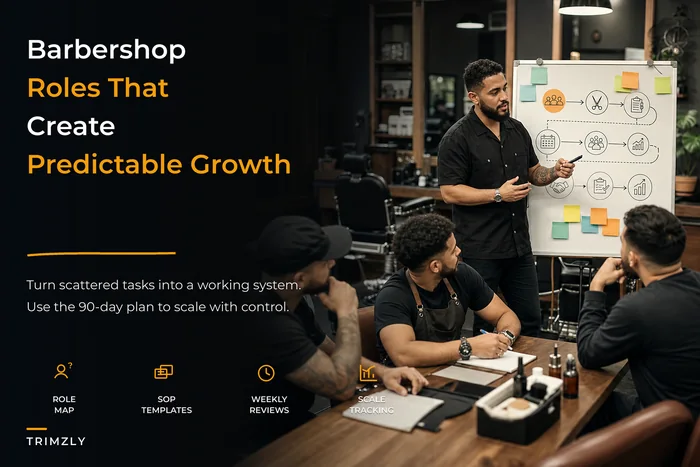
This is the stage where building an actual operating system pays off, and it's worth getting the structure right the first time. The roles, SOPs, and sequencing are laid out in detail in Build a barbershop operating system: roles, SOPs, and a 90-day roadmap to scale predictably — treat that as required reading before you add your third barber.
People artifacts at Small:
-
A repeatable hiring process (not "my buddy knows a guy")
-
A written pay structure everyone understands before they start
-
A basic onboarding path so a new barber is productive in weeks, not months
Technology artifacts at Small:
-
Booking, POS, and ideally payroll talking to each other
-
One client record that follows the client regardless of which barber they see
-
Automated appointment reminders — because manual texting dies the moment you're busy
QA artifacts at Small:
-
A written definition of "done" for your core services
-
Redo tracking — how often, by whom, why
-
Some channel for client feedback that you actually read
A realistic Small-stage scenario
Take a shop with four barbers running roughly 320–360 cuts a month. Before they wrote anything down, they had two recurring problems: inconsistent finishes (one barber's "fade" didn't match another's), and a drawer that came up short more often than it should have. Nobody was stealing — the money was just mishandled because there was no reconciliation habit.
They put in three things: a one-page service standard with photos, a daily reconciliation step at close, and a shared booking system with reminders. Within a couple of months, redos dropped noticeably, the drawer stopped being short, and no-shows fell by something like a third once reminders went out automatically. None of it was fancy. It was just the difference between a business that runs on habits and one that runs on hope.
Go/no-go gate to move to Multi: Your single location runs without you physically present for a full week and the numbers don't slip. Your SOPs are followed when you're not watching. Your finances produce a clean monthly P&L you trust. If the shop only works because you're in it, opening a second one doesn't double your business — it halves your attention and exposes every gap at once.
Stage 3 — Multi: where everything personal has to become a system
The brutal truth about the second location: it doesn't test your ambition, it tests your documentation. Everything you were personally holding together at one site now needs to run in a building you're not standing in.
The owners who struggle here almost always skipped the Small-stage artifacts and tried to scale on charisma. The ones who succeed built the operating foundation first and are now just replicating it.
What genuinely changes at Multi:
-
You need a manager layer. You cannot be the quality control, the schedule, and the cash authority across two buildings. Someone local has to own each site.
-
You need calibration — a way to make sure a cut at Location B meets the same standard as Location A. This is the single most common thing that drifts.
-
You need consolidated finance — per-location P&Ls plus a combined view, so you can tell whether location two is actually profitable or just quietly draining location one.
-
You need role-based technology — managers see their site, you see everything, barbers see their own book.
The full structural breakdown of running more than one site — reporting lines, central vs. local decisions, standardization — is covered in the Multi-location operating model for barbershops, which goes much deeper on how the org actually holds together once you're running multiple teams.
Multi-stage artifact checklist:
-
[ ] Standardized operations playbook (not site-specific SOPs that drift apart)
-
[ ] Named location manager with defined authority and accountability
-
[ ] Per-location and consolidated financial reporting
-
[ ] A calibration routine so service quality stays consistent across sites
-
[ ] An audit cadence — scheduled, not reactive
-
[ ] Role-based access in whatever software you run
-
[ ] A hiring and onboarding system that works without your personal involvement
-
[ ] Clear rules on what decisions are central vs. local
Minimum staffing and tech by stage
Solo: You plus a booking tool that stores client history. That's the whole stack. Resist the urge to over-tool.
Small: 3–6 barbers, optionally a part-time front desk once you're past four chairs. Tech: integrated booking, POS, automated reminders, one client database, payroll that isn't a spreadsheet nightmare.
Multi: A manager per location, a central or shared admin function for scheduling rules and reporting, and software that rolls up data across sites instead of forcing you to log into three separate accounts. The admin layer is the piece owners consistently under-invest in — they'll pay for chairs but not for the coordination that keeps the chairs profitable.
The prioritization problem: where limited money actually goes
Most owners don't have the cash to upgrade all five systems at once. So the real question isn't "what should I improve" — it's "what do I fix first with the money I have."
-
Fix anything leaking cash first. Short drawers, uncontrolled discounts, no cancellation policy. This is defense, and defense funds everything else.
-
Fix the thing that becomes a crisis at the next stage. If you're about to add barbers, SOPs and standards come before fancy marketing.
-
Fix coordination before you fix reach. More bookings into a broken schedule just means more unhappy clients.
-
Fix the single point of failure that is you. Every hour of work that only you can do is a ceiling on growth. Document it, then delegate it.
-
Then, and only then, invest in growth. Marketing, a second location, retail expansion.
The owners who get this backwards spend on a new sign and a bigger ad budget while their drawer is short and their barbers finish cuts five different ways. Growth on a broken foundation just scales the breakage.
When moving to the next stage is a bad idea
Not every shop should scale, and plenty of solid single-location businesses have been wrecked by a second location opened a year too early.
You should NOT move up a stage if:
-
Your current stage only works because you're personally present
-
Your finances can't produce a number you trust
-
You can't name your standards, let alone enforce them
-
Your best barbers are already stretched and unhappy
-
You're chasing growth to escape a cash problem rather than build on a strong one
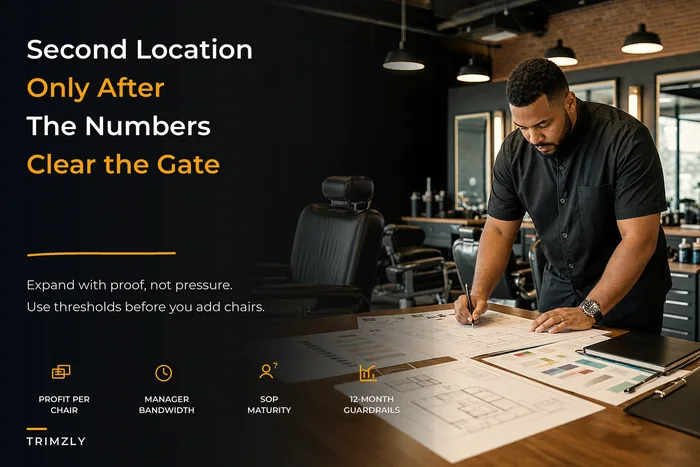
That last one is the quiet killer. Expansion is never a fix for a struggling location — it just adds a second struggling location and splits your attention. Before you even think about a second site, the threshold-based approach in Open a profitable second location: a threshold-based expansion playbook for barbershops lays out the specific financial and operational signals that say "ready" versus "wait." If you're not hitting those thresholds, the right move is almost always to deepen the business you have, not widen it.
How the systems connect — and why ignoring one caps all of them
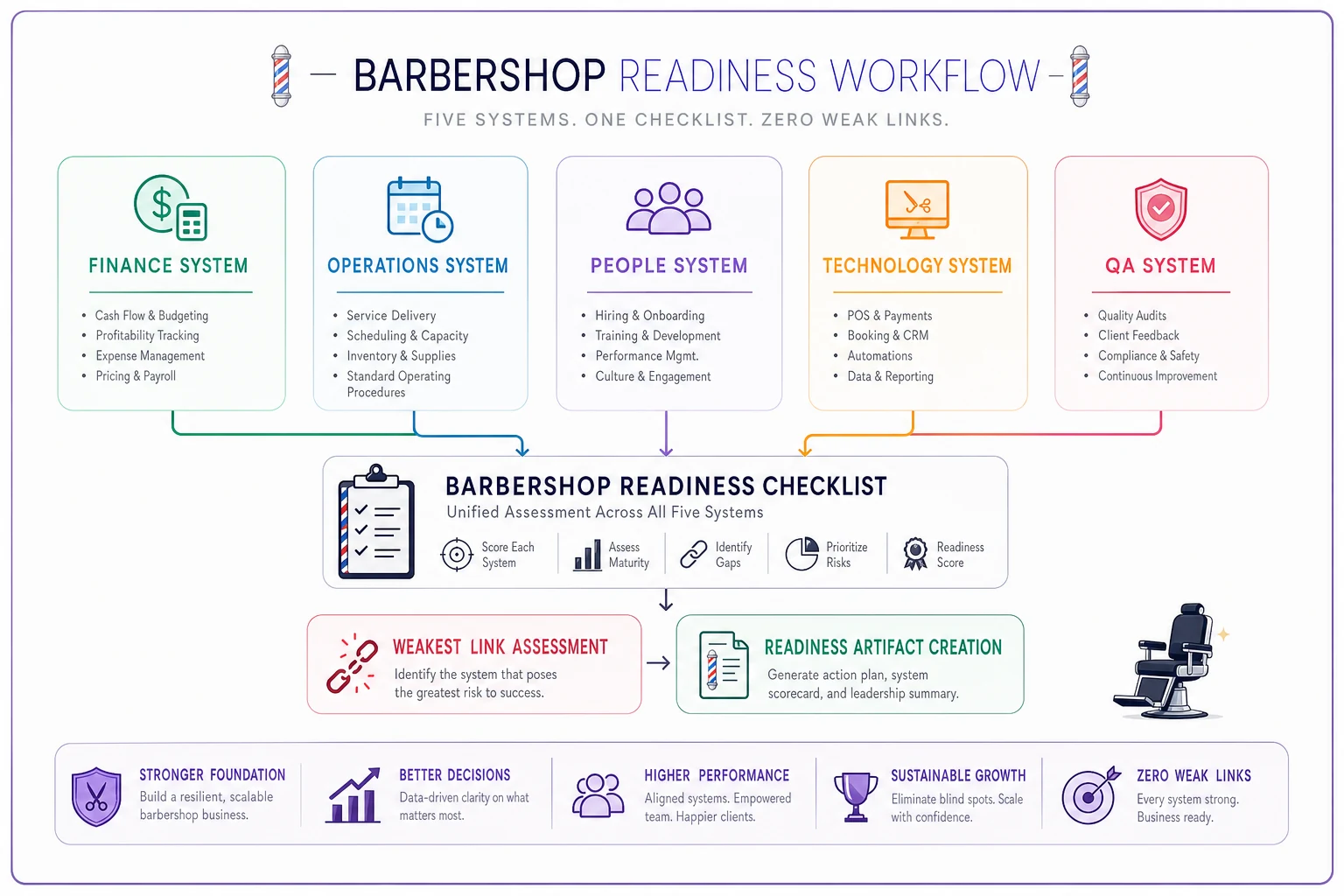
A stage map can accidentally hide the fact that these five systems aren't independent. They're a chain, and a chain caps at its weakest link.
Say your technology is solid — great booking, good POS, clean client records. But your people system is weak: no onboarding, no pay clarity, high turnover. Now your client database fills up with clients who keep getting assigned to barbers who quit three months in. The tech investment is wasted because the people system can't hold the relationships the tech was built to capture.
create an image depicting a workflow showing the five systems (finance, operations, people, technology, QA) feeding into a central readiness checklist, with arrows indicating weakest-link assessment and an artifact-creation step
Or flip it. Strong people, strong standards, but finance is a mess — no per-barber revenue tracking, no labor percentage, no reconciliation. You've got a talented, consistent team quietly running at a loss and you can't see it until a slow quarter exposes everything.
This is why the maturity model matters more than any single improvement. It's not a to-do list, it's a balance check. The goal at each stage is to keep all five systems roughly level, because the lowest one sets your real ceiling. A shop with world-class cutting and a nonexistent cash-control process isn't a world-class shop — it's a cash-control problem waiting to surface.
The owners who build real, durable barbershop businesses think in exactly these terms. They don't ask "how do I grow." They ask "which of my five systems is furthest behind, and what's the one artifact that would level it up." Answer that honestly, over and over, and the stages take care of themselves.
Where to start this week
Pick your current stage, look at the five systems, and find the one that's clearly weakest. Then build the single artifact that would move it — a written standard, a reconciliation habit, a real onboarding path, a client record that actually captures history.
Do that, re-check, and repeat. A barbershop operational maturity model isn't a document you fill out once. It's a lens you keep coming back to every time you feel the business straining against its own systems. The strain is the signal — it's telling you which stage you're actually in, and what you need to build before the next one arrives.
Ready to elevate your barbershop operations?
Join 500+ barbershops using Trimzly to save time, reduce scheduling conflicts, and enhance client satisfaction.