


Most barbershops don't have a pricing problem. They have a pricing governance problem.
The prices themselves are usually fine. The $35 cut, the $20 beard trim, the $15 add-on — those numbers rarely sink a shop. What sinks margins is the complete absence of rules around when those prices flex, who gets a discount, and what happens to a promo once it's live and quietly bleeding into your Saturday 11am slot that would've booked at full price anyway.
That's the gap this piece is about. Not "what should I charge" but the architecture underneath it — the guardrails, the decision tables, and the measurement rhythm that keeps a reasonable price list from turning into a leaky mess the moment you run a holiday special or a slow-Tuesday deal.
Why pricing quietly falls apart (even in well-run shops)
A shop opens with a clean, defensible menu. Over two or three years, pricing accumulates like clutter in a junk drawer. A barber starts giving "their regulars" a standing $5 off. Someone runs a Groupon that never really ended. The front desk waives the long-hair upcharge because arguing about it is annoying. A 15%-off text blast goes out during what turns out to be the busiest week of the quarter.
None of these decisions are crazy in isolation. Together, they form an invisible discount layer that nobody owns and nobody measures. The posted price becomes fiction. What actually hits the register is 8–12% lower, and the owner can't tell you why because there's no single place where pricing rules live.
The core issue is that pricing in most shops is reactive and local. It gets decided at the chair, in the moment, by whoever's standing there. There's no distinction between the shop's strategic price (what the menu says) and its operational price (what gets charged after all the informal adjustments). When those two drift apart, margin leaks and nobody feels the individual cut.
This is why barbershop pricing architecture is worth thinking about as a system rather than a number. A good architecture separates three things that usually get tangled:
-
The base menu — your anchor prices, rarely changed.
-
The flex layer — promos, discounts, occupancy-based adjustments, all governed by rules.
-
The measurement layer — how you check whether the flex layer helped or just gave away margin you'd have earned anyway.
Get those three separated and most pricing chaos resolves itself.
What promos actually do to a calendar
The biggest misunderstanding about promotions is that they create demand. Most of the time they don't. They shift it — and often shift it from a full-price slot to a discounted one.
Never miss a booking amidst the hustle.
Trimzly helps you schedule, confirm, and manage every client visit seamlessly.
- Unified appointment management
- Automated client reminders
- Optimized staff scheduling
No credit card required
Think about a typical week. Your demand isn't flat. It's lumpy — slammed Thursday evening through Saturday, soft Monday through Wednesday afternoon. A blanket 20%-off promo doesn't know the difference. It discounts the Saturday regular who was coming anyway and the Tuesday walk-in you actually wanted to pull in. The Tuesday fill is incremental revenue. The Saturday discount is pure cannibalization — margin you handed back for nothing.
That's the single most expensive mistake in barbershop promotions: running untargeted discounts against peak capacity. If your chairs are already going to fill on Saturday, a Saturday discount can only cost you money. The only promo that makes sense is one aimed at the troughs — the hours and days where an empty chair earns zero.
Generic "percent off everything" deals are usually the worst structure. They apply maximum discount to your highest-demand, highest-margin moments. A smarter architecture ties the availability of a discount to occupancy — so the deal only exists when there's genuinely idle capacity to fill. We'll get to the matrix for that below. If you want the deeper breakdown on structuring the offers themselves, the companion piece on promotions and gift-card rules that boost revenue without cannibalizing regular bookings goes into offer design; here we're focused on the governance around it.
Calendar guardrails: deciding where discounts are even allowed
Before you design a single promo, you need guardrails that answer one question: on this day, at this time, is discounting allowed at all?
The simplest version is a calendar overlay with three zones:
-
Protected zones — peak windows where no discount runs, period. Think Friday 3pm–7pm, all day Saturday, the two weeks before major holidays, back-to-school week, the days before a long weekend. These slots fill on their own. Discounting here is self-sabotage.
-
Flex zones — normal mid-demand hours where promos can run but only under occupancy rules (next section).
-
Fill zones — chronic soft spots. Monday mornings, Tuesday/Wednesday afternoons, the dead hour after lunch. This is where aggressive deals earn their keep because the alternative is an empty chair.
The discipline here is holding the protected zones even when a promo is tempting. A shop that "just this once" runs a holiday-week discount is usually discounting its single most profitable week of the year. Mark those weeks on the calendar in advance — ideally a full year out — so the temptation never becomes a judgment call in the moment.
Mark protected weeks on a shared calendar a year out to remove the need for in-the-moment decisions.
A quick test for whether a slot belongs in the protected zone: look at the same slot across the last 6–8 weeks. If it filled to 85%+ without any promotion, it's protected. If it's routinely below 60%, it's a fill zone. Everything in between is flex. This is a 30-minute exercise with your booking history and it should drive the whole calendar.
Occupancy-linked discount matrix
Instead of a flat discount, you tie the size of the discount to how full that slot is projected to be. The emptier the chair, the more you're willing to give up to fill it — because the baseline is zero.
Below is a simple working matrix for a fill/flex zone slot, with the logic for each tier. The key point is that on a strong week this barely triggers; on a genuinely slow one, it opens up exactly where you need it.
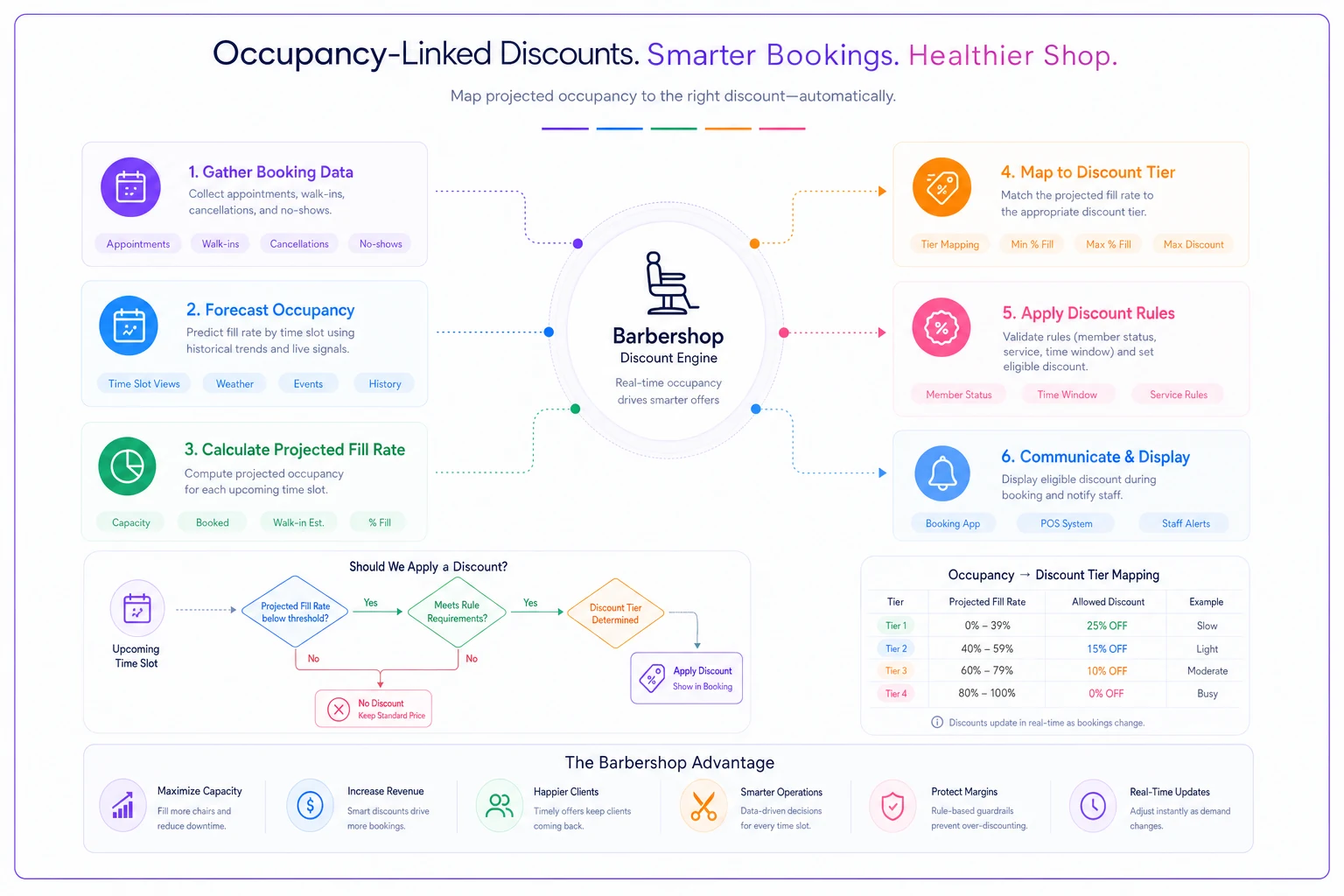
The graphic above shows how projected fill rate maps to allowed discount percentage and the decision steps for whether to apply a discount.
| Projected occupancy (72h out) | Discount allowed | Rationale |
|---|---|---|
| 85%+ | 0% | Slot fills itself. Protect margin. |
| 70–84% | 0–5% | Light nudge only, add-on bundles over price cuts |
| 50–69% | 10% | Real risk of idle chairs; moderate incentive |
| 30–49% | 15–20% | Aggressive fill; something beats nothing |
| Under 30% | Up to 25% + add-on | Deep soft spot; pull walk-ins and new clients |
One important refinement: never let the occupancy discount stack with a barber's informal discount or a loyalty perk. Pick one. Stacking is how a $35 cut quietly becomes a $22 cut, and the barber, the front desk, and the promo engine each think they only gave up "a little."
For the soft-spot slots that stay empty even with a discount, discounting isn't always the answer — sometimes it's a fulfillment problem, not a price problem. A tight waitlist SOP to fill last-minute openings will often fill a slot at full price faster than a discount would, and it should be the first lever you pull before you ever touch price.
Rollback rules: the part everyone skips
The most dangerous promo isn't the one that fails. It's the one that half-works and never ends.
Every discount needs a kill condition written down before it launches. Not a vague "we'll see how it goes" — an actual rule:
-
End date is hard. Every promo has a fixed expiry in the system, not a soft "until we remember to turn it off." Open-ended deals are how a 2019 Groupon is still being honored.
-
Cannibalization trigger. If more than roughly 40% of promo redemptions come from existing regulars who book monthly anyway, the promo is subsidizing loyal clients, not acquiring new ones. That's a rollback signal.
-
Peak-bleed trigger. If protected-zone slots start filling below their normal baseline during a promo, the discount is pulling people out of full-price windows into discounted ones. Kill it.
-
Margin floor. Set a minimum effective ticket. If the average post-discount ticket on a promo drops below your cost-to-serve plus a defined margin, it rolls back automatically regardless of volume.
The reason rollback rules matter more than launch rules: launching a promo is exciting and gets attention. Ending one is boring, nobody owns it, and the longer it runs the more it feels like a permanent entitlement to the clients using it. Writing the end condition on day one removes the awkward "are we still doing that deal?" conversation three months later.
A worked example: three shop archetypes, same promo, very different outcomes
The commuter shop (high weekday peak, dead weekends). Most of its volume is Tuesday–Friday after work. The blanket 15% hammers its best hours. On maybe 320 monthly cuts at a $34 average, the discount applies to a big chunk of already-booked regulars. Effective ticket drops to around $29, and the "new" bookings it generated were marginal. Net effect: roughly a $1,300–$1,600 margin hit for almost no incremental volume. This shop needed protected zones, not a promo.
The neighborhood shop (soft Mondays and midweek afternoons, solid weekends). The occupancy-linked version would've worked beautifully here — discounts only triggering in the soft midweek slots, protected weekends untouched. Run flat instead, it gives away weekend margin while the midweek fill it actually wanted was accidental. With the matrix applied, the same budget fills roughly 25–35 extra midweek cuts a month that would've been empty chairs, and weekend margin stays whole.
The premium/appointment shop (books out 10+ days, rarely has idle chairs). This shop should almost never discount. Its slots fill at full price. A 15%-off month here is close to pure margin donation — on a client base that was booking regardless. For this archetype, the entire flex layer should be near-zero, with any "deal" structured as an add-on or product bundle that raises ticket rather than cutting it.
Same promo. One shop loses money protecting nothing, one shop could win with proper targeting, and one shop should never have run it. The discount wasn't the variable that mattered — the architecture around it was.
The monthly measurement cadence owners can actually run
Pricing architecture that isn't measured decays back into the junk drawer within a quarter. The measurement doesn't need to be fancy. It needs to be monthly and consistent. Thirty to forty-five minutes, same questions every time.
-
Effective ticket vs. menu ticket. What's the gap between posted price and realized price? If it's widening month over month, the flex layer is leaking.
-
Discount source breakdown. What share of discounts came from governed promos vs. informal chair-side give-aways? The informal share should be shrinking.
-
Promo incrementality check. Of the clients who used a promo, how many were new or lapsed vs. active regulars? High regular share = cannibalization.
-
Protected-zone integrity. Did any discount sneak into a protected slot? If yes, how did it get through?
-
Fill-zone yield. Did your soft slots actually fill better in the months you ran targeted discounts there? If not, the problem was availability or marketing, not price.
This is where good booking and POS software earns its place quietly — not by "doing pricing" but by making these numbers pullable without a spreadsheet archaeology project. If you can't easily see effective ticket by slot, discount source, and occupancy at redemption, you're governing blind. The system's job is just to surface these five questions fast enough that you'll actually run the review every month instead of twice a year.
When tightening your pricing architecture makes sense — and when it doesn't
When it makes sense: You're running promos but can't tell if they work. Your realized ticket drifts below your menu and you don't know why. You have clear peak/trough patterns. You've got more than one barber giving informal discounts. Any of these, and the architecture pays for itself fast.
When it's overkill: A true solo operator with a loyal, stable book, no promotions, and a price list that hasn't changed in two years doesn't need an occupancy matrix. The whole apparatus assumes enough volume and variability that rules beat judgment. Below a certain scale, judgment is fine.
Who should NOT start here: If your menu itself is a mess — too many SKUs, unclear anchor prices, confusing upcharges — fix that before layering governance on top. Governance on a broken menu just automates the confusion. Getting the menu clean and the anchor prices right comes first; the companion piece on redesigning your service menu to raise average ticket and simplify bookings is the prerequisite step. Architecture is the second move, not the first.
Putting it together
Pricing architecture isn't about being clever with discounts. It's about building a few boring, durable rules so that your prices behave the way you intend even when you're not standing at the register.
The three layers — a stable base menu, a flex layer governed by calendar guardrails and occupancy rules, and a monthly measurement cadence — work together. The guardrails stop you from discounting demand you already had. The occupancy matrix sizes each discount to the actual value of filling that specific chair. The rollback rules make sure nothing lives past its usefulness. The monthly review keeps the whole thing from quietly decaying.
The shops that protect margin through peaks and promos aren't the ones with the lowest prices or the flashiest deals. They're the ones where someone decided, in advance and in writing, exactly when the shop is willing to give margin away — and when it absolutely isn't.
The shops that protect margin through peaks and promos aren't the ones with the lowest prices or the flashiest deals. They're the ones where someone decided, in advance and in writing, exactly when the shop is willing to give margin away — and when it absolutely isn't.
Ready to elevate your barbershop operations?
Join 500+ barbershops using Trimzly to save time, reduce scheduling conflicts, and enhance client satisfaction.