


Most barbershops don't have a revenue problem. They have a coordination problem. The chairs are busy, the reviews are decent, retail is moving okay — but when you actually sit down and calculate margin per chair, the numbers are all over the place. One chair clears $4,200 a month after everything. The chair right next to it, with a barber working the same hours, clears maybe $1,900. Same rent, same overhead, same walk-in traffic.
That gap is almost never about talent. It's about how pricing, scheduling, commission math, and inventory placement either reinforce each other or quietly work against each other. When they're disconnected — which is the default for most shops — you get leakage everywhere and no single number tells you where it's coming from.
This is what revenue operations actually means for a barbershop. Not a dashboard. Not another report. A loop — a set of rules that feed each other, reviewed on a fixed cadence, so every chair is being pushed toward the same unit of profit.
Why the pieces drift apart in the first place
There's a pattern that shows up constantly. A shop sets prices once — usually when it opens or when rent goes up. Schedules get built around who's available, not around demand. Commission splits get negotiated one barber at a time, often just to close a hire, so no two contracts actually match. Product sits wherever it fit on the shelf two years ago.
Each of those decisions was reasonable in isolation. The problem is they were made at different times, by different logic, and nobody ever connected them.
So you end up with situations like this: your best commission split — say 60/40 in the barber's favor — goes to someone who almost never sells product and books mostly $30 cuts during your slowest hours. Meanwhile your flat-rate chair barber crushes retail and books premium services at peak, and the shop captures almost none of that upside because the contract wasn't structured around any of it.
This usually happens because owners think about revenue in silos. Pricing is a marketing thing. Scheduling is an HR thing. Commissions are a hiring thing. RevOps collapses those silos into one question asked repeatedly: what is each chair contributing per hour, and which lever moves it?
The unit that holds everything together: margin per chair-hour
Before any of the rules make sense, you need one shared number. Not revenue. Not average ticket. Margin per chair-hour.
Never miss a booking amidst the hustle.
Trimzly helps you schedule, confirm, and manage every client visit seamlessly.
- Unified appointment management
- Automated client reminders
- Optimized staff scheduling
No credit card required
Revenue per chair hides cost. Average ticket hides utilization. Margin per chair-hour captures both — what the chair earns, minus the direct cost of earning it (barber pay, product cost, card fees), divided by the hours that chair was actually staffed and sellable.
A typical example:
| Chair | Monthly service rev | Retail rev | Barber cost (comm/rent) | Product + fees | Staffed sellable hrs | Margin/chair-hr |
|---|---|---|---|---|---|---|
| Chair 1 (commission) | $7,800 | $600 | $5,040 | $820 | 160 | ~$21 |
| Chair 2 (commission) | $5,200 | $120 | $3,192 | $410 | 160 | ~$11 |
| Chair 3 (rental) | $6,400 | $1,100 | $1,500 (rent) | $640 | 150 | ~$36 |
Look at Chair 3. Lower service revenue than Chair 1, but by far the most profitable chair in the shop — because the cost structure and retail attach line up. Without margin per chair-hour, you'd probably be celebrating Chair 1 and not thinking twice about Chair 3.
Once every chair is expressed in this number, the rest of the playbook has something to optimize against. Everything below is a set of rules that push this number up without burning out your team or alienating clients.
Rule set 1: Capacity-aware pricing
Static pricing is the single biggest margin leak in most shops. You charge the same $35 for a cut at 2pm on a dead Tuesday as you do at 6pm Friday when you're turning people away. At peak you're leaving money on the table. Off-peak, your chairs sit empty at full price instead of filling at a slight discount.
Capacity-aware pricing doesn't mean surge pricing that annoys regulars. It means a small, rule-based spread tied to demand:
-
Peak windows (your top 25% busiest hours)
standard or slightly premium rate. No discounts, no promos ever land here.
-
Shoulder windows (moderate demand)
standard rate.
-
Off-peak windows (bottom 25%)
this is where promos, new-client offers, and loyalty redemptions live.
The discipline that matters most: promotions are only allowed to touch off-peak capacity. The fastest way to destroy margin is running a 20%-off deal that your existing Friday-evening regulars happily use — you just discounted demand you already had.
If you want to build out the actual rate tiers and promo guardrails, your service menu design is where most of this starts. A cluttered menu makes capacity-aware pricing almost impossible to execute at the chair.
When this makes sense: shops running above roughly 70% peak utilization with visible off-peak dead zones. When it's a bad idea: a brand-new shop with low overall traffic — you don't have enough demand data yet, and you'll mostly just confuse people.
Rule set 2: Schedule templates built around demand, not availability
Most schedules are built backward. You ask who can work when, then slot them in. The result is that your highest-margin barbers often aren't staffed during your highest-margin hours.
A demand-first schedule template flips it. You map your week into those same peak/shoulder/off-peak bands, then staff them deliberately:
-
Identify your true peak hours from the last 8–12 weeks of booking data, not gut feel. Most shops are wrong about at least one of their peaks.
-
Assign your highest margin-per-chair-hour barbers to peak windows. This sounds obvious. Almost nobody does it.
-
Use off-peak for apprentices, ramp-up barbers, and lower-commission chairs — where the discounted pricing from Rule Set 1 can live without dragging down your premium slots.
-
Protect at least one "flex" chair that can absorb walk-ins and waitlist fills during peak. An empty chair at peak is the most expensive thing in your shop.
-
Lock the template for a month, then revisit in your monthly review. Constant reshuffling breaks the barbers' rebook rhythm.
The connection here is the whole point: the pricing bands and the schedule bands are the same bands. Your off-peak discount and your off-peak staffing are one decision, not two. For the mechanics of actually building these day plans, the chair-level scheduling framework has sample day layouts you can adapt.
One quiet mistake worth naming: owners often protect their favorite barbers' schedule preferences over margin. That's a human decision — fine to make — just know what it costs you and make it on purpose.
Protecting a single flex chair during known peaks is a low-cost way to prevent walk-in leakage and preserve peak margin.
The connection here is operational: schedules, pricing, and commission rules must be set to the same bands so behavior and availability align.
Rule set 3: Commission contracts keyed to attach rate
This is where most shops leave the most money, and it rarely gets talked about. Standard commission splits reward service revenue only. So a barber has zero financial reason to sell product, recommend upgrades, or push off-peak rebooking — the stuff that actually lifts chair margin.
Keying commission to attach rate changes the behavior. The structure that tends to work:
-
A base split on services (say 50%).
-
A retail attach bonus
elevated commission on product sales once a barber crosses a threshold attach rate — e.g., product attached to 15%+ of their cuts.
-
An upgrade/add-on tier
higher take on services like beard detail, gray blending, or scalp treatments that lift average ticket without adding much chair time.
A realistic worked example. A barber doing around 340 cuts a month at a 50% base. Flat, they might generate $250 in retail. Add a 25% product commission that only kicks in above a 15% attach rate, and most barbers will chase it. Get that barber to a 20% attach — selling $18 products on roughly 68 of those cuts — and you're looking at around $1,200 in retail, with real margin behind it, from a chair that was previously selling almost nothing.
The attach-rate retail system itself is a bigger topic. The retail and add-on revenue system covers how to actually drive attach at the chair, which is what makes the commission lever work in practice.
| Chair profile | Best contract type | Why |
|---|---|---|
| High-skill, high-demand, sells retail | Lower base + strong attach/add-on bonus | Rewards the behavior that lifts margin |
| Reliable but low retail interest | Flat chair rental | Caps your cost; upside is theirs |
| New/ramping barber | Higher base, no attach pressure yet | Let them build speed first |
| Part-time off-peak filler | Standard split, promo-eligible hours | Fills capacity you'd otherwise lose |
Who should NOT do this: if your attach-rate data is unreliable or you can't cleanly track product sales by barber, don't build commission around it yet. A bonus tied to a number you can't measure accurately causes more fights than it's worth.
Rule set 4: Inventory placement rules
Retail is part of RevOps, not a side project. And placement drives attach more than inventory depth does. Shops obsess over what to stock and completely ignore where it sits relative to the chair.
-
Everything a barber recommends should be within arm's reach of the chair, not across the room at the front desk. Attach happens in the 30 seconds after the cut, in the mirror — not at checkout.
-
Carry a tight core set that every barber actually uses and believes in. Twelve SKUs that move beat forty that gather dust and tie up cash.
-
Match placement to the commission structure. If you're paying attach bonuses on pomade, pomade needs to be the easiest thing in the shop to grab and demo.
-
Reorder on turns, not on empty shelves. Running out of your best attach product during a peak week is a direct hit to the margin you're trying to grow.
The pattern worth noticing: a shop can have a great retail incentive and still see weak attach because the product is physically inconvenient to sell. The broken lever isn't the commission — it's the floor plan.
Tying it together: the monthly RevOps review
None of this works as a one-time setup. It works as a loop. Once a month, same day, same agenda, you run a review that checks whether the four rule sets are still aligned and still pushing margin per chair-hour up.
The cadence:
-
Pull the numbers (first business day of the month)
margin per chair-hour for every chair, retail attach per barber, peak utilization, off-peak fill rate, no-show and empty-chair-at-peak count.
-
Flag the drift. Which chair dropped? Which barber's attach fell below threshold? Did a promo leak into peak? Is a high-margin barber stuck in off-peak slots?
-
Pick a maximum of two changes. This is the discipline most shops miss. Change everything at once and you can't tell what worked. One pricing tweak, one schedule adjustment — that's plenty for a month.
-
Write down the expected effect before you make the change. "Moving Chair 3's barber to Friday peak should add around $300/month in margin." This becomes your payback check next month.
-
Lock it and leave it for the month. Then measure against what you wrote down.
Your monthly review checklist:
Here's a simple visual of that monthly loop.
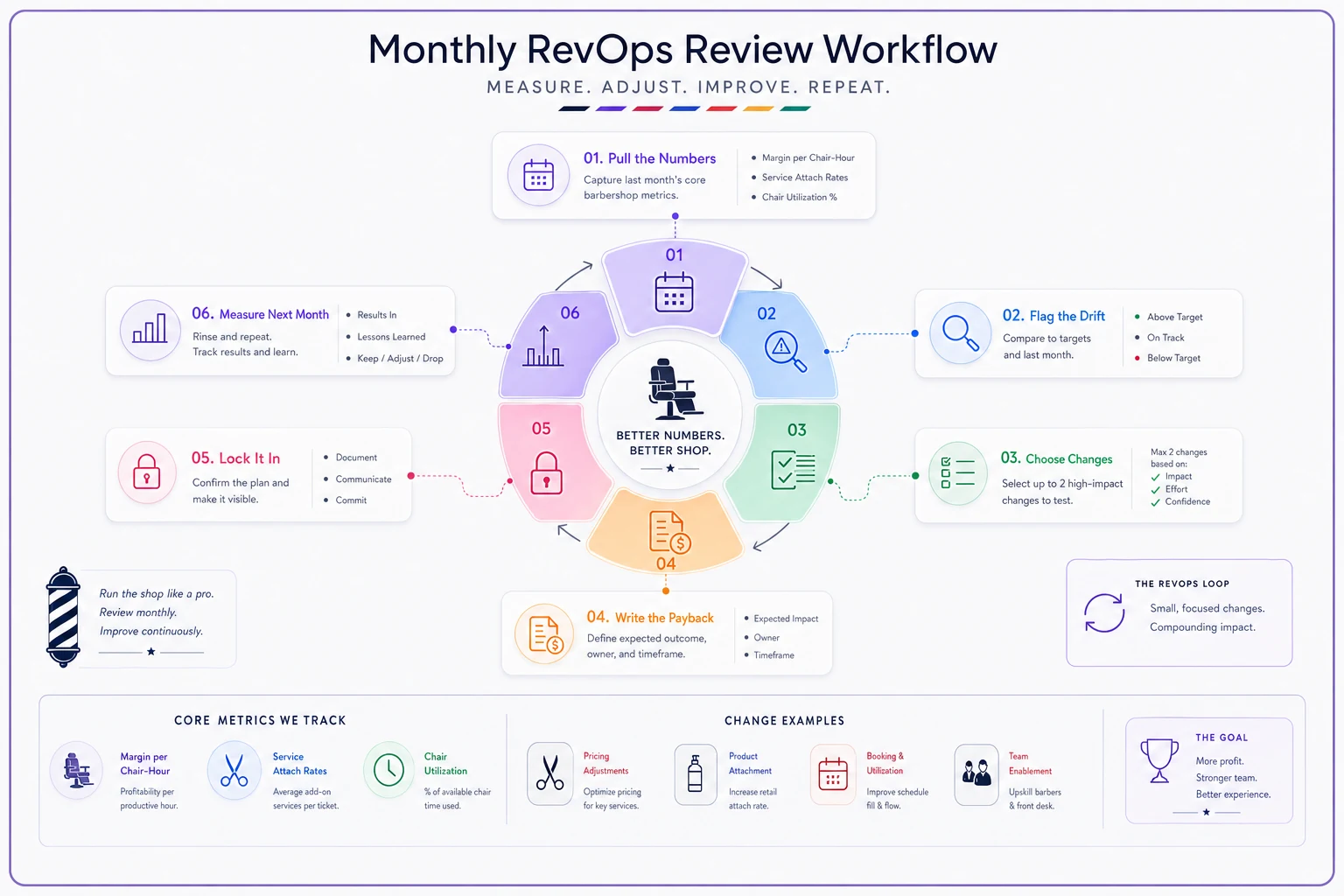
This diagram shows the monthly loop steps in sequence and how each step feeds the next.
-
[ ] Margin per chair-hour calculated for every chair
-
[ ] Retail attach rate pulled per barber vs. their commission threshold
-
[ ] Peak utilization and off-peak fill rate checked
-
[ ] Any promo that touched a peak window flagged and killed
-
[ ] Highest-margin barbers confirmed in highest-demand windows
-
[ ] Core retail SKUs in stock and within arm's reach of each chair
-
[ ] Two (max) changes selected, with written expected payback
-
[ ] Last month's changes measured against last month's prediction
The expected-payback step is what separates a RevOps loop from a "let's try this" shop. Over a few months you build a track record of which levers actually move your margin — and that number is worth more than any single tactic you'll read about.
A real scenario
A three-chair shop, around $42k/month in combined revenue, decent reviews, barbers mostly happy. On paper, fine. But two of the three chairs were clearing under $15/chair-hour.
Digging in: their strongest barber — great retail instincts, high demand — was scheduled Tuesday and Wednesday because those were his days. Their slowest retail barber held Friday/Saturday peak. Commissions were a flat 55% across all three chairs, so nobody had any reason to sell product; retail was under $400/month total. And a standing "$5 off any cut" sign in the window was getting used mostly by Saturday regulars who would've paid full price anyway.
-
Moved the high-retail barber onto Friday/Saturday peak; shifted the slower barber to shoulder and off-peak.
-
Killed the window discount at peak, kept a Tuesday–Wednesday new-client offer only.
-
Added a 25% retail commission above a 15% attach threshold.
After about ten weeks, shop retail went from roughly $400 to around $1,600 a month, the Saturday discount leak stopped, and the two weak chairs moved into the low-$20s per chair-hour. Combined monthly margin improved by somewhere in the $2,800–$3,200 range — not from working harder or raising base prices, but from getting the four levers pointed in the same direction.
None of those tactics were clever. The gain came from coordination and a monthly habit of checking it.
Where software quietly earns its keep
You can run this loop on a spreadsheet, and plenty of single-chair owners do. But the math gets painful fast once you have more than a couple of barbers — margin per chair-hour requires pulling service revenue, retail by barber, pay structure, and staffed hours from four different places every single month.
This is where an operational platform that already holds your bookings, sales, and pay data earns its cost: it surfaces margin per chair-hour and attach rates per barber without you rebuilding the report by hand each time. That's usually what kills the monthly cadence. The review only survives if pulling the numbers takes minutes, not an afternoon.
AI-assisted platforms go a step further — flagging when a promo touched a peak window, or when a barber's attach rate drops two months in a row, without you having to notice it manually. It's not magic, but removing that detection step makes it much easier to actually stay on the loop instead of letting it slide.
The takeaway for your shop
Chair margin doesn't improve because you found one clever pricing trick or one great retail product. It improves when pricing, scheduling, commissions, and inventory stop being four separate conversations and become one system reviewed on a fixed rhythm.
Start with the number — margin per chair-hour — because you can't align levers you can't measure. Then pick the one rule set that's most obviously broken in your shop. For most owners it's the schedule-to-demand mismatch or flat commissions that ignore attach. Fix that one, measure it, and only then move to the next.
The shops that pull ahead aren't the ones with the best single tactic. They're the ones running a boring, repeatable monthly loop that keeps every chair pointed at the same definition of profit.
Chair margin doesn't improve because you found one clever pricing trick or one great retail product. It improves when pricing, scheduling, commissions, and inventory stop being four separate conversations and become one system reviewed on a fixed rhythm.
Ready to elevate your barbershop operations?
Join 500+ barbershops using Trimzly to save time, reduce scheduling conflicts, and enhance client satisfaction.