

Most barbershop owners hit a wall somewhere between their second and fourth location. The shop runs fine. The barbers are good. But suddenly nobody knows who approves a schedule swap, why location 3 pays commission differently than location 1, or why the new hire at the newest shop got trained completely differently than everyone else.
That wall isn't a hiring problem or a management problem. It's a people operations problem — the invisible layer that decides how decisions get made, who owns them, and how consistency travels across shops that never see each other.
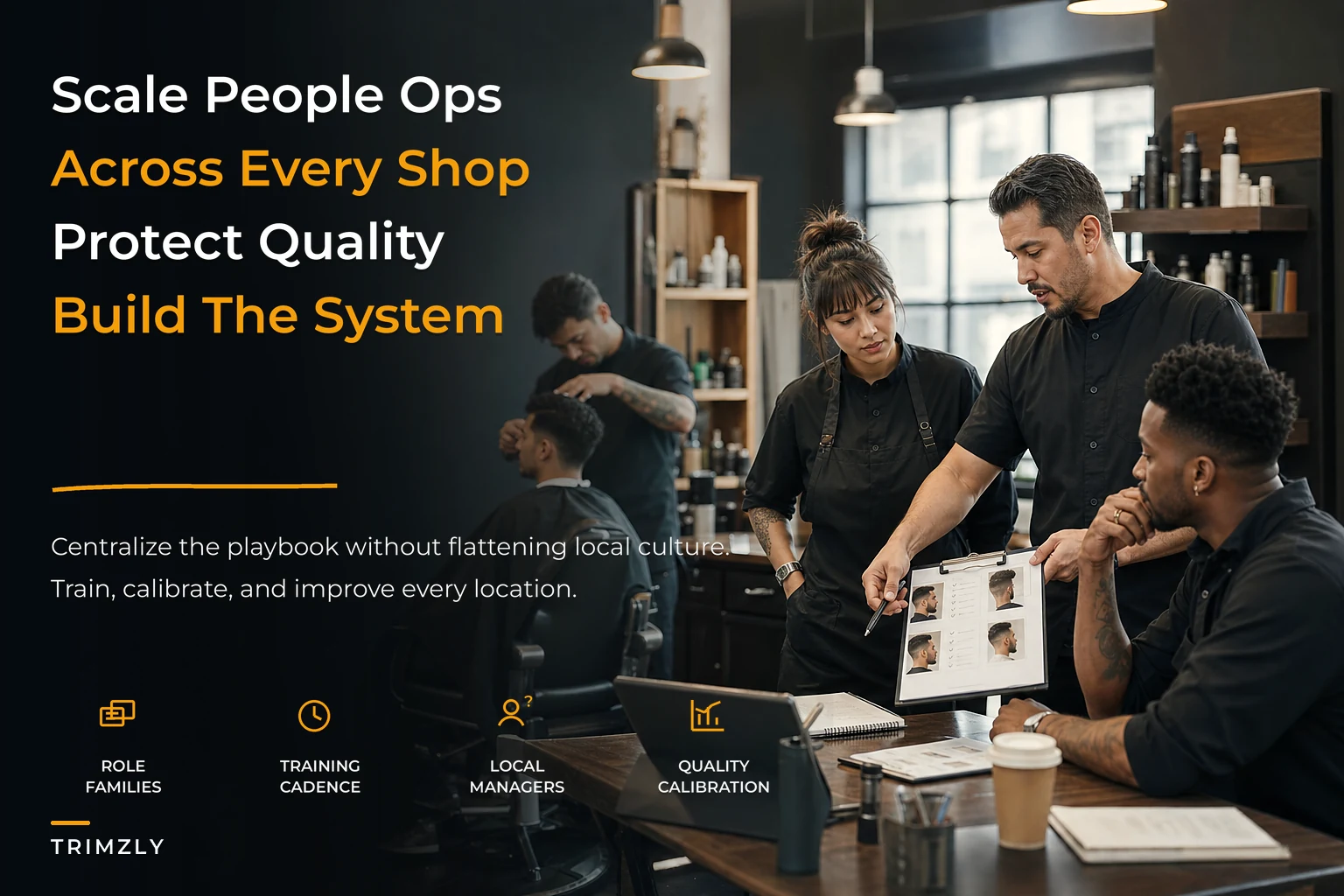
This is a playbook for running People Ops across a portfolio of shops without turning into a corporate machine that kills the culture that made the first shop work. Less about HR paperwork, more about designing the decision-making system underneath your people.
The real problem: decisions drift when nobody defines who owns them
When you have one shop, you make every people decision yourself. Hiring, pay, discipline, training, schedule exceptions — all of it lives in your head and gets decided on the fly. That works because you're physically there.
Add a second location and you start delegating, but you rarely define what you delegated. So a manager at shop 2 starts making judgment calls. Some are fine. Some quietly contradict how shop 1 operates. By shop 4, you have four slightly different companies wearing the same sign.
The drift is almost never dramatic. Nobody wakes up and decides to run their shop differently. It happens through hundreds of small, reasonable local decisions that were never anchored to a standard. A manager gives a top barber a better commission split to keep them. Another manager creates their own onboarding checklist because the "official" one didn't exist. Each choice makes sense locally and creates chaos at the portfolio level.
The fix isn't more control. It's clarity about which decisions belong to the center and which belong to the shop.
The central vs local decision matrix
The single most useful thing you can build is a decision matrix that answers one question for every people decision: who decides this?
Never miss a booking amidst the hustle.
Trimzly helps you schedule, confirm, and manage every client visit seamlessly.
- Unified appointment management
- Automated client reminders
- Optimized staff scheduling
No credit card required
The rule of thumb: standardize the things that protect quality, fairness, and brand — localize the things that require being in the room.
Pay structure, role definitions, and quality standards should be central. Daily scheduling, personality-based coaching, and shift-level judgment calls should be local. When you mix these up — localizing pay or centralizing daily scheduling — you get either inconsistency or bottlenecks.
Here's a working version of the matrix:
| Decision Area | Central (HQ/Owner) | Local (Shop Manager) | Why |
|---|---|---|---|
| Pay bands & commission structure | ✅ Owns | Recommends | Fairness across shops; prevents bidding wars |
| Role families & titles | ✅ Owns | — | Consistent career paths |
| Hiring standards & interview process | ✅ Owns framework | Runs interviews | Quality floor, local fit |
| Final hire approval | Approves offers above band | ✅ Approves within band | Speed without pay drift |
| Onboarding & training curriculum | ✅ Owns content | Delivers & schedules | Consistency of skill |
| Daily/weekly scheduling | Sets rules | ✅ Owns execution | Needs to be in the room |
| Coaching & performance conversations | Sets standards | ✅ Owns delivery | Relationship-driven |
| Discipline & terminations | ✅ Approves serious cases | Handles minor issues | Legal risk + fairness |
| Quality standards & QA rubric | ✅ Owns | Enforces | Brand consistency |
| Culture events, shop vibe | Guardrails only | ✅ Owns | Local energy matters |
Almost every good decision is shared — the center owns the framework, the shop owns the execution inside it. A manager can hire freely, but only within the pay band and against the hiring standard you set. That's the balance that lets you scale without micromanaging.
When central control is a bad idea
Some owners overcorrect and try to run everything from HQ. If a manager has to call you to approve a barber swapping a Tuesday shift, you've built a bottleneck that will strangle you at shop 5. Anything that needs to happen fast and depends on being physically present should stay local. Centralizing those decisions doesn't protect quality — it slows everyone down and signals to your managers that you don't trust them.
Role families: the backbone most shops skip
Before you can standardize pay or training, you need role families — a defined set of roles with clear levels underneath them. Most shops don't have this. They have a pile of individuals with informal titles that mean different things at different locations.
A "senior barber" at one shop might mean five years of experience. At another, it means "the guy who's been here longest." When those two shops share the same owner, that ambiguity turns into pay disputes and promotion confusion.
-
Barber track Apprentice → Junior Barber → Barber → Senior Barber → Master Barber
-
Leadership track Lead Barber → Shift Lead → Shop Manager → Regional Manager
-
Support track Front Desk → Front Desk Lead → Shop Coordinator
Each level needs three things defined: what skills unlock it, what it pays (a band, not a fixed number), and what responsibilities come with it. When those are consistent across every shop, a barber can transfer from location 2 to location 4 and everyone knows exactly what they earn and what's expected.
Define levels with a few measurable skill checkpoints so transfers and promotions are unambiguous.
Shops that define role families first find that pay standardization, training design, and QA almost fall into place. Shops that skip role families end up patching pay and training problems forever because there's no stable structure underneath.
Sample role description: Senior Barber
Here's the skeleton of what a real role description should contain — not a job ad, an internal operating definition:
-
Level Senior Barber (Barber track, level 4 of 5)
-
Unlocks at Consistent 85%+ rebook rate, average ticket in top third of shop, passes advanced technical calibration, 12+ months at Barber level
-
Pay band Commission tier 3 (specific % set centrally), plus retail commission
-
Owns Mentoring one apprentice, running consultations for complex/textured hair, upholding QA standards on their chair
-
Reviewed by Shop Manager quarterly, calibrated against portfolio rubric
Notice it ties skill, pay, and responsibility together. That linkage is what stops the "why does he make more than me" conversations that quietly poison multi-shop cultures.
Training hub design: build once, deliver everywhere
The most common training failure across portfolios is that every shop trains its own way. The founding shop has great tribal knowledge. The newer shops have nothing, so managers improvise. Six months later your newest location produces noticeably weaker haircuts and everyone blames "bad hires" when the real cause was inconsistent training.
A training hub solves this by centralizing the content while keeping delivery local. The center owns the curriculum, the checklists, the skill checkpoints, and the standards. The shop owns scheduling, hands-on delivery, and mentorship.
-
Onboarding (days 1–30) shop systems, tools, service menu, consultation process, front-desk flow. Same for every shop.
-
Technical progression skill modules mapped to role families, so a Junior Barber knows exactly what to master to reach the next level.
-
Recurring calibration ongoing sessions that keep experienced barbers aligned to the same quality bar.
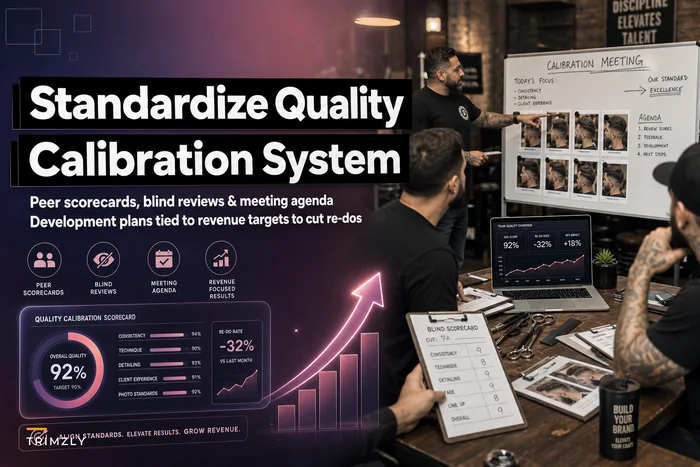
This connects directly to how you ramp new barbers and how you keep quality consistent. A lot of the underlying mechanics — checkpoints, mentorship pairing, and quality standardization — are covered in depth in our barber mentoring and calibration system to standardize quality. The training hub is essentially the portfolio-wide container that makes that mentoring repeatable across shops instead of dependent on whoever happens to be the strongest barber at each location.
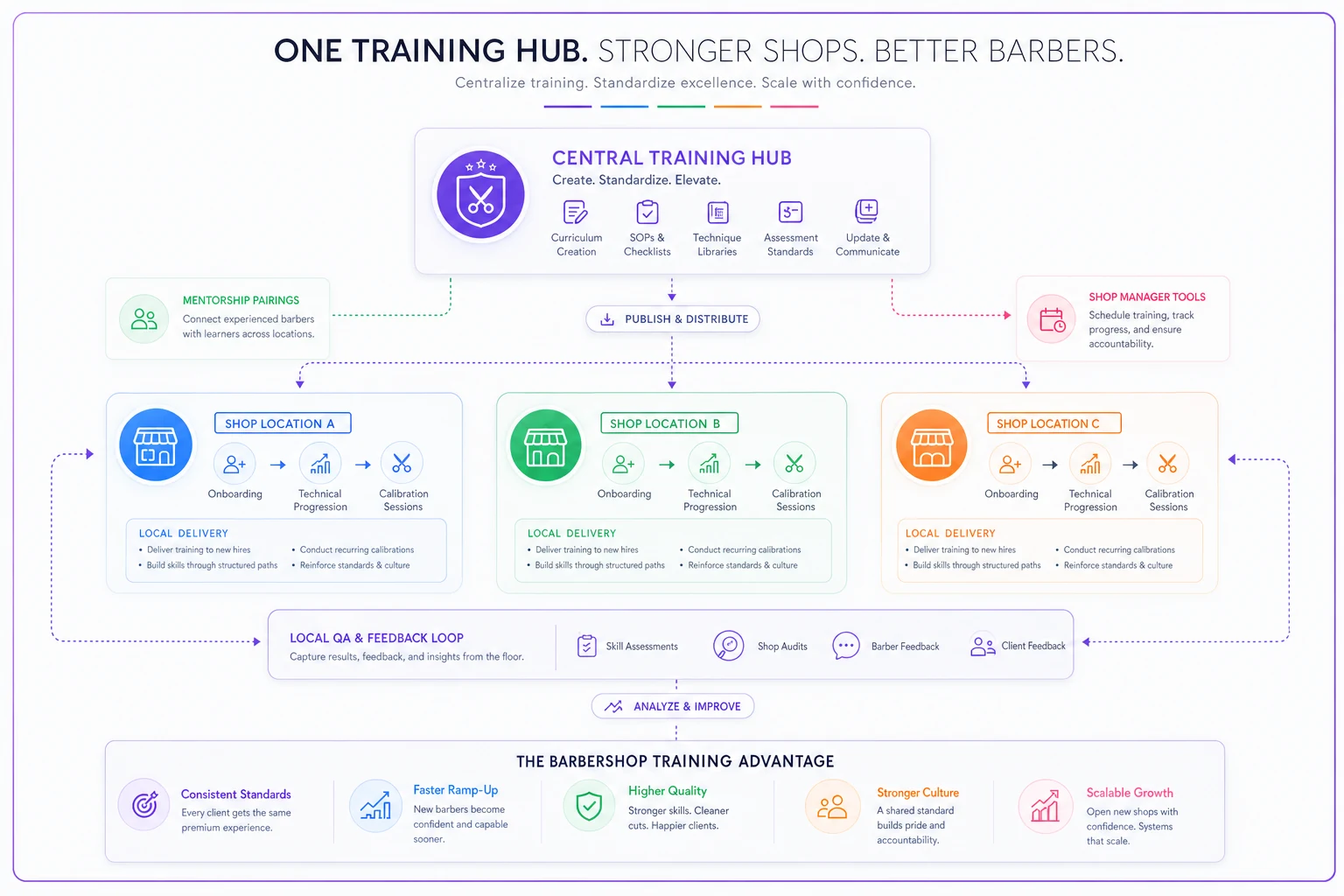
A quick visual of the hub can help managers see where content comes from and what they're responsible for delivering.
The thing most owners miss: training isn't a one-time event, it's a maintenance system. Skills drift. Standards slip. A senior barber who trained beautifully three years ago has slowly developed shortcuts. Without a recurring calibration cadence, your quality bar erodes silently — and you only notice when reviews start dropping.
Standardizing pay and commission across shops (the migration problem)
This is the section owners dread, and for good reason. Migrating multiple shops onto a standardized pay structure is the single highest-risk People Ops move, because you're touching how people feed their families. Do it clumsily and you'll lose your best barbers.
The problem is almost always inherited. You bought or opened shops at different times, made different deals to attract talent, and now you have people doing identical work for wildly different splits. Standardizing without a plan means someone's pay goes down — and that's how good barbers walk.
-
Map current reality. List every barber, their current effective take-home, and their structure. You need the true number, not the stated one.
-
Design the target bands tied to your role families. Every level gets a defined range.
-
Identify the gaps. Who's above band? Who's below? Above-band people are your risk.
-
Grandfather, don't cut. People above the new band keep their pay (often via a personal adjustment or "red circle" rate) but stop getting increases until the band catches up. Cutting active pay is the fastest way to trigger a walkout.
-
Migrate the below-band people up on a timeline — this is your goodwill move and usually cheap relative to the retention it buys.
-
Communicate individually. Group announcements about pay create panic. One-on-one conversations, tied to the role family and what it means for their future, land far better.
A realistic example: an owner with three shops found commission splits ranging from 40% to 58% for the same effective role. Standardizing to a clean tier system would've cut two top earners. Instead they grandfathered those two, brought four underpaid barbers up over a couple of months — costing somewhere around $1,800–$2,400 a month in additional pay — and eliminated the constant "why does she get more" tension. Turnover at the two lagging shops dropped noticeably over the following two quarters, which more than covered the raises.
Pay and hiring mistakes compound faster than almost anything else in a portfolio. If you want the deeper breakdown of where these structures go wrong at the individual-shop level, our post on common hiring and pay mistakes that drain barbershop profits covers the traps that make portfolio-wide migration painful in the first place.
Who should NOT standardize pay yet
If you only have two shops and they're already roughly aligned, don't over-engineer this. Building elaborate bands for six barbers is a waste of energy. Standardization pays off when inconsistency is actively causing turnover, disputes, or hiring confusion. Below that threshold, a simple documented commission structure is enough.
QA and calibration cadence: how consistency actually survives
You can standardize pay, roles, and training and still watch quality drift apart shop by shop. The missing piece is a recurring quality rhythm — a cadence of checks that catches drift before customers do.
-
Weekly (local) Shop manager reviews rebook rates, any complaints, and does a quick visual check on a few finished cuts.
-
Monthly (cross-shop) Managers compare numbers against each other — rebook rates, average ticket, review scores, redo rates. Outliers get flagged.
-
Quarterly (calibration) Senior barbers from every shop do the same technical exercise against the same rubric, so "excellent" means the same thing everywhere.
That quarterly calibration is the one most owners skip, and it's the most important. Without it, each shop slowly redefines "good" based on its own strongest barber. Calibration forces every location back to a single standard.
This whole governance layer — who audits what, how often, and what happens when a shop fails a check — is its own discipline. We go deep on the audit mechanics in don't scale without QA: a governance and audit system for multi-location barbershops, and the People Ops calibration cadence sits right on top of that governance system.
Governance checklist: is your People Ops actually ready to scale?
Before opening the next shop, run through this. If you can't check most of these, you're about to export chaos into a new location.
-
Role families defined with clear levels and skill requirements
-
Pay bands documented for every level, applied consistently
-
A written decision matrix (who decides what
central vs local)
-
Standardized onboarding that any shop can deliver identically
-
Technical training modules mapped to role progression
-
A QA rubric that defines "quality" in objective terms
-
A recurring calibration cadence on the calendar (not aspirational)
-
A pay migration plan for bringing new shops onto your structure
-
Documented process for discipline and terminations
-
One place where all of this actually lives (not scattered across texts and memory)
That last point quietly determines whether the rest survives. When role definitions live in one manager's head, training checklists live in a Google Doc nobody updates, and pay structures live in a spreadsheet only you can find, the system decays. Centralizing this into a single operational platform — where role families, training progress, calibration results, and pay bands are all visible in one place — is what lets you actually enforce consistency instead of hoping for it. The tooling matters less than the principle: one source of truth, accessible to the managers who need it.
A rollout template for standing up People Ops across shops
If you're starting from scattered, here's a sane sequence. Don't try to do all of it at once — you'll overwhelm your managers and stall.
-
Weeks 1–2 Draft role families and the central/local decision matrix. This is the foundation everything else hangs on.
-
Weeks 3–4 Map current pay reality across all shops and design target bands.
-
Weeks 5–6 Build the onboarding curriculum and get every manager delivering it the same way.
-
Weeks 7–8 Run individual pay migration conversations. Grandfather high earners, schedule raises for the underpaid.
-
Weeks 9–10 Stand up the QA rubric and run your first cross-shop calibration.
-
Ongoing Lock the cadence — weekly local checks, monthly comparisons, quarterly calibration.
The order matters. Owners who try to standardize pay before defining role families end up redoing the pay work, because the bands have nothing to attach to.
A real scenario
A four-shop operator had grown by acquisition and inherited three different ways of running people. Onboarding was informal, commission splits ranged all over the place, and the newest shop's reviews were noticeably weaker than the flagship's. The owner was spending most of their week refereeing pay disputes and putting out fires between managers.
They spent about two months building role families, a decision matrix, and a standardized onboarding flow. Pay migration was the hard part — two top barbers got grandfathered, five underpaid barbers got brought up over the quarter. A quarterly calibration got added to the calendar.
The outcome wasn't a dramatic revenue explosion. What changed was quieter and more valuable: the owner stopped being the bottleneck for people decisions. Managers knew what they owned. The weak shop's review scores climbed toward the others over two quarters. Turnover at the two problem locations dropped from a revolving door to something manageable. The owner got their week back — which was the whole point, because now they could actually think about opening shop five.
Bringing it together
People operations across a portfolio isn't about adding HR bureaucracy. It's about deciding, on purpose, which things must be identical everywhere and which things must stay local — and then building the structure that keeps those decisions from drifting.
The shops that scale well aren't the ones with the strictest control. They're the ones where the framework is clear enough that a good manager can make fast, correct decisions without calling the owner, and where "quality" and "fair pay" mean the same thing at every location. Get the role families, the decision matrix, the pay bands, and the calibration cadence right, and the culture that made your first shop work can actually travel to your fifth.
Ready to elevate your barbershop operations?
Join 500+ barbershops using Trimzly to save time, reduce scheduling conflicts, and enhance client satisfaction.