

Most barbershop menus grow the way a garage fills up. Nobody sits down and decides to offer 34 services. It happens one "yes" at a time — a client asks for a hot towel treatment, a new barber wants to bring over his beard sculpting regulars, someone runs a Groupon for a "gentleman's package," and three years later the online booking page looks like a diner menu that takes four pages to scroll through.
The problem isn't variety. The problem is that a bloated menu quietly taxes everything downstream: booking speed, scheduling accuracy, inventory, training, and margin. And because no single service on the list looks obviously bad, owners rarely cut anything. They just keep adding.
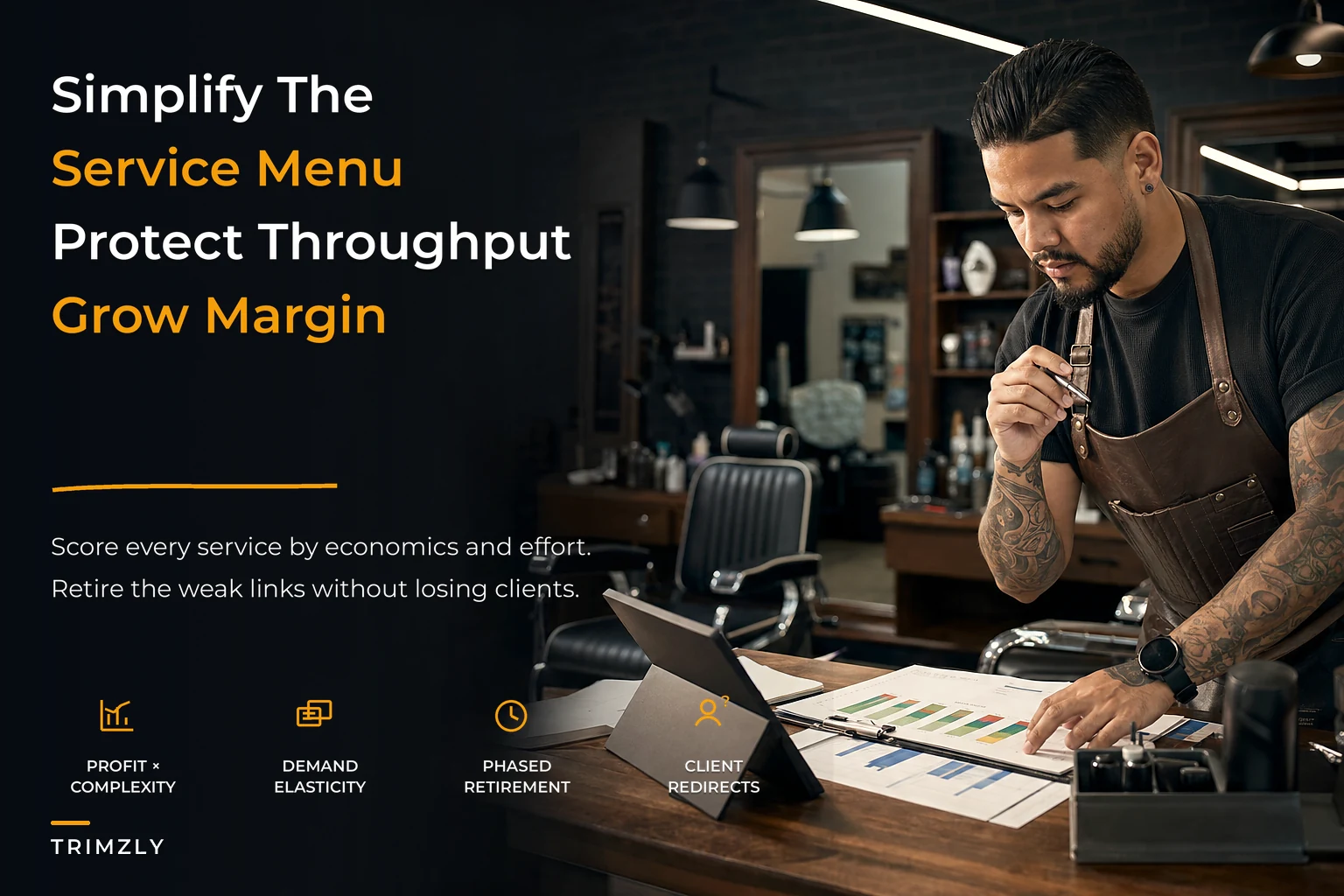
This is about the opposite discipline. How do you score every service you offer, decide what stays, what gets bundled, and what gets retired — without gutting revenue or annoying loyal clients in the process. A real barbershop service portfolio strategy isn't about having fewer options for the sake of "simplicity." It's about knowing exactly what each service does to your throughput and your margin, and shaping the menu around that.
Why menus bloat — and what it actually costs you
Every service you add creates hidden operational drag that never shows up on a single line item.
Take a "signature grooming experience" that runs 55 minutes and prices at $65. On paper it looks like a premium winner. But it books awkwardly against your 30- and 45-minute slots, so it leaves dead gaps in the calendar. It needs three products most of your barbers use twice a month, so those products sit and expire. New barbers can't perform it until month four, so it clogs your senior chairs during peak hours. And clients who book it once often don't rebook because it's expensive and slow.
Now multiply that by six or seven services like it.
-
Cognitive load at booking. More options means slower decisions, more "which one do I pick?" confusion, and more mis-bookings where the client picks a 30-minute service for a job that needs 50.
-
Scheduling friction. Odd service durations fragment the day. A single 55-minute service wedged between 30-minute cuts can waste 15–20 minutes of chair time it never gets credited for.
-
Training and consistency debt. Every service is something a new barber has to learn, and something a client can be disappointed by if it's done inconsistently.
The damage is rarely in any single service. It's in the combinations — the way a long, low-frequency service sits next to your bread-and-butter cuts and makes the whole schedule harder to pack. Complexity compounds. A menu with 12 services and a menu with 30 services don't cost the same to run per booking, even if the average ticket looks similar.
The scorecard: profitability × complexity × elasticity
Instead of arguing about which services "feel" important, score each one on three axes. Keep it simple — a 1 to 5 scale on each is plenty. You're not trying to be precise to the decimal, you're trying to separate the winners from the passengers.
Never miss a booking amidst the hustle.
Trimzly helps you schedule, confirm, and manage every client visit seamlessly.
- Unified appointment management
- Automated client reminders
- Optimized staff scheduling
No credit card required
Profitability — margin per booked hour, not per service. This matters. A $30 cut that takes 25 minutes often beats a $60 service that takes an hour once you account for product cost and the fact that you can do more of them.
Complexity — how hard is it to schedule, staff, and deliver consistently. Long duration, special products, senior-barber-only, high re-do risk — all push complexity up.
Elasticity — how sensitive demand is to price and how "attached" clients are. A standard men's cut is inelastic; people need it on a cycle and won't shop hard on a few dollars. A one-off luxury add-on is highly elastic — demand drops fast when you raise the price or when money's tight.
| Service | Profitability (1–5) | Complexity (1–5) | Elasticity (1–5, low=sticky) | Verdict |
|---|---|---|---|---|
| Standard men's cut | 5 | 1 | 1 | Core — protect it |
| Cut + beard trim combo | 5 | 2 | 2 | Core — promote |
| Skin fade | 4 | 3 | 2 | Keep, price for time |
| Kids cut | 3 | 2 | 3 | Keep, off-peak only |
| Hot towel shave | 3 | 4 | 4 | Bundle candidate |
| Signature grooming experience | 2 | 5 | 5 | Retire or repackage |
| Scalp treatment add-on | 2 | 3 | 4 | Bundle or add-on only |
| Color/gray blending | 4 | 4 | 3 | Keep as specialty, senior only |
The pattern almost always looks like this: two or three services carry the shop, a middle band is fine, and a long tail of low-frequency, high-complexity, high-elasticity services is silently costing you throughput. That long tail is where the whole exercise pays off.
One thing worth flagging — don't confuse low volume with low value. Some specialty work, like color correction or textured-hair services, may book less often but retain high-value clients and differentiate you. Those stay. The retirement conversation is about services that are low volume and high complexity and easily substituted. If you're serving diverse hair textures, that's a deliberate strategic capability, not menu clutter — we covered how to build that out properly in the inclusive services playbook for diverse hair textures.
Bundling rules that raise ticket without adding complexity
Bundling is the move that lets you kill menu clutter and protect revenue at the same time. Done right, you take three separate line items that each caused booking friction and turn them into one clean, sellable service.
-
Bundle around a single time block. A bundle should fit one clean slot (say 45 minutes), not create a new odd duration. If the cut + beard + hot towel doesn't fit a slot you already schedule, redesign it until it does.
-
The anchor must be a core service. Bundle add-ons onto something clients already buy on a cycle. Never build a bundle around an elastic, one-off service — you'll just sell it once.
-
Price the bundle below the sum, above the anchor. If the cut is $30 and the beard trim is $15, don't price the combo at $45 (no reason to book it) or $30 (you're giving away the trim). Land it around $38–$40. Clients feel the deal; you protect margin.
-
Cap the number of bundles at three. Two or three named packages — "The Regular," "The Full Service," "The Reset" — beat eight. More bundles just recreates the clutter problem inside the bundle section.
Price bundles so staff incentives align with the anchor service and avoid creating new odd time blocks.
A well-built bundle does something subtle to your scheduling too: it standardizes durations. When 60% of your bookings fall into three predictable time blocks, the calendar packs itself and dead gaps shrink. That throughput gain is often worth more than the ticket bump.
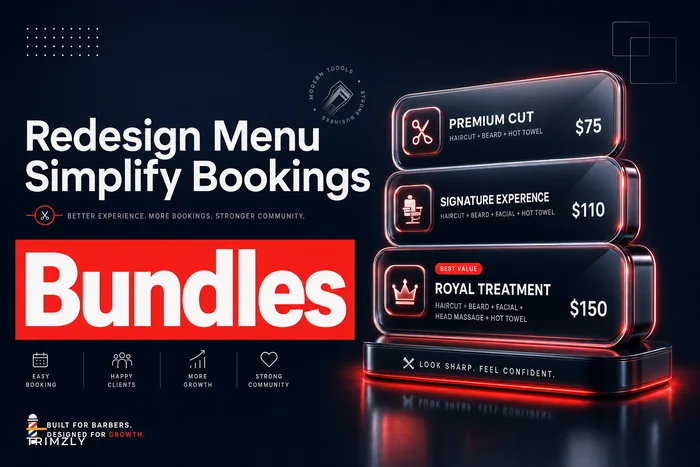
If you're rethinking bundles, it's worth doing it alongside a full menu rework rather than in isolation — the mechanics of restructuring the menu to raise ticket and simplify booking are laid out in redesign your service menu to raise average ticket and simplify bookings.
Trade-offs by shop archetype
There's no universal right menu. The correct portfolio depends on what your shop is actually optimizing for. Three common archetypes, and how the scorecard shifts:
The high-volume neighborhood shop. Throughput is everything. These shops live and die on chair turns. The portfolio should be tight — maybe 6–8 services, mostly cuts and quick add-ons, all built around 30-minute blocks. Anything scoring high on complexity gets cut ruthlessly, even if it's profitable per booking, because it fragments the day. A single 55-minute service can cost two shorter cuts' worth of chair time.
The premium/experience shop. Margin per client outweighs raw volume. This is the one shop type where a longer, higher-complexity service can earn its place — because the whole positioning is built on it. But even here, the menu shouldn't sprawl. Three or four well-defined experiences beat a dozen. Complexity is acceptable; inconsistency is not, which means fewer services done flawlessly.
The mixed shop growing toward multi-chair. This is where menus bloat the worst, because each new barber brings their own specialties. The discipline here is a shared, scored menu that everyone works from — not a personal menu per chair. Otherwise your booking system becomes unmanageable and no two barbers deliver the "same" service the same way.
The insight across all three: your archetype tells you which axis of the scorecard to weight hardest. Volume shops weight complexity. Premium shops weight profitability and consistency. Growing shops weight standardization.
A real scenario: cutting the menu without losing revenue
A two-chair shop in a mid-size suburb had drifted to 21 bookable services. Average ticket sat around $34, and the calendar was constantly leaking 10–15 minute gaps because six of those services had durations that didn't fit the standard slots.
They scored the menu. Nine services fell into the low-profit, high-complexity, high-elasticity corner. Instead of deleting them outright, they:
-
Retired four outright (the ones with near-zero monthly bookings).
-
Folded three add-ons into two bundles anchored on the standard cut.
-
Kept two specialty services but moved them to senior-barber-only, off-peak slots.
Over the following few months, the menu dropped to 11 services. Average ticket moved up to roughly $39–$41 — the bundles did most of that lifting. The bigger win was chair utilization: the day now packed into predictable blocks and dead gaps shrank noticeably. Monthly bookings actually ticked up slightly, because the booking page got faster to navigate and fewer clients mis-booked short slots for long jobs. No revenue was lost. It grew, on fewer services.
They didn't add a single new service or raise a single base price. They just removed friction and let the calendar breathe.
The phased retirement playbook
Killing a service is where owners get nervous, because they picture a loyal client showing up for something that's gone. That fear keeps dead weight on the menu for years. The fix is to retire in stages, not overnight.
-
Hide, don't delete (weeks 1–2). Remove the service from online booking so no new bookings come in, but keep honoring it for anyone who asks. This immediately stops the fragmentation without any client feeling cut off.
-
Watch the tail (weeks 3–6). See who actually still requests it. Usually it's a small, identifiable group — often fewer people than you feared. Now you know exactly who you need to communicate with.
-
Personal redirect (weeks 6–8). Reach out to that specific group and offer the closest bundle or replacement, often with a small transition incentive. This is a personal message, not a mass blast.
-
Full retirement (week 8+). Remove it entirely, update your intake and any style-history notes, and retrain barbers on what to recommend when someone asks for the old service.
Phasing matters because it converts a scary all-at-once cut into a quiet, managed wind-down. Most services die without a single complaint when handled this way.
A quick visual of the phased retirement workflow:
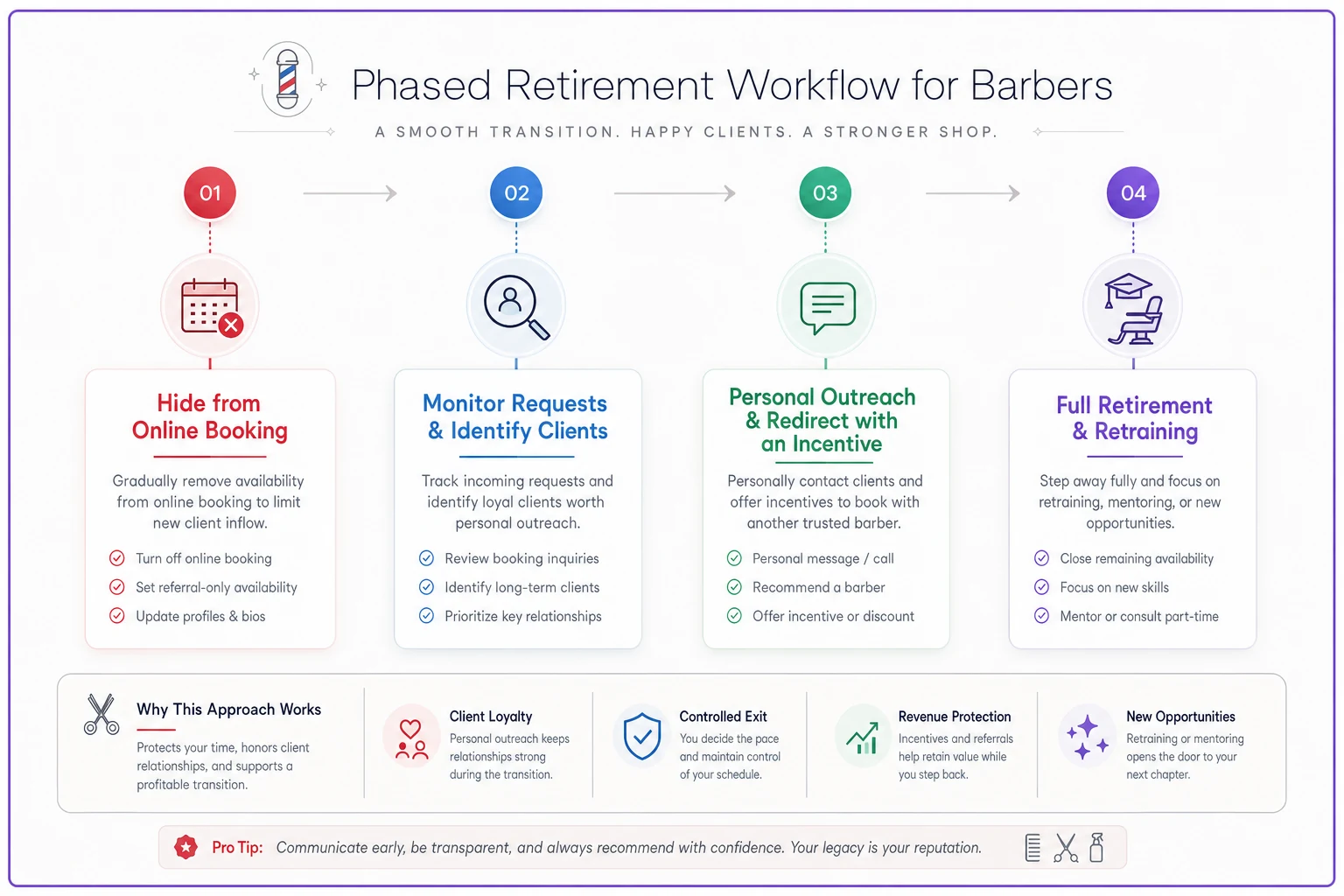
Most services die without a single complaint when handled this way.
Client communication templates
> "We've streamlined our menu to get you in and out faster with more consistent results. Your usual cut is still here — plus we've bundled a few favorites so you get more value in one visit. See the new menu when you book."
> "Hey [name] — quick heads up, we've retired [old service] and rolled the best parts of it into [new bundle], which most clients actually prefer. Next time you're in, we'll set you up with it and take [small incentive] off your first one. Sound good?"
Both frame the change as an upgrade, never as a loss. Clients don't grieve a service they never think about by name. They just want a good cut and a fast booking.
Keeping the portfolio honest as you scale
A scored menu isn't a one-time project. Services creep back in the same way they always did — one barber's specialty, one seasonal promo that never got removed, one add-on a supplier pushed. Left alone, you'll be back at 30 services in two years.
The practical habit: re-score the full menu once or twice a year, and never add a new service without scoring it first. If a proposed service can't clear a minimum bar on profitability and can't fit an existing time block, it doesn't go on the menu — it stays an off-menu, by-request-only offering until it proves demand.
This is also where your booking and reporting setup earns its keep. If your system tracks bookings, durations, and revenue per service, the scorecard basically fills itself in — you're reading real numbers instead of guessing which services pull their weight. If you're still working off a paper book or a tool that doesn't break revenue down by service, that's the first fix, because you can't score what you can't see. Clean per-service data is what turns this from a gut-feel exercise into something you can actually repeat.
The last connection worth making: your menu shapes the very first impression a new client gets. A tight, fast, confident menu converts walk-ins and first-timers better than a sprawling one — and that flows directly into retention. If menu design is one lever, onboarding those first-timers into regulars is the next, and the two work together in the client-lifecycle system for turning walk-ins into lifetime customers.
The takeaway
A great menu isn't the one with the most options. It's the one where every service earns its slot on the calendar. Score what you offer, bundle what belongs together, retire the long tail in stages, and re-check it on a schedule. Do that, and you get a rare combination in this business — a shop that's simpler to run and makes more per chair. The complexity you strip out doesn't come back as lost revenue. It comes back as time, consistency, and margin.
Ready to elevate your barbershop operations?
Join 500+ barbershops using Trimzly to save time, reduce scheduling conflicts, and enhance client satisfaction.