


Barber mentoring and calibration system to standardize quality
Peer-scorecard template, monthly calibration meeting agenda, and individual development plans tied to revenue targets so owners can standardize quality and reduce re-dos.

Effective barbershop management tips, scheduling best practices, client retention strategies, revenue growth insights, AI-driven operational tools, and expert advice tailored for modern barbershop owners and teams.
Peer-scorecard template, monthly calibration meeting agenda, and individual development plans tied to revenue targets so owners can standardize quality and reduce re-dos.
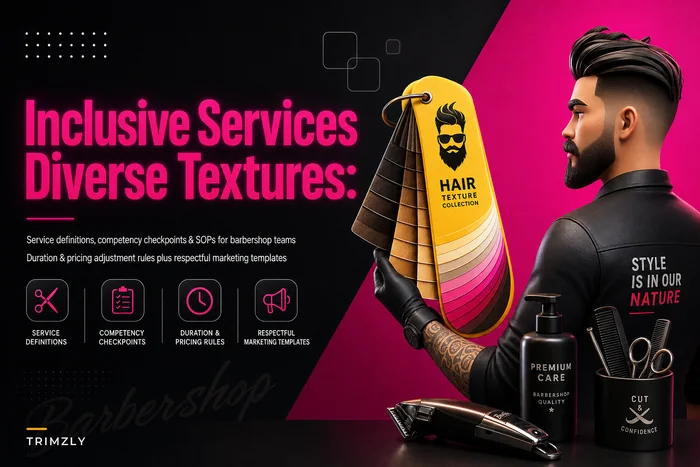
Service definitions by hair type, competency checkpoints, duration/pricing adjustment rules, and marketing copy templates that let shops capture local demand respectfully and profitably.

Practical decision framework for central vs local ownership of functions, cost-allocation rules, sample shared-services job descriptions, and a 12-month rollout for the first 3–5 stores with per-location P&L templates owners can copy.
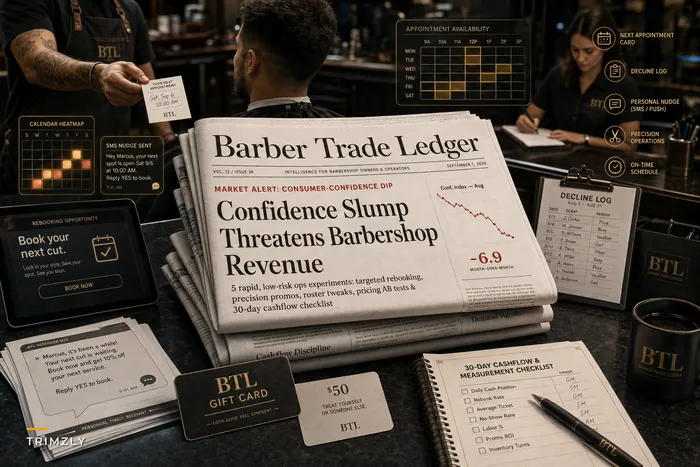
A short, tactical playbook that translates the Conference Board’s August consumer‑confidence decline into five immediate operational experiments: (1) targeted, non‑cannibalizing promotions and gift‑card pilots; (2) segmented rebook and retention campaigns for high‑LTV clients; (3) short‑term pricing/bundle AB tests to protect average ticket; (4) chair‑level rostering and contingency payroll scenarios to align labor with demand; (5) a 30‑day cashflow & measurement checklist with KPIs to track impact. Includes sample messaging, simple math, and metrics owners can implement this week.
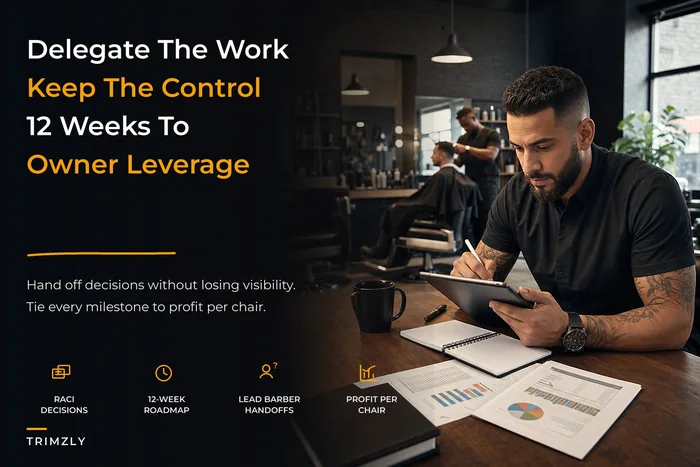
A barber‑owner RACI delegation plan and 12‑week owner transition roadmap that connects delegation steps to profit‑per‑chair and expansion readiness, with role‑level decision rights, meeting cadences, KPIs and sample handoffs/templates.

A shop‑focused governance model including a standards library, sample mystery‑shop scorecards, quarterly QA calendar, corrective‑action loops and a 12‑month rollout runbook with templated audit forms and remediation workflows.

Owner-level decision matrix mapping common investments (staffing, marketing, chairs, retail, tech) to payback windows, cashflow triggers, risk tiers and a 90/180/365 gating process with worked examples and payback math by shop archetype.

Threshold-based go/no-go model (profitability per chair, management bandwidth, SOP maturity), rollout templates, first-year KPI guardrails and repeatable playbook for the first 12 months of a second location.

Barbershop-specific staged migration: audit → sandbox → parallel-run → cutover → post-migrate validations with data-mapping templates, rollback rules and staff-training sequences to minimize downtime and errors.